
Universal Nasal Drops 1 ml Solution
PDF Leaflet Revision Date: 02 April 2025
Clinical Summary
Quick overview from the medicine insert
Indication
Temporary relief of nasal congestion.
Dosage (summary)
2-3 drops in each nostril every 4 hours for adults and children 6-12 years.
Special Populations
- Children
- Hypertension
- Hyperthyroidism
- Cardiovascular disease
- Diabetes mellitus
- Closed-angle glaucoma
- Prostatic hypertrophy
Pregnancy & Breastfeeding
Safety in pregnancy and lactation not established.
Key Drug Interactions
- Antihypertensives
- Cardiac glycosides
- Tricyclic antidepressants
- Monoamine oxidase inhibitors
Contraindications
- Hypersensitivity
- Monoamine oxidase inhibitors
- High blood pressure
- Thyrotoxicosis
- Cardiovascular disease
Common side effects
- Tachycardia
- Dizziness
- Nausea
- Dryness
- Irritation
Counselling Points
- Do not exceed recommended dosage
- Consult doctor if symptoms persist
- Use with caution in special populations
Serious warnings
- Do not use for more than 5 days
- Risk of rebound congestion
- May cause allergic reactions
Important Disclaimer
The Universal Nasal Drops 1 ml Solution professional information leaflet below is the property of Acino Pharma and is provided on Medinsert exactly as issued, with no.. alterations or editorial changes. We make every effort to keep content current by updating documents as soon as new versions become available. Medinsert serves as a trusted access point for healthcare professionals, but does not replace official sources or clinical judgement. For more details, please read our full disclaimer. read more>>
 Healthcare Professionals Only
This content is for registered healthcare professionals
Sign in or create a free account to read the full package insert.
Free for HPCSA-registered professionals. Powered by Medinsert.
Clinical Particulars
Section 4 of the official insert — extracted exactly as issued, no alterations
4.1 THERAPEUTIC INDICATIONS
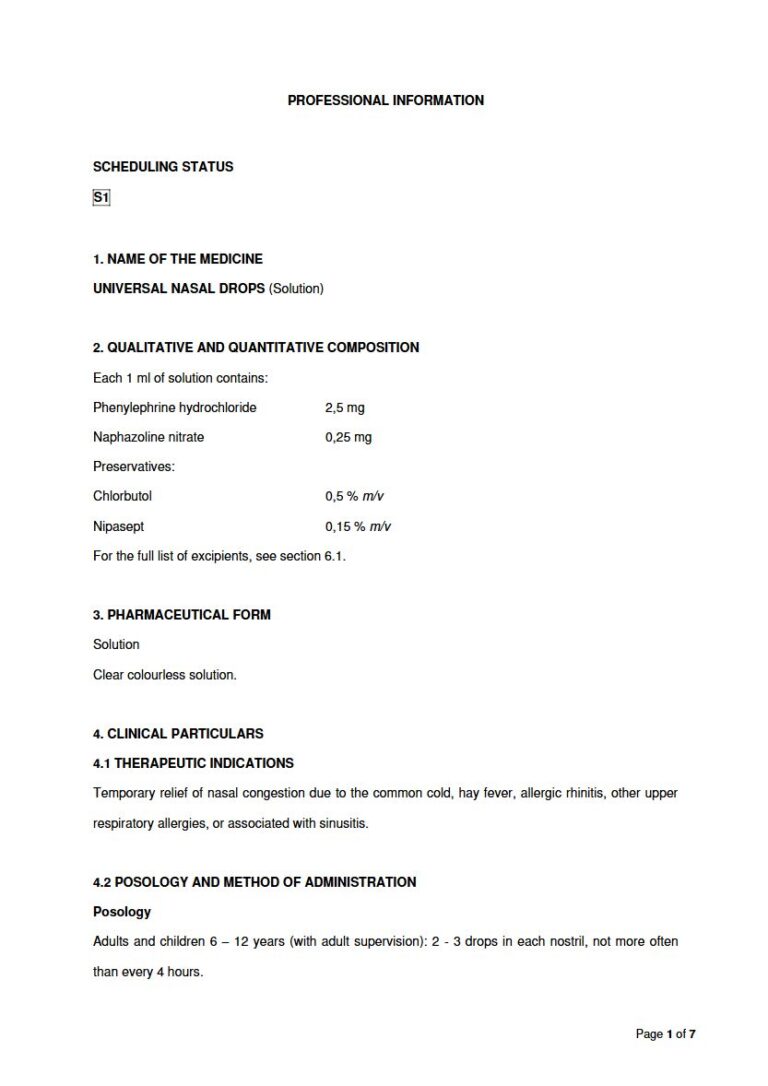
Temporary relief of nasal congestion due to the common cold, hay fever, allergic rhinitis, other upper respiratory allergies, or associated with sinusitis.
4.2 POSOLOGY AND METHOD OF ADMINISTRATION
Posology
Adults and children 6 u2013 12 years (with adult supervision): 2 - 3 drops in each nostril, not more often than every 4 hours.
Method of administration
For nasal use.
4.3 CONTRAINDICATIONS
- Hypersensitivity to phenylephrine hydrochloride, naphazoline nitrate or to any of the ingredients listed in section 6.1.
- In patients receiving monoamine oxidase inhibitor treatment, or within 14 days of its termination.
- Safety in pregnancy and lactation has not been established (see section 4.6).
- Should not be used in the presence of high blood pressure, thyrotoxicosis or patients with cardiovascular disease.
4.4 SPECIAL WARNINGS AND PRECAUTIONS FOR USE
- This product should not be used for more than 5 days. If symptoms persist, consult a doctor.
- Prolonged use or excessive application to the nasal mucosa may produce rebound congestion and rhinorrhoea.
- The use of this container by more than one person may spread infection.
- Children may be especially sensitive to the effects of these medicines. It should be used with special precaution in children.
- Should be used with caution in patients with:
- hypertension
- hyperthyroidism
- cardiovascular disease such as ischaemic heart disease, dysrhythmias, tachycardia, occlusive vascular disease, arteriosclerosis, aneurysms
- diabetes mellitus
- closed-angle glaucoma
- prostatic hypertrophy
- patients undergoing anaesthesia with cyclopropane, halothane or other halogenated anaesthetics (see section 4.5).
- UNIVERSAL NASAL DROPS contains Nipasept as a preservative, which may cause allergic reactions.
4.5 INTERACTION WITH OTHER MEDICINES AND OTHER FORMS OF INTERACTION
- Reversal of the action of anti-hypertensive medicines may occur and therefore special care is advisable in patients receiving antihypertensive therapy. Interaction with alpha- and beta-blockers may be complex and can produce a hypertensive crisis.
- Interactions are possible with guanethidine, reserpine, maprotiline, tricyclic antidepressants, digoxin and alpha-methyldopa.
- An increased risk of dysrhythmias may occur in patients receiving cardiac glycosides, quinidine or tricyclic antidepressants.
- Should be used with caution in patients undergoing anaesthesia with cyclopropane, halothane or other halogenated anaesthetics as they may induce ventricular fibrillations (see section 4.4).
4.6 FERTILITY, PREGNANCY AND LACTATION
Safety in pregnancy and lactation has not been established.
4.7 EFFECTS ON ABILITY TO DRIVE AND USE MACHINES
UNIVERSAL NASAL DROPS have a negligible effect on the ability to drive or use machines. This medicine may cause dizziness which may impact the patientu2019s ability to perform the above tasks.
4.8 UNDESIRABLE EFFECTS
MedDRA system organ class
Frequency Adverse reactions
Metabolism and nutrition disorders: Frequency unknown Appetite reduction and disturbances of glucose metabolism.
Psychiatric disorders Frequency unknown Psychotic states.
Nervous system disorders Frequency unknown Anxiety, restlessness, tremor, insomnia, confusion, irritability, weakness, sweating and headache, dizziness
Cardiac disorders Frequency unknown Tachycardia or bradycardia, cardiac dysrhythmias, palpitations, cardiac arrest and angina.
Vascular disorders Frequency unknown Vasoconstriction with resultant hypertension, the rise in blood pressure may produce cerebral haemorrhage, pulmonary oedema, hypotension with dizziness, fainting and flushing.
Respiratory, thoracic and mediastinal disorders Frequency unknown Dyspnoea, excessive or prolonged use may lead to rebound congestion or rhinorrhoea.
Gastrointestinal disorders Frequency unknown Nausea, vomiting and hyper salivation.
Renal and urinary disorders Frequency unknown Difficulty in micturition and urinary retention
General disorders and administrative site conditions Frequency unknown May cause local irritation at the site of application, for example dryness and stinging of the mouth and throat and increased nasal discharge with sneezing.
Reporting of suspected adverse reactions
Reporting suspected adverse reactions after authorisation of the medicine is important. It allows continued monitoring of the benefit/risk balance of the medicine. Health care providers are requested to report any suspected adverse reactions to SAHPRA via the Med Safety APP (Medsafety X SAHPRA) or via the eReporting platform (who-umc.org) found on the SAHPRA website. You can also report side effects to Acino Pharma (Pty) Ltd., via email on [email protected]
4.9 OVERDOSE
Accidental administration by mouth may cause symptoms of bradycardia, sweating, drowsiness and coma, particularly in children. Hypertension may be followed by rebound hypotension. (see sections 4.4 and 4.8) Treatment is supportive and symptomatic. Severe increase in blood pressure may occur. Treatment with alpha-adrenergic blocking agent to reduce blood pressure should be instituted if myocardial ischaemia or encephalopathy is provoked.
