
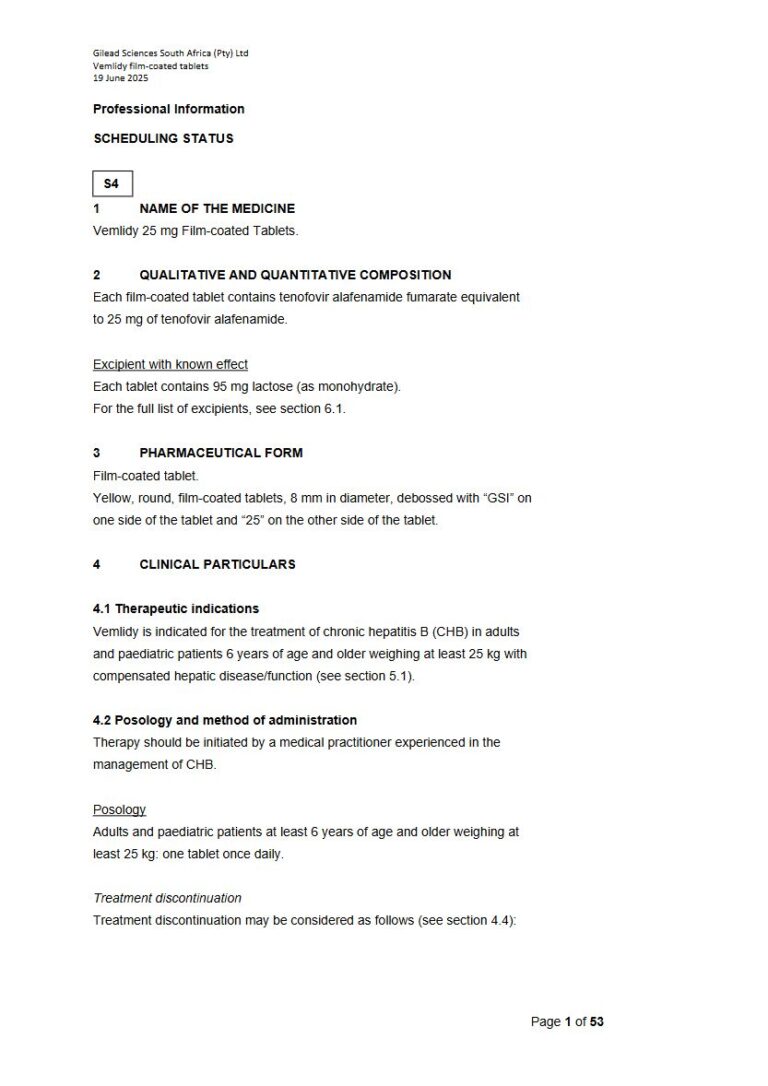
Vemlidy 25mg FC Tablet
PDF Leaflet Revision Date: 19 June 2025
Clinical Summary
Quick overview from the medicine insert
Indication
Treatment of chronic hepatitis B in adults and children 6 years and older.
Dosage (summary)
One tablet once daily with food.
Special Populations
- Elderly
- Renal impairment
- Hepatic impairment
Pregnancy & Breastfeeding
Not recommended during pregnancy or breastfeeding due to potential harm.
Key Drug Interactions
- Avoid with tenofovir disoproxil and adefovir
- P-glycoprotein inducers may decrease efficacy
Contraindications
- Hypersensitivity to tenofovir alafenamide or excipients
- Severe hepatic impairment
Common side effects
- Headache
- Nausea
- Fatigue
Counselling Points
- Take with food
- Monitor liver function regularly
- Use effective contraception
Serious warnings
- Risk of lactic acidosis
- Exacerbation of hepatitis upon discontinuation
Important Disclaimer
The Vemlidy 25mg FC Tablet professional information leaflet below is the property of Gilead Sciences South Africa and is provided on Medinsert exactly as issued, with no.. alterations or editorial changes. We make every effort to keep content current by updating documents as soon as new versions become available. Medinsert serves as a trusted access point for healthcare professionals, but does not replace official sources or clinical judgement. For more details, please read our full disclaimer. read more>>
 Healthcare Professionals Only
This content is for registered healthcare professionals
Sign in or create a free account to read the full package insert.
Free for HPCSA-registered professionals. Powered by Medinsert.
Clinical Particulars
Section 4 of the official insert — extracted exactly as issued, no alterations
4.1 Therapeutic indications
Vemlidy is indicated for the treatment of chronic hepatitis B (CHB) in adults and paediatric patients 6 years of age and older weighing at least 25 kg with compensated hepatic disease/function (see section 5.1).
4.2 Posology and method of administration
Therapy should be initiated by a medical practitioner experienced in the management of CHB.
Posology
Adults and paediatric patients at least 6 years of age and older weighing at least 25 kg: one tablet once daily.
Treatment discontinuation
Treatment discontinuation may be considered as follows (see section 4.4):
- In HBeAg positive patients without cirrhosis, treatment should be administered for at least 6-12 months after HBe seroconversion (HBeAg loss and HBV DNA loss with anti- HBe detection) is confirmed or until HBs seroconversion or until there is loss of efficacy (see section 4.4). Regular reassessment is recommended after treatment discontinuation to detect virological relapse.
- In HBeAg-negative patients without cirrhosis, treatment should be administered at least until HBs seroconversion or until there is evidence of loss of efficacy. With prolonged treatment for more than 2 years, regular reassessment is recommended to confirm that continuing the selected therapy remains appropriate for the patient.
Missed dose
If a dose is missed and less than 18 hours have passed from the time it is usually taken, the patient should take Vemlidy as soon as possible and then resume their normal dosing schedule. If more than 18 hours have passed from the time it is usually taken, the patient should not take the missed dose and should simply resume the normal dosing schedule. If the patient vomits within 1 hour of taking Vemlidy, the patient should take another tablet. If the patient vomits more than 1 hour after taking Vemlidy, the patient does not need to take another tablet.
Special populations
Elderly
No dose adjustment of Vemlidy is required in patients aged 65 years and older (see section 5.2).
Renal impairment
No dose adjustment of Vemlidy is required in adults or adolescents (aged at least 12 years and of at least 35 kg body weight) with estimated creatinine clearance (CrCl) u2265 15 mL/min or in patients with CrCl < 15 mL/min who are receiving haemodialysis. On days of haemodialysis, Vemlidy should be administered after completion of haemodialysis treatment (see section 5.2). Vemlidy is not recommended for use in patients with CrCl < 15 mL/min who are not receiving haemodialysis (see section 4.4). No data are available to make dose recommendations in children aged less than 12 years of age and of less than 35 kg body weight with renal impairment.
Hepatic impairment
No dose adjustment of Vemlidy is required in patients with mild or moderate hepatic impairment (see sections 4.4 and 5.2). Vemlidy is not recommended for use in patients with severe hepatic impairment (Child Pugh C).
Paediatric population
The safety and efficacy of Vemlidy in children younger than 6 years of age or weighing < 25 kg have not yet been established. No data are available.
Method of administration
Oral use. Vemlidy Film-coated Tablets should be taken with food (see section 5.2).
4.3 Contraindications
Hypersensitivity to the active substance or to any of the excipients listed in section 6.1.
Concomitant use with medicines containing tenofovir alafenamide, tenofovir disoproxil fumarate and adefovir dipivoxil.
4.4 Special warnings and precautions for use
Hepatitis B Virus (HBV) transmission
Patients must be advised that Vemlidy does not prevent the risk of transmission of HBV to others through sexual contact or contamination with blood. Appropriate precautions must continue to be used.
Patients with decompensated liver disease
There are limited data on the safety and efficacy of tenofovir alafenamide in HBV infected patients with decompensated liver disease and who have a Child Pugh Turcotte (CPT) score > 9 (i.e. class C). These patients may be at higher risk of experiencing serious hepatic or renal adverse reactions. Therefore, no dose recommendation can be made and Vemlidy is not recommended for use in these patients.
Lactic acidosis and severe hepatomegaly
Lactic acidosis and severe hepatomegaly, including fatal cases have been reported with the use of nucleoside analogues, including tenofovir disoproxil fumarate, another prodrug of tenofovir, alone or in combination with other antiretrovirals. Treatment with Vemlidy should be discontinued in patients who develop clinical and/or laboratory findings suggestive of lactic acidosis or pronounced hepatotoxicity, which may include hepatomegaly and steatosis even in the absence of a marked increase in transaminases.
Clinical features of lactic acidosis are non-specific and include nausea, vomiting, abdominal pain, dyspnoea, fatigue and weight loss. In patients with suspicious symptoms or biochemistry, measure the venous lactate level (normal < 2mmol/l), and the serum bicarbonate and respond as follows:
- Lactate 2-5 mmol/l with minimum symptoms: switch to medicines that are less likely to cause lactic acidosis
- Lactate 5-10 mmol/l with symptoms and/or with reduced standard bicarbonate. Stop NRTIs and change treatment option. Once the lactate has settled, use medicines that are less likely to cause lactic acidosis.
- Exclude other causes (e.g. sepsis, uraemia, diabetic keto acidosis, thyrotoxicosis/hyperthyroidism - Lactate > 10mmol/l. STOP all therapy (80% mortality)
The above values may not be applicable to paediatric patients. Caution should be exercised when administering VEMLIDY to patients with known risk factors for liver disease.
Exacerbation of hepatitis
Flares on treatment
Spontaneous exacerbations in CHB are relatively common and are characterised by transient increases in serum alanine aminotransferase (ALT). After initiating antiviral therapy, serum ALT may increase in some patients. In patients with compensated liver disease, these increases in serum ALT are generally not accompanied by an increase in serum bilirubin concentrations or hepatic decompensation. Patients with cirrhosis may be at a higher risk for hepatic decompensation following hepatitis exacerbation, and therefore should be monitored closely during therapy.
Flares after treatment discontinuation
Acute exacerbation of hepatitis has been reported in patients who have discontinued treatment for CHB, usually in association with rising HBV DNA levels in plasma. The majority of cases are self-limited but severe exacerbations, including fatal outcomes, may occur after discontinuation of treatment for CHB. Hepatic function should be monitored at repeated intervals with both clinical and laboratory follow up for at least 6 months after discontinuation of treatment for CHB. If appropriate, resumption of CHB therapy may be warranted. In patients with advanced liver disease or cirrhosis, treatment discontinuation is not recommended since post treatment exacerbation of hepatitis may lead to hepatic decompensation. Liver flares are especially serious, and sometimes fatal in patients with decompensated liver disease.
4.5 Interactions with other medicines
Vemlidy should not be co-administered with medicines containing tenofovir disoproxil, tenofovir alafenamide or adefovir dipivoxil.
Medicines that may affect tenofovir alafenamide
Tenofovir alafenamide is transported by P-gp and breast cancer resistance protein (BCRP). Medicines that are P-gp inducers (e.g. rifampicin, rifabutin, carbamazepine, phenobarbital or St. Johnu2019s wort) are expected to decrease plasma concentrations of tenofovir alafenamide, which may lead to loss of therapeutic effect of Vemlidy. Co-administration of such medicines with Vemlidy is not recommended.
Co-administration of Vemlidy with medicines that inhibit P-gp and BCRP may increase plasma concentrations of tenofovir alafenamide. Co-administration of strong inhibitors of P-gp with Vemlidy is not recommended.
Tenofovir alafenamide is a substrate of OATP1B1 and OATP1B3 in vitro. The distribution of tenofovir alafenamide in the body may be affected by the activity of OATP1B1 and/or OATP1B3.
Effect of tenofovir alafenamide on other medicines
Tenofovir alafenamide is not an inhibitor of CYP1A2, CYP2B6, CYP2C8, CYP2C9, CYP2C19, or CYP2D6 in vitro. It is not an inhibitor or inducer of CYP3A In Vivo. Tenofovir alafenamide is not an inhibitor of human uridine diphosphate glucuronosyltransferase (UGT) 1A1 in vitro. It is not known whether tenofovir alafenamide is an inhibitor of other UGT enzymes.
Drug interaction information for Vemlidy with potential concomitant medicines is summarised in Table 1 below (increase is indicated as u201cu2191u201d, decrease as u201cu2193u201d, no change as u201c u2194 u201d; twice daily as u201cb.i.d.u201d, single dose as u201cs.d.u201d, once daily as u201cq.du201d). The drug interactions described are based on studies conducted with tenofovir alafenamide or are potential drug interactions that may occur with Vemlidy.
4.6 Fertility, pregnancy and lactation
Women of childbearing potential / contraception in males and females
The use of Vemlidy should be accompanied by the use of effective contraception.
Pregnancy
Safety in pregnancy has not been established and possible harm to the embryo/developing foetus cannot be excluded. The use of Vemlidy is not recommended in pregnancy unless no other appropriate medicine that is known to be safe in pregnancy is available, not tolerated or has failed.
Breast-feeding
Women on treatment with Vemlidy should not breastfeed their babies as harm to the newborn baby/infant cannot be excluded. Based on published data, tenofovir alafenamide and tenofovir are excreted in human milk at low levels in women administered with tenofovir alafenamide. There is insufficient information on the effects of tenofovir in newborns/infants.
Fertility
No human data on the effect of Vemlidy on fertility are available. Animal studies do not indicate harmful effects of tenofovir alafenamide on fertility.
4.7 Effects on ability to drive and use machines
Vemlidy may have minor influence on the ability to drive and use machines. Patients should not drive and use machines until they know how treatment with Vemlidy affects them. Patients should be informed that dizziness, fatigue, nausea and headache have been reported during treatment with Vemlidy.
4.8 Undesirable effects
Summary of the safety profile
Assessment of adverse reactions is based on clinical study data and post marketing data. In pooled safety data from 2 controlled Phase 3 studies (GS-US-320-0108 and GS-US-0110; u201cStudy 108u201d and u201cStudy 110u201d , respectively), the most frequently reported adverse reactions at Week 96 analysis were headache (12 %), nausea (6 %), and fatigue (6 %). After Week 96, patients either remained on their original blinded treatment up to Week 144 or received open-label tenofovir alafenamide.
The safety profile of tenofovir alafenamide was similar in virologically suppressed patients switching from tenofovir disoproxil to tenofovir alafenamide in Study 108, Study 110 and a controlled Phase 3 study GS-US-320-4018 (u201cStudy 4018u201d). Changes in lipid laboratory tests were observed in these studies following a switch from tenofovir disoproxil (see section 5.1).
Tabulated list of adverse events
The following adverse reactions have been identified with tenofovir alafenamide in patients with CHB (Table 2). The adverse reactions are listed below by body system organ class and frequency based on the Week 96 analysis. Frequencies are defined as follows: very common (u2265 1/10), common (u2265 1/100 to < 1/10) or uncommon (u2265 1/1 000 to < 1/100).
Table 2: Adverse Reactions Identified with Tenofovir Alafenamide
System organ class Frequency Adverse reaction
Nervous system disorders Very common Headache
Common Dizziness
Gastrointestinal disorders Common Diarrhoea, vomiting, nausea, abdominal pain, abdominal distension, flatulence
Hepatobiliary disorders Common Increased ALT
Skin and subcutaneous tissue disorders Common Rash, pruritus
Uncommon Angioedema, urticaria
Musculoskeletal and connective tissue disorders Common Arthralgia
General disorders and administration site conditions Common Fatigue
Adverse reaction identified through post-marketing surveillance for tenofovir alafenamide-containing products.
In the open-label Phase 2 study (GS-US-320-4035; u201cStudy 4035u201d) to evaluate the efficacy and safety of switching from another antiviral regimen to tenofovir alafenamide in virologically suppressed HBV infected patients, small median increases in fasting total cholesterol, direct low density lipoprotein (LDL), high density lipoprotein (HDL), and triglycerides from baseline to Week 96 were observed in patients with moderate or severe renal impairment (Part A Cohort 1) and patients with moderate or severe hepatic impairment (Part B), consistent with changes observed in Studies 108 and 110. Small median decreases in total cholesterol, LDL and triglycerides were observed in patients with ESRD on hemodialysis in Part A Cohort 2, while small median increases were observed in HDL from baseline to Week 96. Median (Q1, Q3) change from baseline at Week 96 in total cholesterol to HDL ratio was 0.1 (-0.4, 0.4) in the moderate or severe renal impairment group, and -0.4 (-0.8,-0.1) in patients with ESRD on hemodialysis and 0.1 (-0.2, 0.4) in patients with moderate or severe hepatic impairment.
Metabolic parameters
Body weight and levels of blood lipids and glucose may increase during therapy.
Special populations
In Study 4035 in virologically suppressed patients with moderate to severe renal impairment (eGFR by Cockcroft-Gault method 15 to 59 mL/min; Part A, Cohort 1, N = 78), end stage renal disease (ESRD) (eGFR < 15 mL/min) on haemodialysis (Part A, Cohort 2, N = 15), and/or moderate to severe hepatic impairment (Child-Pugh Class B or C at screening or by history; Part B, N = 31) who switched from another antiviral regimen to tenofovir alafenamide, no additional adverse reactions to tenofovir alafenamide were identified through Week 96.
Paediatric population
The safety of tenofovir alafenamide was evaluated in 88 HBV-infected treatment-nau00efve and treatment-experienced paediatric patients between the ages of 12 to < 18 years weighing u2265 35 kg (tenofovir alafenamide group N=47, placebo group N=23) and 6 to < 12 years weighing u2265 25 kg (tenofovir alafenamide group N=12, placebo group N=6) through Week 24 in a randomised, double-blind, placebo-controlled clinical study GS-US-320-1092 (u201cStudy 1092u201d). After the double-blind phase, patients were switched to open-label tenofovir alafenamide at Week 24. The safety profile of tenofovir alafenamide in paediatric patients was comparable to that in adults. Reductions in bone mineral density (BMD u2265 4%) of the lumbar spine and of whole body have been reported in some paediatric patients 6 years of age and older weighing at least 25 kg who received tenofovir alafenamide for up to 48 weeks (see sections 4.4 and 5.1).
4.9 Overdose
If overdose occurs, the patient must be monitored for evidence of toxicity (see section 4.8), as side effects can be precipitated and/or be of increased severity. Treatment of overdose with Vemlidy consists of symptomatic and general supportive measures including monitoring of vital signs as well as observation of the clinical status of the patient. Tenofovir is efficiently removed by haemodialysis with an extraction coefficient of approximately 54 %. It is not known whether tenofovir can be removed by peritoneal dialysis.
