
Vyzulta 2,4 mg Eye Drops
PDF Leaflet Revision Date: 22 November 2022
Clinical Summary
Quick overview from the medicine insert
Indication
Reduction of intraocular pressure in open-angle glaucoma or ocular hypertension.
Dosage (summary)
One drop in the affected eye(s) once daily in the evening.
Onset of Action / Duration
Onset: 1-3 hours, Duration: 11-13 hours
Special Populations
- Paediatric patients
- Elderly patients
Pregnancy & Breastfeeding
Not recommended in pregnancy; unknown if excreted in breast milk.
Key Drug Interactions
- Concomitant use with other prostaglandin analogues not recommended
Contraindications
- Hypersensitivity to latanoprostene bunod or ingredients
Common side effects
- Conjunctival hyperaemia
- Eye irritation
- Eye pain
Counselling Points
- Do not exceed once daily dosing
- Remove contact lenses before use
Serious warnings
- May cause permanent iris pigmentation
- Caution in intraocular inflammation
Important Disclaimer
The Vyzulta 2,4 mg Eye Drops professional information leaflet below is the property of Soflens and is provided on Medinsert exactly as issued, with no.. alterations or editorial changes. We make every effort to keep content current by updating documents as soon as new versions become available. Medinsert serves as a trusted access point for healthcare professionals, but does not replace official sources or clinical judgement. For more details, please read our full disclaimer. read more>>
 Healthcare Professionals Only
This content is for registered healthcare professionals
Sign in or create a free account to read the full package insert.
Free for HPCSA-registered professionals. Powered by Medinsert.
Clinical Particulars
Section 4 of the official insert — extracted exactly as issued, no alterations
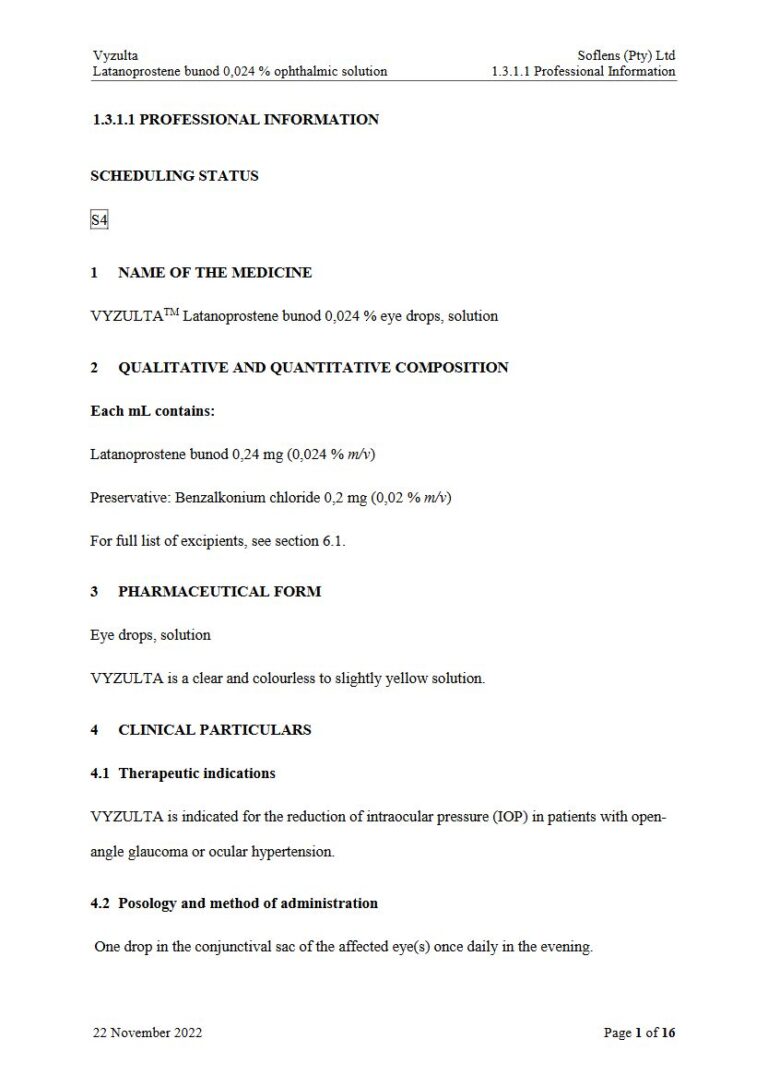
4.1 Therapeutic indications
VYZULTA is indicated for the reduction of intraocular pressure (IOP) in patients with open-angle glaucoma or ocular hypertension.
4.2 Posology and method of administration
One drop in the conjunctival sac of the affected eye(s) once daily in the evening.
Do not administer VYZULTA more than once daily since it has been shown that more frequent administration of prostaglandin analogues may lessen the intraocular pressure lowering effect.
If VYZULTA is to be used concomitantly with other topical ophthalmic medicinal products to lower intraocular pressure, administer each medicine at least five (5) minutes apart.
Paediatric population
Use in paediatric patients aged 16 years and younger is not recommended because of potential safety concerns relating to the increased pigmentation following long-term chronic use.
Geriatric population
No overall clinical differences in safety and effectiveness have been observed between elderly and other adult patients.
4.3 Contraindications
Hypersensitivity to latanoprostene bunod or any other ingredients (see 6.1).
4.4 Special warnings and precautions for use
When to seek medical advice
Patients should seek medical advice concerning the use of VYZULTA if they develop a new ocular condition (e.g. trauma or infection), experience a sudden decrease in visual acuity, have ocular surgery, or develop any ocular reactions, particularly conjunctivitis and eyelid reactions.
Pigmentation
VYZULTA may cause changes to pigmented tissues, especially increased pigmentation of the iris and periorbital tissue (eyelids). (See section 4.8 c)
After discontinuation of VYZULTA, pigmentation of the iris is likely to be permanent, while pigmentation of the periorbital tissue is likely to be reversible in most patients. The long-term effects of increased pigmentation are not known.
While treatment with VYZULTA can be continued in patients who develop noticeably increased iris pigmentation, these patients should be examined regularly.
Eyelash Changes
There is a possibility of eyelash and vellus hair changes in the treated eye during treatment with VYZULTA. These changes may result in a disparity between eyes in length, thickness, pigmentation, number of eyelashes or vellus hairs, and/or misdirection of eyelash growth. Eyelash changes are usually reversible upon discontinuation of treatment. (See section 4.8 c)
Intraocular Inflammation
VYZULTA should be used with caution in patients with a history of intraocular inflammation (iritis/uveitis) and should generally not be used in patients with active intraocular inflammation as it may exacerbate this condition.
Macular Oedema
Macular oedema, including cystoid macular oedema, has been reported during treatment with prostaglandin analogues. These reports have mainly occurred in aphakic patients, in pseudophakic patients with torn posterior lens capsule. VYZULTA should be used with caution in aphakic patients, in pseudophakic patients with a torn posterior lens capsule, or anterior chamber lenses or in patients with known risk factors for cystoid macular oedema (such as diabetic retinopathy and retinal vein occlusion).
Bacterial Keratitis
There have been reports of bacterial keratitis associated with the use of multiple-dose containers of topical ophthalmic products. These containers had been inadvertently contaminated by patients who, in most cases, had a concurrent corneal disease or a disruption of the ocular epithelial surface.
Handling the container
Avoid allowing the tip of the dispensing container to touch the eye, surrounding structures, fingers, or any other surface in order to avoid contamination of the solution by common bacteria known to cause ocular infections. Serious damage to the eye and subsequent loss of vision may result from using contaminated solutions.
Benzalkonium chloride
As the possibility of adverse effects on the corneal permeability, and the danger of disruption of the corneal epithelium with prolonged or repeated usage of benzalkonium chloride preserved ophthalmological preparations cannot be excluded, regular ophthalmological examination is required. Caution should be exercised in the use of benzalkonium chloride preserved topical medication over an extended period in patients with extensive ocular surface disease.
Use with Contact Lenses
Contact lenses may absorb benzalkonium chloride which may change the colour of the contact lenses. They should be removed prior to the administration of VYZULTA. Lenses may be reinserted 15 minutes after administration.
4.5 Interaction with other medicines and other forms of interaction
No interaction studies have been performed with VYZULTA.
If more than one topical ophthalmic medicine is being used, the medicines should be administered with at least five (5) minutes between applications.
There have been reports of paradoxical elevations in IOP following the concomitant ophthalmic administration of two prostaglandin analogues. Therefore, the use of two or more prostaglandins, prostaglandin analogues or prostaglandin derivatives is not recommended.
4.6 Fertility, pregnancy and lactation
Pregnancy
There are no available human data for the use of VYZULTA during pregnancy to inform any medicine associated risks. Latanoprostene bunod has caused miscarriages, abortion, and foetal harm in rabbits. Latanoprostene bunod was shown to be abortifacient and teratogenic when administered intravenously (IV) to pregnant rabbits at exposures u2265 0,28 times the clinical dose. Doses u2265 20 mcg/kg/day (23 times the clinical dose) produced 100 % embryofoetal lethality. Structural abnormalities observed in rabbit foetuses included anomalies of the great vessels and aortic arch vessels, domed head, sternebral and vertebral skeletal anomalies, limb hyperextension and malrotation, abdominal distension and oedema. Latanoprostene bunod was not teratogenic in the rat when administered IV at 150 mcg/kg/day (87 times the clinical dose) (see 5.3). The background risk of major birth defects and miscarriage for the indicated population is unknown. However, the background risk in the U.S. general population of major birth defects is 2 to 4 %, and of miscarriage is 15 to 20 %, of clinically recognized pregnancies.
Breastfeeding
There are no data on the presence of VYZULTA in human milk, the effects on the breastfed infant, or the effects on milk production. The developmental and health benefits of breastfeeding should be considered, along with the motheru2019s clinical need for VYZULTA, and any potential adverse effects on the breastfed infant from VYZULTA.
Fertility
Fertility studies have not been conducted with latanoprostene bunod. The potential to impact fertility can be partially characterized by exposure to latanoprost acid, a common metabolite of both latanoprostene bunod and latanoprost. Latanoprost acid has not been found to have any effect on male or female fertility in animal studies.
4.7 Effects on ability to drive and use machines
As with other eye preparations, patients may experience temporary blurred vision or irritation, pain or itching of the treated eye(s). If blurred vision occurs at installation, the patients should wait until their vision clears before driving or using machinery.
4.8 Undesirable effects
a. Summary of the safety profile
VYZULTA was evaluated in 811 patients in 2 controlled clinical trials of up to 12 months duration. The most common ocular adverse reactions observed in patients treated with latanoprostene bunod were: conjunctival hyperaemia (6 %), eye irritation (4 %), eye pain (3 %), and instillation site pain (2 %).
Approximately 0,6 % of patients discontinued therapy due to ocular adverse reactions including ocular hyperaemia, conjunctival irritation, eye irritation, eye pain, conjunctival oedema, blurred vision, punctate keratitis and foreign body sensation.
b. Tabulated list of adverse reactions
Common (u22651/100 to <1/10) ; Uncommon (u22651/1000 to <1/100)
Eye disorders
Common: conjunctival hyperaemia, ocular hyperaemia, eye irritation, eye pain, eye pruritis, foreign body sensation in the eye
Uncommon: abnormal sensation in the eye, asthenopia, blepharitis, blurred vision, chemical eye injury, conjunctival disorder, conjunctival haemorrhage, conjunctival irritation, conjunctival oedema, cornea presents vital dye staining, dry eye, eye colour change*, eye discharge, eyelid erythema, eyelid hypopigmentation, eyelid margin crusting, eyelid oedema, eyelid pain, eyelid pigmentation*, eyelids pruritis, growth of eyelashes*, increased lacrimation, iris hyperpigmentation*, increased intraocular pressure, keratitis*, meibomianitis, ocular discomfort, photophobia, punctate keratitis, reduced visual acuity, transiently reduced visual acuity, trichiasis, uveitis
General disorders and administrative site conditions
Common: Ocular: instillation site pain
Uncommon: Ocular: instillation site discomfort, instillation site erythema, instillation site hypersensitivity, instillation site irritation, instillation site reaction, pain
Non-ocular: chest discomfort, fatigue
Skin and subcutaneous tissue disorders
Uncommon: Ocular: abnormal hair growth*, hair colour changes*, madarosis, rash, skin hyperpigmentation*
Non-ocular: hyperhidrosis, urticaria
Infections and infestations
Uncommon: ear infection, tooth infection, urinary tract infection, vaginal infection
Psychiatric disorders
Uncommon: insomnia
Nervous system disorders
Uncommon: dysgeusia, headache
Respiratory, thoracic and mediastinal disorders
Uncommon: cough, dyspnoea, sinus congestion
Gastrointestinal disorders
Uncommon: dry mouth, nausea
Reproductive system and breast disorders
Uncommon: breast mass
*See section c
4.9 Overdose
No overdose evaluation was conducted with VYZULTA.
