
Xarelto 10 26.51 mg FC tablets
PDF Leaflet Revision Date: 12 May 2022
Clinical Summary
Quick overview from the medicine insert
Indication
Prevention of VTE in major orthopedic surgery and treatment of DVT/PE.
Dosage (summary)
10 mg once daily for VTE prevention; 15 mg twice daily for DVT/PE treatment.
Special Populations
- Elderly
- Renal impairment
- Hepatic impairment
Pregnancy & Breastfeeding
Contraindicated in pregnancy; use caution in breastfeeding.
Key Drug Interactions
- Strong CYP3A4 inhibitors
- Other anticoagulants
- NSAIDs
Contraindications
- Active bleeding
- Severe hepatic disease
- Hypersensitivity
Common side effects
- Bleeding
- Anaemia
- Dizziness
Counselling Points
- Monitor for signs of bleeding
- Take with or without food
- Do not double doses
Serious warnings
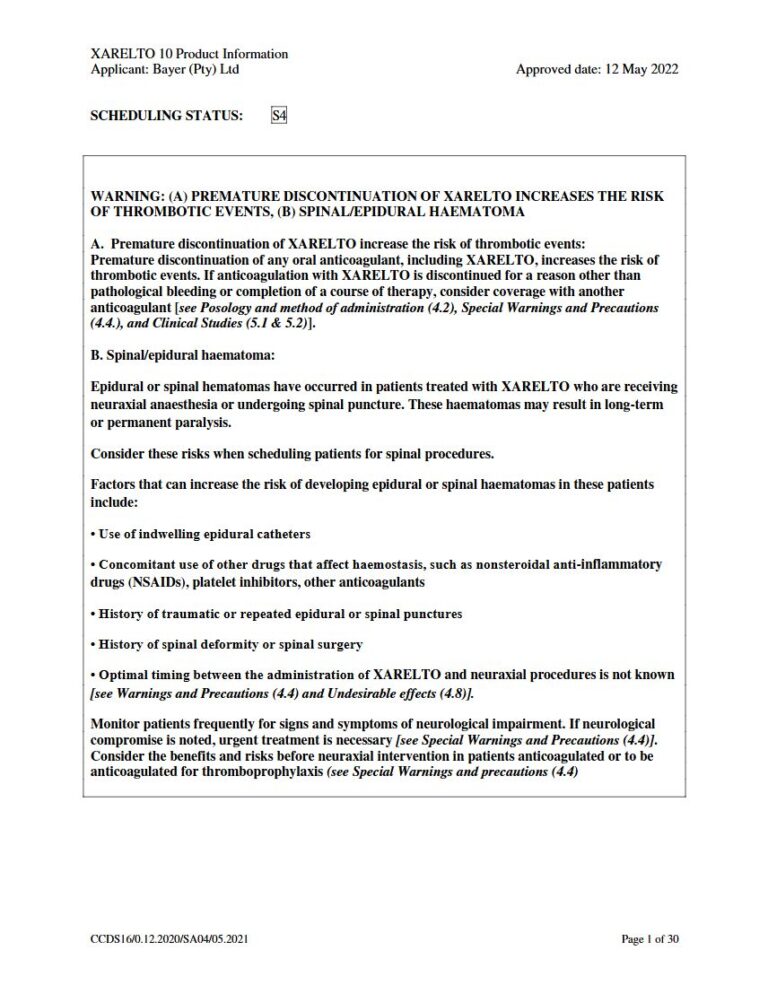
- Increased risk of thrombotic events on discontinuation
- Spinal/epidural hematoma risk
Important Disclaimer
The Xarelto 10 26.51 mg FC tablets professional information leaflet below is the property of Bayer and is provided on Medinsert exactly as issued, with no.. alterations or editorial changes. We make every effort to keep content current by updating documents as soon as new versions become available. Medinsert serves as a trusted access point for healthcare professionals, but does not replace official sources or clinical judgement. For more details, please read our full disclaimer. read more>>
 Healthcare Professionals Only
This content is for registered healthcare professionals
Sign in or create a free account to read the full package insert.
Free for HPCSA-registered professionals. Powered by Medinsert.
Clinical Particulars
Section 4 of the official insert — extracted exactly as issued, no alterations
4.1 Therapeutic indications
XARELTO 10 film-coated tablets are indicated for the prevention of venous thromboembolism (VTE) in patients undergoing major orthopaedic surgery of the lower limbs. Treatment of deep vein thrombosis (DVT) and pulmonary embolism (PE), and prevention of recurrent DVT and PE in adults. (See section 4.4 for haemodynamically unstable PE patients.)
4.2 Posology and method of administration
The recommended dose is one XARELTO 10 tablet once daily for the prevention of venous thromboembolism (VTE) in major orthopaedic surgery. The initial dose should be taken within 6 - 10 hours after surgery provided that haemostasis has been established. If a dose is missed the patient should take XARELTO 10 immediately and continue on the following day with the once daily intake as before.
Duration of treatment
The duration of treatment depends on the type of major orthopaedic surgery. After major hip surgery patients should be treated for 5 weeks. After major knee surgery patients should be treated for 2 weeks.
Treatment of DVT, treatment of PE and prevention of recurrent DVT and PE
The recommended dose for the initial treatment of acute DVT or PE is 15 mg twice daily for the first three weeks followed by 20 mg once daily for the continued treatment and prevention of recurrent DVT and PE. Short duration of therapy (at least 3 months) should be considered in patients with DVT or PE provoked by major transient risk factors (i.e. recent major surgery or trauma). Longer duration of therapy should be considered in patients with provoked DVT or PE not related to major transient risk factors, unprovoked DVT or PE, or a history of recurrent DVT or PE.
When extended prevention of recurrent DVT and PE is indicated (following completion of at least 6 months therapy for DVT or PE), the recommended dose is 10 mg once daily. In patients in whom the risk of recurrent DVT or PE is considered high, such as those with complicated comorbidities, or who have developed recurrent DVT or PE on extended prevention with XARELTO 10 mg once daily, a dose of XARELTO 20 mg once daily should be considered.
The duration of therapy and dose selection should be individualised after careful assessment of the treatment benefit against the risk for bleeding (see section 4.4).
Time period
Dosing schedule
Total daily dose
Treatment and prevention of recurrent DVT and PE
Day 1-21
15 mg twice daily
30 mg
Day 22 onwards
20 mg once daily
20 mg
Prevention of recurrent DVT and PE
Following completion of at least 6 months therapy for DVT or PE
10 mg once daily or 20 mg once daily
10 mg or 20 mg
If a dose is missed during the 15 mg twice daily treatment phase (day 1 - 21), the patient should take XARELTO immediately to ensure intake of 30 mg XARELTO per day. In this case two 15 mg tablets may be taken at once. The patient should continue with the regular 15 mg twice daily intake as recommended on the following day.
If a dose is missed during the once daily treatment phase, the patient should take XARELTO 10 immediately, and continue on the following day with the once daily intake as recommended. The dose should not be doubled within the same day to make up for a missed dose.
Converting from Vitamin K Antagonists (VKA) to XARELTO10
For patients treated for DVT, PE and prevention of recurrence, VKA treatment should be stopped and XARELTO 10 therapy should be initiated once the INR is u2264 2.5. When converting patients from VKAs to XARELTO 10, International Normalised Ratio (INR) values will be falsely elevated after the intake of XARELTO 10. The INR is not valid to measure the anticoagulant activity of XARELTO 10, and therefore should not be used (see section 4.5).
Converting from XARELTO 10 to Vitamin K antagonists (VKA)
There is a potential for inadequate anticoagulation during the transition from XARELTO 10 to VKA. Continuous adequate anticoagulation should be ensured during any transition to an alternate anticoagulant. It should be noted that XARELTO 10 can contribute to an elevated INR.
In patients converting from XARELTO 10 to VKA, VKA should be given concurrently until the INR is u2265 2.0. For the first two days of the conversion period, standard initial dosing of VKA should be used followed by VKA dosing, as guided by INR testing. While patients are on both XARELTO 10 and VKA the INR should not be tested earlier than 24 hours after the previous dose but prior to the next dose of XARELTO 10. Once XARELTO is discontinued INR testing may be done reliably at least 24 hours after the last dose (see sections 4.5 and 5.2).
Converting from parenteral anticoagulants to XARELTO 10
For patients currently receiving a parenteral anticoagulant, discontinue the parenteral anticoagulant and start XARELTO 10, 0 to 2 hours before the time that the next scheduled administration of the parenteral medicinal product (e.g. low molecular weight heparins) would be due or at the time of discontinuation of a continuously administered parenteral medicinal product (e.g. intravenous unfractionated heparin).
Converting from XARELTO 10 to parenteral anticoagulants
Give the first dose of parenteral anticoagulant at the time the next XARELTO 10 dose would be taken.
Special patient populations
Elderly (above 65 years), Gender and Body Weight: No dose adjustment is required for these patient populations.
Paediatric population
Children (up to 18 years of age) The safety and efficacy of XARELTO 10 has not been established in children. No clinical data is available for children.
Patients with impaired liver function
XARELTO 10 is contra-indicated in patients with significant hepatic disease which is associated with coagulopathy leading to a clinically relevant bleeding risk including cirrhotic patients with Child Pugh B and C. (see section 4.3 and 5.2). No dose adjustment is necessary in patients with other hepatic diseases. Limited clinical data in patients with moderate hepatic impairment indicate a significant increase in the pharmacological activity. No clinical data are available for patients with severe hepatic impairment.
Patients with impaired renal function
For the prevention of VTE in adult patients undergoing elective hip or knee replacement surgery, no dose adjustment is required if XARELTO 10 is administered in patients with mild (creatinine clearance 50 u2013 80 mL/min) or moderate (creatinine clearance < 30 - 50 mL/min) renal impairment. Limited clinical data for patients with severe renal impairment (creatinine clearance < 30 mL/min) indicate that rivaroxaban plasma levels are significantly increased in this patient population. Therefore XARELTO 10 must be used with caution in these patients (see section 4.4). Use is not recommended in patients with creatinine clearance < 15 ml/min (see sections 4.4 and 5.2).
- For the treatment of DVT, treatment of PE and prevention of recurrent DVT and PE, no dose adjustment from the recommended dose is necessary in patients with mild renal impairment (creatinine clearance 50 - 80 ml/min) (see section 5.2). In patients with moderate (creatinine clearance 30 - 49 ml/min) or severe (creatinine clearance 15 - 29 ml/min) renal impairment: patients should be treated with 15 mg twice daily for the first 3 weeks. Thereafter, when the recommended dose is 20 mg once daily, a reduction of the dose from 20 mg once daily to 15 mg once daily should be considered if the patientu2019s assessed risk for bleeding outweighs the risk for recurrent DVT and PE. The recommendation for the use of 15 mg is based on PK modelling and has not been studied in this clinical setting (see sections 4.4, 5.1 and 5.2). When the recommended dose is 10 mg once daily, no dose adjustment from the recommended dose is necessary.
Method of administration
XARELTO 10 is for oral use. The tablets can be taken with or without food (see sections 4.5 and 5.2). For patients who are unable to swallow whole tablets, XARELTO 10 tablet may be crushed and mixed with water or apple puree immediately prior to use and administered orally. The crushed XARELTO 10 tablet may also be given through gastric tubes after confirmation of the correct gastric placement of the tube. The crushed tablet should be administered in a small amount of water via a gastric tube after which it should be flushed with water (see section 5.2).
4.3 Contraindications
XARELTO 10 is contra-indicated in patients with:
- Hypersensitivity to rivaroxaban or any excipient of the tablet.
- Clinically significant active bleeding (e.g. intracranial bleeding, gastrointestinal bleeding).
- Hepatic disease which is associated with coagulopathy leading to a clinically relevant bleeding risk including cirrhotic patients with Child Pugh B and C (see section 5.2).
- Lesion or condition, if considered to be a significant risk for major bleeding. This may include current or recent gastrointestinal ulceration, presence of malignant neoplasms at high risk of bleeding, recent brain or spinal injury, recent brain, spinal or ophthalmic surgery, recent intracranial haemorrhage, known or suspected oesophageal varices, arteriovenous malformations, vascular aneurysms or major intraspinal or intracerebral vascular abnormalities.
- Concomitant treatment with any other anticoagulants, e.g. unfractionated heparin (UFH), low molecular weight heparins (enoxaparin, dalteparin, etc.), heparin derivatives (fondaparinux, etc.), oral anticoagulants (warfarin, dabigatran etexilate, apixaban, etc.) except under specific circumstances of switching anticoagulant therapy (see section 4.2) or when UFH is given at doses necessary to maintain an open central venous or arterial catheter (see section 4.5).
- Pregnancy and lactation (see section 4.6).
- Treatment with rivaroxaban in patients with persistent triple positive antiphospholipid syndrome (APS) is contraindicated.
4.4 Special warnings and precautions for use
XARELTO 10 like other antithrombotics should be used with caution in patients with an increased bleeding risk such as:
- Congenital or acquired bleeding disorders
- Uncontrolled severe arterial hypertension
- Active ulcerative gastrointestinal disease
- Recent gastrointestinal ulcerations
- Vascular retinopathy
- Recent intracranial or intracerebral haemorrhage
- Shortly after brain, spinal or ophthalmological surgery
- other gastrointestinal disease without active ulceration that can potentially lead to bleeding complications (e.g. inflammatory bowel disease, oesophagitis, gastritis and gastroesophageal reflux disease)
- bronchiectasis or history of pulmonary bleeding
Haemorrhagic risk
As with other anticoagulants, patients taking XARELTO 10 are to be carefully observed for signs of bleeding. It is recommended to be used with caution in conditions with increased risk of haemorrhage. XARELTO 10 administration should be discontinued if severe haemorrhage occurs (see section 4.9).
In the clinical studies mucosal bleedings (i.e. epistaxis, gingival, gastrointestinal, genito urinary including abnormal vaginal or increased menstrual bleeding) and anaemia were seen more frequently during long term rivaroxaban treatment compared with VKA treatment. Thus, in addition to adequate clinical surveillance, laboratory testing of haemoglobin/haematocrit could be of value to detect occult bleeding and quantify the clinical relevance of overt bleeding, as judged to be appropriate. Any unexplained fall in haemoglobin or blood pressure should lead to a search for a bleeding site.
Several sub-groups of patients, as detailed above, are at increased risk of bleeding. These patients are to be carefully monitored for signs and symptoms of bleeding complications and anaemia after initiation of treatment (see section 4.8). In patients receiving XARELTO 10 for VTE prevention following elective hip or knee replacement surgery, this may be done by regular physical examination of the patients, close observation of the surgical wound drainage and periodic measurements of haemoglobin.
Although treatment with rivaroxaban does not require routine monitoring of exposure, rivaroxaban levels measured with a calibrated quantitative anti-factor Xa assay may be useful in exceptional situations where knowledge of rivaroxaban exposure may help to inform clinical decisions, e.g. overdose and emergency surgery (see sections 5.1 and 5.2).
Bleeding during antithrombotic treatment may unmask underlying yet unknown malignancy, in particular in the gastrointestinal or genitourinary tract. Patients with malignant disease may simultaneously be at higher risk of bleeding and thrombosis. The individual benefit of antithrombotic treatment should be weighed against risk for bleeding in patients with active cancer dependent on tumor location, antineoplastic therapy and stage of disease.
Renal impairment
In patients with severe renal impairment (creatinine clearance < 30 ml/min) rivaroxaban plasma levels may be significantly increased (1.6 fold on average) which may lead to an increased bleeding risk. XARELTO 10 is to be used with caution in patients with creatinine clearance 15 - 29 ml/min. Use is not recommended in patients with creatinine clearance < 15 ml/min (see sections 4.2 and 5.2).
4.5 Interactions with other medicines
XARELTO 10 must be used with caution in patients receiving concomitant systemic treatment with azole-antimycotics (e.g. ketoconazole) or HIV protease inhibitors (e.g. ritonavir). These drugs are strong inhibitors of both CYP 3A4 and P-gp. Therefore, these drugs may increase rivaroxaban plasma concentrations to a clinically relevant degree (see section 4.5).
After treatment is initiated patients should be carefully monitored for signs of bleeding complications. This may be done by regular physical examination of the patients, close observation of the surgical wound drainage and periodic measurements of haemoglobin.
Care should be taken if patients are treated concomitantly with drugs affecting haemostasis such as non-steroidal anti-inflammatory drugs (NSAIDs), acetylsalicylic acid (ASA), platelet aggregation inhibitors, or selective serotonin reuptake inhibitors (SSRIs), and serotonin norepinephrine reuptake inhibitors (SNRIs) or other antithrombotics. For patients at risk of ulcerative gastrointestinal disease an appropriate prophylactic treatment may be considered (see section 4.5).
XARELTO 10 should be used in women of childbearing potential only with effective contraception. No QTc prolonging effect was observed with XARELTO 10.
Patients with prosthetic valves
XARELTO 10 should not be used for thromboprophylaxis in patients having recently undergone transcatheter aortic valve replacement (TAVR). Safety and efficacy of XARELTO 10 have not been studied in patients with prosthetic heart valves; therefore, there are no data to support that XARELTO 10 provides adequate anticoagulation in this patient population. Treatment with XARELTO 10 is not recommended for these patients.
Patients with antiphospholipid syndrome (APS)
Treatment of patients with established APS is not recommended as evidence regarding safety and efficacy, including the benefit/harm balance of rivaroxaban (and DOACs with the same mechanism of action) in APS patients, is inconclusive. There is some evidence that treatment of persistently triple positive APS patients with rivaroxaban is associated with an increased risk of recurrent arterial thrombotic events compared with treatment of these patients with warfarin; a vitamin K antagonist (see section 4.3).
4.6 Fertility, pregnancy and lactation
Pregnancy
No human data on the use of XARELTO 10 in pregnant women are available. Safety and efficacy of XARELTO 10 have not been established in pregnant women. In rats and rabbits XARELTO 10 showed pronounced maternal toxicity with placental changes related to its pharmacological mode of action (e.g., haemorrhagic complications). No primary teratogenic potential was identified. Animal data show that rivaroxaban crosses the placental barrier. Therefore, use of XARELTO 10 is contra-indicated throughout pregnancy. XARELTO 10 should be used in women of childbearing potential only with effective contraception.
Breast-feeding
No human data on use of XARELTO 10 in nursing mothers are available. Safety and efficacy of XARELTO 10 have not been established in nursing mothers. In rats rivaroxaban is secreted into breast milk. Therefore XARELTO 10 may only be administered after breastfeeding is discontinued.
Fertility
No specific studies with rivaroxaban in humans have been conducted to evaluate effects on fertility. In a study on male and female fertility in rats no effects were seen (see section 5.3).
4.7 Effect on ability to drive or use machines
XARELTO has minor influence on the ability to drive and use machines. Adverse reactions like syncope (frequency: uncommon) and dizziness (frequency: common) have been reported (see section 4.8). Patients experiencing these adverse reactions should not drive or use machines.
4.8 Undesirable effects
Summary of the safety profile
The safety of rivaroxaban has been evaluated in twenty phase III studies including 70,021 patients exposed to rivaroxaban (see Table 1).
Table 1: Number of patients studied, total daily dose and maximum treatment duration in phase III studies
Indication Number of patients* Total daily dose Maximum treatment duration
Prevention of venous thromboembolism (VTE) in adult patients undergoing elective hip or knee replacement surgery 6,097 10 mg 39 days
Prevention of VTE in medically ill patients 3,997 10 mg 39 days
Treatment of DVT, PE and prevention of recurrence 6,790 Day 1 - 21: 30 mg Day 22 and onwards: 20 mg After at least 6 months: 10 mg or 20 mg 21 months
Prevention of stroke and systemic embolism in patients with non-valvular atrial fibrillation 7,750 20 mg 41 months
Prevention of atherothrombotic events in patients after an acute coronary syndrome (ACS) 10,225 5 mg or 10 mg respectively, co-administered with either ASA or ASA plus clopidogrel or ticlopidine 31 months
Prevention of atherothrombotic events in patients with CAD/PAD 18,244 5 mg co-administered with ASA or 10 mg alone 47 months
Prevention of stroke and prevention of systemic embolism in patients with a recent Embolic Stroke of Undetermined Source 3,562 15 mg od 24 months
Prevention of symptomatic VTE events and VTE-related deaths for a period of 45 days post-hospital discharge in high-risk medically ill 5,982 10 (or 7.5) mg od 45 days
Reducing the risk of death, myocardial infarction or stroke in subjects with heart failure and significant coronary artery disease following an episode of decompensated heart failure 2,499 2.5 mg bid combined with ASA 100 mg 42 months (or >1,260 days)
Reducing the cumulative incidence of DVT, PE, and VTE-related death in adult subjects with various cancer types at high risk of developing a VTE 405 10 mg od 6.9 months or (207 days)
Comparing a rivaroxaban-based antithrombotic strategy to an antiplatelet-based strategy after transcatheter aortic valve replacement (TAVR) to optimize clinical outcomes 801 10 mg od + low dose ASA / post 90d 10 mg alone 24 months (or 720 days)
Treatment of venous thromboembolism (VTE) and prevention of VTE recurrence in term neonates and children aged less than 18 years following initiation of standard anticoagulation treatment 329 Body weight-adjusted dose to achieve a similar exposure as that observed in adults treated for DVT and PE with 20 mg rivaroxaban once daily 12 months
Prevention of atherothrombotic events in patients after recent revascularization procedure of the lower limb due to symptomatic PAD 3,256 2.5 mg bid combined with ASA 100 mg 42 months
* Patients exposed to at least one dose of rivaroxaban
Table 2: Bleeding* and anaemia events rates in patients exposed to rivaroxaban across the completed phase III studies
Indication Any bleeding Anaemia
Prevention of venous thromboembolism (VTE) in adult patients undergoing elective hip or knee replacement surgery 6.8 % of patients 5.9 % of patients
Prevention of venous thromboembolism in medically ill patients 12.6 % of patients 2.1 % of patients
Treatment of DVT, PE and prevention of recurrence 23 % of patients 1.6 % of patients
Prevention of stroke and systemic embolism in patients with non-valvular atrial fibrillation 28 per 100 patient years 2.5 per 100 patient years
Prevention of atherothrombotic events in patients after an ACS 22 per 100 patient years 1.4 per 100 patient years
Prevention of atherothrombotic events in patients with CAD/PAD 6.7 per 100 patient years 0.15 per 100 patient years**
Prevention of stroke and prevention of systemic embolism in patients with a recent Embolic Stroke of Undetermined Source 12.4 % of patients 0.3 % of patients*
Prevention of symptomatic VTE events and VTE-related deaths for a period of 45 days post-hospital discharge in high-risk medically ill 3.0 % of patients <0.1 % of patients*
Reducing the risk of death, myocardial infarction or stroke in subjects with heart failure and significant coronary artery disease following an episode of decompensated heart failure 11.5% of patients 1.4% of patients*
Reducing the cumulative incidence of DVT, PE, and VTE-related death in adult subjects with various cancer types at high risk of developing a VTE 23.2 of patients 14.1 % of patients*
Comparing a rivaroxaban-based antithrombotic strategy to an antiplatelet-based strategy after transcatheter aortic valve replacement (TAVR) to Optimize clinical outcomes 25.6 % of patients 2.4 % of patients*
Treatment of venous thromboembolism (VTE) and prevention of VTE recurrence in term neonates and children aged less than 18 years following initiation of standard anticoagulation treatment 39.5% of patients 4.6% of patients
Prevention of atherothrombotic events in patients after recent revascularization procedure of the lower limb due to symptomatic (16.9% of patients) 8.38 per 100 patient years (1.5% of patients*) 0.74 per 100 patient years*
*A pre-specified selective approach to adverse event collection was applied
The incidence of ADRs did not increase and no new ADR was identified from the analysis of the adult phase III study data.
Description of selected adverse reactions
Due to the pharmacological mode of action, XARELTO may be associated with an increased risk of occult or overt bleeding from any tissue and organ which may result in post hemorrhagic anemia. The risk of bleedings may be increased in certain patient groups e.g. patients with uncontrolled severe arterial hypertension and/or on concomitant medication affecting hemostasis (see section u2019 Special warnings and precautions for useu2019 ). The signs, symptoms, and severity (including fatal outcome) will vary according to the location and degree or extent of the bleeding and/or anemia (see sectionu2018 Overdose / Management of Bleeding ).
Hemorrhagic complications may present as weakness, paleness, dizziness, headache or unexplained swelling, dyspnea, and unexplained shock. In some cases as a consequence of anemia, symptoms of cardiac ischemia like chest pain or angina pectoris have been observed.
Known complications secondary to severe bleeding such as compartment syndrome and renal failure due to hypoperfusion have been reported for XARELTO. Therefore, the possibility of haemorrhage is to be considered in evaluating the condition in any anticoagulated patient.
Post marketing observations
The following adverse reactions have been reported post-marketing in temporal association with the use of XARELTO. The frequency of these adverse reactions reported from post-marketing experience cannot be estimated.
Immune system disorders: Angioedema and allergic oedema.
Hepatobiliary disorders: Cholestasis, Hepatitis (incl. hepatocellular injury).
Blood and lymphatic system disorders: Thrombocytopenia.
Reporting of suspected adverse reactions
Reporting suspected adverse reactions after authorisation of the medicine is important. It allows continued monitoring of the benefit/risk balance of the medicine. Healthcare professionals are asked to report any suspected adverse reactions to SAHPRA via the u201c 6.04 Adverse Drug Reaction Reporting Form u201d, found online under SAHPRAu2019s publications: https://www.sahpra.org.za/Publications/Index/8
4.9 Overdosage
Overdose following administration of XARELTO 10 may lead to haemorrhagic complications due to its pharmacodynamic properties. Rare cases of overdose up to 1960 mg have been reported. In case of overdose, observe your patient carefully for bleeding complications or other adverse reactions (see section u2018Management of bleedingu2019).
Due to limited absorption a ceiling effect with no further increase in average plasma exposure is expected at supratherapeutic doses of 50 mg rivaroxaban or above. A specific antidote antagonising the pharmacodynamic effect of rivaroxaban is not available in South Africa. The use of activated charcoal to reduce absorption in case of XARELTO 10 overdose may be considered. Administration of activated charcoal up to 8 hours after overdose may reduce the absorption of rivaroxaban. Due to the high plasma protein binding XARELTO 10 is not expected to be dialysable.
Management of bleeding
Should bleeding occur, management of the haemorrhage may include the following steps:
- Delay of next XARELTO 10 administration or discontinuation of treatment as appropriate. Rivaroxaban has a half-life of approximately 5 to 13 hours. Management should be individualised according to the severity and location of the haemorrhage.
- Appropriate symptomatic treatment, e.g. mechanical compression (e.g., for severe epistaxis), surgical interventions, fluid replacement and haemodynamic support, blood product or component transfusion should be considered. If bleeding cannot be controlled by the above measures, consider administration of one of the following procoagulants:
- Activated prothrombin complex concentrate (APCC)
- Prothrombin complex concentrate (PCC)
- Recombinant Factor VIIa (rF VIIa).
- Protamine sulfate and vitamin K are not expected to affect the anticoagulant activity of XARELTO 10. There is no scientific rationale for benefit or experience with systemic haemostatics (e.g. desmopressin, aprotinin, tranexamic acid, aminocaproic acid) in individuals receiving XARELTO 10.
- There is neither scientific rationale for benefit nor experience with the use of the systemic haemostatic desmopressin in individuals receiving XARELTO 10.
