
Zanidip 10mg & 20mg FC tablet
PDF Leaflet Revision Date: 02 April 2025
Clinical Summary
Quick overview from the medicine insert
Indication
Treatment of mild to moderate hypertension.
Dosage (summary)
Starting dose: 10 mg once daily before meals; may increase to 20 mg if needed.
Onset of Action / Duration
Onset: 2 weeks, Duration: 24 hours
Special Populations
- Elderly
- Renal impairment
- Hepatic impairment
Pregnancy & Breastfeeding
Not recommended during pregnancy or lactation.
Key Drug Interactions
- CYP3A4 inhibitors
- Ciclosporin
- Grapefruit juice
Contraindications
- Hypersensitivity
- Severe hepatic impairment
- Severe renal impairment
- Left ventricular outflow tract obstruction
- Untreated congestive cardiac failure
- Unstable angina
- Recent myocardial infarction
Common side effects
- Peripheral oedema
- Headache
- Flushing
- Tachycardia
- Palpitations
Counselling Points
- Take before meals
- Avoid grapefruit juice
- Monitor blood pressure regularly
Serious warnings
- Caution in sick sinus syndrome
- Caution in ischemic heart disease
Important Disclaimer
The Zanidip 10mg & 20mg FC tablet professional information leaflet below is the property of Acino Pharma and is provided on Medinsert exactly as issued, with no.. alterations or editorial changes. We make every effort to keep content current by updating documents as soon as new versions become available. Medinsert serves as a trusted access point for healthcare professionals, but does not replace official sources or clinical judgement. For more details, please read our full disclaimer. read more>>
 Healthcare Professionals Only
This content is for registered healthcare professionals
Sign in or create a free account to read the full package insert.
Free for HPCSA-registered professionals. Powered by Medinsert.
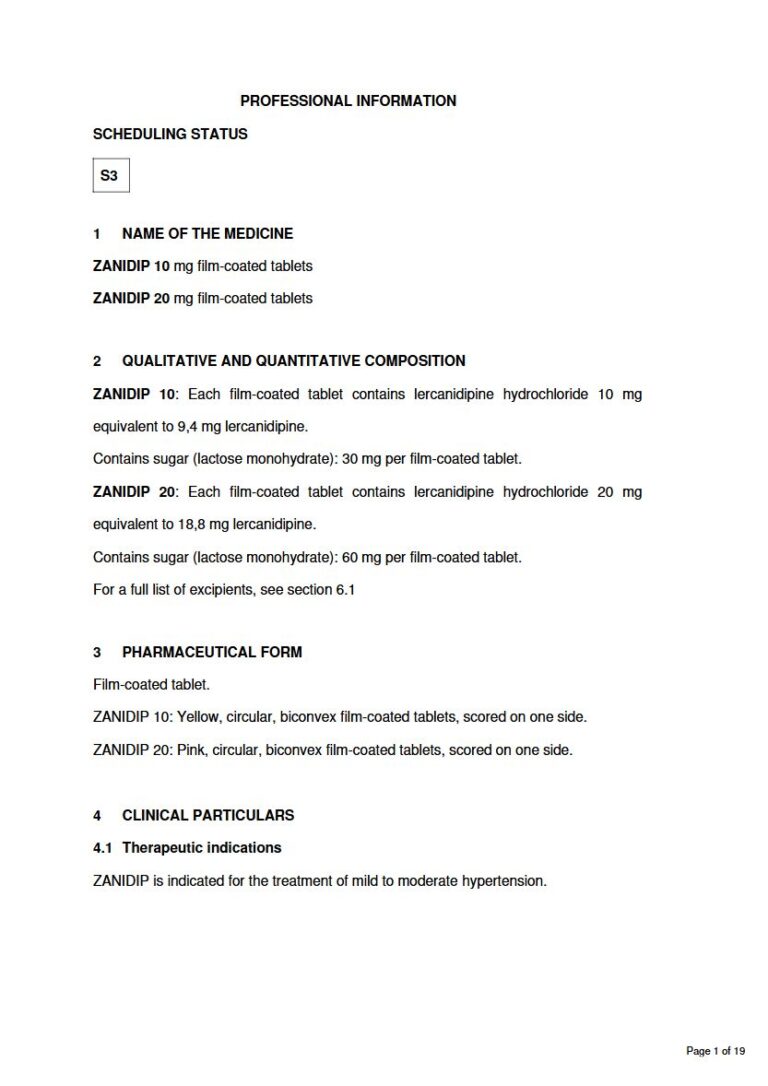
Clinical Particulars
Section 4 of the official insert — extracted exactly as issued, no alterations
4.1 Therapeutic indications
ZANIDIP is indicated for the treatment of mild to moderate hypertension.
4.2 Posology and method of administration
Posology
The recommended starting dosage is 10 mg orally once a day at least 15 minutes before a meal. In patients not responding adequately, the dose may be increased to 20 mg depending on the individual patientu2019s response. Dose titration should be gradual, because it may take about 2 weeks before the maximal antihypertensive effect is apparent.
Elderly patients
Although pharmacokinetic data and clinical experience suggest that no adjustment of the daily dosage is required, special care should be exercised when initiating treatment in the elderly.
Paediatric population
The safety and efficacy of ZANIDIP in children aged up to 18 years have not been established. No data are available.
Patients with renal or hepatic impairment
Special care should be exercised when treatment is commenced in patients with renal or hepatic dysfunction. Although the recommended dosage schedule may be tolerated by these subgroups, an increase in dosage to 20 mg daily must be approached with caution. The antihypertensive effect may be enhanced in patients with hepatic impairment and consequently an adjustment of the dosage should be considered. ZANIDIP contraindicated for use in patients with severe hepatic dysfunction or in patients with severe renal dysfunction (GFR < 30 ml/min) including patients undergoing dialysis (see sections 4.3 and 4.4).
Method of administration
ZANIDIP should not be administered with grapefruit juice (see section 4.3 and 4.5).
4.3 Contraindications
- Hypersensitivity to lercanidipine or to any of the excipients (see section 6.1).
- Women of childbearing potential unless effective contraception is used.
- Left ventricular outflow tract obstruction.
- Untreated congestive cardiac failure.
- Unstable angina pectoris, or recent (within 1 month) of a myocardial infarction.
- Severe hepatic impairment.
- Severe renal impairment (GFR < 30 ml/min), including patients undergoing dialysis.
- Since there is no clinical experience in patients under the age of 18 years, use in children is not recommended.
- ZANIDIP is contraindicated during pregnancy and lactation (see section 4.6).
- Co-administration with:
- inhibitors of CYP3A4 (see section 4.5),
- ciclosporin (see section 4.5).
- grapefruit or grapefruit juice (see section 4.5)
4.4 Special warnings and precautions for use
Sick sinus syndrome
Lercanidipine should be administered with caution in patients with sick sinus syndrome (without a pacemaker).
Left ventricular dysfunction
Although haemodynamic controlled studies revealed no impairment of ventricular function, care is required in patients with moderate to severe left ventricular dysfunction.
Ischaemic heart disease
It has been suggested that some short-acting dihydropyridine may be associated with increased cardiovascular risk in patients with ischemic heart disease. Although lercanidipine is a long-acting dihydropyridine, caution is required in such patients. Some dihydropyridines may rarely lead to precordial pain or angina pectoris. Very rarely patients with pre-existing angina pectoris may experience increased frequency, duration, or severity of these attacks. Isolated cases of myocardial infarction may be observed (see section 4.8).
Use in renal or hepatic impairment
Special care should be exercised when treatment is commenced in patients with mild to moderate renal impairment. Although the usually recommended dose of 10 mg daily may be tolerated, an increase to 20 mg daily should be approached with caution. The antihypertensive effect may be enhanced in patients with moderate hepatic impairment and consequently an adjustment of the dosage should be considered. Lercanidipine is contraindicated in patients with severe hepatic impairment or renal impairment (GFR <30 ml/min), including patients undergoing haemodialysis (see section 4.2 and 4.3).
Peritoneal dialysis
Lercanidipine has been associated with the development of cloudy peritoneal effluent in patients on peritoneal dialysis. The turbidity is due to an increased triglyceride concentration in the peritoneal effluent. Whilst the mechanism is unknown, the turbidity tends to resolve soon after withdrawal of lercanidipine. This is an important association to recognise as cloudy peritoneal effluent can be mistaken for infective peritonitis with consequential unnecessary hospitalisation and empiric antibiotic administration.
4.5 Interaction with other medicines and other forms of interaction
Contraindications of concomitant use
Inhibitors of CYP3A4
Lercanidipine is known to be metabolised by the CYP3A4 enzyme and therefore inhibitors of CYP3A4 administered concurrently may interact with the metabolism and elimination of lercanidipine. An interaction study with a strong CYP3A4 inhibitor, ketoconazole, has shown a considerable increase in plasma levels of lercanidipine (a 15-fold increase of the AUC and an 8-fold increase of the C max for the eutomer S- lercanidipine). Co-prescription of lercanidipine with inhibitors of CYP3A4 (e.g. ketoconazole, itraconazole, ritonavir, erythromycin, troleandomycin, clarithromycin) should be avoided (see section 4.3).
Ciclosporin
Increased plasma levels of both lercanidipine and ciclosporin have been observed following concomitant administration. A study in young healthy volunteers has shown that when ciclosporin was administered 3 hours after the lercanidipine intake, the plasma levels of lercanidipine did not change, while the AUC of ciclosporin increased by 27 %. However, the co-administration of lercanidipine with ciclosporin has caused a 3-fold increase of the plasma levels of lercanidipine and a 21 % increase of the ciclosporin AUC. Ciclosporin and lercanidipine should not be administered together (see section 4.3).
Grapefruit or grapefruit juice
As for other dihydropyridines, lercanidipine is sensitive to inhibition of metabolism by grapefruit or grapefruit juice, with a consequent rise in its systemic availability and increased hypotensive effect. Lercanidipine should not be taken with grapefruit or grapefruit juice (see section 4.3).
Concomitant use not recommended
Inducers of CYP3A4
Co-administration of lercanidipine with CYP3A4 inducers like anticonvulsants (e.g. phenytoin, phenobarbital, carbamazepine) and rifampicin should be approached with caution since the antihypertensive effect may be reduced, and blood pressure should be monitored more frequently than usual (see section 4.4).
Alcohol
Alcohol should be avoided since it may potentiate the effect of vasodilating antihypertensive medicines (see section 4.4).
Precautions including dose adjustments
Substrates of CYP3A4
Caution should be exercised when lercanidipine is co-prescribed with other substrates of CYP3A4, like terfenadine, astemizole, class III antiarrhythmic medicines such as amiodarone, quinidine, sotalol.
Midazolam
When concomitantly administered at a dose of 20 mg with midazolam p.o. to elderly volunteers, lercanidipine absorption was increased (by approximately 40 %) and the rate of absorption was decreased (t max was delayed from 1,75 to 3 hours). Midazolam concentrations were not modified.
Metoprolol
When lercanidipine was co-administered with metoprolol, a u03b2-blocker eliminated mainly by the liver, the bioavailability of metoprolol was not changed while that of lercanidipine was reduced by 50 %. This effect may be due to the reduction in the hepatic blood flow caused by u03b2-blockers and may therefore occur with other medicines of this class. Consequently, lercanidipine may be safely administered with u03b2-adrenoceptor blocking medicines, but dose adjustment may be required.
Digoxin
Co-administration of 20 mg lercanidipine in patients chronically treated with u03b2-methyldigoxin showed no evidence of pharmacokinetic interaction. However, a mean increase of 33 % in digoxin C max was observed, while AUC and renal clearance were not significantly modified. Patients on concomitant digoxin treatment should be closely monitored clinically for signs of digoxin toxicity.
Concomitant use with other medicines
Fluoxetine
An interaction study with fluoxetine (an inhibitor of CYP2D6 and CYP3A4), conducted in volunteers of an age of 65 u00b1 7 years (mean u00b1 s.d.), has shown no clinically relevant modification of the pharmacokinetics of lercanidipine.
Cimetidine
Concomitant administration of cimetidine 800 mg daily does not cause significant modifications in plasma levels of lercanidipine, but at higher doses caution is required since the bioavailability and the hypotensive effect of lercanidipine may be increased.
Simvastatin
When a dose of 20 mg of lercanidipine was repeatedly co-administered with 40 mg of simvastatin, the AUC of lercanidipine was not significantly modified, while simvastatin AUC increased by 56 % and that of its active metabolite u03b2-hydroxyacid by 28 %. It is unlikely that such changes are of clinical relevance. No interaction is expected when lercanidipine is administered in the morning and simvastatin in the evening, as indicated for such medicine.
Warfarin
The co-administration of 20 mg lercanidipine to healthy volunteers given fasted did not alter the pharmacokinetics of warfarin.
Diuretics and ACE inhibitors
Lercanidipine has been safely administered with diuretics and ACE inhibitors.
Other medicines affecting blood pressure
As for all antihypertensive medicines, an increased hypotensive effects may be observed when lercanidipine is administered with other medicines affecting blood pressure, such as alpha-blockers for the treatment of urinary symptoms, tricyclic antidepressants, neuroleptics. On the contrary, a reduction of the hypotensive effect may be observed with a concomitant use with corticosteroids.
4.6 Fertility, pregnancy and lactation
Pregnancy
There are no data from the use of lercanidipine in pregnant women. Studies in animals have not shown teratogenic effects (see section 5.3), but these have been observed with other dihydropyridine compounds. Lercanidipine is not recommended during pregnancy and in women of childbearing-potential not using contraception.
Lactation
It is unknown whether lercanidipine/metabolites are excreted in human milk. A risk to the newborns/infants cannot be excluded. Lercanidipine should not be used during lactation.
Fertility
No clinical data are available with lercanidipine. Reversible biochemical changes in the head of spermatozoa which can impair fecundation have been reported in some patients treated by channel blockers. In cases where repeated in-vitro fertilisation is unsuccessful and where another explanation cannot be found, the possibility of calcium channel blockers as the cause should be considered.
4.7 Effects on ability to drive and use machines
ZANIDIP has minor influence on the ability to drive and use machines. However, caution should be exercised because dizziness, asthenia, fatigue and rarely somnolence may occur.
4.8 Undesirable effects
a. Summary of the safety profile
The safety of lercanidipine at a dose of 10 - 20 mg once daily has been evaluated in double-blind, placebo-controlled clinical trials (with 1 200 patients receiving lercanidipine and 603 patients receiving placebo) and in active-controlled and uncontrolled long term clinical trials on a total of 3 676 hypertensive patients receiving lercanidipine. The most commonly reported adverse reactions in clinical trials and in the post-marketing experience are: peripheral oedema, headache, flushing, tachycardia and palpitations.
b. Tabulated summary of adverse reactions
In the table below, adverse reactions reported in clinical trials and in the worldwide post marketing experience for which a reasonable causal relationship exists are listed by MedDRA system organ class and frequency: very common (u22651/10); common (u22651/100 to <1/10); uncommon (u22651/1,000 to <1/100); rare (u22651/10,000 to <1/1,000); very rare (<1/10,000), not known (cannot be estimated from the available data). Within each frequency grouping the observed adverse reactions are presented in order of decreasing seriousness.
4.9 Overdose
In the post-marketing experience of lercanidipine, some cases of overdose have been reported ranging from 30 - 40 mg up to 800 mg, including reports of suicide attempt.
Symptoms
As with other dihydropyridines, lercanidipine overdosage results in excessive peripheral vasodilation with marked hypotension and reflex tachycardia. However, at very high doses, the peripheral selectivity may be lost, causing bradycardia and a negative inotropic effect. The most common ADRs associated to cases of overdose have been hypotension, dizziness, headache and palpitations.
Treatment
Clinically significant hypotension requires active cardiovascular support including frequent monitoring of cardiac and respiratory function, elevation of extremities and attention to circulating fluid volume and urine output. In view of the prolonged pharmacological effect of lercanidipine, it is essential that the cardiovascular status of the patient is monitored for 24 hours at least. Since the product has a high protein binding, dialysis is not likely to be effective. Patients in whom a moderate to severe intoxication is anticipated should be observed in a high-care setting.
