
Zelboraf 240 mg FC tablets
PDF Leaflet Revision Date: 14 April 2022
Clinical Summary
Quick overview from the medicine insert
Indication
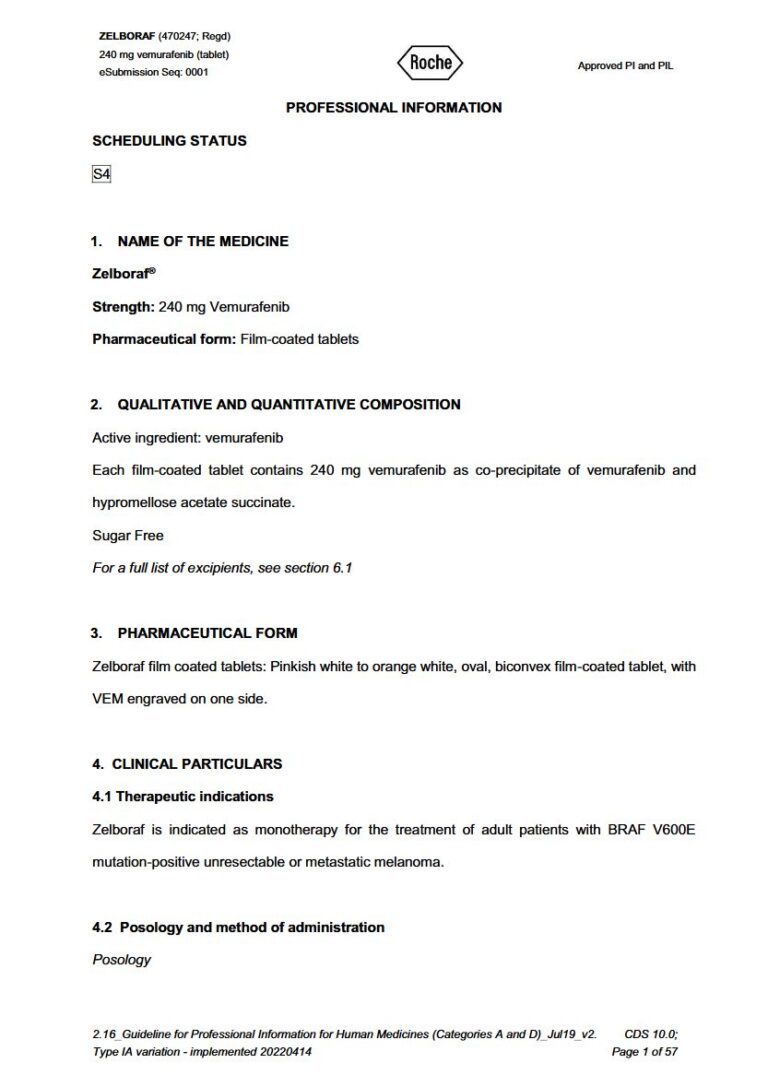
Monotherapy for BRAF V600E mutation-positive unresectable or metastatic melanoma.
Dosage (summary)
960 mg (4 tablets) twice daily, taken consistently with meals.
Special Populations
- Elderly population
- Renal impairment
- Hepatic impairment
Pregnancy & Breastfeeding
Not recommended in pregnancy; breastfeeding should be discontinued.
Key Drug Interactions
- CYP1A2 inhibitors/inducers
- CYP3A4 inhibitors/inducers
- Warfarin
Contraindications
- Hypersensitivity to vemurafenib
- Severe hepatic impairment
- Pregnancy
Common side effects
- Arthralgia
- Fatigue
- Rash
- Photosensitivity
- Nausea
Counselling Points
- Confirm BRAF V600E mutation status before treatment.
- Avoid sun exposure; use sunscreen.
- Report any skin changes immediately.
Serious warnings
- Severe hypersensitivity reactions
- QT prolongation
- Dermatological reactions
Important Disclaimer
The Zelboraf 240 mg FC tablets professional information leaflet below is the property of Roche Products and is provided on Medinsert exactly as issued, with no.. alterations or editorial changes. We make every effort to keep content current by updating documents as soon as new versions become available. Medinsert serves as a trusted access point for healthcare professionals, but does not replace official sources or clinical judgement. For more details, please read our full disclaimer. read more>>
 Healthcare Professionals Only
This content is for registered healthcare professionals
Sign in or create a free account to read the full package insert.
Free for HPCSA-registered professionals. Powered by Medinsert.
Clinical Particulars
Section 4 of the official insert — extracted exactly as issued, no alterations
4.1 Therapeutic indications
Zelboraf is indicated as monotherapy for the treatment of adult patients with BRAF V600E mutation-positive unresectable or metastatic melanoma.
4.2 Posology and method of administration
Posology
Treatment with Zelboraf should be initiated and supervised by a qualified medical practitioner experienced in the use of anticancer medicines. Before taking Zelboraf, patients must have BRAF V600E mutation-positive tumour status confirmed by a validated test (see sections 4.4 and 5). The recommended dose of Zelboraf is 960 mg (four tablets of 240 mg) twice daily (equivalent to a total daily dose of 1 920 mg). The first dose is to be taken in the morning and the second dose is to be taken approximately 12 hours later in the evening. Each dose of Zelboraf in the morning/evening should always be taken in the same manner i.e. either at least 1 hour before or at least 2 hours after a meal.
Method of administration: Zelboraf tablets should to be swallowed whole with water. Zelboraf tablets should not be chewed or crushed.
Duration of treatment: Treatment with Zelboraf should continue until disease progression or the development of unacceptable toxicity (see Tables 1 and 2).
Missed doses: If a dose is missed, it can be taken up to 4 hours prior to the next dose to maintain the twice daily regimen. Both doses should not be taken at the same time.
Vomiting: In case of vomiting after Zelboraf administration the patient should not take an additional dose of the medicine but the treatment should be continued as usual.
Dose adjustments: Management of symptomatic adverse drug reactions or QTc prolongation may require a dose reduction, temporary interruption and/or treatment discontinuation. Dose adjustments resulting in a dose below 480 mg twice daily are not recommended. In the event the patient develops Cutaneous Squamous Cell Carcinoma (cuSCC), it is recommended to continue the treatment without modifying the dose of Zelboraf (see sections 4.4 and 4.8)
4.3 Contraindications
Patients with hypersensitivity to Vemurafenib or to any of its excipients listed in section 6.1. History of severe hepatic impairment (Child-Pugh C). Pregnancy. Women should not breastfeed their infants while on Zelboraf (see section 4.6).
4.4 Special warnings and precautions for use
Before taking Zelboraf, patients must have BRAF V600 mutation-positive tumour status confirmed by a validated test. The efficacy and safety of Zelboraf in patients with tumours expressing BRAF V600 non-E mutations have not been convincingly established (see section 5). Zelboraf should not be used in patients with wild-type BRAF malignant melanoma.
Hypersensitivity reactions: Serious hypersensitivity reactions, including anaphylaxis have been reported in association with Zelboraf (see section 4.8). Severe hypersensitivity reactions may include Stevens-Johnson syndrome, generalised rash, erythema or hypotension. In patients who experience severe hypersensitivity reactions, Zelboraf treatment should be permanently discontinued.
Dermatological reactions: Severe dermatological reactions have been reported in patients receiving Zelboraf, including cases of Stevens-Johnson syndrome and toxic epidermal necrolysis. Drug reaction with eosinophilia and systemic symptoms (DRESS) has been reported in association with Zelboraf (see section 4.8). In patients who experience a severe dermatological reaction, Zelboraf treatment should be permanently discontinued.
Potentiation of Radiation Toxicity: Cases of radiation recall and radiation sensitisation have been reported in patients treated with radiation either prior, during, or subsequent to Zelboraf treatment (see section 4.8 and 4.5). Most cases were cutaneous in nature but some cases involving visceral organs had fatal outcomes. Zelboraf should be used with caution when given concomitantly or sequentially with radiation treatment.
QT Prolongation: Exposure-dependent QT prolongation was observed in an uncontrolled, open-label phase II study in previously treated patients with metastatic melanoma (see section 4.8). QT prolongation may lead to an increased risk of ventricular dysrhythmias including Torsade de Pointes. Treatment with Zelboraf is not recommended in patients with un-correctable electrolyte abnormalities (including magnesium), long QT syndrome, or who are taking medicine known to prolong the QT interval. Electrocardiogram (ECG) and electrolytes (including magnesium) should be monitored in all patients before treatment with Zelboraf, after one month of treatment and after dose modification. Further monitoring is recommended in patients with moderate (Child-Pugh Class B) to severe (Child-Pugh Class C) hepatic impairment monthly during the first 3 months of treatment followed by every 3 months thereafter or more often as clinically indicated. Zelboraf treatment should not be initiated in patients with QTc > 500 milliseconds (ms). If, during treatment, the QTc exceeds 500 ms (CTCAE u2265 grade 3), Zelboraf treatment should be temporarily interrupted, electrolyte abnormalities (including magnesium, calcium and potassium) should be corrected, and cardiac risk factors for QT prolongation (e.g. congestive heart failure, bradydysrhythmias) should be controlled. Re-initiation of treatment should occur once the QTc decreases below 500 ms and at a lower dose as described in Tables 2 and 3.
Ophthalmological reactions: Serious ophthalmological reactions, including uveitis, iritis, photophobia and retinal vein occlusion, have been reported. Patients should be monitored routinely for ophthalmological reactions and be advised to urgently seek medical attention in the event of acute onset eye pain and/or change in visual acuity.
Concurrent administration with ipilimumab: In a Phase I trial, grade 3 increases in transaminases and bilirubin were reported with concurrent administration of ipilimumab (3 mg/kg) and Zelboraf (960 mg BID or 720 mg BID). Based on these data, the concurrent administration of ipilimumab and Zelboraf is not recommended.
Malignancies: Cutaneous Squamous Cell Carcinoma (cuSCC): Cases of cuSCC (which include those classified as keratoacanthoma or mixed keratoacanthoma subtype) have been reported in patients treated with Zelboraf (see section 4.8). CuSCC usually occurred early in the course of treatment. Potential risk factors associated with cuSCC in vemurafenib clinical trials included age (u2265 65 years), prior skin cancer, and chronic sun exposure. Cases of cuSCC were typically managed with simple excision, and patients were able to continue treatment without dose adjustment. It is recommended that all patients receive a dermatological evaluation prior to initiation of therapy and be monitored routinely while on therapy. Any suspicious skin lesions should be excised, sent for dermatopathologic evaluation and treated as per local standard of care. The prescriber should examine the patient monthly during and up to six months after treatment for cuSCC. In patients who develop cuSCC, it is recommended to continue the treatment without dose adjustment. Monitoring should continue for 6 months following discontinuation of Zelboraf or until initiation of another anti-neoplastic therapy. Patients should be instructed to inform their medical practitioners upon the occurrence of any skin changes.
Non-Cutaneous Squamous Cell Carcinoma (non-cuSCC): Cases of non-cuSCC of the head and neck (tongue and tonsils) have been reported in clinical trials where patients received vemurafenib. Patients should undergo a head and neck examination, consisting of at least a visual inspection of oral mucosa and lymph node palpation prior to initiation of treatment and every 3 months during treatment. In addition, patients should undergo a chest Computerised Tomography (CT) scan, prior to initiation of treatment and every 6 months during treatment. Anal examinations and pelvic examinations (for women) are recommended before and at the end of treatment or when considered clinically indicated. Following discontinuation of Zelboraf, monitoring for non-cuSCC should continue for up to 6 months or until initiation of another anti-neoplastic therapy. Abnormal findings should be managed according to clinical practices.
New primary melanoma: New primary melanomas have been reported in clinical trials. Cases were managed with excision and patients continued treatment without dose adjustment. Monitoring for skin lesions should occur as outlined above for cutaneous squamous cell carcinoma.
Other Malignancies: Zelboraf may cause progression of cancers associated with RAS mutations (see section 4.8). Zelboraf should be used with caution in patients with prior or concurrent cancer associated with RAS mutation.
Pancreatitis: Pancreatitis has been reported in Zelboraf-treated patients. It generally occurs within two weeks after initiation of Zelboraf treatment. Unexplained abdominal pain should be promptly investigated (including measurement of amylase and lipase serum levels). Patients should be closely monitored when re-starting Zelboraf after an episode of pancreatitis.
Liver injury: Liver injury, including cases of severe liver injury, has been reported with Zelboraf (see section 4.8). Liver laboratory abnormalities may occur with Zelboraf (see section 4.8). Liver enzymes (transaminases and alkaline phosphatase) and bilirubin should be monitored before initiation of treatment and monthly during treatment, or as clinically indicated. Laboratory abnormalities should be managed with dose reduction, treatment interruption or with treatment discontinuation (see section 4.2).
Creatinine: Laboratory abnormalities have been reported, mostly cases of mild (> 1-1,5 x ULN) to moderate (> 1,5 u2013 3 x ULN) serum creatinine elevation. In most cases, serum creatinine elevations appear to be reversible (see section 4.8). However, acute kidney failure may occur. Serum creatinine should be measured before initiation of treatment and periodically monitored during treatment as clinically indicated. For recommended dose modifications, see section 4.2. It is thought that Zelboraf directly inhibits creatinine elimination by the kidney.
4.5 Interactions with other medicines
Zelboraf is a moderate CYP1A2 inhibitor and a CYP3A4 inducer. Zelboraf may increase the plasma exposure of medicines predominantly metabolised by CYP1A2 and decrease the plasma exposure of medicines predominantly metabolised by CYP3A4. Concomitant use of Zelboraf with medicines metabolised by CYP1A2 and CYP3A4 with narrow therapeutic windows is not recommended. Dose adjustments for medicines predominantly metabolised via CYP1A2 or CYP3A4 should be considered based on their therapeutic windows before concomitantly treating with Zelboraf (see sections 4.5 and 4.6). Perform additional INR (International Normalised Ratio) monitoring when Zelboraf is used concomitantly with warfarin. Zelboraf is an inhibitor of the efflux transporters P-glycoprotein (P-gp). Vemurafenib may increase the plasma exposure of medicinal products that are P-gp substrates. Caution should be exercised when dosing vemurafenib concurrently with P-gp substrates. Dose reduction of the concomitant P-gp substrate medicine may be considered, if clinically indicated (see section 4.5).
4.6 Fertility, pregnancy and lactation
Fertility
No specific studies with vemurafenib have been conducted in animals to evaluate the effect on fertility. However, in repeat-dose toxicity studies in rats and dogs, no histopathological findings were noted in reproductive organs in males and females (see section 5.3).
Women of childbearing potential / Contraception in males and females: Men and women of childbearing potential have to use effective contraception during treatment and for at least 6 months after treatment. Zelboraf might decrease the efficacy of hormonal contraceptives (see section 4.5).
Pregnancy: Safety in pregnancy has not been established. Zelboraf revealed no evidence of teratogenicity in preclinical studies. In animal studies, vemurafenib was found to cross the placenta. Based on its mechanism of action, vemurafenib could cause foetal harm when administered to a pregnant woman. Zelboraf should not be administered to pregnant women (see section 4.3).
Breastfeeding: A risk to the newborns/infants cannot be excluded. Breastfeeding should be discontinued during treatment with Zelboraf (see section 4.3).
4.7 Effects on ability to drive and use machines
Zelboraf has an influence on the ability to drive and use machines. Patients should be made aware of the potential fatigue, dizziness or eye problems that could be a reason for not driving. (see section 4.8).
4.8 Undesirable effects
The most common adverse medicine reactions (> 30 %) reported with Zelboraf include: arthralgia, fatigue, rash, photosensitivity reaction, nausea, alopecia and pruritus, diarrhoea, headache, vomiting, skin papilloma and hyperkeratosis. The most common (u2265 5 %) Grade 3 ADRs were cuSCC, keratoacanthoma, rash, arthralgia and increased Gammaglutamyl transferase (GGT). CuSCC was very commonly reported and was most commonly treated by local excision. ADRs which were reported in melanoma patients are listed below by MedDRA body system organ class, frequency and grade of severity. The following convention has been used for the classification of frequency: Very common u2265 1/10 Common u2265 1/100 to < 1/10 Uncommon u2265 1/1 000 to < 1/100 Rare u2265 1/10 000 to < 1/1 000 Very rare < 1/10 000 In this section, ADRs are based on results in 500 patients from a phase III randomised open label study in adult patients with BRAF V600 mutation-positive unresectable or stage IV melanoma, as well as a phase II single-arm study in patients with BRAF V600 mutation-positive stage IV melanoma who had previously failed at least one prior systemic therapy (see section 5). All terms included are based on the highest percentage observed among phase II and phase III clinical trials. Within each system organ class, ADR with the same frequency are presented in order of decreasing seriousness and were reported using NCI-CTCAE v 4.0 (common toxicity criteria) for assessment of toxicity.
4.9 Overdose
There is no specific antidote for overdose with Zelboraf. Patients who develop adverse reactions should receive appropriate symptomatic treatment. No cases of overdose have been observed with Zelboraf in clinical trials. Dose limiting toxicities for Zelboraf include rash with pruritus and fatigue. In case of suspected overdose, Zelboraf should be withheld and supportive care initiated.
