
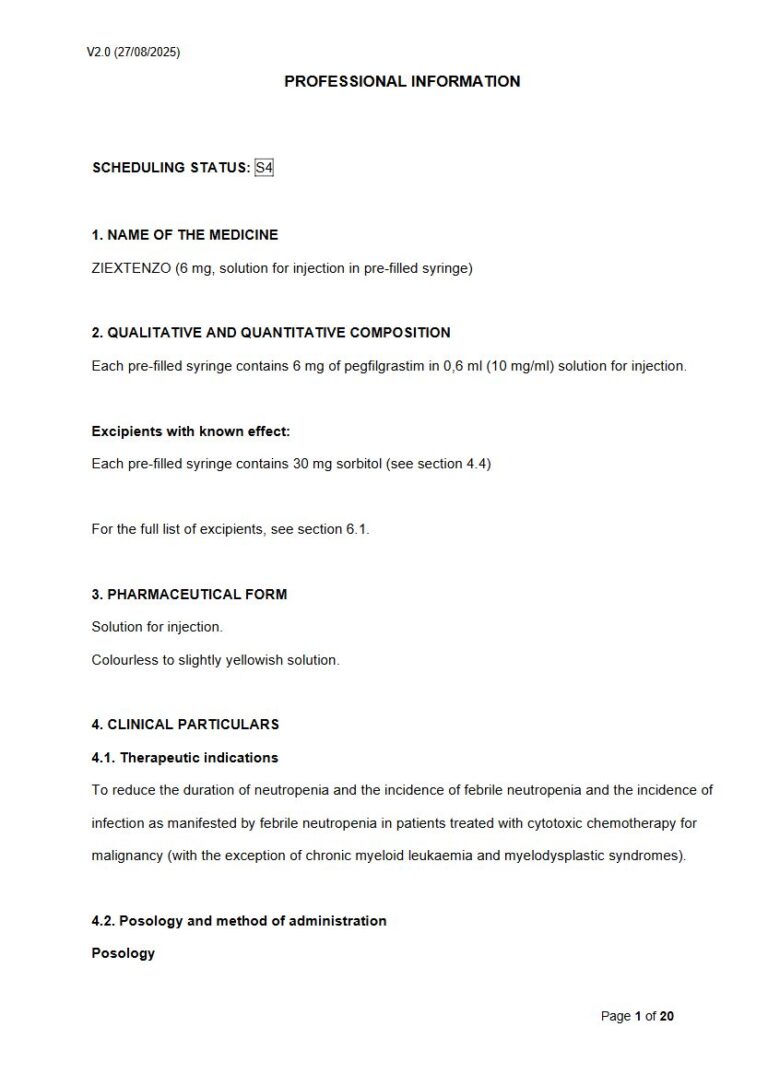
Ziextenzo 6,0 mg Solution for injection
PDF Leaflet Revision Date: 25 August 2025
Clinical Summary
Quick overview from the medicine insert
Indication
To reduce duration and incidence of neutropenia in chemotherapy patients.
Dosage (summary)
6 mg subcutaneously, 24 hours post-chemotherapy cycle.
Special Populations
- Elderly
- Renal impairment
- Hepatic impairment
Pregnancy & Breastfeeding
Not recommended in pregnancy; insufficient data for breastfeeding.
Key Drug Interactions
- Cytotoxic chemotherapy
- Lithium
- 5-fluorouracil
Contraindications
- Hypersensitivity to pegfilgrastim or excipients
Common side effects
- Bone pain
- Musculoskeletal pain
- Nausea
- Headache
Counselling Points
- Monitor for allergic reactions
- Report any pulmonary symptoms
- Avoid in hypersensitivity history
Serious warnings
- Pulmonary adverse events
- Capillary leak syndrome
- Splenic rupture
- Myelodysplastic syndrome
Important Disclaimer
The Ziextenzo 6,0 mg Solution for injection professional information leaflet below is the property of Sandoz Sa and is provided on Medinsert exactly as issued, with no.. alterations or editorial changes. We make every effort to keep content current by updating documents as soon as new versions become available. Medinsert serves as a trusted access point for healthcare professionals, but does not replace official sources or clinical judgement. For more details, please read our full disclaimer. read more>>
 Healthcare Professionals Only
This content is for registered healthcare professionals
Sign in or create a free account to read the full package insert.
Free for HPCSA-registered professionals. Powered by Medinsert.
Clinical Particulars
Section 4 of the official insert — extracted exactly as issued, no alterations
4.1. Therapeutic indications
To reduce the duration of neutropenia and the incidence of febrile neutropenia and the incidence of infection as manifested by febrile neutropenia in patients treated with cytotoxic chemotherapy for malignancy (with the exception of chronic myeloid leukaemia and myelodysplastic syndromes).
4.2. Posology and method of administration
Posology
Adults (u2265 18 years): One 6 mg dose (a single pre-filled syringe) of ZIEXTENZO is recommended for each chemotherapy cycle, administered as a subcutaneous injection approximately 24 hours following cytotoxic chemotherapy.
Children and Adolescents: There are insufficient data to recommend the use of ZIEXTENZO in children and adolescents under 18 years of age. ZIEXTENZO therapy should be initiated and supervised by physicians experienced in oncology and/or haematology. For instructions on handling of the medicine before administration, see section 6.6.
4.3. Contraindications
Hypersensitivity to pegfilgrastim, filgrastim, E. coli derived proteins, or to any excipients.
4.4 Special warnings and precautions for use
Traceability: In order to improve the traceability of granulocyte-colony stimulating factors (G-CSFs), the trade name of the administered product should be clearly recorded in the patient file.
Limited clinical data suggest a comparable effect on time to recovery of severe neutropenia for pegfilgrastim to filgrastim in patients with de novo acute myeloid leukaemia (AML) (see section 5.1). However, the long-term effects of pegfilgrastim have not been established in AML; therefore, it should be used with caution in this patient population.
Granulocyte-colony stimulating factor can promote growth of myeloid cells in vitro and similar effects may be seen on some non-myeloid cells in vitro. The safety and efficacy of pegfilgrastim have not been investigated in patients with myelodysplastic syndrome, chronic myelogenous leukaemia, and in patients with secondary AML; therefore, it should not be used in such patients.
Particular care should be taken to distinguish the diagnosis of blast transformation of chronic myeloid leukaemia from AML. The safety and efficacy of pegfilgrastim administration in de novo AML patients aged < 55 years with cytogenetics t(15;17) have not been established. The safety and efficacy of pegfilgrastim have not been investigated in patients receiving high dose chemotherapy. This medicinal product should not be used to increase the dose of cytotoxic chemotherapy beyond established dosage regimens.
Pulmonary adverse events: Pulmonary adverse reactions, in particular interstitial pneumonia, have been reported after G-CSF administration. Patients with a recent history of pulmonary infiltrates or pneumonia may be at higher risk (see section 4.8). The onset of pulmonary signs such as cough, fever, and dyspnoea in association with radiological signs of pulmonary infiltrates, and deterioration in pulmonary function along with increased neutrophil count may be preliminary signs of Acute Respiratory Distress Syndrome (ARDS). In such circumstances ZIEXTENZO should be discontinued at the discretion of the physician and the appropriate treatment given (see section 4.8).
Glomerulonephritis: Glomerulonephritis has been reported in patients receiving filgrastim and pegfilgrastim. Generally, events of glomerulonephritis resolved after dose reduction or withdrawal of filgrastim and pegfilgrastim. Urinalysis monitoring is recommended.
Capillary leak syndrome: Capillary leak syndrome has been reported after granulocyte-colony stimulating factor administration and is characterised by hypotension, hypoalbuminaemia, oedema and haemoconcentration. Patients who develop symptoms of capillary leak syndrome should be closely monitored and receive standard symptomatic treatment, which may include a need for intensive care (see section 4.8).
Splenomegaly and splenic rupture: Generally asymptomatic cases of splenomegaly and cases of splenic rupture, including some fatal cases, have been reported following administration of pegfilgrastim (see section 4.8). Therefore, spleen size should be carefully monitored (e.g. clinical examination, ultrasound). A diagnosis of splenic rupture should be considered in patients reporting left upper abdominal pain or shoulder tip pain.
Thrombocytopenia and anaemia: Treatment with ZIEXTENZO alone does not preclude thrombocytopenia and anaemia because full dose myelosuppressive chemotherapy is maintained on the prescribed schedule. Regular monitoring of platelet count and haematocrit is recommended. Special care should be taken when administering single or combination chemotherapeutic medicines which are known to cause severe thrombocytopenia.
Myelodysplastic syndrome and acute myeloid leukaemia in breast and lung cancer patients: In the post-marketing observational study setting, pegfilgrastim in conjunction with chemotherapy and/or radiotherapy has been associated with development of myelodysplastic syndrome (MDS) and acute myeloid leukaemia (AML) in breast and lung cancer patients (see section 4.8). Monitor breast and lung cancer patients for signs and symptoms of MDS/AML.
Sickle cell anaemia: Sickle cell crises have been associated with the use of pegfilgrastim in patients with sickle cell trait or sickle cell disease (see section 4.8). Therefore, physicians should use caution when prescribing ZIEXTENZO in patients with sickle cell trait or sickle cell disease, should monitor appropriate clinical parameters and laboratory status and be attentive to the possible association of this medicine with splenic enlargement and vaso-occlusive crisis.
Leukocytosis: White blood cell (WBC) counts of 100 x 109/L or greater have been observed in less than 1 % of patients receiving pegfilgrastim. No adverse events directly attributable to this degree of leukocytosis have been reported. Such elevation in white blood cells is transient, typically seen 24 to 48 hours after administration and is consistent with the pharmacodynamic effects of this medicine. Consistent with the clinical effects and the potential for leukocytosis, a WBC count should be performed at regular intervals during therapy. If leukocyte counts exceed 50 x 109/L after the expected nadir, this medicine should be discontinued immediately.
Hypersensitivity: Hypersensitivity, including anaphylactic reactions, occurring on initial or subsequent treatment have been reported in patients treated with pegfilgrastim. Permanently discontinue pegfilgrastim in patients with clinically significant hypersensitivity. Do not administer ZIEXTENZO to patients with a history of hypersensitivity to pegfilgrastim or filgrastim. If a serious allergic reaction occurs, appropriate therapy should be administered, with close patient follow-up over several days.
Stevens - Johnson syndrome: Stevens-Johnson syndrome (SJS), which can be life-threatening or fatal, has been reported rarely in association with pegfilgrastim treatment. If the patient has developed SJS with the use of pegfilgrastim, treatment with ZIEXTENZO must not be restarted in this patient at any time.
Immunogenicity: As with all therapeutic proteins, there is a potential for immunogenicity. Rates of generation of antibodies against pegfilgrastim is generally low. Binding antibodies do occur as expected with all biologics; however, they have not been associated with neutralising activity at present.
Aortitis: Aortitis has been reported after G-CSF administration in healthy subjects and in cancer patients. The symptoms experienced included fever, abdominal pain, malaise, back pain and increased inflammatory markers (e.g. c-reactive protein and white blood cell count). In most cases aortitis was diagnosed by CT scan and generally resolved after withdrawal of G-CSF. See also section 4.8.
Other warnings: The safety and efficacy of pegfilgrastim for the mobilisation of blood progenitor cells in patients or healthy donors has not been adequately evaluated. Increased haematopoietic activity of the bone marrow in response to growth factor therapy has been associated with transient positive bone-imaging findings. This should be considered when interpreting bone-imaging results. ZIEXTENZO contains 30 mg sorbitol in each pre-filled syringe which is equivalent to 50 mg/mL. The additive effect of concomitantly administered products containing sorbitol (or fructose) and dietary intake of sorbitol (or fructose) should be taken into account. ZIEXTENZO contains less than 1 mmol (23 mg) sodium per 6 mg dose, that is to say essentially 'sodium-free'.
4.5 Interaction with other medicines and other forms of interaction
Due to the potential sensitivity of rapidly dividing myeloid cells to cytotoxic chemotherapy, pegfilgrastim should be administered at least 24 hours after administration of cytotoxic chemotherapy. In clinical trials, pegfilgrastim has been safely administered 14 days before chemotherapy. Concomitant use of pegfilgrastim with any chemotherapy medicines has not been evaluated in patients. In animal models concomitant administration of pegfilgrastim and 5-fluorouracil (5-FU) or other antimetabolites has been shown to potentiate myelosuppression. Possible interactions with other haematopoietic growth factors and cytokines have not been specifically investigated in clinical trials. The potential for interaction with lithium, which also promotes the release of neutrophils, has not been specifically investigated. There is no evidence that such an interaction would be harmful. The safety and efficacy of pegfilgrastim has not been evaluated in patients receiving chemotherapy associated with delayed myelosuppression e.g. nitrosoureas. Specific interaction or metabolism studies have not been performed; however, clinical trials have not indicated an interaction of pegfilgrastim with any other medicines.
4.6 Fertility, pregnancy and lactation
Pregnancy: There are no or limited amount of data from the use of pegfilgrastim in pregnant women. Studies in animals have shown reproductive toxicity (see section 5.3). Pegfilgrastim is not recommended during pregnancy and in women of childbearing potential not using contraception.
Breastfeeding: There is insufficient information on the excretion of pegfilgrastim/metabolites in human milk, a risk to the newborns/infants cannot be excluded. A decision must be made whether to discontinue breast-feeding or to discontinue/abstain from ZIEXTENZO therapy taking into account the benefit of breast-feeding for the child and the benefit of therapy for the woman.
Fertility: Pegfilgrastim did not affect reproductive performance or fertility in male or female rats at cumulative weekly doses approximately 6 to 9 times higher than the recommended human dose (based on body surface area) (see section 5.3).
4.7 Effects on ability to drive and use machines
ZIEXTENZO has no or negligible influence on the ability to drive and use machines.
4.8 Undesirable effects
Summary of the safety profile: The most frequently reported adverse reactions were bone pain and musculoskeletal pain. Bone pain was generally of mild to moderate severity, transient and could be controlled in most patients with standard analgesics. Hypersensitivity-type reactions, including skin rash, urticaria, angioedema, dyspnoea, erythaema, flushing, and hypotension occurred on initial or subsequent treatment with pegfilgrastim. Serious allergic reactions, including anaphylaxis can occur in patients receiving pegfilgrastim (see section 4.4). Capillary Leak Syndrome, which can be life-threatening if treatment is delayed, has been reported less frequently in cancer patients undergoing chemotherapy following administration of granulocyte colony-stimulating factors; see section 4.4 and section u201cDescription of selected adverse reactionsu201d below. Splenomegaly, generally asymptomatic, is less frequent. Splenic rupture including some fatal cases is less frequently reported following administration of pegfilgrastim (see section 4.4).
Less frequent pulmonary adverse reactions including interstitial pneumonia, pulmonary oedema, pulmonary infiltrates and pulmonary fibrosis have been reported. Uncommonly, cases have resulted in respiratory failure or ARDS, which may be fatal (see section 4.4). Isolated cases of sickle cell crises have been reported in patients with sickle cell trait or sickle cell disease (uncommon in sickle cell patients) (see section 4.4)
Tabulated summary of adverse reactions:
System Organ Class Adverse reactions Frequent Less frequent Frequency unknown Neoplasms benign, malignant and unspecified (incl. cysts and polyps) Myelodysplastic syndrome 1, Acute myeloid leukaemia 1 Blood and lymphatic system disorders Thrombocytopenia 1 Leukocytosis 1 Sickle cell crisis 2 Splenomegaly 2 Splenic rupture 2 Immune system disorders Hypersensitivity reactions Anaphylaxis Metabolism Elevations in uric acid and nutrition disorders Nervous system disorders Headache 1 Vascular disorders Capillary leak syndrome 1 Aortitis Respiratory, thoracic and mediastinal disorders Acute Respiratory Distress Syndrome 2 Pulmonary adverse reactions (interstitial pneumonia, pulmonary oedema, pulmonary infiltrates and pulmonary fibrosis), Haemoptysis, Pulmonary haemorrhage Gastrointestinal disorders Nausea 1 Skin and subcutaneous tissue disorders Dermatitis contact 1 Sweet's syndrome (acute febrile neutrophilic dermatosis) 1,2 ,Cutaneous vasculitis 1,2 ,Stevens-Johnson syndrome Musculoskeletal and connective tissue disorders Bone pain, Musculo-skeletal pain (myalgia, arthralgia, pain in extremity, back pain, musculo-skeletal pain, neck pain) Renal and urinary disorders Glomerulonephritis 2 General disorders and administrative site conditions Injection site pain 1 Non-cardiac chest pain Injection site reactions 2 Investigations Elevations in lactate dehydrogenase and alkaline phosphatase 1 Transient elevations in LFTs for ALT or AST 1 1 See section u201cDescription of selected adverse reactionsu201d below. 2 This adverse reaction was identified through post-marketing surveillance but not observed in randomised, controlled clinical trials in adults. The frequency category was estimated from a statistical calculation based upon 1,576 patients receiving pegfilgrastim in nine randomised clinical trials.
Description of selected adverse reactions: Less frequent cases of Sweet's syndrome have been reported, although in some cases underlying haematological malignancies may play a role. Less frequent events of cutaneous vasculitis have been reported in patients treated with pegfilgrastim. The mechanism of vasculitis in patients receiving pegfilgrastim is unknown. Injection site reactions, including injection site erythaema (less frequent) as well as injection site pain (frequent) have occurred on initial or subsequent treatment with pegfilgrastim. Common cases of leukocytosis (White Blood Count [WBC] > 100 x 109/L) have been reported (see section 4.4). Reversible, mild to moderate elevations in uric acid and alkaline phosphatase, with no associated clinical effects, were less frequent; reversible, mild to moderate elevations in lactate dehydrogenase, with no associated clinical effects, were uncommon in patients receiving pegfilgrastim following cytotoxic chemotherapy. Nausea and headaches were frequently observed in patients receiving chemotherapy. Less frequent elevations in liver function tests (LFTs) for alanine aminotransferase (ALT) or aspartate aminotransferase (AST), have been observed in patients after receiving pegfilgrastim following cytotoxic chemotherapy. These elevations are transient and return to baseline. An increased risk of MDS/AML following treatment with pegfilgrastim in conjunction with chemotherapy and/or radiotherapy has been observed in an epidemiological study in breast and lung cancer patients (see section 4.4). Frequent cases of thrombocytopenia have been reported. Cases of capillary leak syndrome have been reported in the post-marketing setting with granulocyte-colony stimulating factor use. These have generally occurred in patients with advanced malignant diseases, sepsis, taking multiple chemotherapy medications or undergoing apheresis (see section 4.4).
Paediatric population: The experience in children is limited. A higher frequency of serious adverse reactions in younger children aged 0 to 5 years (92 %) has been observed compared to older children aged 6 to 11 and 12 to 21 years respectively (80 % and 67 %) and adults. The most frequent adverse reaction reported was bone pain (see section 5.1 and 5.2).
Reporting of suspected adverse reactions: Reporting suspected adverse reactions after authorisation of the medicine is important. It allows continued monitoring of the benefit/risk balance of the medicinal product. Healthcare providers are asked to report any suspected adverse reactions to SAHPRA via the u201c6.04 Adverse Drug Reactions Reporting Formu201d, found online under SAHPRAu2019s publications: https://www.sahpra.org.za/Publications/Index/8. Suspected adverse reactions can also be reported directly to the HCR via the link: https://pvi1j.solutions.iqvia.com or the e-mail address, [email protected].
4.9 Overdose
Single doses of 300 u03bcg/kg have been administered to a limited number of healthy volunteers and 195 patients with non-small cell lung cancer without serious adverse effects. The adverse events were similar to those in subjects receiving lower doses of pegfilgrastim.
