
Zoladex 10,8 mg Injection
PDF Leaflet Revision Date: 02 August 2022
Clinical Summary
Quick overview from the medicine insert
Indication
Management of prostate cancer, endometriosis, uterine fibroids, and oestrogen-receptor-positive breast cancer.
Dosage (summary)
10.8 mg subcutaneously every 3 months for men; every 12 weeks for women.
Special Populations
- Renal impairment
- Hepatic impairment
- Elderly
Pregnancy & Breastfeeding
Contraindicated in pregnancy and breastfeeding.
Contraindications
- Severe hypersensitivity
- Pregnancy
- Lactation
- Children
Common side effects
- Hot flushes
- Headaches
- Change in libido
- Sweating
- Reduction in bone mineral density
Counselling Points
- Monitor blood glucose in diabetic patients
- Use non-hormonal contraception during therapy
- Report any severe abdominal pain or bleeding
Serious warnings
- May cause reduction in bone mineral density
- Risk of ureteric obstruction or spinal cord compression
Important Disclaimer
The Zoladex 10,8 mg Injection professional information leaflet below is the property of Astrazeneca Pharmaceuticals and is provided on Medinsert exactly as issued, with no.. alterations or editorial changes. We make every effort to keep content current by updating documents as soon as new versions become available. Medinsert serves as a trusted access point for healthcare professionals, but does not replace official sources or clinical judgement. For more details, please read our full disclaimer. read more>>
 Healthcare Professionals Only
This content is for registered healthcare professionals
Sign in or create a free account to read the full package insert.
Free for HPCSA-registered professionals. Powered by Medinsert.
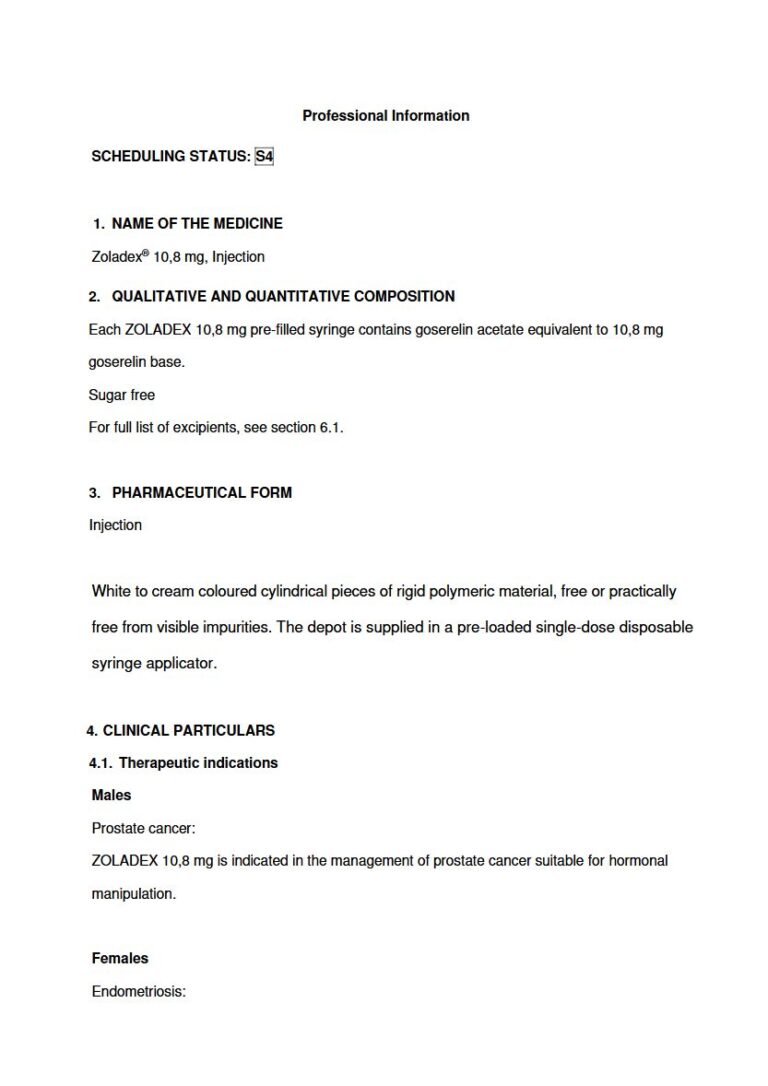
Clinical Particulars
Section 4 of the official insert — extracted exactly as issued, no alterations
4.1. Therapeutic indications
Males
Prostate cancer: ZOLADEX 10,8 mg is indicated in the management of prostate cancer suitable for hormonal manipulation.
Females
Endometriosis: Relief of clinical symptoms associated with endometriosis.
Uterine fibroids: Reduction of uterine fibroid size before surgery.
Breast cancer: ZOLADEX 10.8 mg is indicated in the management of oestrogen-receptor-positive breast cancer in premenopausal women. ZOLADEX should not be used for more than 6 months for gynaecological indications in women due to its effects on bone metabolism (see section 4.4).
4.2. Posology and method of administration
Adult men, including the elderly: One ZOLADEX 10,8 mg injected subcutaneously into the anterior abdominal wall, every 3 months (see section 5.1).
Adult women: One ZOLADEX 10,8 mg injected subcutaneously into the anterior abdominal wall, every 12 weeks. No dosage adjustment is necessary for patients with renal impairment, hepatic impairment, nor for the elderly. For correct administration of ZOLADEX, see instructions on the carton.
Children: ZOLADEX 10,8 mg is not for use in children. (See section 4.3).
4.3. Contraindications
Known severe hypersensitivity to the active substance or to any of the excipients of ZOLADEX 10,8 mg.
Pregnancy and lactation (see section 4.6).
Children: ZOLADEX is not indicated for use in children (see section 4.2).
4.4. Special warnings and precautions for use
Patients with proven non-hormone dependent cancer e.g. those who have failed to respond to previous surgical castration or oestrogens, are less likely to respond to ZOLADEX than previously untreated patients.
The use of ZOLADEX in men at particular risk of developing ureteric obstruction or spinal cord compression should be considered carefully and the patients monitored closely during the first month of therapy. If spinal cord compression or renal impairment due to ureteric obstruction are present or develop, specific standard treatment of these complications should be instituted.
ZOLADEX may cause an increase in uterine cervical resistance, which may result in difficulty when the cervix is dilated. Care should be taken when dilating the cervix.
The safety and efficacy of ZOLADEX for gynaecological conditions have not been established for periods exceeding 6 months (see section 4.4).
The use of ZOLADEX may cause a reduction in bone mineral density. In women, current available data suggest that recovery of bone loss occurs on cessation of therapy in the majority. In women receiving ZOLADEX 3,6 mg for the treatment of endometriosis, the addition of hormone replacement therapy (a daily oestrogenic agent and a progestogenic agent) has been shown to reduce bone mineral density loss and vasomotor symptoms. There is no experience of the use of hormone replacement therapy in women receiving ZOLADEX 10,8 mg. In men, preliminary data suggest the use of a bisphosphonate in combination with an LHRH agonist may reduce bone mineral loss.
A reduction in glucose tolerance has been observed in males receiving LHRH agonists such as ZOLADEX. This may manifest as diabetes or loss of glycaemic control in those with pre-existing diabetes mellitus. Consideration should therefore be given to monitoring blood glucose.
Time to return of menses after cessation of therapy with ZOLADEX 10,8 mg may be prolonged.
Following long-term repeated dosing with ZOLADEX, an increased incidence of benign pituitary tumours have been observed in male rats. Whilst this finding is similar to that previously noted in this species following surgical castration, any relevance to man has not been established.
4.5. Interaction with other medicines and other forms of interaction
None known.
4.6. Fertility, pregnancy and lactation
Pregnancy: ZOLADEX 10,8 mg should not be used in pregnancy, as there is a theoretical risk of abortion or foetal abnormality if LHRH agonists are used during pregnancy (see section 4.3). Potentially fertile women should be examined carefully before treatment to exclude pregnancy. Non-hormonal methods of contraception should be employed during therapy until menses resume (see section 4.4 re: u2018time to return of mensesu2019).
Breastfeeding: The use of ZOLADEX 10,8 mg during breastfeeding is contraindicated (see section 4.3).
4.7. Effects on ability to drive and use machines
There is no evidence that ZOLADEX results in impairment of these activities.
4.8. Undesirable effects
The frequencies of adverse events are ranked according to the following:
Very common (u2265 1/10); Common (u2265 1/100, < 1/10); Uncommon (u2265 1/1 000, < 1/100); Rare (u2265 1/10 000, < 1/1 000); Very rare (< 1/10 000).
System Organ Class Frequency Classification Adverse Reaction Female Male Neoplasms benign, malignant and unspecified Common Increase in signs and symptoms in breast cancer Immune system disorders Rare Hypersensitivity reactions 1 Hypersensitivity reactions 1 Endocrine disorders Rare Pituitary apoplexy 2 Metabolism and nutrition disorders Uncommon Hypercalcaemia (on initiation of therapy) Psychiatric disorders Very common Change in libido 3, depression Decrease in potency 4, sexual dysfunction Nervous system disorders Very common Headaches Non-specific paraesthesias Uncommon Spinal cord compression Vascular disorders Very common Hot flushes 3, transient increases in systolic and diastolic blood pressure levels 5 Hot flushes 4 Skin and subcutaneous tissue disorders Very common Sweating 3 Sweating 4 Common Skin rashes 6 System Organ Class Frequency Classification Adverse Reaction Female Male Musculoskeletal and connective tissue disorders Common Reduction in bone mineral density 7, increase in bone pain 7 Uncommon Arthralgia Renal and urinary disorders Uncommon Ureteric obstruction 8 Reproductive system and breast disorders Very common Change in breast size, vaginal dryness Common Breast swelling Uncommon Breast tenderness Rare Ovarian cyst formation, ovarian hyperstimulation 1. Hypersensitivity reactions, which may include anaphylaxis, angioedema, urticaria, eczema and bronchospasm. 2. Less frequently cases of pituitary apoplexy have been reported following initial administration of ZOLADEX 3,6 mg. 3. Which may require withdrawal of therapy. 4. Seldom requiring withdrawal of therapy. 5. Changes in blood pressure, manifest as hypotension or hypertension, have been occasionally observed in patients administered ZOLADEX. The changes are usually transient, resolving either during continued therapy or after cessation of therapy with ZOLADEX. Rarely, such changes have been sufficient to require medical intervention, including withdrawal of treatment from ZOLADEX. In hypertensive patients, blood pressure should be monitored more frequently and therapy may have to be adjusted. 6. Skin rashes have been reported which are generally mild, often regressing without discontinuation of therapy. 7. The use of ZOLADEX may cause a reduction in bone mineral density (see u201cWarnings and Special Precautionsu201d). Initially, prostate cancer patients may experience a temporary increase in bone pain, which can be managed symptomatically. 8. Following administration of ZOLADEX 10,8 mg isolated cases of ureteric obstruction have been recorded. A reduction in glucose tolerance has been observed in males receiving LHRH agonists such as ZOLADEX. This may manifest as diabetes or loss of glycaemic control in those with pre-existing diabetes mellitus. Blood lipids (total cholesterol, low density cholesterol, triglycerides) may increase. Occasional local reactions including mild bruising at the subcutaneous injection sites, have been reported. The following occasional serious adverse effects have been associated with the use of ZOLADEX: Interstitial lung infiltrates, joint swelling and effusions in joints, carpal tunnel syndrome, and erythema multiforme. In women with fibroids, degeneration of fibroids may occur resulting in abdomino-pelvic pain, low grade fever, continual bleeding and occasional enlargement of the fibroid and ascites. Pelvic pain, sometimes severe and related to haemorrhage into uterine fibromyoma may occur. Patients should be warned to contact their doctor. Dyspareunia, dysmenorrhoea as well as menorrhagia, uterine and vaginal bleeding have been observed in patients treated for uterine fibroids. During early ZOLADEX treatment, some women may experience vaginal bleeding of variable duration and intensity. Such bleeding usually represents oestrogen withdrawal bleeding and is expected to stop spontaneously but may also be caused by degenerating fibromyoma. Spotting is common. During treatment with ZOLADEX, patients may enter the natural menopause. Some women do not resume menses on cessation of therapy. Reporting of suspected adverse reactions Reporting suspected adverse reactions after authorisation of the medicine is important. It allows continued monitoring of the benefit/risk balance of the medicine. Health care providers are asked to report any suspected adverse reactions to SAHPRA via the u201c6.04 Adverse Drug Reactions Reporting Formu201d, found online under SAHPRAu2019s publications: https://www.sahpra.org.za/Publications/Index/8
4.9. Overdose
There is no human experience of overdosage. Animal tests suggest that no effect other than the intended therapeutic effects on sex hormone concentrations and on the reproductive tract will be evident with higher doses of ZOLADEX 10,8 mg. If overdosage occurs, this should be managed symptomatically.
