
Mucofizz 200 mg tablets.
PDF Leaflet Revision Date: 14 January 2025
Clinical Summary
Quick overview from the medicine insert
Indication
Mucolytic for non-infective secretions in cystic fibrosis and respiratory conditions.
Dosage (summary)
Adults: 1 tablet 2-3 times daily for max 14 days.
Special Populations
- Asthmatic patients
- Elderly with respiratory insufficiency
- Cirrhosis
Pregnancy & Breastfeeding
Not recommended during pregnancy or breastfeeding.
Key Drug Interactions
- Antitussives
- Tetracycline (except doxycycline)
- Nitroglycerin
- Carbamazepine
Contraindications
- Hypersensitivity to acetylcysteine
- Pregnancy
- Lactation
- Children under 2 years
- Active peptic ulceration
Common side effects
- Nausea
- Vomiting
- Diarrhea
- Abdominal pain
- Hypersensitivity reactions
Counselling Points
- Dissolve tablet in water before use
- Do not exceed 14 days without consulting a doctor
- Monitor for skin reactions
Serious warnings
- Severe skin reactions (Stevens-Johnson syndrome)
- Bronchospasm in asthmatics
Important Disclaimer
The Mucofizz 200 mg tablets. professional information leaflet below is the property of Pharma Dynamics and is provided on Medinsert exactly as issued, with no.. alterations or editorial changes. We make every effort to keep content current by updating documents as soon as new versions become available. Medinsert serves as a trusted access point for healthcare professionals, but does not replace official sources or clinical judgement. For more details, please read our full disclaimer. read more>>
 Healthcare Professionals Only
This content is for registered healthcare professionals
Sign in or create a free account to read the full package insert.
Free for HPCSA-registered professionals. Powered by Medinsert.
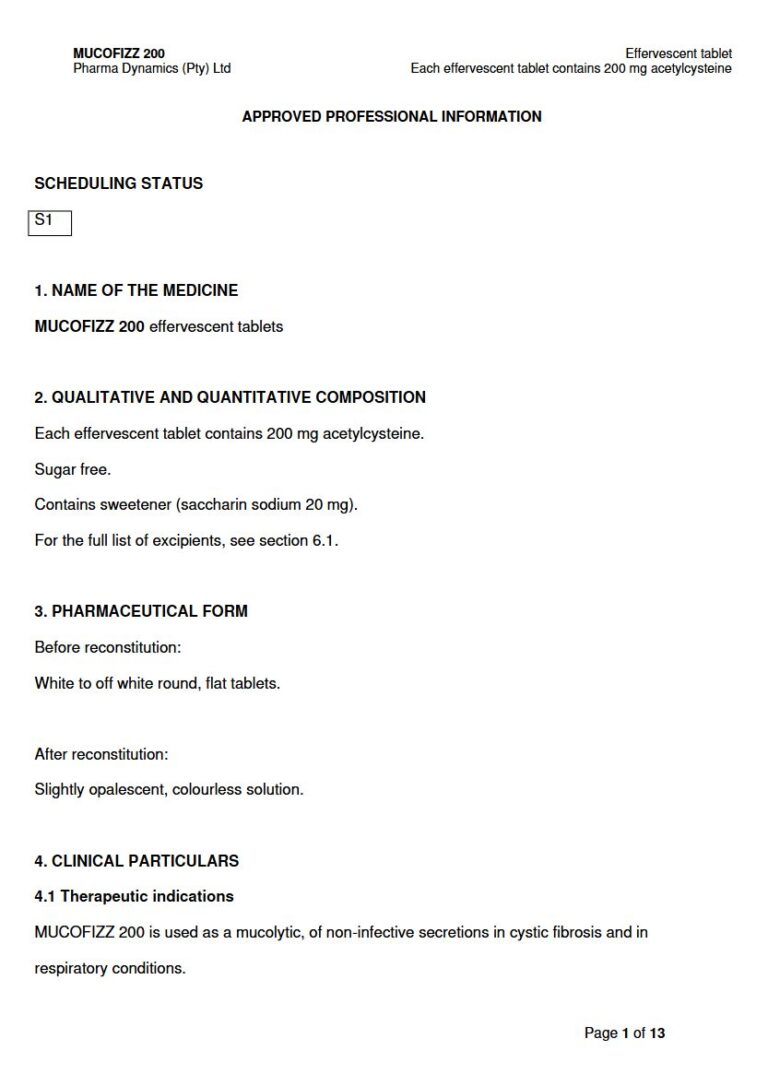
Clinical Particulars
Section 4 of the official insert — extracted exactly as issued, no alterations
4.1 Therapeutic indications
MUCOFIZZ 200 is used as a mucolytic, of non-infective secretions in cystic fibrosis and in respiratory conditions.
4.2 Posology and method of administration
Posology
Adults and adolescents from 14 years of age: One (1) effervescent tablet two to three times daily (equivalent to 400 to 600 mg N - acetylcysteine/day) for a maximum of 14 days.
Paediatric population
Children from 6 to 14 years of age: One (1) effervescent tablet twice daily (equivalent to 400 mg N -acetylcysteine/day) for a maximum of 14 days.
Children from 2 to 5 years of age: Half (u00bd) an effervescent tablet two to three times daily (equivalent to 200 to 300 mg N - acetylcysteine/day) for a maximum of 14 days.
Method of administration
Oral use. MUCOFIZZ 200 effervescent tablets should be dissolved in a glass of water before use. Do not use continuously for more than 14 days without consulting a medical practitioner.
4.3 Contraindications
MUCOFIZZ 200 is contraindicated in:
- Hypersensitivity to acetylcysteine or to any of the ingredients of MUCOFIZZ 200 (see section 6.1)
- Pregnancy and lactation (see section 4.6)
- Children under the age of 2 years
- Active peptic ulceration.
4.4 Special warnings and precautions for use
The occurrence of severe skin reactions such as Stevens-Johnson syndrome and Lyell's syndrome has very rarely been reported in temporal connection with the use of acetylcysteine, as contained in MUCOFIZZ 200. Should cutaneous and mucous membrane changes appear, medical advice should be sought immediately and the use of MUCOFIZZ 200 be discontinued (see also section 4.8).
MUCOFIZZ 200 should be used with caution in asthmatic patients and elderly patients with respiratory insufficiency. Patients with bronchial asthma should be closely monitored during therapy; if bronchospasm occurs, treatment with MUCOFIZZ 200 should be discontinued immediately and appropriate treatment must be instituted.
Administration of acetylcysteine, as in MUCOFIZZ 200, especially at the beginning of treatment, may liquefy bronchial secretions and, at the same time, increase their volume. If the patient is unable to cough this up sufficiently, to avoid retention of secretions postural drainage and tracheal suction should be used.
MUCOFIZZ 200 may disrupt the gastric mucosal barrier. It should therefore be used with caution in patients with a history of peptic ulceration especially if, in addition, other medicines are taken that irritate the mucous membranes of the gastrointestinal tract. Medicine-induced nausea and vomiting may occur and may increase the risk of gastrointestinal haemorrhage in patients predisposed to the condition.
The total clearance of acetylcysteine in patients with cirrhosis was found to be markedly impaired, and the elimination half-life almost twice that of healthy patients. Since some of the more serious adverse effects of acetylcysteine occur when plasma concentrations are high, increased vigilance for untoward anaphylactoid reactions and other adverse effects may be necessary in patients with cirrhosis taking MUCOFIZZ 200.
Caution should be exercised in patients with histamine intolerance. Long-term therapy of these patients should be avoided as acetylcysteine affects histamine metabolism and may lead to symptoms of intolerance (e.g. headache, runny nose, itching).
Acetylcysteine, as in MUCOFIZZ 200, can cause interference with the colorimetric assay method for the determination of salicylates as well as with tests for ketone bodies in urine.
Paediatric population
Children under 2 years of age MUCOFIZZ 200 must not be used in children under 2 years of age (see section 4.3).
4.5 Interaction with other medicines and other forms of interaction
Antitussive medicines and MUCOFIZZ 200 should not be administered concomitantly because reducing the cough reflex may lead to a build-up of bronchial secretions. An especially careful diagnosis is required for this combination treatment.
MUCOFIZZ 200 must be administered separately from tetracycline hydrochloride (with the exception of doxycycline, aminoglycosides and penicillins) and other oral antibiotics, with an interval of at least 2 hours as there is a degree of antibiotic inactivation when taken together.
Activated charcoal may reduce the effect of acetylcysteine as in MUCOFIZZ 200.
Concurrent administration of nitro-glycerine (glyceryl trinitrate) and MUCOFIZZ 200 causes significant hypotension and leads to temporal artery dilation with possible onset of headache. If concurrent administration of nitro-glycerine (glyceryl trinitrate) and MUCOFIZZ 200 is required, patients should be monitored for, and warned about, the onset of hypotension that can be severe and accompanied by a headache.
Simultaneous intake of acetylcysteine and carbamazepine can result in sub-therapeutic carbamazepine concentrations.
4.6 Fertility, pregnancy and lactation
Safety and efficacy during pregnancy and lactation have not been established.
Pregnancy
MUCOFIZZ 200 should not be used during pregnancy (see section 4.3).
Breastfeeding
It is not known whether acetylcysteine crosses into breastmilk. MUCOFIZZ 200 should not be taken when breastfeeding (see section 4.3).
Fertility
Fertility data are not available.
4.7 Effects on ability to drive and use machines
No studies on the effects on the ability to drive or use machines have been performed. MUCOFIZZ 200 has no or negligible influence on the ability to drive and use machines.
4.8 Undesirable effects
Summary of the safety profile
The most frequent side effects associated with oral use of MUCOFIZZ 200 affect the gastrointestinal tract. Hypersensitivity reactions, including anaphylactic shock, anaphylactic / anaphylactoid reactions, bronchospasm, angioedema, rash and itching were reported less frequently.
Tabulated list of adverse effects
System Organ Class Frequency Side effects
- Immune system disorders Less frequent Hypersensitivity reactions, anaphylactic/anaphylactoid reactions, anaphylactic shock angioedema
- Metabolism and nutrition disorders Frequency unknown Acidosis
- Nervous system disorders Less frequent Frequency unknown Headache, Syncope, convulsions
- Eye disorders Less frequent Blurred vision
- Ear and labyrinth disorders Less frequent Tinnitus
- Cardiac disorders Less frequent Frequency unknown Tachycardia, Cardiac arrest
- Vascular disorders Less frequent Frequency unknown Hypotension, haemorrhage, Hypertension, flushing, sweating
- Respiratory, thoracic and mediastinal disorders Less frequent Frequency unknown Dyspnoea, bronchospasm, rhinorrhoea, Respiratory arrest, haemoptysis
- Gastrointestinal disorders Less frequent Abdominal pain, diarrhoea, nausea, vomiting, stomatitis, heartburn
- Hepatobiliary disorders Frequency unknown Disturbances in liver function
- Skin and subcutaneous tissue disorders Less frequent Frequency unknown Urticaria, rash, pruritus, exanthema, Stevens-Johnson syndrome, toxic epidermal Necrolysis (TEN), Oedema of the face
- Musculoskeletal, connective tissue and bone disorders Frequency unknown Arthralgia
- General disorders and administrative site conditions Less frequent Chills, fever
a. Description of selected adverse reactions
The occurrence of serious skin reactions such as Stevens-Johnson syndrome and toxic epidermal necrolysis have been reported in temporal association with the use of acetylcysteine, as in MUCOFIZZ 200. In most of these cases reported at least one other medicine was administered at the same time, which may have possibly enhanced the described mucocutaneous effects. In case of recurrent skin and mucosal lesions, medical advice should be sought at once and the use of MUCOFIZZ 200 terminated immediately.
A decreased blood platelet aggregation in the presence of acetylcysteine, as in MUCOFIZZ 200, has been confirmed by various studies. The clinical relevance has not yet been clarified to date.
Reporting of suspected adverse reactions
Reporting suspected adverse reactions after authorisation of the medicine is important. It allows continued monitoring of the benefit/risk balance of the medicine. Healthcare professionals are requested to report any suspected adverse reactions to SAHPRA via the Med Safety APP (Medsafety X SAHPRA) and eReporting platform (who-umc.org) found on SAHPRA website. An email can be sent directly to the company, [email protected], to ensure safety of the product.
4.9 Overdose
Signs and symptoms: An acute overdose of MUCOFIZZ 200, can cause gastrointestinal symptoms such as nausea, vomiting and diarrhoea. Infants are at risk of hypersecretion.
Management of overdose: Treatment is symptomatic and supportive.
