
Calquence 100mg Capsule
Clinical Summary
Quick overview from the medicine insert
Indication
Treatment of mantle cell lymphoma (MCL) and chronic lymphocytic leukaemia (CLL).
Dosage (summary)
100 mg (1 tablet) twice daily for both MCL and CLL.
Special Populations
- Elderly (u2265 65 years)
- Renal impairment
- Hepatic impairment
Pregnancy & Breastfeeding
Not recommended during pregnancy; avoid breastfeeding during treatment and for 2 days after last dose.
Key Drug Interactions
- Strong CYP3A inhibitors
- Strong CYP3A inducers
Contraindications
- Hypersensitivity to acalabrutinib or excipients
Common side effects
- Infection
- Headache
- Diarrhoea
- Bruising
- Fatigue
Counselling Points
- Take at the same time each day
- Do not take extra doses for missed doses
- Monitor for signs of bleeding or infection
Serious warnings
- Serious haemorrhagic events
- Serious infections
- Cytopenias
- Atrial fibrillation
Important Disclaimer
The Calquence 100mg Capsule professional information leaflet below is the property of Astrazeneca Pharmaceuticals and is provided on Medinsert exactly as issued, with no.. alterations or editorial changes. We make every effort to keep content current by updating documents as soon as new versions become available. Medinsert serves as a trusted access point for healthcare professionals, but does not replace official sources or clinical judgement. For more details, please read our full disclaimer. read more>>
 Healthcare Professionals Only
This content is for registered healthcare professionals
Sign in or create a free account to read the full package insert.
Free for HPCSA-registered professionals. Powered by Medinsert.
Clinical Particulars
Section 4 of the official insert — extracted exactly as issued, no alterations
4.1 Therapeutic indications
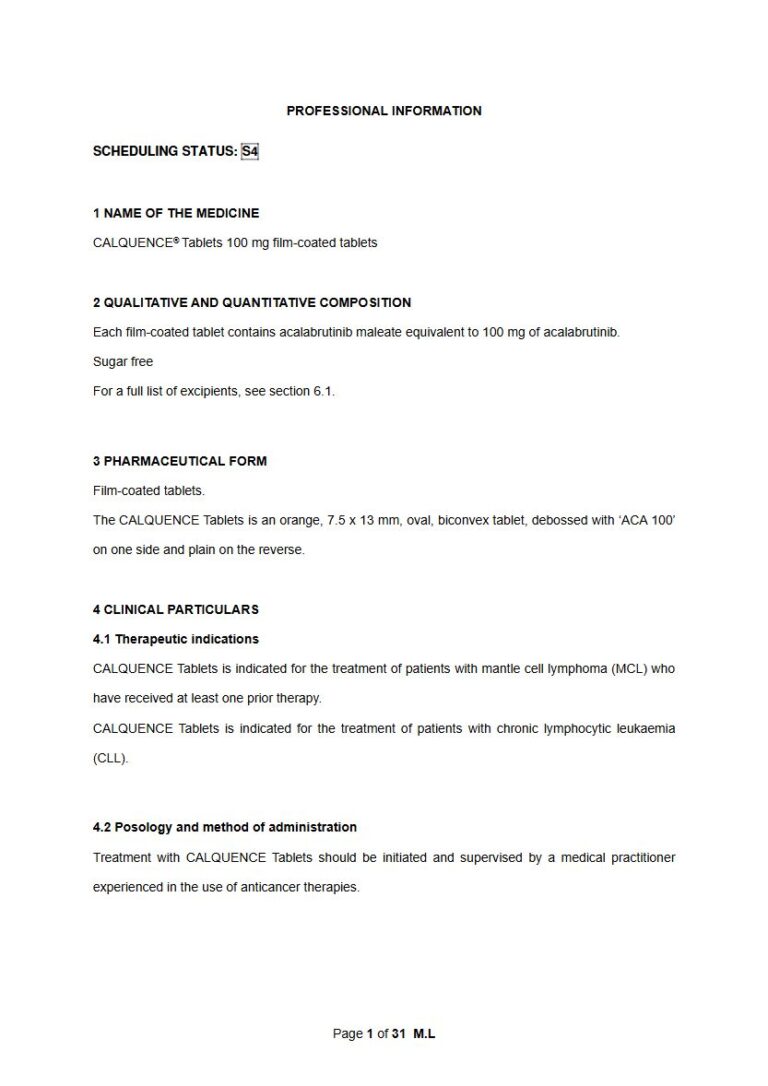
CALQUENCE Tablets is indicated for the treatment of patients with mantle cell lymphoma (MCL) who have received at least one prior therapy. CALQUENCE Tablets is indicated for the treatment of patients with chronic lymphocytic leukaemia (CLL).
4.2 Posology and method of administration
Treatment with CALQUENCE Tablets should be initiated and supervised by a medical practitioner experienced in the use of anticancer therapies.
Posology
MCL
The recommended dose of CALQUENCE Tablets for the treatment of MCL is 100 mg (1 tablet) twice daily.
CLL
The recommended dose of CALQUENCE Tablets for the treatment of CLL is 100 mg (1 tablet) twice daily, either as monotherapy or in combination with obinutuzumab. Refer to the obinutuzumab prescribing information for recommended obinutuzumab dosing information. (For details of the combination regimen, see section 5.1).
Doses should be separated by approximately 12 hours. Treatment with CALQUENCE Tablets should continue until disease progression or unacceptable toxicity.
Missed Dose
If a patient misses a dose of CALQUENCE Tablets by more than 3 hours, instruct the patient to take the next dose at its regularly scheduled time. Extra tablets of CALQUENCE Tablets should not be taken to make up for a missed dose.
Dose Adjustments
Recommended dose modifications of CALQUENCE Tablets for Grade u2265 3 adverse reactions are provided in Table 1. Temporarily interrupt CALQUENCE Tablets to manage a Grade u2265 3 non-haematological treatment-related adverse reaction, Grade 3 thrombocytopenia with significant bleeding, Grade 4 thrombocytopenia, or Grade 4 neutropenia lasting longer than 7 days. Upon resolution of the adverse reaction to Grade 1 or baseline (recovery), restart CALQUENCE Tablets as recommended in Table 1.
Method of Administration
CALQUENCE Tablets should be swallowed whole with water at approximately the same time each day. CALQUENCE Tablets can be taken with or without food. The tablet should not be chewed, crushed, dissolved, or divided.
4.3 Contraindications
Hypersensitivity to the active substance or to any of the excipients listed in section 6.1.
4.4 Special warnings and precautions for use
Haemorrhage
Serious haemorrhagic events, including fatal events, have occurred in patients with haematologic malignancies (n=1040) treated with CALQUENCE Tablets monotherapy. Major haemorrhage (Grade 3 or higher bleeding events, serious, or any central nervous system events) occurred in 3.6% of patients, with fatalities occurring in 0.1% of patients. Overall, bleeding events including bruising and petechiae of any grade occurred in 46% of patients with haematological malignancies. The mechanism for the bleeding events is not well understood. Patients receiving antithrombotic agents may be at increased risk of haemorrhage. Use caution with antithrombotic agents and consider additional monitoring for signs of bleeding when concomitant use is medically necessary. Consider the benefit-risk of withholding CALQUENCE Tablets for at least 3 days pre- and post- surgery.
Infections
Serious infections (bacterial, viral or fungal), including fatal events have occurred in patients with haematologic malignancies (n=1040) treated with CALQUENCE Tablets monotherapy. Grade 3 or higher infections occurred in 18% of these patients. The most frequently reported Grade 3 or higher infection was pneumonia. Infections due to hepatitis B virus (HBV) reactivation, aspergillosis, and progressive multifocal leukoencephalopathy (PML) have occurred. Consider prophylaxis in patients who are at increased risk for opportunistic infections. Monitor patients for signs and symptoms of infection and treat as medically appropriate.
Cytopenias
Treatment-emergent Grade 3 or 4 cytopenias, including neutropenia (21%), anaemia (10%) and thrombocytopenia (7%) based on laboratory measurements, occurred in patients with haematologic malignancies (n=1040) treated with CALQUENCE Tablets monotherapy. Monitor complete blood counts as medically appropriate.
Second Primary Malignancies
Second primary malignancies, including non-skin cancers, occurred in 12% of patients with haematologic malignancies (n=1040) treated with CALQUENCE Tablets monotherapy. The most frequent second primary malignancy was skin cancer, which occurred in 7% of patients. Monitor patients for the appearance of skin cancers.
Atrial Fibrillation
In patients with haematologic malignancies (n=1040) treated with CALQUENCE Tablets monotherapy, Grade 3 atrial fibrillation/flutter occurred in 1% of patients, and Grade 1 or 2 in 3% of patients. Monitor for symptoms (e.g., palpitations, dizziness, syncope, chest pain, dyspnoea) of atrial fibrillation and atrial flutter and obtain an ECG as appropriate.
4.5 Interaction with other medicinal products and other forms of interaction
Active substances that may increase CALQUENCE Tablets plasma concentrations
CYP3A Inhibitors
Co-administration with a strong CYP3A inhibitor (200 mg itraconazole once daily for 5 days) increased acalabrutinib Cmax and AUC by 3.7-fold and 5.1-fold in healthy subjects (N=17), respectively. When accounting for both acalabrutinib and its active metabolite, ACP-5862, physiologically based pharmacokinetic (PBPK) simulations with strong, moderate, and weak CYP3A inhibitors show no meaningful change in total AUC of active components. Consider alternative therapies that do not strongly inhibit CYP3A activity. Patients taking strong CYP3A inhibitors (e.g., ketoconazole, conivaptan, clarithromycin, indinavir, itraconazole, ritonavir, telaprevir, posaconazole, voriconazole) with CALQUENCE Tablets should be monitored more closely for adverse reactions.
Active substances that may decrease CALQUENCE Tablets plasma concentrations
CYP3A Inducers
Co-administration of a strong CYP3A inducer (600 mg rifampin once daily for 9 days) decreased acalabrutinib Cmax and AUC by 68% and 77% in healthy subjects (N=24), respectively. When accounting for both acalabrutinib and its active metabolite, ACP-5862, PBPK simulations with strong CYP3A inducers showed a 21-51% decrease in total AUC of active components. Simulations with a moderate CYP3A inducer (efavirenz) showed a 25% decrease in total AUC of active components.
Consider alternative therapies to strong inducers of CYP3A activity (e.g., phenytoin, rifampin, carbamazepine). Avoid St. Johnu2019s wort which may unpredictably decrease acalabrutinib plasma concentrations. If a strong CYP3A inducer cannot be avoided, increase the CALQUENCE Tablets dose to 200 mg twice daily.
Gastric Acid Reducing Medications
No clinically significant differences in acalabrutinib pharmacokinetics were observed when used concomitantly with rabeprazole, a proton pump inhibitor. Acalabrutinib tablets can be co-administered with gastric acid reducing agents (proton pump inhibitors, H2-receptor antagonists, antacids).
Active substances whose plasma concentrations may be altered by CALQUENCE Tablets
CYP3A Substrates
Based on in vitro data and PBPK modelling, no interaction with CYP substrates is expected at the clinically relevant concentrations (see section 5.2).
Effects of Acalabrutinib and its active metabolite, ACP-5862, on Drug Transport Systems
Acalabrutinib may increase exposure to co-administered BCRP substrates (e.g., methotrexate) by inhibition of intestinal BCRP (see section 5.2) ACP-5862 may increase exposure to co-administered MATE1 substrates (e.g., metformin) by inhibition of MATE1 (see section 5.2).
Effect of food on acalabrutinib
In healthy subjects, administration of a single 100 mg dose of acalabrutinib with a high fat, high calorie meal (approximately 918 calories, 59 grams carbohydrate, 59 grams fat, and 39 grams protein) did not affect the mean AUC as compared to dosing under fasted conditions. Resulting Cmax decreased by 54% and Tmax was delayed 1-2 hours.
4.6 Fertility, pregnancy and lactation
Pregnancy
CALQUENCE Tablets should not be used during pregnancy and women of childbearing potential should be advised to avoid becoming pregnant while receiving CALQUENCE Tablets. Administration of acalabrutinib to pregnant rabbits at exposures 4-times the human AUC at the recommended dose was associated with reduced foetal growth (see section 5.3). Dystocia was observed in a rat study involving dosing animals from implantation throughout gestation, parturition and lactation at exposures > 2.3-times the human AUC at the recommended dose (see section 5.3).
Breastfeeding
It is not known whether acalabrutinib is excreted in human milk. Acalabrutinib and its active metabolite were present in the milk of lactating rats. Breastfeeding mothers should not breastfeed during treatment with CALQUENCE Tablets and for 2 days after receiving the last dose.
Fertility
There are no data on the effect of CALQUENCE Tablets on human fertility. In a nonclinical study of acalabrutinib in male and female rats, no adverse effects on fertility parameters were observed (see section 5.3).
4.7 Effects on ability to drive and use machines
CALQUENCE Tablets has no or negligible influence on the ability to drive and use machines. However, during treatment with acalabrutinib fatigue and dizziness have been reported and patients who experience these symptoms should observe caution when driving or using machines.
4.8 Undesirable effects
Summary of safety profile
The overall safety profile of acalabrutinib is based on pooled data from 1040 patients with haematologic malignancies receiving acalabrutinib monotherapy. The most common (u2265 20%) adverse drug reactions (ADRs) of any grade reported in patients receiving acalabrutinib were infection, headache, diarrhoea, bruising, musculoskeletal pain, nausea, fatigue, and rash. The most commonly reported (u2265 5%) Grade u2265 3 adverse drug reactions were infection (17.6%), neutropenia (14.2%), and anaemia (7.8%).
Dose reductions due to adverse events were reported in 4.2% of patients. Discontinuation due to adverse events were reported in 9.3% of the patients. The median dose intensity was 98.7%.
Tabulated list of adverse reactions
The following adverse drug reactions (ADRs) have been identified in clinical studies with patients receiving CALQUENCE Tablets monotherapy as treatment for haematological malignancies. The median duration of acalabrutinib monotherapy treatment across the pooled dataset was 24.6 months. Adverse drug reactions are listed according to system organ class (SOC) in MedDRA. Within each system organ class, the adverse drug reactions are sorted by frequency, with the most frequent reactions first. In addition, the corresponding frequency category for each ADR is based on the CIOMS III convention and is defined as: very common (u22651/10); common (>1/100 to <1/10); uncommon (u22651/1,000 to <1/100); rare (u22651/10,000 to <1/1000); very rare (<1/10,000); not known (cannot be estimated from available data).
4.9 Overdose
There is no specific treatment for acalabrutinib overdose and symptoms of overdose have not been established. In the event of an overdose, patients must be closely monitored for signs or symptoms of adverse reactions and appropriate symptomatic treatment instituted.
