
Aciclovir 250 & 500 Viatris Injection
PDF Leaflet Revision Date: 04 November 2024
Clinical Summary
Quick overview from the medicine insert
Indication
Treatment and prophylaxis of Herpes simplex and Varicella zoster infections.
Dosage (summary)
Adults: 5-10 mg/kg every 8 hours; duration typically 5 days.
Special Populations
- Elderly
- Renal impairment
- Immunocompromised patients
Pregnancy & Breastfeeding
Safety in pregnancy and lactation not established.
Key Drug Interactions
- Probenecid
- Cimetidine
- Ciclosporin
- Tacrolimus
Contraindications
- Hypersensitivity to aciclovir or components
Common side effects
- Headaches
- Nausea
- Dizziness
- Fatigue
- Rashes
Counselling Points
- Monitor for skin reactions
- Maintain hydration
- May cause dizziness
Serious warnings
- Renal impairment caution
- DRESS risk
- Hydration required
Important Disclaimer
The Aciclovir 250 & 500 Viatris Injection professional information leaflet below is the property of Viatris South Africa and is provided on Medinsert exactly as issued, with no.. alterations or editorial changes. We make every effort to keep content current by updating documents as soon as new versions become available. Medinsert serves as a trusted access point for healthcare professionals, but does not replace official sources or clinical judgement. For more details, please read our full disclaimer. read more>>
 Healthcare Professionals Only
This content is for registered healthcare professionals
Sign in or create a free account to read the full package insert.
Free for HPCSA-registered professionals. Powered by Medinsert.
Clinical Particulars
Section 4 of the official insert — extracted exactly as issued, no alterations
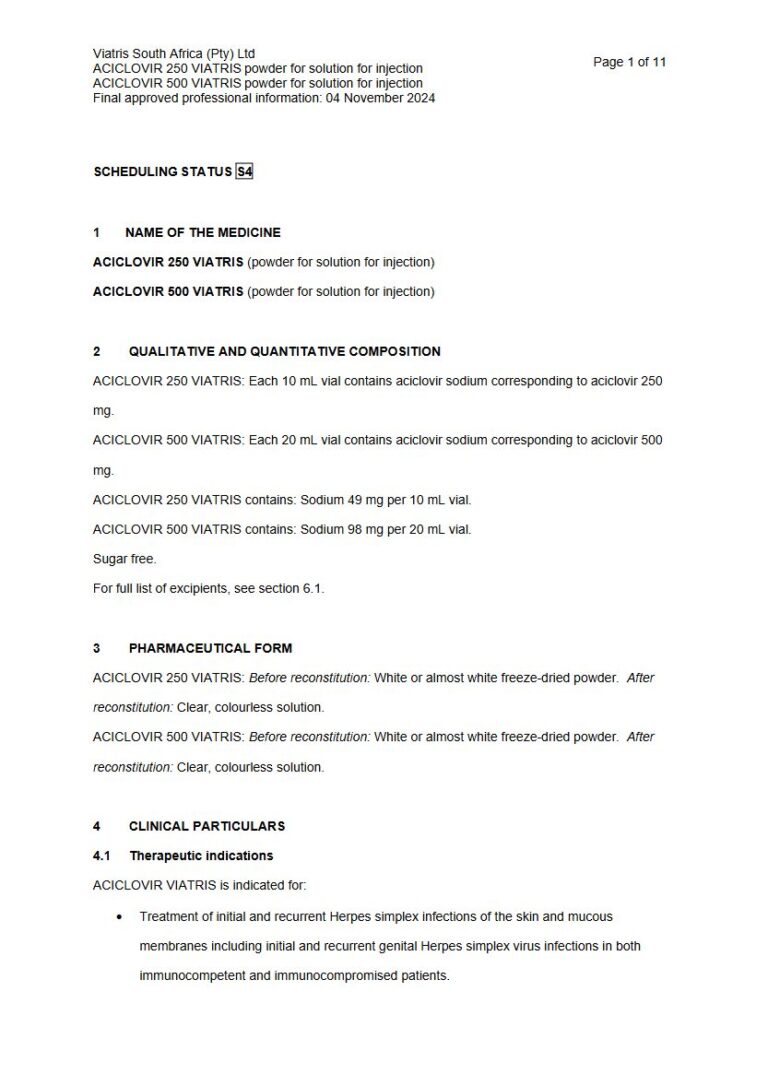
4.1 Therapeutic indications
ACICLOVIR VIATRIS is indicated for:
- Treatment of initial and recurrent Herpes simplex infections of the skin and mucous membranes including initial and recurrent genital Herpes simplex virus infections in both immunocompetent and immunocompromised patients.
- Suppression of recurrent genital Herpes simplex infections in immunocompetent patients.
- Prophylaxis of Herpes simplex infections in immunocompromised patients.
- Treatment of Herpes zoster (shingles) infections if the lesions are not older than 72 hours.
- Treatment of Varicella zoster (chickenpox) infection within 24 hours after appearance of the typical chickenpox lesions.
4.2 Posology and method of administration
Posology
Duration of treatment is normally 5 days. Refer to section 6.6 for reconstitution of preparations and handling of ACICLOVIR VIATRIS.
Special populations
Herpes simplex encephalitis & neonates herpes simplex infections: Usually 10 days' treatment, considering the patientu2019s condition and response.
Herpes simplex infection:
- Immunocompromised patients:
- Adults: 5 mg/kg - 8 hourly.
- Children: 250 mg/m2 - 8 hourly.
Varicella-zoster:
- Immunocompromised patients (normal renal function):
- Adults: 10 mg/kg - 8 hourly.
- Children: 500 mg/m2 - 8 hourly.
Herpes simplex encephalitis:
- Normal / immunocompromised patients (normal renal function):
- Adults: 10 mg/kg - 8 hourly.
- Children: 500 mg/m2 - 8 hourly.
Herpes simplex infections:
- Neonates: 10 mg/kg - 8 hourly.
Severely immunocompromised patients:
- Adults: Bone marrow recipients should receive intravenous (IV) aciclovir 3 times daily for one month prior to receiving oral therapy. Duration of therapy is 6 months and 12 months in patients with advanced HIV disease.
Elderly: Adequate hydration must be ensured in patients taking high doses of ACICLOVIR VIATRIS. Plasma concentrations of ACICLOVIR VIATRIS are higher in geriatric patients compared to younger patients, in part due to age-related changes in renal function. Dose reductions may be necessary in the elderly with impaired renal function.
Renal function impairment:
Treatment and prophylaxis of Herpes simplex infections: Mild to moderate impairment u2014 No dose adjustment necessary.
Method of administration
Administer by slow intravenous infusion over 1hr.
4.3 Contraindications
Hypersensitivity to ACICLOVIR VIATRIS, valaciclovir or to any components of the formulation (as listed in section 6.1).
4.4 Special warnings and precautions for use
- ACICLOVIR VIATRIS should be administered with caution with renal impairment and doses should be adjusted according to creatinine clearance. Severe renal impairment - A dose reduction is required in patients with a creatinine clearance of <10 mL/minute.
- Safety and efficacy in pregnancy have not been established (see section 4.6).
- ACICLOVIR VIATRIS must be given by slow intravenous infusion over a one-hour period (see section 4.2).
- Care should be taken to maintain adequate hydration in patients receiving high doses of ACICLOVIR VIATRIS. Renal impairment usually responds rapidly to rehydration of the patient and/or dosage reduction or withdrawal of ACICLOVIR VIATRIS.
- Use in Renal Impairment: Aciclovir as contained in ACICLOVIR VIATRIS is eliminated by renal clearance. In patients with impaired renal function the dosage must be adjusted in order to avoid accumulation of aciclovir as contained in ACICLOVIR VIATRIS in the body (see section 4.2). For patients who are treated with high doses of ACICLOVIR VIATRIS intravenous infusion, e.g. because of herpes encephalitis, special attention must be paid to the renal function, particularly in patients who are dehydrated or who have impaired renal function.
- Drug reaction with eosinophilia and systemic symptoms (DRESS): DRESS, which can be life-threatening or fatal, has been reported in association with aciclovir treatment. At the time of prescription patients should be advised of the signs and symptoms and monitored closely for skin reactions. If signs and symptoms suggestive of DRESS appear, aciclovir should be withdrawn immediately and an alternative treatment considered (as appropriate). If the patient has developed DRESS with the use of aciclovir, treatment with aciclovir must not be restarted in this patient at any time.
- Use in the Elderly: Elderly patients are likely to have reduced renal function and therefore the need for dose reduction must be considered in this group of patients (see section 4.2).
- Sodium warning: ACICLOVIR 250 VIATRIS contains 49 mg sodium per 10 mL, equivalent to 2,45 % of the WHO recommended maximum daily intake of 2 g sodium for an adult. ACICLOVIR 500 VIATRIS contains 98 mg sodium per 20 mL, equivalent to 4,9 % of the WHO recommended maximum daily intake of 2 g sodium for an adult. ACICLOVIR VIATRIS is sugar free.
4.5 Interaction with other medicines and other forms of Interaction
- Although no clinically significant interactions have been reported, any medicine which is excreted via renal tubular secretion may compete with this mechanism or affect renal physiology and may increase ACICLOVIR VIATRIS plasma concentration.
- Probenecid and cimetidine have been shown to decrease the renal excretion and to increase the area under the curve (AUC) of ACICLOVIR VIATRIS.
- Increases in plasma AUCs of ACICLOVIR VIATRIS and of the inactive metabolite of mycophenolate mofetil, have been shown when the medicines are co-administered.
- Monitor for changes in renal function when administering ACICLOVIR VIATRIS with medicines that affect other aspects of renal physiology (e.g. ciclosporin, tacrolimus) (see section 4.4).
- No significant increase in toxicity was noted when zidovudine was given together with ACICLOVIR VIATRIS.
4.6 Fertility, pregnancy and lactation
Pregnancy: Safety and efficacy in pregnancy have not been established.
Breastfeeding: Safety and efficacy in lactation have not been established.
4.7 Effects on ability to drive and use machines
As ACICLOVIR VIATRIS may cause dizziness, confusion and hallucinations, patients must be informed that it may affect their mental and/or physical abilities to perform or execute tasks or activities requiring mental alertness, judgment and/or sound coordination and vision.
4.8 Undesirable effects
Tabulated list of adverse reactions
Body System Undesirable effect Frequent Less frequent Frequency not known
Blood and the lymphatic system disorders: Anaemia, leukopenia, thrombocytopenia, neutropenia, hypotension.
Immune system disorders: Anaphylaxis.
Central nervous system disorders: Headaches, fatigue, reversible neurological reactions such as dizziness, confused states, hallucinations, tremors, psychosis, agitation, somnolence, convulsions, and coma (especially in patients with renal impairment in whom the dosage was more than that recommended).
Vascular disorders: Phlebitis.
Respiratory, thoracic and mediastinal disorders: Dyspnoea.
Gastrointestinal disorders: Nausea, vomiting, diarrhoea, abdominal pain.
Hepato-biliary disorders: Reversible increases in bilirubin and liver enzymes, hepatitis, jaundice.
Skin and subcutaneous tissue disorders: Diffuse hair loss, hypersensitivity reactions including rashes, photosensitivity, urticaria, pruritus, angioedema, fevers.
Drug reaction with eosinophilia and systemic symptoms (DRESS) (see section 4.4).
Renal and urinary disorders: Increases in blood urea and creatinine, acute renal failure.
Post-marketing side effects:
- Immune system disorders: anaphylaxis, angioedema.
- Psychiatric and nervous system disorders: headache, dizziness, agitation, confusion, tremor, ataxia, dysarthria, hallucinations, psychotic symptoms, convulsions, somnolence, encephalopathy, coma.
- Respiratory, thoracic and mediastinal disorders: dyspnoea.
- Gastrointestinal disorders: diarrhoea, abdominal pain.
- Hepatobiliary disorders: reversible increases in bilirubin, hepatitis, jaundice.
- Skin and subcutaneous tissue disorders: accelerated diffuse hair loss. The relationship of accelerated diffuse hair loss to ACICLOVIR VIATRIS therapy is uncertain.
- Renal and urinary disorders: renal impairment, acute renal failure, renal pain. Renal pain may be associated with renal failure and crystalluria.
- General disorders and administration site conditions: fatigue, fever, local inflammatory reactions. Severe local inflammatory reactions sometimes leading to ulceration have occurred when ACICLOVIR VIATRIS has been inadvertently infused into extravascular tissues.
4.9 Overdose
Symptoms:
- In overdose, side effects can be precipitated and/or be of increased severity (see section 4.8).
- Overdose of intravenous ACICLOVIR VIATRIS has resulted in elevations of serum creatinine, blood urea nitrogen and subsequent renal failure.
- Neurological effects including confusion, hallucinations, agitation, seizures, and coma have been described in association with overdose.
Treatment:
- Treatment is symptomatic and supportive.
- Haemodialysis, if required, significantly enhances the removal of ACICLOVIR VIATRIS from the blood.
