
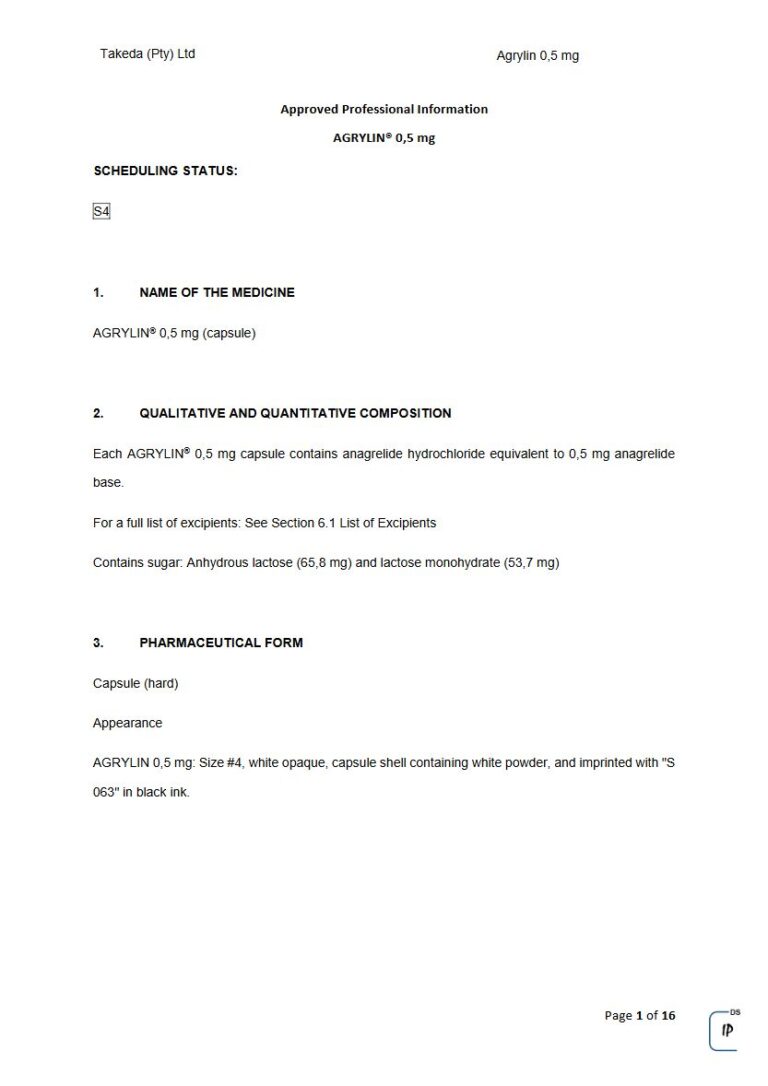
Agrylin 0,5 mg Capsule
PDF Leaflet Revision Date: 31 January 2025
Clinical Summary
Quick overview from the medicine insert
Indication
To reduce platelet count in essential thrombocythemia and other myeloproliferative disorders.
Dosage (summary)
0.5 mg four times daily or 1 mg twice daily for adults.
Onset of Action / Duration
Onset: 7-14 days, Duration: 4-12 weeks
Special Populations
- Elderly
- Hepatic impairment
- Renal impairment
Pregnancy & Breastfeeding
Not recommended in pregnancy; potential fetal harm. Discontinue breastfeeding during treatment.
Key Drug Interactions
- Aspirin
- CYP1A2 inhibitors
- Digoxin
- Warfarin
Contraindications
- Severe hepatic impairment
- Hypersensitivity
Common side effects
- Headache
- Palpitations
- Nausea
- Oedema
- Diarrhoea
Counselling Points
- Monitor platelet counts regularly
- Avoid abrupt discontinuation
- Report signs of thrombotic complications
Serious warnings
- Cardiovascular risks
- Thrombotic risk
- QT interval prolongation
Important Disclaimer
The Agrylin 0,5 mg Capsule professional information leaflet below is the property of Takeda and is provided on Medinsert exactly as issued, with no.. alterations or editorial changes. We make every effort to keep content current by updating documents as soon as new versions become available. Medinsert serves as a trusted access point for healthcare professionals, but does not replace official sources or clinical judgement. For more details, please read our full disclaimer. read more>>
 Healthcare Professionals Only
This content is for registered healthcare professionals
Sign in or create a free account to read the full package insert.
Free for HPCSA-registered professionals. Powered by Medinsert.
Clinical Particulars
Section 4 of the official insert — extracted exactly as issued, no alterations
4.1 Therapeutic Indications
To reduce the platelet count in patients with essential thrombocythemia, polycythemia vera and other myeloproliferative disorders.
4.2 Posology and method of administration
Treatment with AGRYLIN capsules should be initiated under close medical supervision.
Posology
The recommended starting dosage of AGRYLIN for adult patients is 0,5 mg four times daily or 1 mg twice daily (2 capsules of 0,5 mg twice a day), WHICH SHOULD BE MAINTAINED FOR AT LEAST ONE WEEK.
Special Populations
Elderly patients
There are no special requirements for dosing the geriatric population.
Patients with hepatic impairment
It is recommended that patients with moderate hepatic impairment start anagrelide therapy at a dose of 0,5 mg/day and be maintained for a minimum of one week with careful monitoring of cardiovascular effects. The dosage increment must not exceed more than 0,5 mg/day in any one-week. The potential risks and benefits of anagrelide therapy in a patient with mild or moderate impairment of hepatic function should be assessed before treatment is commenced. Use of anagrelide in patients with severe hepatic impairment has not been studied. Use of anagrelide in patients with severe hepatic impairment is contraindicated (see 4.3 Contraindications).
Paediatric patients
Starting doses in paediatric patients have ranged from 0,5 mg per day to 0,5 mg four times daily (qid). As there are limited data on the appropriate starting dose for paediatric patients, an initial dose of 0,5 mg per day is recommended. In both adult and paediatric patients, dosage should then be adjusted to the lowest effective dosage required to reduce and maintain platelet count below 600 000 /uL, and ideally to the normal range. The dosage should be increased by not more than 0,5 mg/day in any one week. Maintenance dosing is not expected to be different between adult and paediatric patients. Dosage should not exceed 10 mg/day or 2,5 mg in a single dose (see section 4.4). To monitor the effect of AGRYLIN and prevent the occurrence of thrombocytopenia, platelet counts should be performed every two days during the first week of treatment and at least weekly thereafter until the maintenance dosage is reached. Typically, platelet count begins to respond within 7 to 14 days at the proper dosage. The time to complete response, defined as platelet count u2264 600 000 /u03bcL, ranged from 4 to 12 weeks. Most patients will experience an adequate response at a dose of 1,5 to 3,0 mg/day. Patients with known or suspected heart disease, renal insufficiency or hepatic dysfunction should be monitored closely.
Method of Administration
For oral use. The capsules must be swallowed whole. Do not crush or dilute the contents in a liquid.
4.3 Contraindications
- Hypersensitivity to the active substance or any of the excipients.
- AGRYLIN is contraindicated in patients with severe hepatic impairment. Exposure to AGRYLIN is increased 8-fold in patients with moderate hepatic impairment (see section 5.2). Use of AGRYLIN in patients with severe hepatic impairment has not been studied (see section 4.4).
4.4 Special warnings and precautions for use
Cardiovascular: AGRYLIN should be used with caution in patients with known or suspected heart disease, and only if the potential benefits of therapy outweigh the potential risks. Moreover, serious cardiovascular adverse events have also occurred in patients without suspected heart disease and with normal pre-treatment cardiovascular examinations. Because of the positive inotropic effects and side-effects of AGRYLIN, a pre-treatment cardiovascular examination is recommended along with careful monitoring during treatment. In humans, therapeutic doses of AGRYLIN may cause cardiovascular effects, including vasodilatation, torsade de pointes, tachycardia, palpitations, cardiomyopathy, cardiomegaly, cardiac arrhythmias and congestive heart failure. Caution should be taken when using anagrelide in patients with known risk factors for prolongation of the QT interval, such as congenital long QT syndrome, a known history of acquired QTc prolongation, medicinal products that can prolong QTc interval and hypokalaemia. Care should also be taken in populations that may have a higher maximum plasma concentration (Cmax) of anagrelide or its active metabolite, 3-hydroxy anagrelide, e.g., hepatic impairment or use with CYP1A2 inhibitors (see section 4.5). Close monitoring for an effect on the QTc interval is advisable.
Thrombotic Risk: Abrupt treatment discontinuation should be avoided due to the risk of sudden increase in platelet counts, which may lead to potentially fatal thrombotic complications, such as cerebral infarction. Patients should be advised how to recognize early signs and symptoms suggestive of thrombotic complications, such as cerebral infarction, and if symptoms occur to seek medical assistance.
Renal: It is recommended that patients with renal insufficiency (creatine > 0,002 g/1 dl) receive AGRYLIN when in the medical doctoru2019s judgment, the potential benefits of therapy outweigh the potential risks. These patients should be monitored closely for signs of renal toxicity while receiving AGRYLIN.
Hepatic: Exposure to AGRYLIN is increased 8-fold in patients with moderate hepatic impairment (see section 5.2). Use of AGRYLIN in patients with severe hepatic impairment has not been studied. The potential risks and benefits of AGRYLIN therapy in a patient with mild and moderate impairment of hepatic function should be assessed before treatment is commenced. In patients with moderate hepatic impairment, dose reduction is required and patients should be carefully monitored for cardiovascular effects (see section 4.2).
Treatment discontinuation: In the event of dosage interruption or treatment withdrawal, the rebound in platelet count is variable, but the platelet count will start to increase within 4 days of stopping treatment with anagrelide and will return to pre-treatment levels within 10 to 14 days, possibly rebounding above baseline values. Therefore, platelets should be monitored frequently (see section 4.2).
Precautions: Laboratory tests: AGRYLIN therapy requires close clinical supervision of the patient. While the platelet count is being lowered (usually during the first two weeks of treatment), blood counts (haemoglobin, white blood cells), and renal function (serum creatinine, BUN) should be monitored. Cases of clinically significant hepatotoxicity (including symptomatic ALT and AST elevations and elevations greater than three times the ULN) have been reported in post-marketing surveillance. Measure liver function tests (ALT, AST) before initiating anagrelide treatment and during therapy. In 9 subjects receiving a single 5 mg dose of AGRYLIN standing blood pressure fell an average of 22/15 mmHg, usually accompanied by dizziness. Only minimal changes in blood pressure were observed following a dose of 2 mg.
Excipients: AGRYLIN contains lactose. Patients with rare hereditary problems of galactose intolerance, the Lapp lactase deficiency or glucose-galactose malabsorption should not take this medicine.
4.5 Interaction with other medicines and other forms of interaction
Limited PK and/or PD studies investigating possible interactions between AGRYLIN and other medicines have been conducted. In vivo interaction studies in humans have demonstrated that digoxin and warfarin do not affect the PK properties of AGRYLIN, nor does AGRYLIN affect the PK properties of digoxin or warfarin. In two clinical interaction studies in healthy subjects, co-administration of single-dose AGRYLIN 1 mg and aspirin 900 mg or repeat-dose AGRYLIN 1 mg once daily and aspirin 75 mg once daily showed greater ex vivo anti-platelet aggregation effects than administration of aspirin alone. Co-administered AGRYLIN 1mg and aspirin 900 mg single-doses had no effect on bleeding time, prothrombin time (PT) or activated partial thromboplastin time (aPTT). In some ET patients concomitantly treated by AGRYLIN and aspirin, major haemorrhages occurred. Therefore, the potential risks and benefits of concomitant use of anagrelide with aspirin should be assessed, particularly in patients with a high risk profile for haemorrhage, before treatment is commenced. Medicine interaction studies have not been conducted with the other common medications used concomitantly with anagrelide in clinical trials which were paracetamol, furosemide, iron, ranitidine, hydroxyurea, and allopurinol. AGRYLIN is metabolized at least in part by CYP1A2. It is known that CYP1A2 is inhibited by several medicinal products, including fluvoxamine, and such medicinal products could theoretically adversely influence the clearance of AGRYLIN. AGRYLIN demonstrates some limited inhibitory activity towards CYP1A2 which may present a theoretical potential for interaction with other co-administered medicines sharing that clearance mechanism e.g. theophylline. AGRYLIN is an inhibitor of cyclic AMP PDE III. The effects of medicines with similar properties such as inotropes milrinone, enoximone, amrinone, olprinone and cilostazol may be exacerbated by anagrelide. There is a single case report which suggests that sucralfate may interfere with AGRYLIN absorption. Food has no clinically significant effect on the bioavailability of AGRYLIN.
4.6 Fertility, Pregnancy and Lactation
There are no adequate and well controlled studies in pregnant and breastfeeding women. Studies in animals have shown reproductive toxicity. The potential risk for humans is unknown.
Pregnancy: AGRYLIN use is not recommended in women who are or may become pregnant. Women of childbearing age should use adequate contraceptive methods to prevent pregnancy. AGRYLIN may cause foetal harm when administered to a pregnant woman.
Breastfeeding: It is not known whether AGRYLIN is excreted in milk. Since many medicines are excreted in human milk and because of the potential for adverse reactions in breast-feeding infants, mothers should discontinue breast-feeding when taking AGRYLIN.
Fertility: No human data on the effect of anagrelide on fertility are available. In male rats, there was no effect on fertility or reproductive performance with anagrelide. In female rats, using doses in excess of the therapeutic range, anagrelide disrupted implantation.
4.7 Effects on ability to drive or use machines
Dizziness has been reported as an adverse effect from taking AGRYLIN. This may impair the patientu2019s ability to drive or use machinery.
4.8 Undesirable Effects
The safety of AGRYLIN has been examined in 4 open label clinical studies. In three of the studies 942 patients who received anagrelide at a mean dose of approximately 2 mg/day were assessed for safety. In these studies 22 patients received anagrelide for up to four years. In the later study 3660 patients who received AGRYLIN at a mean dose of approximately 2 mg/day were assessed for safety. In this study 34 patients received anagrelide for up to five years. The most frequently reported adverse reactions to AGRYLIN are headaches (14 %), palpitations (9 %), nausea and oedema (6 %) and diarrhoea (5 %). These adverse drug reactions are expected based on the pharmacology of anagrelide (inhibition of PDE III). Gradual dose titration may help diminish the side-effects.
Tabulated list of adverse reactions: Adverse reactions arising from clinical studies, post-authorisation safety studies and spontaneous reports are presented in the table below. Within the system organ classes they are listed under the following headings: Very common (u22651/10); Common (u22651/100 to <1/10); Uncommon (u22651/1,000 to <1/100); Rare (u22651/10,000 to <1/1,000); Very rare (<1/10,000), not known (cannot be estimated from the available data). Within each frequency grouping, adverse reactions are presented in order of decreasing seriousness.
MedDRA System Organ Class Frequency of adverse reactions
Very common Common Uncommon Rare Not known
Blood and lymphatic system disorders
Anaemia Pancytopenia Thrombocytopenia Haemorrhage Ecchymosis
Metabolism and nutrition disorders
Fluid retention Oedema Weight loss Weight gain
Nervous system disorders
Headache Dizziness Depression Amnesia Confusion Insomnia Paraesthesia Hypoaesthesia Migraine Dysarthria Somnolence Abnormal coordination Cerebral infarction*
Nervousness Dry mouth Eye disorders
Diplopia Vision abnormal
Ear and labyrinth disorders
Tinnitus
Cardiac disorders
Tachycardia Palpitations Ventricular tachycardia Congestive heart failure Atrial fibrillation Supraventricular tachycardia Arrhythmia Hypertension Syncope Myocardial infarction Cardiomyopathy Cardiomegaly Pericardial effusion Angina pectoris Postural hypotension Vasodilatation Prinzmetal angina Torsade de pointes
Respiratory, thoracic and mediastinal disorders
Pulmonary hypertension Pneumonia Pleural effusion Dyspnoea Epistaxis Pulmonary infiltrates Interstitial lung disease including pneumonitis and allergic alveolitis
Gastrointestinal disorders
Diarrhoea Vomiting Abdominal pain Nausea Flatulence Gastrointestinal haemorrhage Pancreatitis Anorexia Dyspepsia Constipation Gastrointestinal disorder Colitis Gastritis Gingival bleeding
Hepatobiliary disorders
Hepatic enzymes increased Hepatitis
Skin and subcutaneous tissue disorders
Rash Alopecia Pruritus Dry skin
Skin discoloration
Musculoskeletal and connective tissue disorders
Arthralgia Myalgia Back pain
Renal and urinary disorders
Impotence Renal failure Nocturia Tubulointerstitial nephritis
General disorders and administration site conditions
Fatigue Chest pain Fever Chills Malaise Weakness Flu-like syndrome Pain Asthenia
Investigations
Blood creatinine increased
* Cerebral infarction (see section 4.4 Thrombotic Risk)
Reporting of suspected adverse reactions
Reporting suspected adverse reactions after authorisation of the medicine is important. It allows continued monitoring of the benefit/risk balance of the medicine. Health care providers are asked to report any suspected adverse reactions to SAHPRA via the Med Safety APP (Medsafety X SAHPRA) and eReporting platform (who-umc.org) found on SAHPRA website.
4.9 Overdosage
There have been post marketing case reports of intentional overdose with anagrelide hydrochloride. Reported symptoms include sinus tachycardia and vomiting. Symptoms resolved with conservative management. Platelet reduction from anagrelide therapy is dose-related; therefore thrombocytopenia, which can potentially cause bleeding, is expected from overdosage. Should overdosage occur, cardiac and central nervous system toxicity can also be expected.
Treatment: In case of overdosage, close clinical supervision of the patient is required; this especially includes monitoring of the platelet count for thrombocytopenia. Dosage should be decreased or stopped, as appropriate, until the platelet count returns to within the normal range. There is no antidote for anagrelide (see section 4.4).
