
Tractocile 7.5 mg/1 ml Solution
PDF Leaflet Revision Date: 25 September 2022
Clinical Summary
Quick overview from the medicine insert
Indication
To delay imminent pre-term birth in pregnant women.
Dosage (summary)
Initial bolus: 6.75 mg IV, followed by loading infusion: 300 u00b5g/min for 3 hours, then 100 u00b5g/min for up to 45 hours.
Onset of Action / Duration
Onset: 10 mins, Duration: up to 48 hours
Special Populations
- Renal impairment
- Hepatic impairment
Pregnancy & Breastfeeding
Use only between 26-33 weeks gestation; discontinue breastfeeding during treatment.
Key Drug Interactions
- Labetalol
- Betamethasone
Contraindications
- Gestational age <26 or >33 weeks
- Premature rupture of membranes >30 weeks
- Antepartum uterine hemorrhage
- Intrauterine growth restriction
- Eclampsia
- Intrauterine fetal death
- Known hypersensitivity
Common side effects
- Nausea
- Headache
- Dizziness
- Tachycardia
- Hypotension
Counselling Points
- Start treatment as soon as pre-term labor is diagnosed.
- Monitor for signs of adverse effects.
- Avoid driving if experiencing dizziness.
Serious warnings
- Risk of chorioamnionitis with premature rupture of membranes
- Use with caution in hepatic impairment
- Monitor uterine contractions and fetal heart rate
Important Disclaimer
The Tractocile 7.5 mg/1 ml Solution professional information leaflet below is the property of Ferring and is provided on Medinsert exactly as issued, with no.. alterations or editorial changes. We make every effort to keep content current by updating documents as soon as new versions become available. Medinsert serves as a trusted access point for healthcare professionals, but does not replace official sources or clinical judgement. For more details, please read our full disclaimer. read more>>
 Healthcare Professionals Only
This content is for registered healthcare professionals
Sign in or create a free account to read the full package insert.
Free for HPCSA-registered professionals. Powered by Medinsert.
Clinical Particulars
Section 4 of the official insert — extracted exactly as issued, no alterations
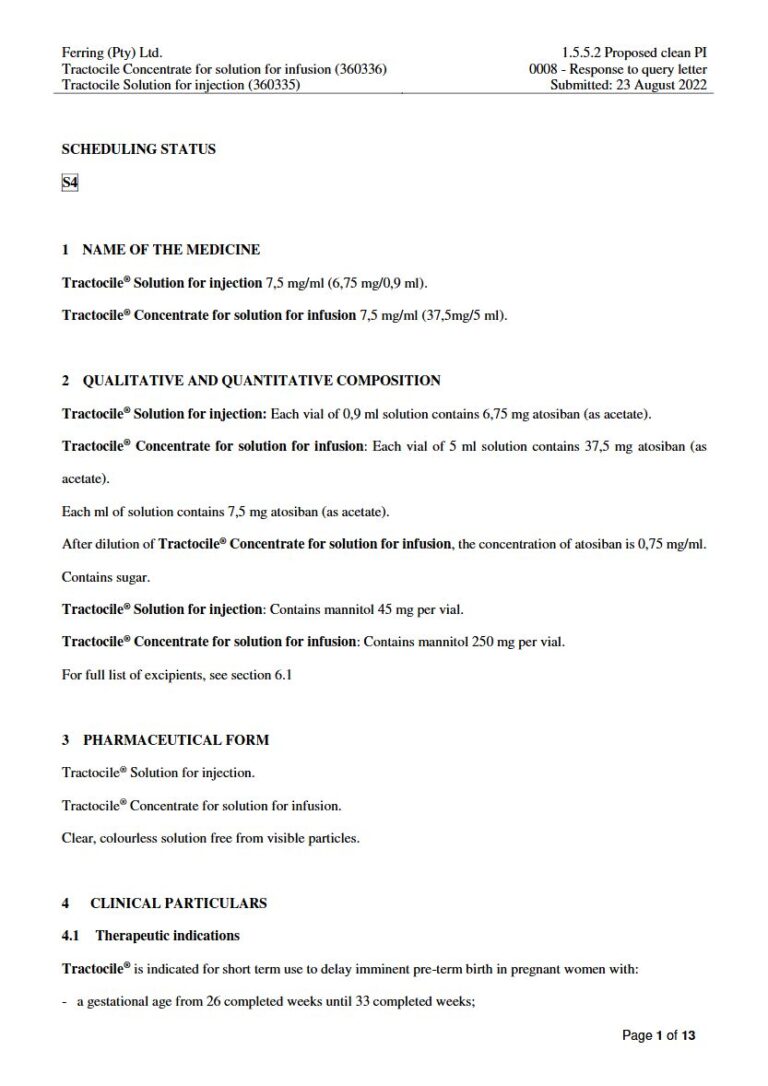
4.1 Therapeutic indications
Tractocile u00ae is indicated for short term use to delay imminent pre-term birth in pregnant women with:
- a gestational age from 26 completed weeks until 33 completed weeks;
- regular uterine contractions of at least 30 seconds duration at a rate of u2265 4 per 30 minutes;
- a cervical dilation of 1 to 3 cm (0-3 for nulliparas) and effacement of u2265 50 %;
- a foetus without signs of foetal distress.
4.2 Posology and method of administration
Posology
Treatment with Tractocile u00ae should be initiated and maintained by a medical practitioner experienced in the treatment of pre-term labour. Tractocile u00ae is administered intravenously in three successive stages: an initial bolus dose (6,75 mg), performed with Tractocile u00ae Solution for injection 6,75 mg/0,9 ml, immediately followed by a continuous high dose infusion (loading infusion 300 u03bcg/min) of Tractocile u00ae Concentrate for solution for infusion 37,5 mg/5 ml mg/ml during three hours, followed by a lower dose of Tractocile u00ae Concentrate for solution for infusion 37,5 mg/5 ml (subsequent infusion 100 u03bcg/min) up to 45 hours. The duration of the treatment should not exceed 48 hours. The total dose given during a full course of Tractocile u00ae therapy should preferably not exceed 330 mg of the active substance.
Intravenous therapy using the initial bolus injection of Tractocile u00ae Solution for injection 6,75 mg/0,9 ml should be started as soon as possible after diagnosis of pre-term labour. Once the bolus has been injected, proceed with the infusion. In the case of persistence of uterine contractions during treatment with Tractocile u00ae, alternative therapy should be considered. There is no data available regarding the need for dose adjustments in patients with renal or liver insufficiency.
The following table shows the full posology of the bolus injection followed by the infusion:
| Step | Regimen | Injection/infusion rate | Atosiban dose |
|---|---|---|---|
| 1 | 0,9 ml intravenous bolus | over 1 minute | 6,75 mg |
| 2 | 3 hours intravenous loading infusion | 24 ml/hour | 18 mg/hour |
| 3 | subsequent intravenous infusion | 8 ml/hour | 6 mg/hour |
Re-treatment
In case a re-treatment with Tractocile u00ae is needed, it should also commence with a bolus injection of Tractocile u00ae Solution for injection 6,75 mg/0,9 ml followed by infusion with Tractocile u00ae Concentrate for solution for infusion 37,5 mg/5 ml.
Special populations
Patients with renal or hepatic impairment
There is no experience with Tractocile u00ae treatment in patients with impaired function of the liver or kidneys. Renal impairment is not likely to warrant a dose adjustment, since only a small extent of atosiban is excreted in the urine. In patients with impaired hepatic function, Tractocile u00ae should be used with caution (see section 4.4 and 5.2).
Paediatric population
The safety and efficacy of Tractocile u00ae in pregnant women aged less than 18 years have not been established. No data are available.
Method of administration
For instructions on preparation of the medicine before administration, see section 6.6.
4.3 Contraindications
Tractocile u00ae should not be used in the following conditions:
- Gestational age below 26 completed weeks or over 33 completed weeks, as there was increased foetal mortality
- Premature rupture of the membranes > 30 weeks of gestation
- Antepartum uterine haemorrhage requiring immediate delivery
- Intrauterine growth restriction and abnormal foetal heart rate
- Eclampsia and severe pre-eclampsia
- Intrauterine foetal death
- Suspected intrauterine infection
- Placenta praevia
- Abruptio placenta
- Any other conditions of the mother or foetus, in which continuation of pregnancy is hazardous
- Known hypersensitivity to the active substance or any of the excipients.
4.4 Special warnings and precautions for use
When Tractocile u00ae is used in patients in whom premature rupture of membranes cannot be excluded, the benefit of delaying delivery should be balanced against the potential risk of chorioamnionitis. There is no experience with Tractocile u00ae treatment in patients with impaired function of the liver or kidneys. Renal impairment is not likely to warrant a dose adjustment, since only a small extent of atosiban is excreted in the urine. In patients with impaired hepatic function, atosiban should be used with caution (see sections 4.2 and 5.2).
Tractocile u00ae has not been used in patients with an abnormal placental site. There is only limited clinical experience in the use of Tractocile u00ae in multiple pregnancies because of the small number of patients treated. The benefit of Tractocile u00ae in this subgroup is therefore uncertain.
Re-treatment with Tractocile u00ae is possible, but there is only limited clinical experience available with multiple re-treatments, up to 3 re-treatments (see section 4.2 Posology and method of administration).
In case of intrauterine growth retardation, the decision to continue or reinitiate the administration of Tractocile u00ae depends on the assessment of foetal maturity.
During administration of Tractocile u00ae it is advisable to monitor uterine contractions and foetal heart rate. As an antagonist of oxytocin, atosiban may theoretically facilitate uterine relaxation and postpartum bleeding, therefore, blood loss after delivery should be monitored. However, inadequate uterus contraction postpartum was not observed during the clinical trials.
Tractocile u00ae should only be used when pre-term labour has been diagnosed between 26 and 33 completed weeks of gestation. Multiple pregnancy and medicine with tocolytic activity like calcium channel blockers and beta-mimetics are known to be associated with increased risk of pulmonary oedema. Therefore, Tractocile u00ae should be used with caution in case of multiple pregnancy and/or concomitant administration of other medicine with tocolytic activity (see section 4.8).
4.5 Interaction with other medicines and other forms of interaction
It is unlikely that atosiban is involved in cytochrome P450 mediated medicine interactions as in vitro investigations have shown that atosiban is not a substrate for the cytochrome P450 system, and does not inhibit the cytochrome P450 enzymes involved in the metabolism of medicines. Interaction studies have been performed with labetalol and betamethasone in healthy, female volunteers. No clinically relevant interaction was found between atosiban and betamethasone or labetalol.
4.6 Fertility, pregnancy and lactation
Pregnancy
Tractocile u00ae should only be used when pre-term labour has been diagnosed between 26 and 33 completed weeks of gestation.
Breastfeeding
If during pregnancy the woman is already breastfeeding an earlier child, then breastfeeding should be discontinued during treatment with Tractocile u00ae, since the release of oxytocin during breastfeeding may augment uterine contractility, and may counteract the effect of tocolytic therapy. In atosiban clinical trials no effects were observed on breastfeeding. Small amounts of atosiban have been shown to pass from plasma into the breast milk of breastfeeding women.
Fertility
Embryo-foetal toxicity studies have not shown toxic effects of atosiban. No studies were performed that covered fertility and early embryonic development.
4.7 Effects on ability to drive and use machines
Atosiban may cause dizziness. Patients experiencing dizziness should not drive or use machines.
4.8 Undesirable effects
Undesirable effects for the mother during the use of Tractocile u00ae in clinical trials were reported. The observed undesirable effects were generally of a mild severity. A total of 48 % of the patients treated with Tractocile u00ae experienced undesirable effects. The most commonly reported adverse reaction in the mother is nausea (14 %). For the newborn, the clinical trials did not reveal any specific undesirable effects of atosiban. The infant adverse events were in the range of normal variation and were comparable with both placebo and beta-mimetic group incidences.
The frequency of adverse reactions listed below is defined using the following convention: Very common (u22651/10); Common (u22651/100 to <1/10); Uncommon (u22651/1,000 to <1/100); Rare (u22651/10,000 to <1/1,000). Within each frequency grouping, adverse reactions are presented in order of decreasing seriousness.
Immune system disorders
- Rare: Allergic reaction
Metabolism and nutrition disorders
- Common: Hyperglycaemia
Psychiatric disorders
- Uncommon: Insomnia
Nervous system disorders
- Common: Headache, dizziness
Cardiac disorders
- Common: Tachycardia
Vascular disorders
- Common: Hypotension, hot flush
Gastrointestinal disorders
- Very common: Nausea
- Common: Vomiting
Skin and subcutaneous tissue disorders
- Uncommon: Pruritis, rash
Reproductive system and breast disorders
- Rare: Uterine haemorrhage, uterine atony
General disorders and administration site conditions
- Common: Injection site reaction
- Uncommon: Pyrexia
Post-marketing experience
Respiratory events like dyspnoea and pulmonary oedema, particularly in association with concomitant administration of other medicinal products with tocolytic activity, like calcium antagonists and beta-mimetics, and/or in women with multiple pregnancy, have been reported during post-marketing.
Reporting of suspected adverse reactions
Reporting suspected adverse reactions after authorisation of Tractocile u00ae is important. It allows continued monitoring of the benefit/risk balance of the medicine. Healthcare providers are asked to report any suspected adverse reactions to SAHPRA via the u201c6.04 Adverse Drug Reactions Reporting Formu201d, found online under SAHPRAu2019s publications: https://www.sahpra.org.za/Publications/Index/8
4.9 Overdose
See section 4.8 Undesirable effects. There is no known specific treatment in case of an overdose. Treatment is symptomatic and supportive.
