
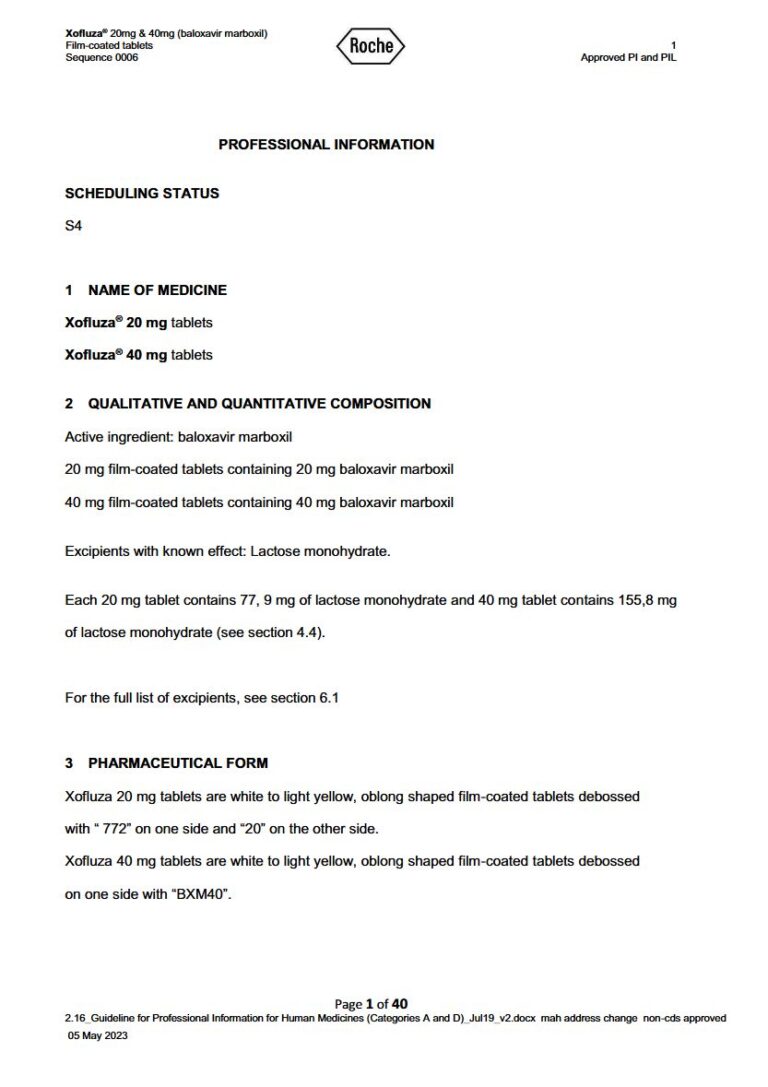
Xofluza 20mg & 40mg Film-coated tablets
PDF Leaflet Revision Date: 05 May 2023
Clinical Summary
Quick overview from the medicine insert
Indication
Treatment and post-exposure prophylaxis of influenza in patients aged 12 and above.
Dosage (summary)
Single dose: 40 mg for 40-<80 kg; 80 mg for u226580 kg. No adjustments for elderly or renal impairment.
Onset of Action / Duration
Onset: within 48 hours of symptom onset.
Special Populations
- Elderly
- Renal impairment
- Hepatic impairment
Pregnancy & Breastfeeding
Avoid in pregnancy; safety during lactation not established.
Key Drug Interactions
- Avoid with polyvalent cation products
- Itraconazole may increase levels
Contraindications
- Hypersensitivity to baloxavir marboxil or excipients
Common side effects
- Diarrhoea
- Bronchitis
- Nausea
- Nasopharyngitis
- Headache
Counselling Points
- Take within 48 hours of symptom onset
- Avoid dairy and certain supplements
- Report any allergic reactions
Serious warnings
- Potential for hypersensitivity reactions
Important Disclaimer
The Xofluza 20mg & 40mg Film-coated tablets professional information leaflet below is the property of Roche Products and is provided on Medinsert exactly as issued, with no.. alterations or editorial changes. We make every effort to keep content current by updating documents as soon as new versions become available. Medinsert serves as a trusted access point for healthcare professionals, but does not replace official sources or clinical judgement. For more details, please read our full disclaimer. read more>>
 Healthcare Professionals Only
This content is for registered healthcare professionals
Sign in or create a free account to read the full package insert.
Free for HPCSA-registered professionals. Powered by Medinsert.
Clinical Particulars
Section 4 of the official insert — extracted exactly as issued, no alterations
4.1 Therapeutic indication
Treatment of Influenza
Xofluza is indicated for the treatment of influenza in patients aged 12 and above who have been symptomatic for no more than 48 hours. Xofluza is indicated for treatment of uncomplicated influenza in patients aged 12 years and above who have been symptomatic for no more than 48 hours, and are at high risk of developing influenza complications.
Post-exposure prophylaxis of Influenza
Xofluza is indicated for the post-exposure prophylaxis of influenza in individuals aged 12 and above.
4.2 Posology and method of administration
Method of Administration
Xofluza may be taken with or without food (see 5.1). However, co-administration of Xofluza with dairy products and polyvalent cation containing laxatives or antacids, or oral supplements containing iron, zinc, selenium, calcium, magnesium should be avoided (see 4.5)
Treatment of Influenza.
A single dose of Xofluza should be taken within 48 hours of symptom onset.
Post-exposure prophylaxis of Influenza
A single dose of Xofluza should be taken as soon as possible within 48 hours following close contact with an individual known or suspected to have influenza.
The recommended dose of Xofluza depending on body weight is shown in Table 1
Patient Body Weight (kg) Recommended Single Oral Dose
- 40 kg to < 80 kg 40 mg
- u2265 80 kg 80 mg
Dose Modifications
No dose reductions of Xofluza are recommended
Elderly use
No dosage adjustment is recommended (see section 5.2).
Renal Impairment
The safety and efficacy of Xofluza has not been studied in patients with renal impairment. A change in dose is not required for patients with renal impairment (see section 5.2).
Hepatic Impairment
No dose adjustment is required in patients with mild (Child-Pugh class A) to moderate (Child-Pugh class B) hepatic impairment (see section 5.2). Xofluza has not been studied in patients with severe hepatic impairment.
4.3 Contraindications
Xofluza is contraindicated in patients with a known hypersensitivity to baloxavir marboxil or any of the excipients in Xofluza.
4.4 Special warnings and precautions for use
General
No warnings and precautions based on the available data.
Sugar
Xofluza contains lactose. Patients with the rare hereditary conditions of galactose intolerance lactase deficiency, glucose-galactose malabsorption intolerance should not take Xofluza. Xofluza contains lactose which may have an effect on the glycaemic control of patients with diabetes mellitus.
4.5 Interaction with other medicines and other forms of interaction
No clinically significant interactions are anticipated between baloxavir marboxil or its active metabolite, baloxavir and substrates, inhibitors, or inducers of cytochrome P450 (CYP enzymes), substrates or inhibitors of UDP-glucuronosyltransferasHe (UGT) enzyme, or gut, renal, or hepatic transporters. Polyvalent cation containing products may decrease plasma concentrations of baloxavir. Xofluza should not be taken with polyvalent cation containing laxatives or antacids, or oral supplements containing iron, zinc, selenium, calcium, magnesium.
Effects of Other medicines on Baloxavir Marboxil or its Active Metabolite Baloxavir
Itraconazole, an inhibitor of P-gp, increased the Cmax and AUC 0 - inf of baloxavir 1.33 fold and 1.23 fold, respectively. These increases are not considered to be clinically meaningful. Probenecid, an inhibitor of UGT enzyme, decreased the Cmax and AUC 0-inf of baloxavir by 21 % and 25 %, respectively. These decreases are not considered to be clinically meaningful.
Effects of Baloxavir Marboxil or its Active Metabolite Baloxavir on other medicines
In in vitro studies at clinically relevant concentrations, baloxavir marboxil and its active metabolite, baloxavir did not inhibit any of the following isozymes of CYP or UGT family: CYP1A2, CYP2B6, CYP2C8, CYP2C9, CYP2C19, CYP2D6, CYP3A4, UGT1A1, UGT1A3, UGT1A4, UGT1A6, UGT1A9, UGT2B7, and UGT2B15 isozymes). In in vitro studies at clinically relevant concentrations, baloxavir marboxil and baloxavir did not cause significant induction of CYP1A2, CYP2B6, and CYP3A4. In in vitro transporter studies at clinically relevant concentrations, baloxavir marboxil and baloxavir inhibited the efflux transporter (P-gp). Baloxavir but not baloxavir marboxil inhibited BCRP. Based on in vitro transporter studies, despite a weak in vitro inhibitory potential, baloxavir is not expected to be an in vivo inhibitor of OATP1B1, OATP1B3, OCT1, OCT2, OAT1, OAT3, MATE1, or MATE2K, hence no relevant pharmacokinetic interaction is anticipated between baloxavir and medicines which are substrates of these transporters. A single 40 mg dose of baloxavir marboxil did not affect the pharmacokinetics of midazolam, a substrate of CYP3A4, suggesting that baloxavir marboxil or baloxavir is not expected to affect the pharmacokinetics of co-administered medicines that are substrates of CYP3A. A single 80 mg dose of baloxavir marboxil did not affect the pharmacokinetics of digoxin, a substrate of P-gp, suggesting that baloxavir marboxil or baloxavir is not expected to affect the pharmacokinetics of co-administered medicines that are substrates of P-gp. A single 80 mg dose of baloxavir marboxil decreased Cmax and AUC0-inf of rosuvastatin, a substrate of BCRP, by 18 % and 17 %, respectively. These decreases are not considered to be clinically meaningful and indicate that baloxavir marboxil or baloxavir is not expected to affect the pharmacokinetics of co-administered drugs that are substrates of BCRP.
4.6 Fertility, pregnancy and lactation
Pregnancy
Xofluza should be avoided during pregnancy. The potential risk of Xofluza in pregnant women is unknown. Xofluza given to pregnant rabbits caused maternal toxicity resulting in miscarriages and an increase in the incidence of skeletal abnormalities.
Breastfeeding/Lactation
The safety of Xofluza during lactation has not been established. Use of Xofluza during lactation is not recommended. It is not known whether baloxavir marboxil and the active metabolite, baloxavir, are excreted in human breast milk. When dosed at 1 mg/kg, baloxavir marboxil or its metabolites are secreted in the milk of lactating rats.
Labour and Delivery
The safe use of Xofluza during labor and delivery has not been established.
Fertility
No effects on fertility were observed in animal studies performed with Xofluza.
4.7 Effects on ability to drive and use machines.
No studies on the effects on the ability to drive and to use machines have been performed.
4.8 Undesirable effects
Clinical Trials
The overall safety profile of Xofluza is based on data from 2 483 subjects in 18 clinical trials receiving Xofluza. Treatment of influenza
No adverse drug reactions were observed on pooled data from 3 placebo controlled clinical studies (studies 1518T0821, 1601T0831and 1602T0832) in adult and adolescent patients, in which a total of 1 640 patients received Xofluza. This included otherwise healthy adults, and adolescents and patients at high risk of developing complications associated with influenza, e.g. elderly patients and patients with chronic cardiac or respiratory disease. 1 334 patients (81,3 %) were adults u2265 18 years to u2264 64 years, 209 patients (12,7 %) were adults u2265 65 years and 97 patients (5,9 %) were adolescents (u2265 12 years to < 18 years). Of these, 1 440 patients received Xofluza at 40 mg and 80 mg doses and 100 patients each received 10 mg or 20 mg doses. The safety profile in patients at high risk was similar to that in otherwise healthy adults and adolescents
Post-exposure prophylaxis of Influenza
No adverse drug reactions have been identified based on a placebo-controlled clinical study (study 1719T0834), in which a total of 374 subjects received Xofluza. The safety profile of Xofluza administered for post-exposure prophylaxis of influenza is comparable to the safety profile established for the treatment of influenza
Table 2 Incidence of adverse events occurring in u2265 1 % of subjects receiving Xofluza in the acute uncomplicated influenza trials
Adverse Event Xofluza (N- 710) Placebo (N = 409)
- Diarrhoea 3 % 5 %
- Bronchitis 2 % 4 %
- Nausea 1 % 1 %
- Nasopharyngitis 1 % 1 %
- Headache 1 % 2 %
Post marketing experience
The following adverse drug reactions have been identified from postmarketing Experience with baloxavir marboxil (Table 3) based on spontaneous case reports and cases from non-interventional study programs. Adverse drug reactions are listed according to system organ classes in MedDRA and the corresponding frequency category estimation for each adverse drug reaction is based on the following convention.
Table 3 Adverse drug reactions from post marketing experience
Adverse reactions Frequency Category
- Anaphylaxis Unknown 1
- Anaphylactic reactions Unknown 1
- Hypersensitivity Unknown 1
- Skin and subcutaneous disorders
- Urticaria Uncommon 2
- Angioedema Unknown 1
1 Not observed in clinical trials. As these events are reported voluntarily from a population of uncertain size, it is not possible to reliably estimate their frequency.
2 Calculated from frequency of events in completed clinical studies. Hypersensitivity reactions have been observed in the postmarketing setting which include reports of anaphylaxis/anaphylactic reactions and less severe forms of hypersensitivity reactions including urticaria and angioedema.
Reporting of suspected adverse reactions
Reporting suspected adverse reactions after authorisation of the medicine is important. It allows continued monitoring of the benefit/risk balance of the medicine. Healthcare professionals are asked to report any suspected adverse reactions to SAHPRA via he 6.04 Adverse Drug Reaction Report Form, found online under SAHPRAu2019s publications: https://www.sahpra.org.za/Publications/Index/8
4.9 Overdose
Clinical experience
Reports of overdoses with Xofluza have been received from clinical trials and during postmarketing experience. In the majority of cases reporting overdose, no adverse events were reported. Whilst a limited number of cases of overdose have been reported in association with adverse events, data are insufficient to determine what symptoms may be anticipated as a result of an overdose
Management:
No known specific antidote exists for Xofluza. In the event of overdose, standard supportive medical care should be initiated based on the patientu2019s signs and symptoms. Xofluza is unlikely to be significantly removed by dialysis due to high serum protein binding.
