
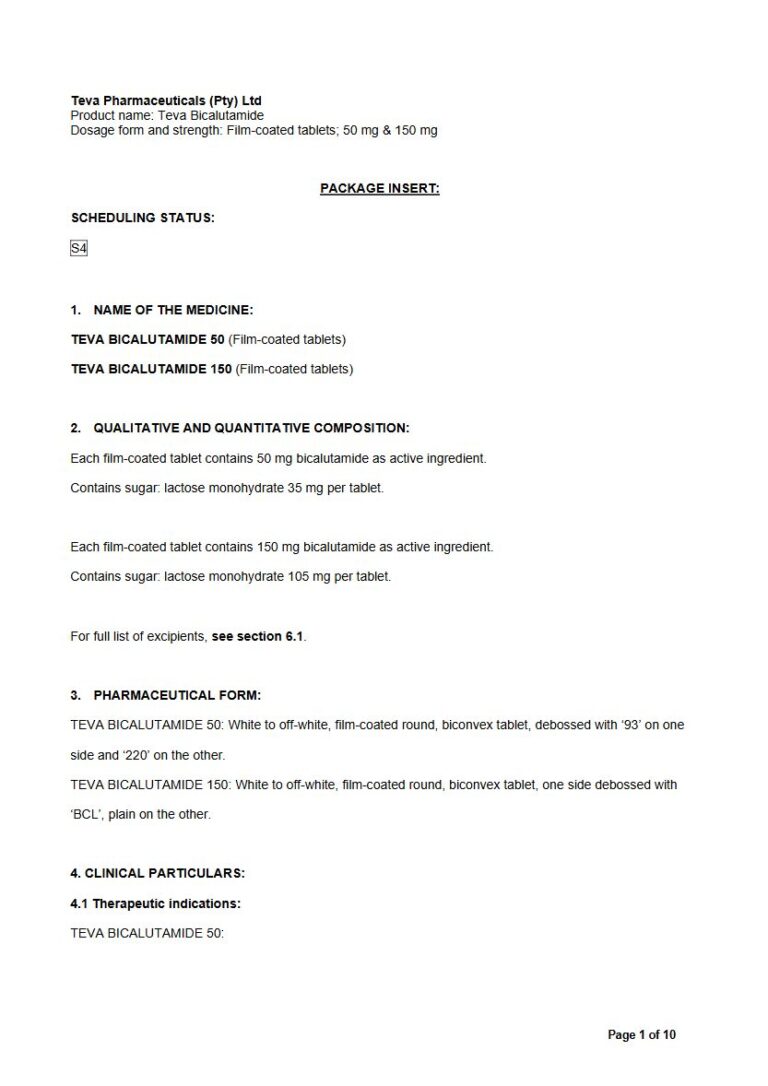
Teva Bicalutamide 50 mg & 150 mg Film-coated tablets
PDF Leaflet Revision Date: 29 April 2023
Clinical Summary
Quick overview from the medicine insert
Indication
Treatment of advanced prostate cancer.
Dosage (summary)
50 mg once daily; 150 mg once daily for two years or until progression.
Special Populations
- Renal impairment
- Hepatic impairment
Pregnancy & Breastfeeding
Contraindicated in pregnancy and breastfeeding.
Key Drug Interactions
- Coumarin anticoagulants
- Ketoconazole
- Cimetidine
Contraindications
- Hypersensitivity to bicalutamide
- Females
- Children
- Pregnant women
- Nursing mothers
Common side effects
- Anaemia
- Dizziness
- Decreased libido
- Hot flushes
- Hepatotoxicity
Counselling Points
- Take with or without food
- Report any signs of liver dysfunction
- Avoid in pregnancy and breastfeeding
Serious warnings
- Risk of non-alcoholic fatty liver disease
- Monitor hepatic function in severe impairment
Important Disclaimer
The Teva Bicalutamide 50 mg & 150 mg Film-coated tablets professional information leaflet below is the property of Teva Pharmaceuticals and is provided on Medinsert exactly as issued, with no.. alterations or editorial changes. We make every effort to keep content current by updating documents as soon as new versions become available. Medinsert serves as a trusted access point for healthcare professionals, but does not replace official sources or clinical judgement. For more details, please read our full disclaimer. read more>>
 Healthcare Professionals Only
This content is for registered healthcare professionals
Sign in or create a free account to read the full package insert.
Free for HPCSA-registered professionals. Powered by Medinsert.
Clinical Particulars
Section 4 of the official insert — extracted exactly as issued, no alterations
4.1 Therapeutic indications
TEVA BICALUTAMIDE 50:
The treatment of advanced prostate cancer in combination with Luteinising Hormone Release Hormone (LHRH) analogue therapy or surgical castration.
TEVA BICALUTAMIDE 150:
In patients with locally advanced prostate cancer (T3-4, any N, M0/T1-2, N+, M0) TEVA BICALUTAMIDE 150 is indicated as immediate therapy either alone or as adjuvant to treatment by radical prostatectomy or radiotherapy. TEVA BICALUTAMIDE 150 is indicated as monotherapy for the management of patients with locally advanced, non-metastatic prostate cancer for whom surgical or medical castration is not appropriate.
4.2 Posology and method of administration
Posology:
TEVA BICALUTAMIDE 50:
Adult males (including the elderly): One tablet (50 mg) once daily. Treatment with TEVA BICALUTAMIDE 50 should be started at least three days prior to commencing treatment with a LHRH analogue, or at the same time as surgical castration.
TEVA BICALUTAMIDE 150:
Adult males (including the elderly): One tablet (150 mg) once daily for two years or until progression.
Renal impairment: No dosage adjustments required.
Hepatic impairment: No dosage reduction required for patients with mild hepatic impairment. Increased accumulation may occur in patients with moderate to severe impairment.
4.3. Contraindications
TEVA BICALUTAMIDE is contraindicated in:
u2022 Patients with a known hypersensitivity towards bicalutamide or any of the excipients of TEVA BICALUTAMIDE.
u2022 Females.
u2022 Children.
u2022 Pregnant women.
u2022 Nursing mothers.
4.4 Special warnings and precautions for use
Since TEVA BICALUTAMIDE is extensively metabolised in the liver, metabolism may be delayed in patients with moderate to severe hepatic function impairment, resulting in prolonged elimination half-life and increased risk of toxicity. Periodic assessment of hepatic function should be considered during long term use of TEVA BICALUTAMIDE. Caution should be exercised with the co-administration of TEVA BICALUTAMIDE with medicines metabolised by cytochrome P450 (see section 4.5). TEVA BICALUTAMIDE can increase the risk of non-alcoholic fatty liver disease (NAFLD) and associated liver disease. TEVA BICALUTAMIDE contains lactose monohydrate. Patients with the rare hereditary conditions of galactose intolerance, total lactase deficiency or glucose-galactose malabsorption should not take TEVA BICALUTAMIDE. Caution should be exercised in patients with lactose intolerance. This medicine contains less than 1 mmol sodium (23 mg) per tablet, that is to say essentially u2018sodium - freeu2019.
4.5 Interaction with other medicines and other forms of interaction
Caution and increased monitoring of prothrombin time [PT] or International Normalised Ratio [INR] are recommended if treatment with TEVA BICALUTAMIDE is initiated in a patient stabilised on a coumarin-derivative anticoagulant. TEVA BICALUTAMIDE may displace coumarin anticoagulants, such as warfarin, from their protein binding sites. Adjustment of anticoagulant dosage may be necessary.
Concurrent administration of TEVA BICALUTAMIDE with agents that may inhibit oxidation of the bicalutamide e.g. ketoconazole and cimetidine, can lead to increased concentrations of bicalutamide and caution should be exercised. Medication with a narrow therapeutic index (e.g. cisapride, cyclosporine and astemizole) predominantly metabolised by CYP 3A4 should be used with caution when administered with TEVA BICALUTAMIDE. Medicines metabolised by cytochrome P450. Although clinical studies using antipyrine as a marker of cytochrome P450 (CYP) activity showed no evidence of an interaction potential with TEVA BICALUTAMIDE, midazolam exposure (AUC) was increased by up to 80 %, after co-administration with TEVA BICALUTAMIDE for 28 days. This rise is comparable to that seen in other studies after administration of grapefruit juice. Caution should be exercised with the co-administration of TEVA BICALUTAMIDE with compounds such as these, (see section 4.4).
4.6 Fertility, pregnancy and lactation
TEVA BICALUTAMIDE is contraindicated in pregnant women and breastfeeding mothers (see section 4.3).
4.7 Effects on ability to drive and use machines
TEVA BICALUTAMIDE has no effect on the ability to drive or operate machinery.
4.8 Undesirable effects
b. TABULATED LIST OF ADVERSE REACTIONS:
SYSTEM ORGAN CLASS: FREQUENCY: EVENT:
Infections and infestations Frequent infection, including pulmonary and upper respiratory tract infection
Blood and lymphatic system disorders Frequent anaemia Less frequent thrombocytopenia, leukopenia, neutropenia
Immune system disorders Less frequent hypersensitivity, angioedema, urticaria
Metabolism and nutrition disorders Frequent decrease in or loss of appetite Frequency unknown diabetes mellitus, hyperglycaemia
Psychiatric disorders Frequent decreased libido, depression
Nervous system disorders Frequent dizziness, somnolence Less frequent fever, neuromuscular symptoms or neuropathy, confusion, dryness of mouth, nervousness
Cardiac disorders Frequent myocardial infarct (fatal outcomes have been reported), cardiac failure 1 Less frequent hypertension Frequency unknown angina, conduction defects including PR and QT interval prolongation, dysrhythmias and non-specific ECG changes
Vascular disorders Frequent hot flushes
Respiratory, thoracic and mediastinal disorders Less frequent interstitial lung disease * (fatal outcomes have been reported), dyspnoea pulmonary disorder runny nose sore throat tightness in chest
Gastrointestinal disorders Frequent abdominal pain, constipation, diarrhoea, nausea, dyspepsia, flatulence Less frequent gastrointestinal or rectal bleeding, bloated feeling, gas or indigestion, vomiting Frequency unknown Anorexia
Hepato-biliary disorders Frequent hepatotoxicity, jandice, including cholestatic jaundice, Hypertransaminasaemia 1, non-alcoholic fatty liver disease and associated liver diseases Less frequent hepatitis, methaemoglobinaemia, hepatic failure * (fatal outcomes have been reported
Skin and subcutaneous tissue disorders Frequent alopecia, hirsutism/ hair re-growth, dry skin, pruritus, rash Less frequent photosensitivity reaction itching of skin Frequency unknown sweating
Renal and urinary disorders Frequent haematuria Frequency unknown nocturia
Reproductive system and breast disorders Frequent gynaecomastia, breast tenderness, erectile dysfunction
General disorder Frequent weakness (asthenia), oedema, chest pain Less frequent chills, drowsiness, flu-like syndrome, headache
Investigations Frequent weight increase *Listed as an adverse drug reaction following review of post-marketing data.
1. Hepatic changes are rarely severe and were frequently transient, resolving or improving with continued therapy or following cessation of therapy. Reporting of suspected adverse reactions: Reporting suspected adverse reactions after authorisation of the medicinal product is important. It allows continued monitoring of the benefit/risk balance of the medicinal product. Healthcare professionals are asked to report any suspected adverse reactions to SAHPRA via the 6.04 Adverse Drug Reactions Reporting Form, found under SAHPRAu2019s publications: https://www/sahpra.org.za/Publications/Index/8
4.9 Overdose
There are no experience of human overdosage. No specific therapeutic recommendation can be made in cases of overdosage. Dialysis may not be helpful, since TEVA BICALUTAMIDE is not recovered unchanged in the urine due to its high protein binding. Frequent monitoring of vital signs and general supportive care is indicated.
