
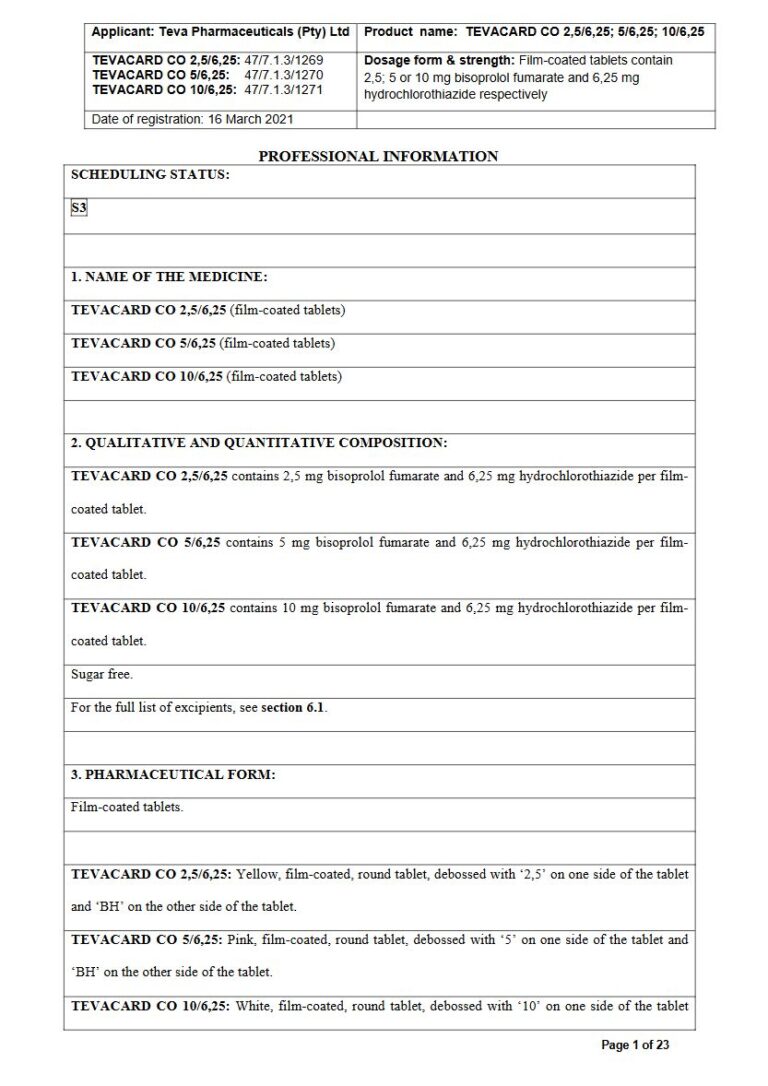
Tevacard Co 10 mg Film-Coated Tablets
PDF Leaflet Revision Date: 13 April 2023
Clinical Summary
Quick overview from the medicine insert
Indication
Treatment of hypertension.
Dosage (summary)
Start with 2.5 mg/6.25 mg once daily, max 10 mg/6.25 mg once daily.
Special Populations
- Renal impairment
- Hepatic impairment
Pregnancy & Breastfeeding
Contraindicated in pregnancy and breastfeeding.
Key Drug Interactions
- Lithium
- Calcium antagonists
- NSAIDs
Contraindications
- Hypersensitivity to components
- Acute heart failure
- Cardiogenic shock
- Severe bronchial asthma
- Severe renal impairment
Common side effects
- Dizziness
- Fatigue
- Gastrointestinal complaints
Counselling Points
- Monitor blood pressure regularly
- Report any skin changes
- Avoid abrupt discontinuation
Serious warnings
- Abrupt withdrawal may worsen condition
- Risk of non-melanoma skin cancer
Important Disclaimer
The Tevacard Co 10 mg Film-Coated Tablets professional information leaflet below is the property of Teva Pharmaceuticals and is provided on Medinsert exactly as issued, with no.. alterations or editorial changes. We make every effort to keep content current by updating documents as soon as new versions become available. Medinsert serves as a trusted access point for healthcare professionals, but does not replace official sources or clinical judgement. For more details, please read our full disclaimer. read more>>
 Healthcare Professionals Only
This content is for registered healthcare professionals
Sign in or create a free account to read the full package insert.
Free for HPCSA-registered professionals. Powered by Medinsert.
Clinical Particulars
Section 4 of the official insert — extracted exactly as issued, no alterations
4.1 Therapeutic indications
TEVACARD CO is indicated for the treatment of hypertension.
4.2 Posology and method of administration
Antihypertensive therapy may be initiated with the lowest dose of TEVACARD CO, one 2,5 mg/6,25 mg tablet once daily. Subsequent dose adjustment may be carried out with TEVACARD CO tablets up to the maximum recommended dose of one 10 mg/6,25 mg tablet once daily, as appropriate. If withdrawal of TEVACARD CO therapy is planned, it should be achieved gradually over a period of about 2 weeks. Patients should be carefully observed.
Special populations: Dosage adjustment on the basis of age is not usually necessary, unless there is also significant renal or hepatic dysfunction.
Paediatric population: There is no paediatric experience with TEVACARD CO.
Method of administration: For oral use.
4.3 Contraindications
- hypersensitivity to bisoprolol, hydrochlorothiazide, other thiazides, sulphonamides, or any of the excipients of TEVACARD CO listed in section 6.1
- acute heart failure or during episodes of heart failure decompensation requiring intravenous inotropic therapy
- cardiogenic shock
- second or third degree AV block
- sick sinus syndrome
- sinoatrial block
- symptomatic bradycardia
- severe bronchial asthma or severe chronic obstructive pulmonary disease
- severe forms of peripheral arterial occlusive disease or severe forms of Raynaud's syndrome
- untreated phaeochromocytoma
- patients with a history of previous and/or current basal cell carcinomas and/or squamous cell carcinomas of the skin and lip
- severe renal impairment (creatinine clearance < 30 ml/min)
- severe hepatic impairment
- metabolic acidosis
- refractory hypokalaemia
- pregnancy or lactation (see section 4.6)
- safety and efficacy in children have not been established.
4.4 Special warnings and precautions for use
Treatment with bisoprolol as contained in TEVACARD CO must not be withdrawn abruptly unless clearly indicated, since abrupt withdrawal of bisoprolol may lead to an acute deterioration of the patient's condition in particular in patients with ischaemic heart disease.
TEVACARD CO must be used with caution in patients with:
Liver disease: Liver disease, thiazide diuretics and related products may trigger hepatic encephalopathy. Should this happen, diuretic therapy must be stopped immediately.
Asthma and chronic obstructive pulmonary disease: Beta-blockers may be used only in mild forms of asthma or COPD, using a beta 1-selective adrenoceptor blocking medicine and a low starting dose. Pulmonary function testing is recommended before the start of therapy. Concomitant bronchodilating therapy is recommended in symptomatic patients. Occasionally, an increase in airway resistance may occur in patients with asthma or COPD, therefore the dose of beta 2-stimulants may have to be increased.
Acute respiratory toxicity: Very rare severe cases of acute respiratory toxicity, including acute respiratory distress syndrome (ARDS) have been reported after taking hydrochlorothiazide as contained in TEVACARD CO. Pulmonary oedema typically develops within minutes to hours after hydrochlorothiazide intake. At the onset, symptoms include dyspnoea, fever, pulmonary deterioration and hypotension. If diagnosis of ARDS is suspected, TEVACARD CO should be withdrawn and appropriate treatment given. Hydrochlorothiazide should not be administered to patients who previously experienced ARDS following hydrochlorothiazide intake.
Cardiac failure: Patients with compensated cardiac failure who require beta-blocker therapy may be administered bisoprolol as contained in TEVACARD CO using a very low starting dose, to be increased gradually with close medical monitoring.
First degree atrioventricular block: Having negative dromotropic activity, beta-blockers should be used cautiously in patients with first degree atrioventricular block.
Prinzmetalu2019s angina: Beta-blockers may increase the frequency and length of vasospastic episodes in patients with Prinzmetalu2019s angina. A beta 1-selective beta-blocker may be used in minor or mixed clinical presentations of Prinzmetalu2019s angina if a vasodilator is used concurrently.
Peripheral arterial occlusive disease: Beta-blockers may aggravate symptoms of peripheral arterial occlusive disease (PAOD) or Raynaud's syndrome. Such patients should preferably be prescribed a beta 1-selective beta-blocker.
Phaeochromocytoma: In patients with phaeochromocytoma, TEVACARD CO must not be administered until after alpha-receptor blockade. Blood pressure should be closely monitored.
Elderly: No dose adjustment is normally required. However, elderly patients should be closely monitored (see paragraph Fluid and electrolyte balance).
Diabetics: Diabetic patients should be aware of the risk of hypoglycaemic episodes and of the increased need for careful home glucose monitoring in the initial phase of therapy. The warning signs of hypoglycaemia, particularly tachycardia, palpitations and sweating, may be masked.
Psoriasis: There have been reports of beta-blockers being associated with worsening of psoriasis, thus patients with psoriasis should receive TEVACARD CO only if clearly needed.
Hypersensitivity reactions: In patients at risk of severe anaphylactic reaction to whatever allergen, particularly when using iodine-containing contrast materials (see section 4.5) or during specific immunotherapy (desensitisation), beta-blockers may aggravate the anaphylactic reaction and cause unresponsiveness to the usual doses of epinephrine used to treat hypersensitivity reactions.
General anaesthesia: In patients undergoing general anaesthesia, beta-blockade reduces the incidence of dysrhythmias and myocardial ischaemia during induction and intubation, and in the post-operative period. It is currently recommended that maintenance beta-blockade be continued peri-operatively. The anaesthetist must be aware of beta-blockade because of the potential for interactions with other medicines, resulting in bradydysrhythmias, attenuation of reflex tachycardia and decreased reflex ability to compensate for blood loss. If it is thought necessary to withdraw beta-blocker therapy before surgery, this should be done gradually and completed about 48 hours before anaesthesia.
Hyperthyroidism: Beta-blockers may mask the cardiovascular signs of hyperthyroidism.
Competitive athletes: Competitive athletes should be aware that TEVACARD CO contains a substance that may give a positive reaction in doping tests.
Strict fasting: TEVACARD CO must be used with caution in patients under strict fasting.
4.5 Interaction with other medicines and other forms of interaction
Combinations not recommended:
- Lithium: TEVACARD CO may intensify the cardiotoxic and neurotoxic effect of lithium through a reduction of lithium excretion.
- Calcium antagonists of the verapamil type and the diltiazem type: Negative effect on contractility and atrioventricular conduction. Intravenous administration of verapamil in patients on u03b2-blocker treatment may lead to profound hypotension and atrioventricular block.
- Centrally-acting antihypertensive medicines: Concomitant use of centrally-acting antihypertensive medicines may lead to a further reduction in heart rate and cardiac output and to vasodilatation. Abrupt withdrawal may increase the risk of u2018rebound hypertensionu2019.
Combinations to be used with caution:
- Calcium antagonists of the dihydropyridine type: Concomitant use may increase the risk of hypotension, and an increase in the risk of a further deterioration of the ventricular pump function in patients with heart failure cannot be excluded.
- Concomitant use with other antihypertensive medicines or with other medicines with blood pressure lowering potential may increase the risk of hypotension.
- ACE inhibitors, Angiotensin II antagonists: Risk of significant fall in blood pressure and/or acute renal failure during initiation of ACE inhibitor therapy in patients with pre-existing sodium depletion (particularly in patients with renal artery stenosis). If prior diuretic therapy has produced sodium depletion, either stop the diuretic 3 days before starting ACE inhibitor therapy, or initiate ACE inhibitor therapy at a low dose.
- Class-I antidysrhythmic medicines: Effect on atrio-ventricular conduction time may be potentiated and negative inotropic effect increased.
- Class-III antidysrhythmic medicines: Effect on atrio-ventricular conduction time may be potentiated.
Antidysrhythmic medicines that may induce torsade de pointes: Hypokalaemia may facilitate the occurrence of torsades de pointes.
Non-antidysrhythmic medicines that may induce torsade de pointes: Hypokalaemia may facilitate the occurrence of torsades de pointes.
Parasympathomimetic medicines: Concomitant use may increase atrio-ventricular conduction time and the risk of bradycardia.
Topical beta-blockers: (e.g. eye drops for glaucoma treatment) may add to the systemic effects of bisoprolol.
Insulin and oral antidiabetic medicines: Increase of blood sugar lowering effect. Blockade of beta-adrenoceptors may mask symptoms of hypoglycaemia.
Anaesthetic medicines: Attenuation of the reflex tachycardia and increase of the risk of hypotension.
Digitalis glycosides: Increase of atrio-ventricular conduction time, reduction in heart rate. If hypokalaemia and/or hypomagnesaemia develop during treatment with TEVACARD CO the myocardium may show increased sensitivity to cardiac glycosides, leading to an enhanced effect and adverse effects of the glycosides.
Non-steroidal anti-inflammatory drugs (NSAIDs): NSAIDs may reduce the hypotensive effect. In patients developing hypovolaemia the concomitant administration of NSAIDs can trigger acute renal failure.
Beta-sympathomimetics: Combination with bisoprolol as contained in TEVACARD CO may reduce the effect of both medicines.
4.6 Fertility, pregnancy and lactation
Pregnancy: TEVACARD CO is contraindicated during pregnancy (see section 4.3). Administration to pregnant mothers shortly before giving birth or during labour may result in the new-born infant being born hypotonic, collapsed or hypoglycaemic.
Bisoprolol: Bisoprolol has pharmacological effects that may cause harmful effects on pregnancy and/or the foetus/newborn. In general, beta-adrenoceptor blockers reduce placental perfusion, which has been associated with growth retardation, intra-uterine death, abortion or early labour. Adverse effects (e.g. hypoglycaemia and bradycardia) may occur in the foetus and newborn infant. If treatment with beta-adrenoceptor blockers is necessary, beta 1-selective adrenoceptor blockers are preferable.
Hydrochlorothiazide: There is limited experience with hydrochlorothiazide during pregnancy, especially during the first trimester. Animal studies are insufficient. Hydrochlorothiazide crosses the placenta. Based on the pharmacological mechanism of action of hydrochlorothiazide its use during the second and third trimester may compromise feto-placental perfusion and may cause foetal and neonatal effects like icterus, disturbance of electrolyte balance and thrombocytopenia. Hydrochlorothiazide should not be used for gestational oedema, gestational hypertension or pre-eclampsia due to the risk of decreased plasma volume and placental hypoperfusion, without a beneficial effect on the course of the disease. Hydrochlorothiazide should not be used for essential hypertension in pregnant women.
Breastfeeding: TEVACARD CO is contraindicated in breastfeeding women. Hydrochlorothiazide can inhibit the milk production (see section 4.3).
4.7 Effects on ability to drive and use machines
TEVACARD CO has no or negligible influence on the ability to drive and use machines. Depending on the individual patientu2019s response to treatment with bisoprolol/hydrochlorothiazide the ability to drive and use machines may be impaired. This should be considered particularly at the start of treatment as well as in conjunction with alcohol.
4.8 Undesirable effects
Neoplasms benign, malignant and unspecified (incl cysts and polyps): Frequency unknown Non-melanoma skin cancer (Basal cell carcinoma and squamous cell carcinoma)
Blood and lymphatic system disorders: Less frequent Leucopenia, thrombocytopenia, agranulocytosis
Metabolism and nutrition disorders: Less frequent Loss of appetite, hyperglycaemia, hyperuricaemia, disturbances of fluid and electrolyte balance (in particular hypokalaemia and hyponatraemia, also hypomagnesaemia and hypochloraemia as well as hypercalcaemia), metabolic alkalosis
Psychiatric disorders: Less frequent Depression, sleep disorders, nightmares, hallucinations
Nervous system disorders: Frequent Dizziness*, headache*
Eye disorders: Less frequent Reduced tear flow (to be taken into consideration in patients wearing contact lenses), visual disturbances, conjunctivitis Frequency unknown Choroidal effusion
Ear and labyrinth disorders: Less frequent Hearing disorders
Cardiac disorders: Less frequent Bradycardia, atrioventricular conduction disturbances, worsening of pre-existing heart failure
Vascular disorders: Frequent Feeling of coldness or numbness in extremities Less frequent Orthostatic hypotension
Respiratory, thoracic and mediastinal disorders: Less frequent Bronchospasm in patients with bronchial asthma or history of obstructive airways disease, allergic rhinitis, acute respiratory distress syndrome (ARDS)
Gastrointestinal disorders: Frequent Gastrointestinal complaints such as nausea, vomiting, diarrhoea, constipation Less frequent Abdominal complaints, pancreatitis
Hepato-biliary disorders: Less frequent Hepatitis, jaundice
Skin and subcutaneous tissue disorders: Less frequent Hypersensitivity reactions such as itching, flush, rash, photodermatitis, purpura, urticaria, anaphylactic reactions, toxic epidermic necrolysis (Lyell syndrome), alopecia, cutaneous lupus erythematosus. Beta-blockers may provoke or worsen psoriasis or induce psoriasis-like rash
Musculoskeletal and connective tissue disorders: Less frequent Muscle weakness, muscle cramps
Reproductive system and breast disorders: Less frequent Potency disorders
General disorders and administration site conditions: Frequent Fatigue* Less frequent Asthenia, chest pain
Investigations: Less frequent Increase in amylase, reversible increase of serum creatinine and urea, increased triglyceride and cholesterol levels, glucosuria, increase in liver enzymes (ASAT, ALAT)
* These symptoms especially occur at the beginning of therapy. They are generally mild and often disappear within 1 to 2 weeks.
Description of selected adverse reactions: Non-melanoma skin cancer: Based on available data from epidemiological studies, cumulative dose-dependent association between HCTZ and NMSC has been observed (see also sections 4.4 and 5.1).
Reporting of suspected adverse reactions: Reporting suspected adverse reactions after authorisation of the medicine is important. It allows continued monitoring of the benefit/risk balance of the medicine. Healthcare providers are asked to report any suspected adverse reactions to SAHPRA via the 6.04 Adverse Drug Reactions Reporting Form, found online under SAHPRAu2019s publications: https://www.sahpra.org.za/Publications/Index/8.
4.9 Overdose
Symptoms: The most common signs expected with overdose of a beta-blocker are bradycardia, hypotension, bronchospasm, acute cardiac insufficiency and hypoglycaemia.
The clinical picture in acute or chronic overdose of hydrochlorothiazide is characterised by the extent of fluid and electrolyte loss. The most common signs are dizziness, nausea, somnolence, hypovolaemia, hypotension, hypokalaemia.
Management: In general, if overdose occurs, discontinuation of TEVACARD CO and supportive and symptomatic treatment is recommended. Repeated activated charcoal is necessary in severe overdose. Bradycardia: administer intravenous atropine (1-2 mg). Alternatively, dobutamine or isoprenaline (25 u03bcg), may be required to reverse beta-blockade. Under some circumstances, transvenous pacemaker insertion may be necessary. Hypotension: intravenous fluids and vasopressors should be administered. Atrioventricular block (second or third degree): patients should be carefully monitored and treated with isoprenaline infusion or intravenous cardiac pacemaker insertion. Acute worsening of heart failure: administer intravenous diuretics, inotropic medicines, vasodilating medicines. Bronchospasm: administer bronchodilator therapy such as isoprenaline, beta 2-sympathomimetic medicines and/or aminophylline. Hypoglycaemia: administer intravenous glucose.
