
Myleran 2 mg Film-coated tablets
PDF Leaflet Revision Date: 5 March 2020
Clinical Summary
Quick overview from the medicine insert
Indication
Palliative treatment of chronic myelogenous leukaemia.
Dosage (summary)
Induction: 0.06 mg/kg/day (max 4 mg). Maintenance: 0.5 to 2 mg/day.
Special Populations
- Obese patients
- Paediatric patients
Pregnancy & Breastfeeding
Contraindicated in pregnancy and lactation; teratogenic effects noted.
Key Drug Interactions
- Azole antifungals
- Thioguanine
- Phenytoin
- Cyclophosphamide
Contraindications
- Hypersensitivity to busulfan
- Resistance to busulfan
- Concomitant use with live vaccines
Common side effects
- Leukopenia
- Thrombocytopenia
- Nausea
- Vomiting
- Diarrhoea
Counselling Points
- Monitor blood counts regularly
- Avoid live vaccines
- Consider sperm preservation in men
Serious warnings
- Risk of pulmonary toxicity
- Bone marrow aplasia
- Hepatic veno-occlusive disease
Important Disclaimer
The Myleran 2 mg Film-coated tablets professional information leaflet below is the property of Pharmacare Limited and is provided on Medinsert exactly as issued, with no.. alterations or editorial changes. We make every effort to keep content current by updating documents as soon as new versions become available. Medinsert serves as a trusted access point for healthcare professionals, but does not replace official sources or clinical judgement. For more details, please read our full disclaimer. read more>>
 Healthcare Professionals Only
This content is for registered healthcare professionals
Sign in or create a free account to read the full package insert.
Free for HPCSA-registered professionals. Powered by Medinsert.
Clinical Particulars
Section 4 of the official insert — extracted exactly as issued, no alterations
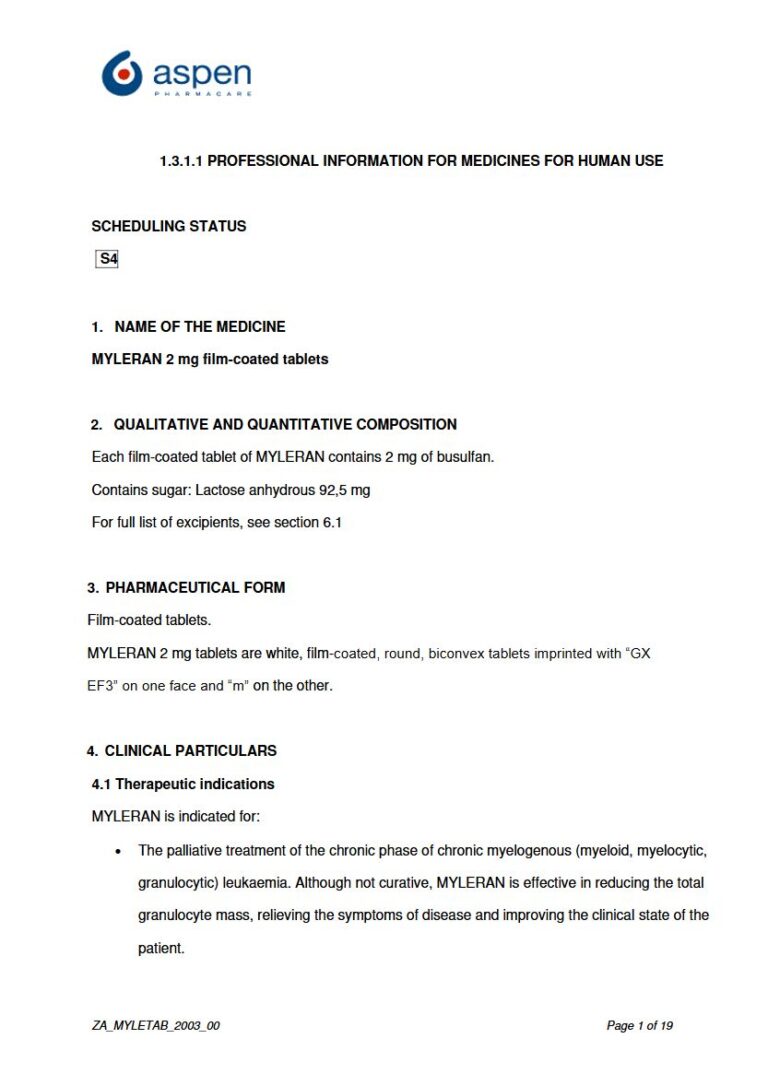
4.1 Therapeutic indications
MYLERAN is indicated for:
- The palliative treatment of the chronic phase of chronic myelogenous (myeloid, myelocytic, granulocytic) leukaemia. Although not curative, MYLERAN is effective in reducing the total granulocyte mass, relieving the symptoms of disease and improving the clinical state of the patient.
4.2 Posology and method of administration
Posology
MYLERAN film-coated tablets are usually given in courses or administered continuously. The dose must be adjusted for the individual patient under close clinical and haematological control. Should a patient require an average daily dose of less than the content of the available MYLERAN tablets, this can be achieved by introducing one or more MYLERAN free days between treatment days. The tablets should not be divided (see section 4.4).
Obese patients
Dosing based on body surface area or adjusted ideal body weight should be considered in the obese (see section 5.2).
Chronic myeloid leukaemia (CML)
Induction in adults
The dose is 0,06 mg/kg/day, with an initial daily maximum of 4 mg, which may be given as a single dose. The dose should be increased only if the response is inadequate after three weeks. 6 mg to 8 mg daily has been given in refractory cases. Treatment should be continued until the total leukocyte count has fallen to between 15 and 25 x 109/u2113 (typically 12 to 20 weeks). Treatment may then be interrupted, following which a further fall in the leukocyte count may occur over the next two weeks. Continued treatment at the induction dose after this point or following depression of the platelet count to below 100 x 109/u2113 is associated with a significant risk of prolonged and possibly irreversible bone marrow aplasia.
Maintenance in adults
Control of the leukaemia may be achieved for long periods without further MYLERAN treatment; further courses are usually given when the leukocyte count rises to 50 x 109/u2113, or symptoms return. Maintenance is only recommended when a remission is shorter than 3 months. The usual maintenance dosage is 0,5 to 2 mg/day, but individual requirements may be less. The aim is to maintain a leucocyte count of 10 to 15 x 109/u2113 and blood counts must be performed at least every 4 weeks. The maintenance dose may also be adjusted by reducing the number of treatment days per week. Should a patient require an average daily dose of less than the content of one tablet, the maintenance dose may be adjusted by introducing one or more MYLERAN free days between treatment days. There is individual variation in the response to MYLERAN and in a small proportion of patients the bone marrow may be extremely sensitive (see section 4.4). Therefore, the blood count must be monitored at least weekly during the induction phase.
Paediatric population
Induction: 0,06 mg/kg to 0,12 mg/kg of body weight or 1,8 to 4,6 mg/m2 of body surface per day. The dosage is titrated to reduce and maintain a leucocyte count of about 20 000 cells/mm3. MYLERAN may be used to treat Philadelphia chromosome positive (Ph' positive) disease, but the Ph' negative juvenile variant responds poorly. Lower doses of MYLERAN should be used if it is administered in conjunction with other cytotoxic medicines (see section 4.5 and section 4.8).
Method of administration
For oral administration.
4.3 Contraindications
MYLERAN is contraindicated in:
- Patients with hypersensitivity to busulfan or to any of the other excipients in MYLERAN (see section 2 and section 6.1)
- Patients whose disease has demonstrated resistance to busulfan, as in MYLERAN.
- Concomitant use with live attenuated viruses.
- Pregnancy and lactation (see section 4.6).
4.4 Special warnings and precautions for use
BUSULFAN, AS IN MYLERAN, IS AN ACTIVE CYTOTOXIC MEDICINE FOR USE ONLY UNDER THE DIRECTION OF MEDICAL PRACTITIONERS EXPERIENCED IN THE ADMINISTRATION OF SUCH MEDICINES.
Immunisation
Immunisation using a live organism vaccine has the potential to cause infection in immunocompromised hosts. Therefore, immunisations with live organism vaccines should be avoided (see section 4.3).
Pulmonary toxicities
Busulfan, as in MYLERAN should be discontinued if lung toxicity develops (see section 4.8). Pulmonary toxicity after either high or conventional dose treatment typically presents with non-specific non-productive cough, dyspnoea and hypoxia with evidence of abnormal pulmonary physiology (see section 4.8). Other cytotoxic medicines may cause additive lung toxicity. It is possible that subsequent radiotherapy can augment subclinical lung injury caused by busulfan, as in MYLERAN. Once pulmonary toxicity is established the prognosis is poor despite MYLERAN withdrawal and there is little evidence that corticosteroids are helpful.
Idiopathic pneumonia syndrome is a non-infectious diffuse pneumonia which usually occurs within three months of high-dose MYLERAN conditioning prior to allogeneic or autologous haemopoietic transplant. Diffuse alveolar haemorrhage may also be detected in some cases after broncholavage. Chest X-rays or CT scans show diffuse or nonspecific focal infiltrates and biopsy shows interstitial pneumonitis and diffuse alveolar damage and sometimes fibrosis. Interstitial pneumonitis may occur following conventional dose use and lead to pulmonary fibrosis. Diffuse interstitial pulmonary fibrosis, with progressive dyspnoea and a persistent, non-productive cough has occurred, usually after prolonged treatment over a number of years. Histological features include atypical changes of the alveolar and bronchiolar epithelium and the presence of giant cells with large hyperchromatic nuclei. The onset is usually insidious but may also be acute. The lung pathology may be complicated by superimposed infections. Pulmonary ossification and dystrophic calcification have also been reported. Other cytotoxic medicines may cause additive lung injury.
Radiotherapy
Busulfan, as in MYLERAN, is ineffective once blast transformation has occurred. MYLERAN should not generally be given in conjunction with or soon after radiotherapy.
Anaesthesia
If anaesthesia is required in patients with possible pulmonary toxicity, the concentration of inspired oxygen should be kept as low as safely possible and careful attention given to post-operative respiratory care.
Renal and urinary
Hyperuricaemia and/or hyperuricosuria are not uncommon in patients with chronic myeloid leukaemia (CML) and should be corrected before starting treatment with MYLERAN. During treatment, hyperuricaemia and the risk of uric acid nephropathy should be prevented by adequate prophylaxis, including adequate hydration and the use of allopurinol. Studies in renally impaired patients have not been conducted. However, as MYLERAN is moderately excreted in the urine, dose modification is not recommended in these patients. Caution is recommended.
Hepatobiliary
There have been reports of cholestatic jaundice and liver function abnormalities, but MYLERAN is not generally considered to be significantly hepatotoxic at normal therapeutic doses. However, retrospective review of postmortem reports of patients, who had been treated with low dose MYLERAN for at least two years for CML showed evidence of centrilobular sinusoidal fibrosis. Busulfan, as in MYLERAN, has not been studied in patients with hepatic impairment. Since MYLERAN is mainly metabolised through the liver, caution should be observed when MYLERAN is used in patients with pre-existing liver impairment, especially in those with severe hepatic impairment.
Skin and subcutaneous tissue
Hyperpigmentation occurs, particularly in those with a dark complexion. It is often most marked on the neck, upper trunk, nipples, abdomen and palmar creases. This may also occur as part of a clinical syndrome resembling Addisonu2019s disease (see section 4.8).
General disorders
Following prolonged MYLERAN therapy, hyperpigmentation may occur as a part of a clinical syndrome resembling adrenal insufficiency (Addison's disease). It is characterised by weakness, severe fatigue, anorexia, weight loss, nausea and vomiting and hyperpigmentation of the skin, but without biochemical evidence of adrenal suppression or mucous membrane hyperpigmentation or hair loss (see section 4.8: Skin and subcutaneous tissue disorders). The syndrome may resolve when MYLERAN is withdrawn.
Interaction with azoles
Patients co-administered with azole antifungals including ketoconazole, itraconazole or metronidazole with conventional doses of MYLERAN should be monitored closely for signs of busulfan toxicity. Weekly measurements of blood counts are recommended when co-administering these medicines (see section 4.5).
Monitoring
Careful attention must be paid to monitoring the blood counts throughout treatment to avoid the possibility of excessive myelosuppression and the risk of irreversible bone marrow aplasia (see section 4.8). Hepatic veno-occlusive disease is a major complication that can occur during treatment with MYLERAN. Patients who have received prior radiation therapy, for three or more cycles of chemotherapy, may be at an increased risk of developing hepatic veno-occlusive disease (see section 4.8).
Safe handling of MYLERAN
Provided the outer coating is intact, there is no risk in handling MYLERAN. The tablets should not be divided. Handlers of MYLERAN should follow guidelines for the handling of cytotoxic medicines according to prevailing local recommendations and/or regulation.
Mutagenicity
Various chromosome aberrations have been noted in cells from patients receiving MYLERAN.
Carcinogenicity
Widespread epithelial dysplasia has been observed in patients treated with long-term busulfan, as in MYLERAN, with some of the changes resembling precancerous lesions. A number of malignant tumours have been reported in patients who have received busulfan, as in MYLERAN, treatment. Evidence is growing that busulfan, in common with other alkylating medicines, is leukaemogenic. In a controlled prospective study in which two years busulfan, as in MYLERAN, treatment was given as an adjuvant to surgery for lung cancer, long-term follow up showed an increased incidence of acute leukaemia compared with the placebo-treated group. The incidence of solid tumours was not increased.
Teratogenicity
Busulfan, as in MYLERAN is teratogenic in animal studies and potentially teratogenic in humans. A few cases of congenital abnormalities, not necessarily attributable to MYLERAN, have been reported and third trimester exposure may be associated with impaired intra-uterine growth.
Oogenesis and spermatogenesis
Busulfan, as in MYLERAN, interferes with oogenesis and spermatogenesis. MYLERAN may cause sterility in both sexes. Men treated with MYLERAN should be informed about sperm preservation prior to treatment (see section 4.6 and section 4.8).
Porphyria
Busulfan, as in MYLERAN, should be used only when no safer alternative is available and precautions should be considered in vulnerable patients.
4.5 Interaction with other medicines and other forms of interaction
Thioguanine
The combination of MYLERAN and thioguanine may result in the development of nodular regenerative hyperplasia, portal hypertension and oesophageal varices. Thioguanine is associated with significant hepatotoxicity (see section 4.5).
Immunosuppressive therapy
Patients receiving, MYLERAN should not be vaccinated with live organism vaccines (see section 4.3 The effects of other cytotoxics producing pulmonary toxicity may be additives. Subsequent radiotherapy may augment lung injury caused by busulfan, as in MYLERAN. Once pulmonary toxicity is established the prognosis is poor despite MYLERAN withdrawal, and there is little evidence that corticosteroids are helpful. The onset is usually insidious but may also be acute (see section 4.4).
Phenytoin
The administration of phenytoin to patients receiving high-dose MYLERAN may result in a decrease in the myeloblastive effect.
Itraconazole
The concomitant administration of itraconazole to patients receiving MYLERAN may result in reduced busulfan clearance. In patients receiving high-dose busulfan, as in MYLERAN it has been reported that co-administration of itraconazole decreases clearance of busulfan by approximately 20 % with corresponding increases in plasma busulfan levels (see section 4.4).
Metronidazole
Metronidazole has been reported to increase trough levels of busulfan, as in MYLERAN, by approximately 80 %. Fluconazole had no effect on busulfan clearance. MYLERAN, in combination with itraconazole or metronidazole is associated with an increased risk of busulfan toxicity (see section 4.4).
Cyclophosphamide
Hepatic veno-occlusive disease and other regimen-related toxicities have been observed in patients treated with high-dose MYLERAN, and cyclophosphamide when the first dose of cyclophosphamide has been delayed for more than 24 hours after the last dose of MYLERAN (see section 4.4).
Paracetamol
Paracetamol is described to decrease glutathione levels in blood and tissues, and may therefore decrease busulfan, as in MYLERAN clearance when used in combination.
Paediatric patients
In the paediatric population, for the combined busulfan-melphalan regimen it has been reported that the administration of melphalan less than 24 hours after the last oral busulfan, as in MYLERAN, administration may influence the development of toxicities.
4.6 Fertility, pregnancy and lactation
MYLERAN is contraindicated in pregnancy and lactation (see section 4.3). MYLERAN is teratogenic in laboratory animals.
Pregnancy
Highly effective contraceptive precautions should be taken/used when either partner is receiving MYLERAN.
Breastfeeding
It is not known whether MYLERAN or its metabolites are excreted in human breast milk. Mothers on MYLERAN therapy should not breastfeed their infants.
Fertility
MYLERAN can lead to suppression of ovarian function and amenorrhoea in women and suppression of spermatogenesis in men. MYLERAN may cause sterility in both sexes. In women MYLERAN may cause severe and persistent ovarian failure, including failure to achieve puberty after administration to young girls and pre-adolescents at high-dose. MYLERAN may also cause male infertility, azoospermia and testicular atrophy in male patients receiving MYLERAN (see section 4.4).
4.7 Effects on ability to drive and use machines
MYLERAN has moderate influence on the ability to drive and use machines since side effects such as convulsions and eye disorders have been reported in patients receiving MYLERAN (see section 4.8).
4.8 Undesirable effects
Tabulated list of adverse reactions
Adverse events are listed below by system organ class and frequency. Frequencies are defined as: very common (u2265 1/10), common (u2265 1/100, < 1/10), uncommon (u2265 1/1 000, < 1/100), rare (u2265 1/10 000, < 1/1 000) and very rare (< 1/10 000) including isolated reports
System organ class Frequency Side effects
Neoplasms benign, malignant and unspecified (incl. cysts and polyps) Common Leukaemia secondary to oncology chemotherapy
Blood and the lymphatic system disorders Very common Dose-related bone marrow depression, manifesting as leukopenia and thrombocytopenia
Rare Aplastic anaemia (sometimes irreversible), typically following long-term conventional doses and also high doses of MYLERAN.
Nervous system disorders Rare Convulsions (observed at high-dose)
Very rare Myasthenia gravis
Eye disorders Rare Lens disorder and cataract (which may be bilateral) corneal thinning (have been reported after bone marrow transplantation preceded by high-dose MYLERAN treatment)
Cardiac disorders Common At high-dose: cardiac tamponade in patients with thalassaemia
Respiratory, thoracic and mediastinal disorders Very common Idiopathic pneumonia syndrome
Common Interstitial lung disease following long term conventional dose use, pulmonary toxicity typically presents with nonspecific persistent nonproductive cough, progressive dyspnoea and hypoxia with evidence of abnormal pulmonary physiology
Unknown: Pulmonary ossification, pulmonary fibrosis
Gastrointestinal disorders Very common Nausea, vomiting, diarrhoea, mouth ulceration
Rare Dry mouth
Unknown Tooth hypoplasia
Hepatobiliary disorders Very common Hyperbilirubinaemia, jaundice, venoocclusive liver disease and centrilobular sinusoidal (biliary) fibrosis with hepatic atrophy and hepatic necrosis
Rare Cholestatic jaundice and abnormal hepatic function, centrilobular sinusoidal (biliary) fibrosis
Skin and subcutaneous tissue disorders Common Alopecia (hair loss), skin hyperpigmentation
Rare Skin reactions including urticaria, erythema multiforme, erythema nodosum, porphyria non-acute, (allopurinol-type) rash, excessive dryness and fragility of the skin with complete anhidrosis, cheilosis, an increased cutaneous radiation effect has been observed in patients receiving radiotherapy soon after high-dose MYLERAN, an increased radiation skin injury in patients receiving radiotherapy soon after high-dose busulfan
Musculoskeletal and connective tissue disorders Rare Sju00f6grenu2019s syndrome
Renal and urinary disorders Common At high-dose in combination with cyclophosphamide haemorrhagic cystitis
Reproductive system and breast disorders Very common Ovarian disorder and amenorrhoea with menopausal symptoms in pre-menopausal patients, at high-dose; severe and persistent ovarian failure, including failure to achieve puberty after administration to young girls and pre-adolescents at high-dose, male infertility, there have been clinical reports of sterility, azoospermia and testicular atrophy in male patients receiving MYLERAN
Very rare Gynaecomastia
General disorders and administration site conditions Rare Dysplasia
Very rare Clinical syndrome (characterized by weakness, severe fatigue, anorexia, weight loss, nausea and vomiting and hyperpigmentation of the skin)
Unknown Dystrophic calcification
Reporting of suspected adverse reactions
Reporting suspected adverse reactions after authorisation of the medicine is important. It allows continued monitoring of the benefit/risk balance of the medicine. Healthcare providers are asked to report any suspected adverse reactions to: SAHPRA: https://www.sahpra.org.za/health-products-vigilance/ Aspen Pharmacare: E-mail: [email protected] Tel: 0800 118 088
4.9 Overdose
Symptoms
The acute dose-limiting toxicity of MYLERAN in man is myelosuppression. If high-dose MYLERAN is used in association with bone marrow transplantation, gastro-intestinal toxicity becomes dose-limiting, with mucositis, nausea, vomiting, diarrhoea and anorexia (see section 4.8). The main effect of chronic overdosage is bone marrow depression and pancytopenia.
Management
There is no known antidote. Dialysis should be considered in the management of overdose as there is one report of successful dialysis of busulfan, as in MYLERAN. Appropriate supportive treatment should be given during the period of haematological toxicity. Since, busulfan is metabolised through conjugation with glutathione, administration of glutathione might be considered.
