
Cravedon 6,25 Mg/12,5 Mg/25 Mg Tablets
PDF Leaflet Revision Date: 24 October 2023
Clinical Summary
Quick overview from the medicine insert
Indication
Essential hypertension, symptomatic CHF, left ventricular dysfunction post-MI.
Dosage (summary)
Initiate at 12.5 mg once daily for hypertension; CHF starts at 3.125 mg twice daily.
Special Populations
- Renal impairment
- Hepatic impairment
- Elderly
- Diabetic patients
Pregnancy & Breastfeeding
Not recommended in pregnancy; excreted in breast milk.
Key Drug Interactions
- Digoxin
- Cimetidine
- NSAIDs
- Amiodarone
- Fluoxetine
Contraindications
- Hypersensitivity
- Severe heart disease
- 2nd/3rd degree AV block
- Asthma
- COPD with bronchospasm
Common side effects
- Dizziness
- Headache
- Bradycardia
- Hypotension
- Nausea
Counselling Points
- Take with food for CHF
- Monitor blood glucose in diabetics
- Do not stop abruptly
- Avoid driving if dizzy
Serious warnings
- Bradycardia
- Worsening heart failure
- Withdrawal syndrome
- Severe cutaneous adverse reactions
Important Disclaimer
The Cravedon 6,25 Mg/12,5 Mg/25 Mg Tablets professional information leaflet below is the property of Smart Pharmaceuticals and is provided on Medinsert exactly as issued, with no.. alterations or editorial changes. We make every effort to keep content current by updating documents as soon as new versions become available. Medinsert serves as a trusted access point for healthcare professionals, but does not replace official sources or clinical judgement. For more details, please read our full disclaimer. read more>>
 Healthcare Professionals Only
This content is for registered healthcare professionals
Sign in or create a free account to read the full package insert.
Free for HPCSA-registered professionals. Powered by Medinsert.
Clinical Particulars
Section 4 of the official insert — extracted exactly as issued, no alterations
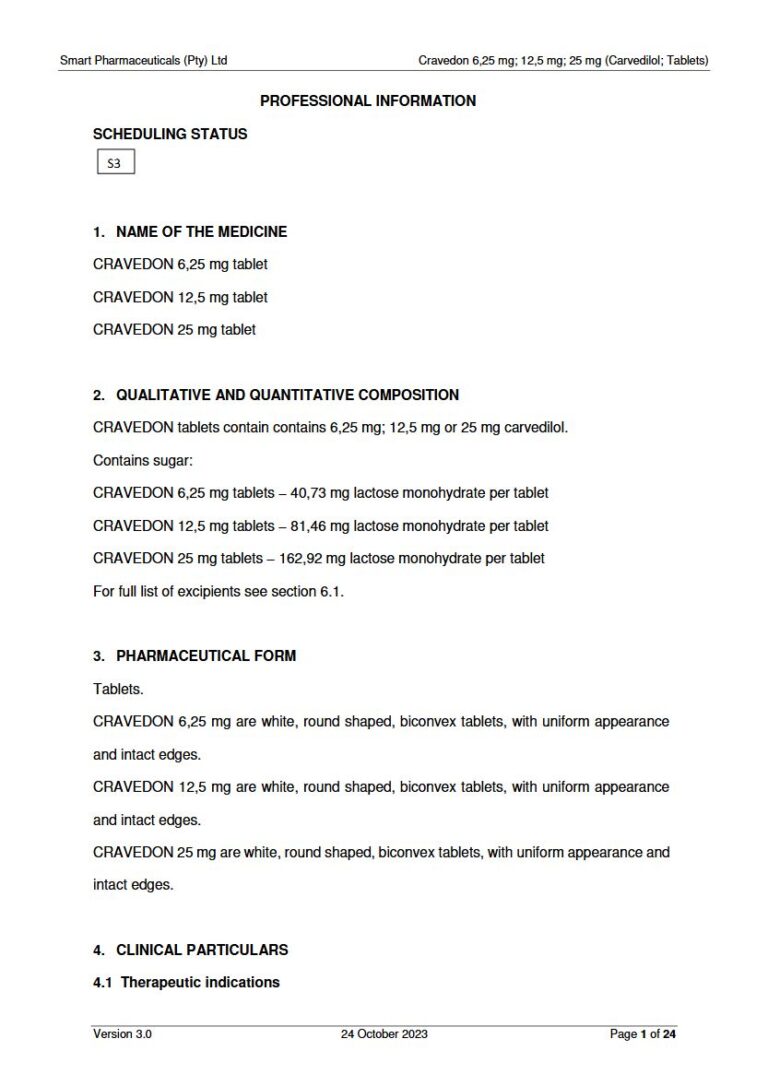
4.1 Therapeutic indications
Essential hypertension
nTreatment of mild to moderate essential hypertension.
nSymptomatic congestive heart failure (CHF)
nCRAVEDON is indicated for the treatment of mild, moderate, and severe stable, symptomatic heart failure of ischaemic or cardiomyopathic origin.
nCRAVEDON may be used as adjunct to standard therapy.
nCRAVEDON has been used in patients unable to tolerate an ACE- inhibitor and patients who are, or are not, taking digoxin.
nLeft ventricular dysfunction following uncomplicated acute myocardial infarction
nLong term treatment following otherwise uncomplicated myocardial infarction, but with left ventricular dysfunction (left ventricular ejection fraction (LVEF) u2264 40 % or wall motion index u2264 1,3), in combination with ACE inhibitors and other treatments recommended in the management of patients after myocardial infarction.
4.2 Posology and method of administration
Posology
nEssential hypertension
nAdults
nThe recommended dose for initiation of therapy is 12,5 mg once a day for the first two days. Thereafter the recommended dosage is 25 mg once a day. Combination with a diuretic may also give the desired response.
nElderly
nThe recommended dose for initiation of therapy is 12,5 mg once daily, which has provided satisfactory control in some patients. If the response is inadequate, the dose may be titrated at intervals of at least two weeks up to the recommended daily dose of 25 mg once a day or in divided doses.
nIn hypertensive patients it is not necessary to time the dose in relation to meals. At doses higher than 25 mg the incidence of side effects increases significantly with only a marginal increase in efficacy.
nTreatment of symptomatic congestive heart failure
nCRAVEDON should be taken with food to slow the rate of absorption and reduce the incidence of orthostatic effects. Dosage must be individualised and closely monitored by a medical practitioner experienced in the management of heart failure, during up-titration. For those patients receiving digoxin, diuretics and ACE-inhibitors, dosing of these medicines should be stabilised prior to initiation of CRAVEDON treatment.
nThe recommended dose for initiation of therapy is 3,125 mg twice daily for at least 2 weeks. If this dose is tolerated, the dosage may subsequently be increased, at intervals of not less than two weeks, to 6,25 mg twice daily, followed by 12,5 mg twice daily and thereafter 25 mg twice daily. Dosing should be increased to the highest level tolerated by the patient. The maximum recommended dose is 25 mg twice daily in patients weighing less than 85 kg and 50 mg twice daily in patients weighing more than 85 kg.
nBefore each dose increase, the patient should be evaluated by the medical practitioner for symptoms of worsening heart failure or vasodilation. Transient worsening of heart failure or fluid retention should be treated with increased doses of diuretics, although occasionally it may be necessary to lower the dose of CRAVEDON or temporarily discontinue CRAVEDON treatment.
nIf CRAVEDON treatment is discontinued for more than two weeks, therapy should be recommenced at 3,125 mg twice daily and up-titrated in line with the above dosing recommendation. Symptoms of vasodilation such as postural hypotension, headache and dizziness may be managed initially by a reduction in the dose of diuretics. If symptoms persist, the dose of ACE inhibitor (if used) may be reduced, followed by a reduction in the dose of CRAVEDON if necessary. Under these circumstances, the dose of CRAVEDON should not be increased until symptoms of worsening heart failure or vasodilation have been stabilised.
nLeft ventricular dysfunction following otherwise uncomplicated acute myocardial infarction
nDosage must be individualised and closely monitored by a medical practitioner during up-titration. Treatment may be started as an inpatient or outpatient when the patient is haemodynamically stable and fluid retention has been minimised.
nPrior to initiating CRAVEDON: Haemodynamically stable patients should have received an ACE inhibitor for at least 48 hours, given at a stable dose during at least the preceding 24 hours.
nCRAVEDON can then be started between day 3 and day 21 after the myocardial infarction.
nFirst dose of CRAVEDON: The initial recommended dose is 6,25 mg. Patients should remain under close medical supervision for at least 3 hours following the initial dose. (See section 4.4).
nSubsequent doses of CRAVEDON: If the patient has tolerated the first dose (i.e. heart rate > 50 beats/minute, systolic blood pressure > 80 mmHg, measured with the patient seated, and absence of clinical signs of intolerance), the dose should be increased to 6,25 mg twice daily and maintained for 3 to 10 days. The dose should be reduced to 3,125 mg twice daily if the patient develops signs of intolerance during this period, in particular bradycardia < 50 beats/minute, systolic blood pressure < 80 mmHg, measured with the patient seated, or fluid retention. If this dose is not tolerated, treatment should be stopped. If it is well tolerated, it should be increased again to 6,25 mg twice daily after 3 to 10 days.
nSubsequent up-titration: if the dose of 6,25 mg twice daily is well tolerated, the dose should be increased at intervals of 3 to 10 days to 12,5 mg twice daily and then to 25 mg twice daily. The maintenance dose is the maximum dose tolerated by the patient. The maximum recommended dose is 25 mg twice daily, irrespective of the patient's weight.
nDuration of Treatment
nTreatment with CRAVEDON is a long-term therapy. Treatment should not be stopped abruptly but rather gradually reduced at weekly intervals. This is particularly important in the case of patients with concomitant coronary heart disease.
nSpecial Populations
nRenal impairment
nAvailable pharmacokinetic data in patients with varying degrees of renal impairment (including renal failure) suggest no changes in CRAVEDON dosing recommendations are warranted in patients with moderate to severe renal insufficiency.
nHepatic impairment
nCRAVEDON is contraindicated in patients with clinical manifestations of liver dysfunction. See (section 4.3). A pharmacokinetic study in cirrhotic patients has shown that exposure (AUC) to CRAVEDON was increased by 6,8-fold in patients with liver impairment as compared to healthy subjects.
nDiabetic Patients
nCRAVEDON may increase insulin resistance and mask hypoglycaemic symptoms and decrease the body's response to hypoglycaemia.
nElderly
nThere is no evidence to support dose adjustment.
nPaediatric population
nThe safety and efficacy of CRAVEDON in children and adolescents (< 18 years) has not been established. See section 5.2, u2018 Special populations u2019.
nMethod of Administration
nThe tablets are to be swallowed with sufficient fluid.
4.3 Contraindications
CRAVEDON must not be used in patients with:
n- n
- Hypersensitivity to carvedilol or any component of CRAVEDON (see section 6.1) n
- Severe heart disease. n
- 2nd and 3rd degree atrioventricular (A-V) block. n
- Sick sinus syndrome (including sino-atrial block). n
- Cardiogenic shock. n
- Severe bradycardia (< 50 bpm). n
- Asthma. n
- Chronic obstructive pulmonary disease (COPD) with a bronchospastic component. n
- Clinically manifest liver dysfunction. n
- Safety in children has not been established. n
- Severe hypotension (systolic blood pressure < 85 mmHg). n
4.4 Special warnings and precautions for use
CRAVEDON should not be given to patients with bronchospasm or obstructive airways disease, allergic conditions involving the airways (e.g. allergic rhinitis, glottis oedema), metabolic acidosis, sinus bradycardia, or partial heart block.
nIt should be given to patients with congestive heart failure only after having achieved adequate clinical control, and then only with great caution. Patients with phaeochromocytoma should first be adequately controlled by alpha blockade before initiating therapy with CRAVEDON. It should be used with caution in patients with renal impairment.
nChronic congestive heart failure
nIn congestive heart failure patients, worsening cardiac effects or fluid retention may occur during up-titration of CRAVEDON. If such symptoms occur, the dose of diuretics should be increased and the CRAVEDON dose should not be further increased until clinical stability resumes, or it may be necessary to lower the CRAVEDON dose or temporarily discontinue it. Such episodes do not preclude subsequent successful up-titration of CRAVEDON. In patients who have congestive heart failure controlled with digoxin, diuretics and/or an ACE inhibitor, CRAVEDON should be used with caution as both digoxin and CRAVEDON slow A-V conduction. (See section 4.3).
nLeft ventricular dysfunction following uncomplicated acute myocardial infarction
nBefore treatment with CRAVEDON is initiated the patient must be clinically stable and should have received an ACE inhibitor for at least the preceding 48 hours, and the dose of the ACE inhibitor should have been stable for at least the preceding 24 hours. (See section 4.2).
nWithdrawal syndrome
nCRAVEDON treatment should not be discontinued abruptly, particularly in patients suffering from ischaemic heart disease. The withdrawal of CRAVEDON in these patients should be over the course of one to two weeks.
nBradycardia
nCRAVEDON may induce bradycardia. If the pulse rate drops to less than 55 beats/min, the dosage must be reduced.
nDiabetes
nCare should be taken in the administration of CRAVEDON to patients with diabetes mellitus, as it may be associated with worsening control of blood glucose, or the early signs and symptoms of acute hypoglycaemia may be masked or attenuated. Regular monitoring of blood glucose is therefore required in diabetics when CRAVEDON is initiated or up-titrated and hypoglycaemic therapy adjusted accordingly.
nThyrotoxicosis
nIt is to be expected that CRAVEDON may mask the symptoms of thyrotoxicosis.
nRenal function in congestive heart failure (CHF)
nPatients with renal insufficiency require no dosage adjustment since CRAVEDON is cleared mainly by the liver. Reversible deterioration of renal function has been observed with CRAVEDON therapy in CHF patients with low blood pressure (systolic < 100 mmHg), ischaemic heart disease and diffuse vascular disease, and/or underlying renal insufficiency. In CHF patients with these risk factors, renal function should be monitored during up-titration of CRAVEDON and the medicine discontinued or dosage reduced if worsening of renal function occurs.
nChronic obstructive pulmonary disease (COPD)
nCRAVEDON should not be used in patients with COPD with a bronchospastic component. (See section 4.3). Patients with COPD should be closely monitored during initiation and up-titration of CRAVEDON and CRAVEDON should be discontinued if any evidence of bronchospasm is observed during treatment.
nContact lenses
nWearers of contact lenses should bear in mind the possibility of reduced lacrimation.
nPeripheral vascular disease and Raynaud's phenomenon
nCRAVEDON should be used with caution in patients with peripheral vascular disease (e.g. Raynaud's disease or Raynaud's phenomenon) as u03b2-blockers can precipitate or aggravate symptoms of arterial insufficiency.
nAnaesthesia and major surgery
nCaution should be exercised in patients undergoing general surgery, because of the synergistic negative inotropic effects of CRAVEDON and anaesthetic medicines.
nHypersensitivity
nCare should be taken in administering CRAVEDON to patients with a history of hypersensitivity reactions, and in patients undergoing desensitisation therapy, as u03b2-blockers may increase both the sensitivity towards allergens and the severity of hypersensitivity reactions.
nSevere cutaneous adverse reactions (SCARs)
nSevere cutaneous adverse reactions such as toxic epidermal necrolysis (TEN) and Stevens-Johnson syndrome (SJS) have been reported during treatment with CRAVEDON, (see section 4.8, u2018 Post-Marketing u2019). CRAVEDON should be permanently discontinued in patients who experience severe cutaneous adverse reactions possibly attributable to CRAVEDON.
nPsoriasis
nPatients with a history of psoriasis associated with u03b2-blocker therapy should take CRAVEDON only after consideration of the risk-benefit ratio.
4.5 Interactions with other medicinal products
There are a number of important pharmacokinetic and pharmacodynamic interactions with other medicines (e.g. digoxin, ciclosporin, rifampicin, anaesthetic medicines, anti-dysrhythmic medicines). (See section 4.5).
nPhaeochromocytoma
nIn patients with phaeochromocytoma, an alpha-blocking agent should be initiated prior to the use of CRAVEDON.
nPrinzmetal's variant angina
nCRAVEDON may provoke chest pain in patients with Prinzmetal's variant angina. However, there is no clinical experience with CRAVEDON in these patients, and caution should be exercised in the administration of CRAVEDON to patients suspected of having Prinzmetal's variant angina.
nVagal influences
nThe patient can be protected against vagal influences by the intravenous administration of 1 - 2 mg atropine. In case of severe postural hypotension CRAVEDON should be discontinued in these patients.
nInformation about excipients
nCRAVEDON contains lactose, therefore patients with rare hereditary problems of galactose intolerance, total lactase deficiency, or glucose-galactose malabsorption should not take CRAVEDON.
4.6 Fertility, pregnancy and lactation
Pregnancy
nThere is no adequate clinical experience with CRAVEDON in pregnant women. CRAVEDON should not be used in pregnant women.
nu03b2-blockers reduce placental perfusion, which may result in intrauterine foetal death, and immature and premature deliveries. In addition, adverse effects (especially hypoglycaemia and bradycardia) may occur in the foetus and neonate. There may be an increased risk of cardiac and pulmonary complications in the neonate in the postnatal period. There is no evidence from animal studies that carvedilol has any teratogenic effects.
nBreastfeeding
nCRAVEDON and/or its metabolites are excreted in breast milk; breast-feeding is therefore not recommended during administration of CRAVEDON.
4.7 Effects on ability to drive and use machines
No studies on the effects on the ability to drive and to use machines have been performed. Patients taking CRAVEDON should be warned not to drive or operate machinery if they experience dizziness or related symptoms. This applies particularly when starting or changing treatment and in conjunction with alcohol.
4.8 Undesirable effects
Adverse reactions have been ranked under the heading of system-organ class and frequency using frequent and less frequent including isolated cases. In clinical trials in patients with following indications: chronic heart failure, left ventricular dysfunction following acute myocardial infarction, hypertension and the long term management of coronary heart disease the following adverse drug reactions were reported:
nBlood and Lymphatic System Disorders
n- n
- Frequent: anaemia n
- Less frequent: thrombocytopenia, leukopenia n
Nervous system disorders
n- n
- Frequent: dizziness, headache, syncope, presyncope n
- Less frequent: paraesthesia n
Psychiatric Disorders
n- n
- Frequent: depression, depressed mood n
- Less frequent: sleep disorders n
Cardiac disorders
n- n
- Frequent: cardiac failure, bradycardia, hypervolaemia, fluid overload n
- Less frequent: atrioventricular block, angina pectoris n
Vascular disorders
n- n
- Frequent: hypotension, orthostatic hypotension, disturbances of peripheral circulation (cold extremities, peripheral vascular disease, exacerbation of intermittent claudication and Raynaudu2019s phenomenon), hypertension n
Respiratory, thoracic and mediastinal disorders
n- n
- Frequent: Dyspnoea, pulmonary oedema, asthma in predisposed patients, wheezing in patients with asthma and COPD n
- Less frequent: nasal congestion n
Gastrointestinal disorders
n- n
- Frequent: nausea, diarrhoea, vomiting, dyspepsia, abdominal pain n
- Less frequent: constipation, dry mouth n
Hepatobiliary disorders
n- n
- Less frequent: increased alanine aminotransferase (ALT), aspartate aminotransferase (AST) and gamma-glutamyltransferase (GGT) n
Renal and urinary disorders
n- n
- Frequent: renal failure and renal function abnormalities in patients with diffuse vascular disease and/or underlying renal insufficiency n
- Less Frequent: micturition disorders n
Reproductive system and breast disorders
n- n
- Less frequent: erectile dysfunction n
Immune System Disorders
n- n
- Less frequent: hypersensitivity (allergic reactions) n
Infections and Infestations
n- n
- Frequent: pneumonia, bronchitis, upper respiratory tract infection, urinary tract infection n
Metabolism and Nutrition Disorders
n- n
- Frequent: increased weight, hypercholesterolaemia, impaired blood glucose (hyperglycaemia, hypoglycaemia) in patients with pre-existing diabetes n
Musculoskeletal and Connective Tissue Disorders
n- n
- Frequent: Pain in extremities n
Eye Disorders
n- n
- Frequent: visual impairment, decreased lacrimation (dry eye), eye irritation n
Skin and Subcutaneous Disorders
n- n
- Less frequent: Skin reactions (e.g. allergic exanthema, dermatitis, urticarial, pruritus, psoriatic and lichen planus like skin lesions) n
General disorders and administration site conditions
n- n
- Frequent: asthenia (fatigue), oedema, pain n
Description of selected adverse reactions
nThe frequency of adverse reactions is not dose-dependent, with the exception of dizziness, abnormal vision and bradycardia. Dizziness, syncope, headache and asthenia are usually mild and are more likely to occur at the beginning of treatment. In patients with congestive heart failure, worsening cardiac failure and fluid retention may occur during up-titration of CRAVEDON dose. (See section 4.4). Cardiac failure was a very commonly reported adverse event in patients with left ventricular dysfunction following acute myocardial infarction. Reversible deterioration of renal function has been observed with CRAVEDON therapy in chronic heart failure patients with low blood pressure, ischaemic heart disease and diffuse vascular disease and/or underlying renal insufficiency. (See section 4.4).
nPost-Marketing
nThe following adverse events have been identified during post-marketing use of carvedilol. Because these events are reported from a population of uncertain size, it is not always possible to reliably estimate their frequency and/or establish a causal relationship to medicine exposure.
nRenal and urinary disorders: Cases of urinary incontinence in women, which may resolve upon discontinuation of the medication, have been reported.
nSkin and subcutaneous tissue disorders: Alopecia. Severe cutaneous adverse reactions (toxic epidermal necrolysis, Stevens-Johnson syndrome). (See section 4.4).
nMetabolism and nutrition disorders: Due to the u03b2-blocking properties, it is also possible for latent diabetes mellitus to become manifest, manifest diabetes to be aggravated, and blood glucose counter-regulation to be inhibited.
nReporting of suspected adverse reactions
nReporting of suspected adverse reactions after authorisation of the medicine is important. It allows continued monitoring of the benefit/risk balance of the medicine. Health care providers are asked to report any suspected adverse reactions to SAHPRA via the u201c6.04 Adverse Drug Reactions Reporting Formu201d, found online under SAHPRAu2019s publications: https://www.sahpra.org.za/Publications/Index/8
4.9 Overdose
Symptoms: In the event of overdosage, there may be severe hypotension, bradycardia, heart failure, cardiogenic shock and cardiac arrest. There may also be respiratory problems, bronchospasm, vomiting, disturbed consciousness and generalised seizures.
nTreatment: Patients should be monitored for the above mentioned signs and symptoms and managed according to the best judgment of the treating medical practitioners and according to standard practice for patients with u03b2-blocker overdose (e.g. atropine, transvenous pacing, glucagon, phosphodiesterase inhibitor such as amiodarone or milrinone, P-sympathomimetics).
nImportant Note: In the event of severe intoxication where there are symptoms of shock, treatment with antidotes must be continued for a sufficiently long period of time since a prolonged elimination half-life of CRAVEDON from deeper compartments can be expected. The duration of the supportive therapy depends on the severity of the overdose. The supportive treatment should therefore be continued until the patient's condition has stabilised.
