
Deseblok 5 mg FC tablets
PDF Leaflet Revision Date: 12 April 2022
Clinical Summary
Quick overview from the medicine insert
Indication
Relief of allergic rhinitis and chronic idiopathic urticaria symptoms.
Dosage (summary)
1 tablet (5 mg) once daily for adults and adolescents u2265 12 years.
Onset of Action / Duration
Onset: 1-2 hours, Duration: 24 hours
Special Populations
- Severe renal insufficiency
- Children under 12 years
Pregnancy & Breastfeeding
Not recommended during pregnancy or breastfeeding.
Key Drug Interactions
- Ketoconazole
- Erythromycin
- Fluoxetine
Contraindications
- Hypersensitivity to desloratadine or excipients
Common side effects
- Headache
- Dizziness
- Somnolence
- Dry mouth
Counselling Points
- Avoid alcohol
- May cause dizziness, caution with driving
Serious warnings
- Caution in patients with a history of seizures
Important Disclaimer
The Deseblok 5 mg FC tablets professional information leaflet below is the property of Smart Pharmaceuticals and is provided on Medinsert exactly as issued, with no.. alterations or editorial changes. We make every effort to keep content current by updating documents as soon as new versions become available. Medinsert serves as a trusted access point for healthcare professionals, but does not replace official sources or clinical judgement. For more details, please read our full disclaimer. read more>>
 Healthcare Professionals Only
This content is for registered healthcare professionals
Sign in or create a free account to read the full package insert.
Free for HPCSA-registered professionals. Powered by Medinsert.
Clinical Particulars
Section 4 of the official insert — extracted exactly as issued, no alterations
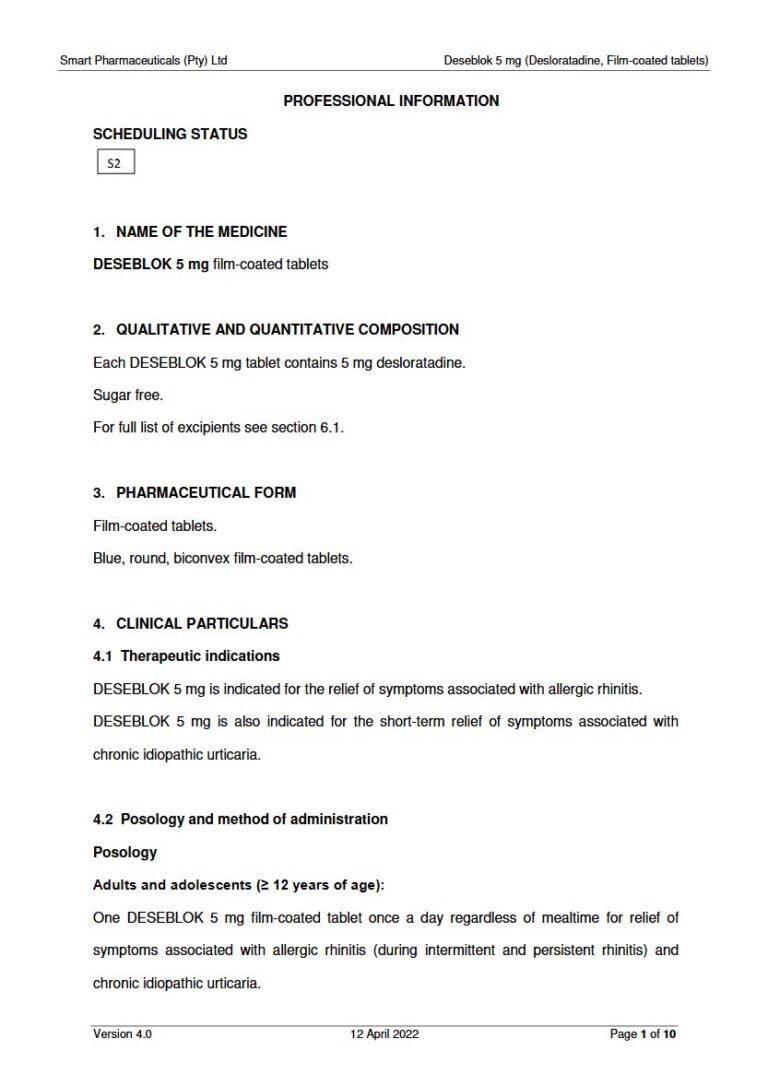
4.1 Therapeutic indications
DESEBLOK 5 mg is indicated for the relief of symptoms associated with allergic rhinitis. DESEBLOK 5 mg is also indicated for the short-term relief of symptoms associated with chronic idiopathic urticaria.
4.2 Posology and method of administration
Posology
Adults and adolescents (u2265 12 years of age): One DESEBLOK 5 mg film-coated tablet once a day regardless of mealtime for relief of symptoms associated with allergic rhinitis (during intermittent and persistent rhinitis) and chronic idiopathic urticaria.
Intermittent allergic rhinitis (presence of symptoms for less than 4 days per week or for less than 4 weeks) should be managed in accordance with the evaluation of the patientu2019s disease history. Treatment can be discontinued after symptoms are resolved and reinitiated upon their reappearance. In persistent allergic rhinitis (presence of symptoms for more than 4 days or more per week or for more than 4 weeks), continued treatment may be proposed to patients during allergen exposure periods. Improvement of symptoms associated with seasonal allergic rhinitis, usually becomes noticeable within 1 u2013 2 hours after administration of DESEBLOK 5 mg.
Method of administration
For oral use with or without food.
4.3 Contraindications
Hypersensitivity to desloratadine or to any of the other inactive ingredients (see section 6.1).
4.4 Special warnings and precautions for use
In the case of severe renal insufficiency, DESEBLOK 5 mg should be taken with caution (see section 5.2). DESEBLOK 5 mg should be taken with caution in patients with medical or family history of seizures, and mainly young children (see section 4.8), being more susceptible to develop new seizures with desloratadine, as in DESEBLOK 5 mg treatment. Healthcare providers may consider discontinuing desloratadine in patients who experience a seizure while on treatment.
Special Precautions
Safety and efficacy of DESEBLOK 5 mg in children under 12 years of age have not been established. Safety and efficacy of desloratadine have not been established for treatment periods in excess of 4 weeks.
4.5 Interactions with other medicines and other forms of interaction
Co-administration of desloratadine, as contained in DESEBLOK 5 mg, with ketoconazole increases the maximum desloratadine concentration (C max) by 45 % and the area under the time concentration curve (AUC) by 37 %. Co-administration of desloratadine, as contained in DESEBLOK 5 mg, with erythromycin increased the C max of desloratadine by 24 % and the AUC by 14 %. Co-administration of desloratadine, as contained in DESEBLOK 5 mg, with azithromycin resulted in an increase of both C max (31 %) and AUC (12 %) of azithromycin. The increase in C max and AUC of desloratadine, as contained in DESEBLOK 5 mg, when co-administered with either ketoconazole or erythromycin did not cause any clinical relevant adverse events in the populations studied. Co-administration of cimetidine with desloratadine, as contained in DESEBLOK 5 mg, did not significantly affect the pharmacokinetics of desloratadine. Co-administration of fluoxetine with desloratadine, as contained in DESEBLOK 5 mg, caused an increase in the C max of desloratadine by 15 % and an increase of 13 % in AUC and 17 % in C max of 3-OH desloratadine respectively. The C max and AUC of fluoxetine were reduced by 9 % and 11 % respectively. The corresponding mean parameters of norfluoxetine increased by 23 % and 18 % respectively, with co-administration of desloratadine, as contained in DESEBLOK 5 mg, and fluoxetine. No clinically relevant changes in desloratadine plasma concentrations were observed in multiple-dose ketoconazole and cimetidine interaction trials. In a clinical pharmacology trial, desloratadine tablets taken concomitantly with alcohol did not potentiate the performance- impairing effects of alcohol (see section 5.1). However, cases of alcohol intolerance and intoxication have been reported during post-marketing use. Therefore, caution is recommended if alcohol is taken concomitantly.
Paediatric population
Interaction studies have only been performed in adults.
4.6 Fertility, pregnancy and lactation
Pregnancy
Desloratadine, as in DESEBLOK 5 mg, were not found to be teratogenic in animal studies. The safe use of DESEBLOK 5 mg during pregnancy has not been established and is therefore not recommended.
Breastfeeding
Desloratadine is excreted into breast milk, therefore the use of DESEBLOK 5 mg is not recommended in breastfeeding woman.
Fertility
There are no data available on male and female fertility.
4.7 Effects on ability to drive and use machines
Desloratadine, as in DESEBLOK 5 mg can cause dizziness and somnolence. It is recommended that patients be advised not to engage in activities requiring mental alertness, such as driving a vehicle or using machines, until they have established their own response to DESEBLOK 5 mg.
4.8 Undesirable effects
System organ class Frequency Adverse reactions
Immune system disorders Less frequent Hypersensitivity reactions (such as anaphylaxis, angioedema, dyspnoea, pruritus, rash and urticaria)
Metabolism and nutrition disorders Frequency unknown Increased appetite
Psychiatric disorders Less frequent Frequency unknown Hallucinations, Abnormal behaviour, aggression
Nervous system disorders Frequent Less frequent Headache, Dizziness, somnolence, insomnia, psychomotor hyperactivity, seizures
Cardiac disorders Less frequent Frequency unknown Tachycardia, palpitations, QT prolongation
Gastrointestinal disorders Frequent Less frequent Dry mouth, Abdominal pain, nausea, vomiting, dyspepsia, diarrhoea
Hepatobiliary disorders Less frequent Frequency unknown Elevations of liver enzymes, increased bilirubin, hepatitis, Jaundice
Skin and subcutaneous tissue disorders Frequency unknown Photosensitivity
Musculoskeletal and connective tissue disorders Less frequent Myalgia
General disorders and administration site conditions Frequent Frequency unknown Fatigue, Asthenia
Investigations Frequency unknown Increase in body mass
Paediatric population
Other undesirable effects reported during the post-marketing period in paediatric patients with an unknown frequency included QT prolongation, dysrhythmia, bradycardia, abnormal behaviour and aggression.
Reporting of suspected adverse reactions
Reporting of suspected adverse reactions after authorisation of DESEBLOK 5 mg is important. It allows continued monitoring of the benefit/risk balance of DESEBLOK 5 mg. Health care providers are asked to report any suspected adverse reactions via the u201c6.04 Adverse Drug Reactions Reporting Formu201d, found online under SAHPRAu2019s publications: https://www.sahpra.org.za/Publications/Index/8
4.9 Overdose
The adverse event profile associated with overdosage, as seen during post-marketing use, is similar to that seen with therapeutic doses, but the magnitude of the effects can be higher.
Symptoms
Based on a multiple dose clinical trial, in which up to 45 mg of desloratadine was administered (nine times the clinical dose), no clinically relevant effects were observed.
Treatment
In the event of overdose, consider standard measures to remove unabsorbed active substance. Symptomatic and supportive treatment is recommended. Desloratadine is not eliminated by haemodialysis; it is not known if it is eliminated by peritoneal dialysis.
