
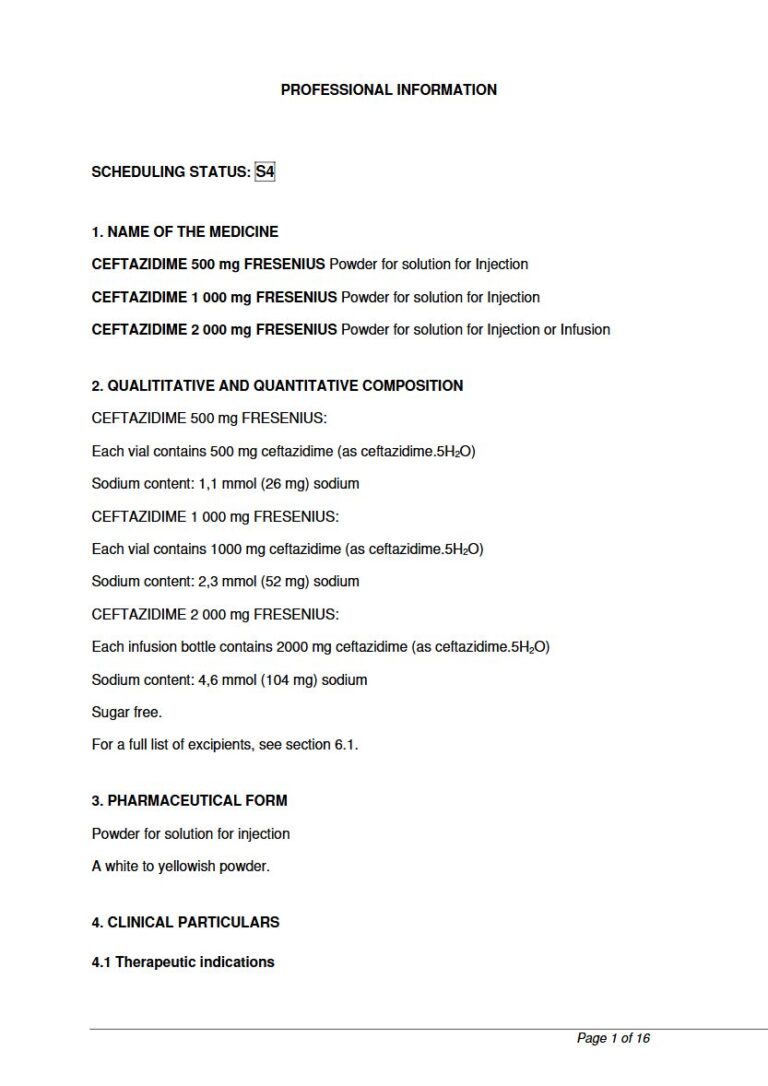
Ceftazidime 500 Mg/000 Mg Solution
PDF Leaflet Revision Date: 09 March 2023
Clinical Summary
Quick overview from the medicine insert
Indication
Treatment of severe infections caused by susceptible organisms.
Dosage (summary)
Adults: 1-6 g/day; 1 g or 2 g IV/IM every 8-12 hours.
Special Populations
- Cystic fibrosis
- Elderly
- Renal impairment
Pregnancy & Breastfeeding
Not established; avoid in pregnancy and breastfeeding.
Key Drug Interactions
- Nephrotoxic agents (e.g., aminoglycosides)
- Probenecid
Contraindications
- Hypersensitivity to ceftazidime or u03b2-lactams
Common side effects
- Diarrhoea
- Rash
- Eosinophilia
Counselling Points
- Report any allergic reactions.
- Monitor for signs of diarrhoea.
- Avoid use in pregnancy unless necessary.
Serious warnings
- Serious hypersensitivity reactions
- Clostridium difficile-associated diarrhoea
Important Disclaimer
The Ceftazidime 500 Mg/000 Mg Solution professional information leaflet below is the property of Fresenius Kabi South Africa and is provided on Medinsert exactly as issued, with no.. alterations or editorial changes. We make every effort to keep content current by updating documents as soon as new versions become available. Medinsert serves as a trusted access point for healthcare professionals, but does not replace official sources or clinical judgement. For more details, please read our full disclaimer. read more>>
 Healthcare Professionals Only
This content is for registered healthcare professionals
Sign in or create a free account to read the full package insert.
Free for HPCSA-registered professionals. Powered by Medinsert.
Clinical Particulars
Section 4 of the official insert — extracted exactly as issued, no alterations
4.1 Therapeutic indications
CEFTAZIDIME FRESENIUS is indicated for the treatment of the following infections when caused by susceptible organisms:
Severe infections including: septicaemia, bacteraemia, peritonitis, and in immunocompromised patients, caused by Streptococcus pyogenes, Streptococcus Group B, Streptococcus pneumoniae, Streptococcus mitis, Streptococcus spp., Escherichia coli, Haemophilus influenzae, Klebsiella pneumoniae, Salmonella spp., Acinetobacter spp., Yersinia enterocolitica, or Pasteurella multocida.
u2022 Respiratory tract infections such as pneumonia, bronchopneumonia, and bronchitis including lung infections in patients with cystic fibrosis, caused by Streptococcus pneumoniae, Haemophilus influenzae, Klebsiella pneumoniae, Haemophilus parainfluenzae, Escherichia coli, Streptococcus pyogenes, Proteus mirabilis, Serratia spp., or Enterobacter spp.
u2022 Ear, nose and throat infections, caused by Streptococcus pneumoniae, Haemophilus influenzae, Klebsiella pneumoniae, Haemophilus parainfluenzae, Escherichia coli, Streptococcus pyogenes, Proteus mirabilis, Serratia spp., or Enterobacter spp.
u2022 Urinary tract infections, caused by Neisseria gonorrhoeae, Escherichia coli, Proteus mirabilis, Klebsiella pneumoniae, Proteus vulgaris, Morganella morganii, Enterobacter spp., or Citrobacter spp.
u2022 Skin and soft tissue infections, caused by Streptococcus pyogenes, Streptococcus spp., Escherichia coli, Enterobacter spp., Klebsiella pneumoniae, Proteus mirabilis, or Morganella morganii.
u2022 Gastrointestinal, biliary and abdominal infections, caused by Escherichia coli, Klebsiella pneumoniae, Streptococcus spp., Salmonella spp., Shigella spp., or Yersinia enterocolitica.
4.2 Posology and method of administration
Posology
General dosage recommendations: CEFTAZIDIME FRESENIUS is to be used by the parenteral route, the dosage depends upon the severity, sensitivity and type of infection and the age, mass and renal function of the patient.
Adults: The adult dosage range for CEFTAZIDIME FRESENIUS is 1 to 6 g per day: for instance, 1 g or 2 g given 12 or 8 hourly by IV or IM injection. In urinary tract infections and in many less serious infections, 500 mg or 1 g, 12 hourly is usually adequate. In the majority of infections, 1 g, 8 hourly or 2 g, 12 hourly should be given. In very severe infections, especially in immunocompromised patients, including those with neutropenia, 2 g, 8 or 12 hourly should be administered.
Special populations
Cystic fibrosis: In fibrocystic adults with normal renal function who have pseudomonal lung infections, high doses of 100 to 150 mg/kg/day as three divided doses should be used. In adults with normal renal function 9 g/day has been used.
Use in elderly: In view of the reduced clearance of ceftazidime in acutely ill elderly patients, the daily dosage should not normally exceed 3 g, especially in those over 80 years of age.
Dosage in impaired renal function: CEFTAZIDIME FRESENIUS is excreted by the kidneys almost exclusively by glomerular filtration. Therefore, in patients with impaired renal function it is recommended that the dosage of CEFTAZIDIME FRESENIUS should be reduced to compensate for its slower excretion, except in mild impairment, i.e. glomerular filtration rate (GFR) greater than 50 mL/min. In patients with suspected renal insufficiency, and initial loading dose of 1 g of CEFTAZIDIME FRESENIUS may be given. An estimate of GFR should be made to determine the appropriate maintenance dose.
Recommended maintenance doses are shown below:
Recommended maintenance doses of CEFTAZIDIME FRESENIUS in renal insufficiency
Creatinine clearance mL/min** Approx. serum creatinine* u03bcmol/l (mg/dl) Recommended unit dose CEFTAZIDIME FRESENIUS (g) Frequency of dosing (hourly)
50 u2013 31 150 u2013 200 (1,7 u2013 2,3) 1 12
30 u2013 16 200 u2013 350 (2,3 u2013 4,0) 1 24
15 u2013 6 350 u2013 500 (4,0 u2013 5,6) 0,5 24
500 (> 5,6) 0,5 48
* The serum creatinine values are approximate values and do not indicate the same degree of impairment for all patients with impaired renal function; this applies especially to elderly patients in which the renal function is over-rated on the basis of the serum creatinine concentration.
** Relative to the body surface
Patients with severe infections, especially neutropenic patients, who would normally receive 6 g of CEFTAZIDIME FRESENIUS daily were it not for renal insufficiency, the unit dose given in the table above may be increased by 50 % or the dosing frequency increased appropriately. In such patients it is recommended that ceftazidime serum levels should be monitored and trough levels should not exceed 40 mg/l. When only serum creatinine is available, the following formula (Cockcroftu2019s equation) may be used to estimate creatinine clearance. The serum creatinine should represent a steady state of renal function:
Creatinine clearance (mL/min) = Males: [140 u2013 age] x mass (kg) Scr(u03bcmol /l) Females: multiply by 0,85
In children the creatinine clearance should be adjusted for body surface area or lean body mass and the dosing frequency reduced in cases of renal insufficiency as for adults. The serum half-life of ceftazidime during haemodialysis ranges from 3 to 5 hours. The appropriate maintenance dose of CEFTAZIDIME FRESENIUS should be repeated following each haemodialysis period.
Paediatric population
Infants and children (> 2 months): The usual dosage range for children aged over two months is 30 to 100 mg/kg/day, given as two or three divided doses. The dosage for children over 2 months but under 1 year is generally 25 to 50 mg/kg twice daily. Doses up to 50 mg/kg three times per day, to a maximum of 6 g daily, may be given to infected immunocompromised or fibrocystic children.
Neonates (and children) up to 2 months of age: Whilst clinical experience is limited, a dose of 60 mg/kg/day given as two divided doses has proved to be effective. In the neonate the serum half-life of ceftazidime can be three to four times that in adults.
Method of administration
CEFTAZIDIME FRESENIUS may be given intravenously or by deep intramuscular injection into a large muscle mass such as the upper outer quadrant of the gluteus maximus or lateral part of the thigh. For single use only. Any remaining solution must be discarded. Only clear solutions practically free from particles should be used. For instructions on reconstitution and dilution before administration of CEFTAZIDIME FRESENIUS, see section 6.6.
4.3 Contraindications
- Hypersensitivity to ceftazidime, cephalosporin antibiotics or to any of the excipients in CEFTAZIDIME FRESENIUS.
- Immediate and severe hypersensitivity (e.g. anaphylactic reaction) to any other type of u03b2-lactam antibacterial medicine (e.g. penicillins, monobactams or carbapenems).
4.4 Special warnings and precautions for use
Antibiotic stewardship
Prescribers should adhere to the principles of antimicrobial stewardship. To reduce the development of drug-resistant bacteria and maintain the effectiveness of CEFTAZIDIME FRESENIUS, it should be used to treat only indicated infections that are proven or strongly suspected to be caused by susceptible bacteria. It is recommended that CEFTAZIDIME FRESENIUS be used only after consultation with a medical practitioner with appropriate experience in the management of infectious diseases.
Hypersensitivity reactions
Serious and occasionally fatal hypersensitivity reactions have been reported. In severe hypersensitivity reactions, treatment with CEFTAZIDIME FRESENIUS must be discontinued immediately and adequate emergency measures must be initiated. Before beginning treatment, it should be established whether the patient has a history of severe hypersensitivity reactions to ceftazidime, to other cephalosporins or to any other type of u03b2-lactam medicine. Caution should be used if CEFTAZIDIME FRESENIUS is given to patients with a history of non-severe hypersensitivity to other u03b2-lactam medicines.
Clostridium difficile -associated diarrhoea
Antibacterial medicine-associated colitis and pseudo-membranous colitis have been reported with CEFTAZIDIME FRESENIUS and may range in severity from mild to life-threatening. Therefore, it is important to consider this diagnosis in patients who present with diarrhoea during or subsequent to the administration of CEFTAZIDIME FRESENIUS (see section 4.8). Discontinuation of therapy with CEFTAZIDIME FRESENIUS and the administration of specific treatment for Clostridium difficile should be considered. Medicines that inhibit peristalsis should not be given.
Patients with renal impairment
Ceftazidime is eliminated via the kidneys; therefore, the dose of CEFTAZIDIME FRESENIUS should be reduced according to the degree of renal impairment. Patients with renal impairment should be closely monitored for both safety and efficacy. Neurological sequelae, including tremor, myoclonus, non-convulsive status epilepticus, convulsion, encephalopathy and coma, have been reported with ceftazidime when the dose has not been reduced in patients with renal impairment (see section 4.2).
Concurrent treatment with high doses of cephalosporins and nephrotoxic medicines such as aminoglycosides or potent diuretics (e.g. furosemide) may adversely affect renal function.
Non-susceptible organisms
Prolonged use of CEFTAZIDIME FRESENIUS may result in the overgrowth of non-susceptible organisms (e.g. enterococci, fungi), which may require interruption of treatment or other appropriate measures.
Non-medicine interference
Ceftazidime does not interfere with enzyme-based tests for glycosuria, but slight interference (false-positive) may occur with copper reduction methods (Benedict's, Fehling's, Clinitest). Ceftazidime does not interfere in the alkaline picrate assay for creatinine.
Direct antiglobulin test (DAGT or Coombs test) seroconversion and potential risk of haemolytic anaemia
Positive results to be direct antiglobulin test (DAGT, or Coombs test) have been found during treatment with CEFTAZIDIME FRESENIUS and these can interfere with blood cross matching and/or may cause medicine induced immune haemolytic anaemia. While DAGT seroconversion in patients receiving CEFTAZIDIME FRESENIUS was frequent in clinical studies, there was no evidence of haemolysis in patients who developed a positive DAGT on treatment (see section 4.8). However, the possibility that haemolytic anaemia could occur in association with CEFTAZIDIME FRESENIUS treatment cannot be ruled out. Patients experiencing anaemia during or after treatment with CEFTAZIDIME FRESENIUS should be investigated for this possibility.
Controlled sodium diet
The sodium content of the medicinal product (26 mg sodium for CEFTAZIDIME 500 mg FRESENIUS, 52 mg sodium for CEFTAZIDIME 1 000 mg FRESENIUS and 104 mg sodium for CEFTAZIDIME 2 000 mg FRESENIUS) should be considered for patients who are on a controlled sodium diet.
Paediatric population
There is a potential risk of overdosing, particularly for paediatric patients aged from 3 to less than 12 months of age. Care should be taken when calculating the volume of administration of the dose (see section 4.2).
4.5 Interaction with other medicines and other forms of interaction
The concomitant use of a nephrotoxic medicine such as the aminoglycoside gentamicin may increase the risk of kidney damage with CEFTAZIDIME FRESENIUS. There is also some evidence for enhanced nephrotoxicity with a loop diuretic like furosemide.
The renal excretion of CEFTAZIDIME FRESENIUS is inhibited by probenecid.
There may be antagonism between CEFTAZIDIME FRESENIUS and bacteriostatic antibacterial agents. Chloramphenicol is antagonistic in vitro with ceftazidime and other cephalosporins. The clinical relevance of this finding is unknown, but if concurrent administration of CEFTAZIDIME FRESENIUS with chloramphenicol is proposed, the possibility of antagonism should be considered.
4.6 Fertility, pregnancy and lactation
Pregnancy
Safety in pregnancy has not been established. CEFTAZIDIME FRESENIUS should not be used during pregnancy unless clearly necessary.
Breastfeeding
Safety of breastfeeding has not been established. Ceftazidime is excreted in human milk. Women receiving CEFTAZIDIME FRESENIUS should not breastfeed their infants.
Fertility
The effects of ceftazidime on fertility in humans have not been studied. Animal studies with ceftazidime do not indicate harmful effects with respect to fertility.
4.7 Effects on ability to drive or use machines
Undesirable effects may occur (e.g. dizziness), which may influence the ability to drive and use machines (see section 4.8).
4.8 Undesirable effects
Summary of the safety profile
The most frequent adverse reactions are eosinophilia, thrombocytosis, phlebitis or thrombophlebitis with intravenous administration, diarrhoea, transient increases in hepatic enzymes, maculopapular or urticarial rash, pain and/or inflammation following intramuscular injection and positive antiglobulin test (DAGT).
Tabulated list of adverse reactions
System organ class/frequency Adverse reaction
Infections and infestations
Frequent: Candidiasis (including vulvovaginal candidiasis and oral candidiasis), vaginitis.
Less frequent: Clostridium difficile colitis, pseudomembranous colitis
Blood and lymphatic system disorders
Frequent: Positive direct antiglobulin test (DAGT) (see section 4.4), eosinophilia, thrombocytosis, thrombocytopenia
Less frequent: Neutropenia, leukopenia, lymphocytosis
Frequency unknown: Agranulocytosis, haemolytic anaemia
Immune system disorders
Frequent: Hypersensitivity reactions
Frequency unknown: Anaphylaxis
Nervous system disorders
Frequent: Headache, dizziness
Less frequent: Paraesthesia
Frequency unknown: Convulsions and other signs of CNS toxicity, especially in patients with severe renal impairment
Gastrointestinal disorders
Frequent: Diarrhoea, abdominal pain, nausea, vomiting
Less frequent: Dysgeusia
Frequency unknown: Prolonged use may result in overgrowth of non-susceptible organisms.
Hepatobiliary disorders
Frequent: Increased alanine aminotransferase, increased aspartate aminotransferase, increased blood alkaline phosphatase, increased Gamma-glutamyltransferase, increased blood lactate dehydrogenase
Frequency unknown: Hepatitis and cholestatic jaundice
Skin and subcutaneous tissue disorders
Frequent: Maculopapular rash, urticaria, pruritus
Frequency unknown: Stevens-Johnson syndrome, erythema multiforme, toxic epidermal necrolysis, angioedema, Drug Reaction with Eosinophilia and Systemic Symptoms (DRESS)
Renal and urinary disorders
Less frequent: Increased blood creatinine, increased blood urea, acute kidney injury, tubulointerstitial nephritis
General disorders and administration site conditions
Frequent: Infusion site thrombosis, infusion site phlebitis, pyrexia
Frequency unknown: Pain and/or inflammation at the injection site following intramuscular administration
Reporting of suspected adverse reactions
Reporting suspected adverse reactions after authorisation of the medicine is important. It allows continued monitoring of the benefit/risk balance of the medicine. Health care providers are requested to report any suspected adverse drug reactions to SAHPRA via the Med Safety APP (Medsafety X SAHPRA) and eReporting platform (who-umc.org) found on SAHPRA website. Healthcare providers are asked to report any suspected adverse drug reactions to the Holder of the Certificate of Registration at the following email address: [email protected] and to the relevant medicineu2019s regulatory authority in the country where the product is marketed.
4.9 Overdose
See section 4.8. Overdosage can lead to neurological sequelae including encephalopathy, convulsions and coma. Serum levels of CEFTAZIDIME FRESENIUS are reduced by dialysis. Treatment is supportive and symptomatic.
