
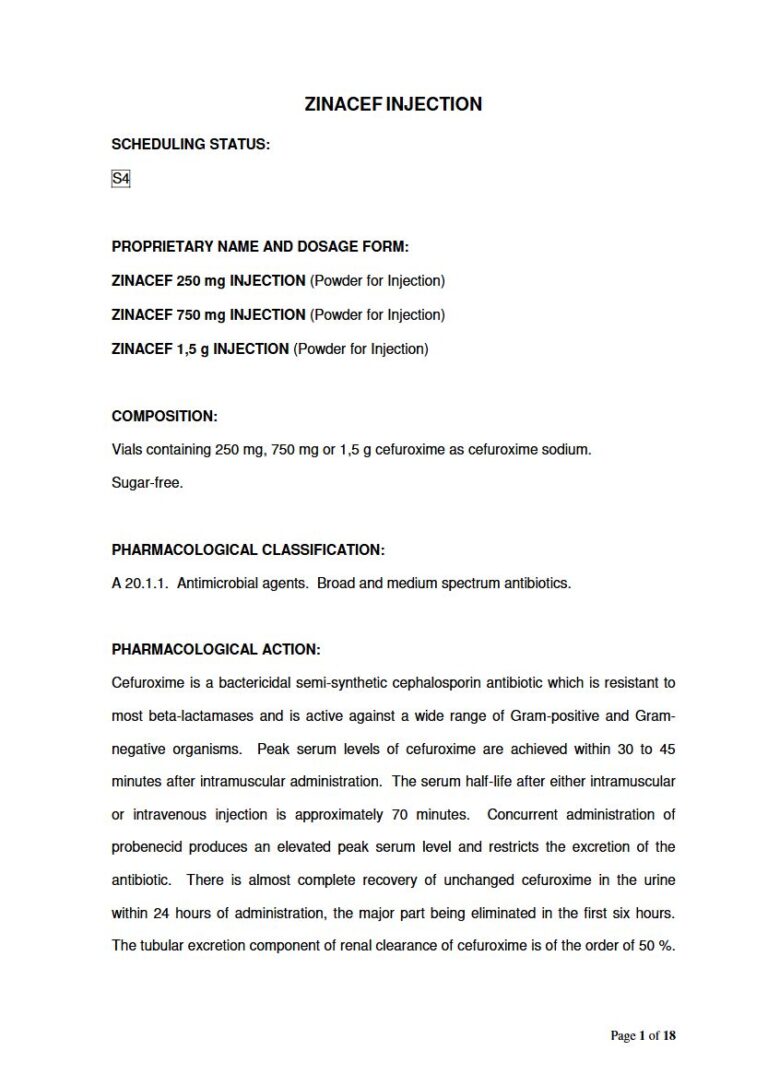
Zinacef 250mg, 750mg & 1.5g Injection
PDF Leaflet Revision Date: 28 September 2000
Clinical Summary
Quick overview from the medicine insert
Indication
Treatment of infections caused by susceptible organisms.
Dosage (summary)
Adults: 1.5 to 6 g/day; 750 mg three times daily for mild infections, 1.5 g three times daily for severe infections.
Onset of Action / Duration
Onset: 30-45 mins, Duration: ~70 mins
Special Populations
- Renal impairment
Pregnancy & Breastfeeding
Safety in pregnancy and lactation not established.
Key Drug Interactions
- Probenecid may elevate serum levels
- Avoid furosemide due to nephrotoxicity risk
Contraindications
- Hypersensitivity to cephalosporins
Common side effects
- Rashes
- Thrombophlebitis
- Gastrointestinal disturbance
- Candida intertrigo
Counselling Points
- Report any allergic reactions
- Monitor for loose stools
- Do not use with other medications simultaneously
Serious warnings
- Monitor renal function in patients with renal impairment
- Risk of antibiotic colitis with prolonged use
Important Disclaimer
The Zinacef 250mg, 750mg & 1.5g Injection professional information leaflet below is the property of Gsk and is provided on Medinsert exactly as issued, with no.. alterations or editorial changes. We make every effort to keep content current by updating documents as soon as new versions become available. Medinsert serves as a trusted access point for healthcare professionals, but does not replace official sources or clinical judgement. For more details, please read our full disclaimer. read more>>
 Healthcare Professionals Only
This content is for registered healthcare professionals
Sign in or create a free account to read the full package insert.
Free for HPCSA-registered professionals. Powered by Medinsert.
Clinical Particulars
Section 4 of the official insert — extracted exactly as issued, no alterations
4.1 Therapeutic indications
Cefuroxime is indicated for the treatment of the following infections when caused by susceptible strains of the designated micro-organisms:
- Respiratory tract infections.
- Ear, nose and throat infections.
- Urinary tract infections.
- Soft tissue infections.
- Obstetrics and gynaecological infections.
- Gonorrhoea.
- Prophylaxis against infection in abdominal, gynaecological, cardiac and pulmonary surgery where there is increased risk from infection.
Bacteriology: Sensitivity tests should be carried out whenever possible. Cefuroxime has activity against:
- Staphylococcus aureus including penicillin-resistant strains but not the rare methicillin-resistant strains.
- Escherichia coli.
- Klebsiella spp.
- Enterobacter spp.
- Streptococcus pyogenes.
- Streptococcus viridians.
- Clostridium spp.
- Proteus mirabilis.
- Proteus rettgeri.
- Proteus vulgaris.
- Proteus morganii.
- Neisseria spp - including u03b2-lactamase producing strains of N. gonorrhoeae.
- Haemophilus influenzae.
- Bacteroides fragilis.
- Staphylococcus epidermidis.
4.2 Posology and method of administration
General dosage recommendation:
Adults: The dosage range for cefuroxime lies between 1,5 to 6,0 g/day. Many infections will respond to 750 mg three times daily by intramuscular or intravenous injection. For more severe infections, this dose should be increased to 1,5 g three times daily intravenously. The frequency of intramuscular or intravenous injection can be increased to six hourly if necessary.
Infants and children: Doses of 30 to 100 mg/kg/day, given as 3 or 4 divided doses. A dose of 60 mg/kg/day will be appropriate for most infections.
Other recommendations:
Gonorrhoea: 1,5 g cefuroxime should be given as a single dose. This may be given as 2 x 750 mg injections into different sites, e.g. each buttock.
Prophylaxis: The usual dose is 1,5 g intravenously with induction of anaesthesia for abdominal and gynaecological operations, but may be supplemented with two 750 mg intramuscular doses 8 and 16 hours later. In cardiac and pulmonary operations, the usual dose is 1,5 g intravenously with induction of anaesthesia continuing with 750 mg intramuscularly three times daily for a further 24 to 48 hours.
Dosage in impaired renal function: Cefuroxime is excreted by the kidneys. Therefore, in patients with markedly impaired renal function it is recommended that the dosage of cefuroxime should be reduced to compensate for its slower excretion. However, it is not necessary to reduce the dose until the GFR falls below 20 ml/min. In adults with marked impairment (GFR 10 to 20 ml/min), 750 mg twice daily is recommended and with severe impairment (GFR less than 10 ml/min) 750 mg once daily is adequate. For patients on dialysis, a further 750 mg dose should be given at the end of each dialysis. When continuous peritoneal dialysis is being used, a suitable dosage is usually 750 mg twice daily.
Administration:
Intramuscular injection: Add 1 ml sterile Water for Injections to 250 mg cefuroxime or 3 ml sterile Water for Injections to 750 mg cefuroxime. Shake gently to produce an opaque suspension. Suspensions which appear granular must be discarded.
Intravenous injection: Dissolve cefuroxime in sterile Water for Injections using at least 2 ml for 250 mg, at least 6 ml for 750 mg, or 15 ml for 1,5 g. Solutions which appear turbid must be discarded.
Intravenous infusion: For short intravenous infusion (30 to 60 minutes) 1,5 g may be dissolved in 50 ml sterile Water for Injections. These solutions may be given directly into the vein or introduced into the tubing of the giving set if the patient is receiving parenteral fluids. Solutions which appear turbid must be discarded. Suspensions of cefuroxime for intramuscular injection and aqueous solutions for direct intravenous injection should be used within 5 hours if kept below 25 u00b0C or within 48 hours if refrigerated. Some increase in colour may occur on storage. Solutions for short intravenous infusion (1,5 g plus 50 ml sterile Water for Injections) which show less increase in colour, should be used within 24 hours if kept below 25 u00b0C or within 72 hours if refrigerated. Cefuroxime is compatible with the more commonly used intravenous fluids. It will retain potency for up to 24 hours at room temperature in Sodium Chloride Injection B.P. 0,9 % m/v, 5 % Dextrose Injection B.P., 0,18 % m/v Sodium Chloride plus 4 % Dextrose Injection B.P. and Compound Sodium Lactate Injection B.P. (Hartmann's solution). The pH of 2,74 % m/v Sodium Bicarbonate Injection B.P. considerably affects the colour of the solution and therefore this solution is not recommended for the dilution of cefuroxime. However, if required for patients receiving Sodium Bicarbonate Injection by infusion the cefuroxime may be introduced into the tube of the giving set. The stability of cefuroxime in Sodium Chloride Injection B.P. 0,9 % m/v and in 5 % Dextrose Injection is not affected by the presence of hydrocortisone sodium phosphate. Cefuroxime is also compatible with aqueous solutions containing up to 1 % lignocaine hydrochloride.
4.3 Contraindications
Hypersensitivity to cephalosporin antibiotics.
4.4 Special warnings and precautions for use
Special care is indicated in patients who have experienced an allergic reaction to penicillins or other u03b2-lactams. Prolonged use may result in the overgrowth of non-susceptible organisms. Patients developing frequent loose stools should be carefully monitored for the possible development of an antibiotic colitis. Concomitant use of ZINACEF and furosemide should be avoided when possible. If they are used together renal function should be monitored closely as furosemide may enhance the nephrotoxic potential of the cephalosporins. The combined use of cephalosporins and aminoglycosides seems to increase the risk of nephrotoxicity and should be undertaken with caution and with close monitoring of renal function. As a precaution, renal function should be monitored if this is already impaired.
4.5 Interactions with other medicines
ZINACEF does not interfere in enzyme-based tests for glucosuria. Slight interference with copper reduction methods (Benedict's, Fehling's, Clinitest) may be observed. However, this should not lead to false-positive results. ZINACEF may cause false-negative reactions in the ferricyanide test. Some cephalosporins can cause a falsely high reading in the alkaline picrate assay for creatinine, although the degree of elevation is unlikely to be of clinical importance. It is possible that cefuroxime may also interfere with this determination. ZINACEF must not be administered simultaneously with other medicines.
4.6 Fertility, pregnancy and lactation
Safety in pregnancy and lactation has not been established.
4.7 Effects on ability to drive and use machines
Not provided in the text.
4.8 Undesirable effects
Effects reported include rashes, thrombophlebitis after intravenous injection, gastrointestinal disturbance and Candida intertrigo. The principal changes in haematological parameters seen in some patients have been of unexplained decreased haemoglobin concentration and of eosinophilia. Patients developing eosinophilia should have renal function closely monitored since hypersensitivity with acute renal failure has previously been documented. Patients developing decreased haemoglobin concentration should have bone marrow response monitored. Leucopenia and neutropenia have also been noted. A positive Coombs' test has been found in patients treated with cefuroxime; this phenomenon can interfere with the cross-matching of blood. There are sometimes rises in serum liver enzymes or serum bilirubin particularly in patients with pre-existing liver disease. There may also be some variation in the results of biochemical tests of renal function but these do not appear to be of clinical importance. Hypersensitivity reactions including skin rashes (maculopapular and urticarial), drug fever and anaphylaxis have been reported. Transient pain may be experienced at the site of intramuscular injection. This is more likely to occur with higher doses. However, it is unlikely to be a cause for discontinuation of treatment.
4.9 Overdose
See SIDE EFFECTS. Serum levels of cefuroxime are reduced by dialysis. Treatment is supportive and symptomatic.
