
Cefuroxime 750 Mg/500 Mg Solution
PDF Leaflet Revision Date: 18 August 2025
Clinical Summary
Quick overview from the medicine insert
Indication
Treatment of infections caused by susceptible organisms.
Dosage (summary)
Adults: 750 mg to 1.5 g three times daily; adjust for renal impairment.
Onset of Action / Duration
Onset: 30-45 mins, Duration: 6-8 hours
Special Populations
- Renal impairment
- Hepatic impairment
Pregnancy & Breastfeeding
Safety in pregnancy and breastfeeding not established.
Key Drug Interactions
- Aminoglycosides
- Diuretics
- Probenecid
Contraindications
- Hypersensitivity to cephalosporins
- Hypersensitivity to penicillins
Common side effects
- Neutropenia
- Eosinophilia
- Injection site reactions
Counselling Points
- Monitor for allergic reactions
- Report severe skin reactions immediately
Serious warnings
- Severe cutaneous adverse reactions
- Hypersensitivity reactions
Important Disclaimer
The Cefuroxime 750 Mg/500 Mg Solution professional information leaflet below is the property of Fresenius Kabi South Africa and is provided on Medinsert exactly as issued, with no.. alterations or editorial changes. We make every effort to keep content current by updating documents as soon as new versions become available. Medinsert serves as a trusted access point for healthcare professionals, but does not replace official sources or clinical judgement. For more details, please read our full disclaimer. read more>>
 Healthcare Professionals Only
This content is for registered healthcare professionals
Sign in or create a free account to read the full package insert.
Free for HPCSA-registered professionals. Powered by Medinsert.
Clinical Particulars
Section 4 of the official insert — extracted exactly as issued, no alterations
4.1 Therapeutic indications
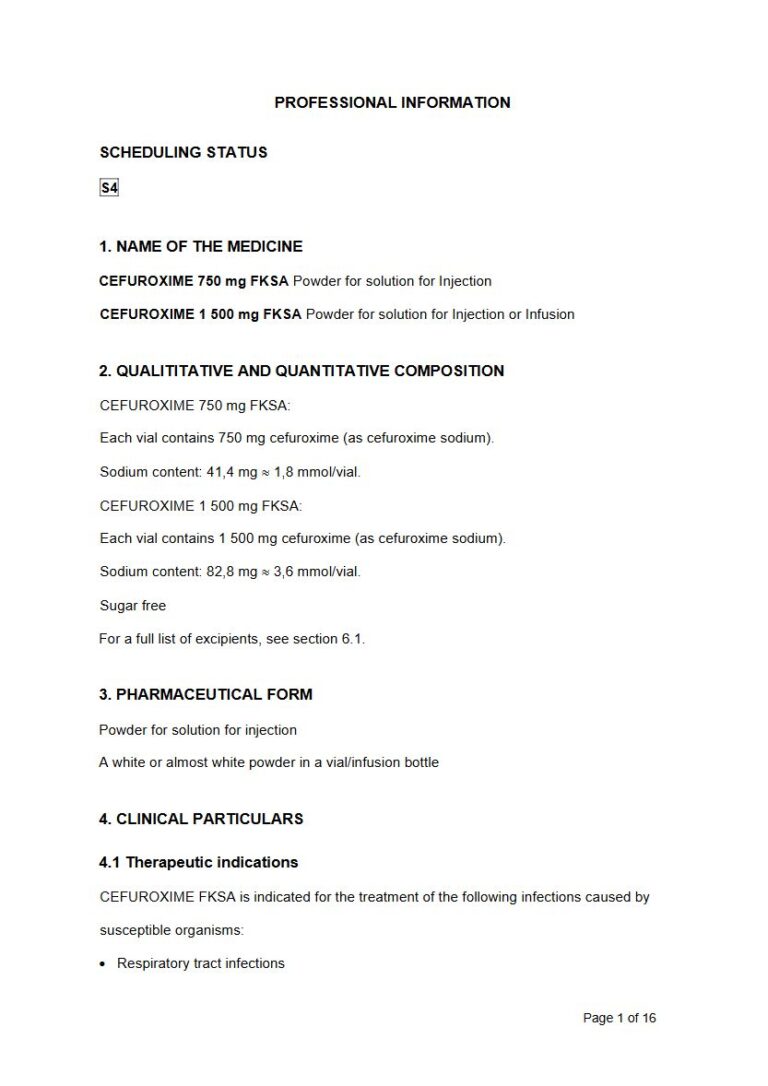
CEFUROXIME FKSA is indicated for the treatment of the following infections caused by susceptible organisms:
- Respiratory tract infections
- Ear, nose and throat infections
- Urinary tract infections
- Soft tissue infections
- Obstetric and gynaecological infections
- Gonorrhoea
- Prophylaxis against infection in abdominal, gynaecological, cardiac and pulmonary surgery where there is increased risk for infection.
Sensitivity tests should be carried out whenever possible. In vitro sensitivity does not imply in vivo efficacy (clinical).
CEFUROXIME FKSA has activity against the following organisms:
- Staphylococcus aureus including penicillin-resistant strains, but not rare methicillin-resistant strains
- Escherichia coli
- Klebsiella spp.
- Enterobacter spp.
- Streptococcus pyogenes
- Streptococcus viridans
- Clostridium spp.
- Proteus mirabilis
- Proteus rettgeri
- Proteus vulgaris
- Proteus morganii
- Neisseria spp. u2013 including u03b2-lactamase producing strains of N. gonorrhoeae
- Haemophilus influenzae
- Bacteroides fragilis
- Staphylococcus epidermidis
In the treatment of infections caused by Pseudomonas aeruginosa, an aminoglycoside should be administered concomitantly.
4.2 Posology and method of administration
Posology
General dosage recommendation:
Adults: Dosage range for CEFUROXIME FKSA lies between 1,5 to 6,0 g/day. Many infections will respond to 750 mg three times daily by intramuscular or intravenous injection. For more severe infections, this dose should be increased to 1,5 g three times daily intravenously. The frequency of intramuscular or intravenous injections can be increased to six hourly if necessary.
Infants > 3 months and children: Doses of 30 to 60 mg/kg/day, increased to 100 mg/kg/day if necessary, given in 3 or 4 divided doses. A dose of 60 mg/kg/day will be appropriate for most infections.
Other recommendations:
Gonorrhoea: 1,5 g CEFUROXIME FKSA should be given as a single dose. This may be given as 2 x 750 mg injections into different sites, e.g. each buttock.
Prophylaxis (surgical infections):
Abdominal and gynaecological operations: The usual dose is 1,5 g CEFUROXIME FKSA intravenously with induction of anaesthesia and may be supplemented by 2 x 750 mg intramuscular doses 8 and 16 hours later.
Cardiac and pulmonary operations: The usual dose is 1,5 g intravenously with induction of anaesthesia, continuing with 750 mg intramuscularly three times daily for a further 24 to 48 hours.
Special populations
Dosage in impaired renal function: The dosage of CEFUROXIME FKSA should be reduced in patients with impaired renal function to compensate for its slower excretion. It is not necessary to reduce the dose until the GFR falls below 20 mL/min.
Creatinine clearance (mL/min) Dose (base)
- 10 u2013 20 750 mg every 12 hours
- < 10 750 mg every 24 hours
- Haemodialysis patients 750 mg at the end of each dialysis period
- Continuous peritoneal dialysis patients 750 mg every 12 hours
Method of administration
Intramuscular injection: See Posology. For instructions on preparation of CEFUROXIME FKSA, see section 6.6. Suspensions which appear granular must be discarded.
Intravenous injection: CEFUROXIME FKSA may be given by slow intravenous injection over 3 to 5 minutes. When reconstituted the white to almost white powder gives a colourless to slightly yellow solution. Inspect the reconstituted solution visually for particulate matter and discolouration prior to administration. The reconstituted solution must be clear. For single use only. Any remaining solution should be discarded. For instructions on preparation of CEFUROXIME FKSA before administration, see section 6.6.
Intravenous infusion: For short intravenous infusion (30 to 60 minutes) 1,5 g may be dissolved in 50 mL sterile water for injection. These solutions may be given directly into the vein or introduced into the tubing of the giving set if the patient is receiving parenteral fluids. Solutions which appear turbid must be discarded. For information on compatible intravenous fluids, see section 6.6. For instructions on preparation of CEFUROXIME FKSA before administration, see section 6.6.
4.3 Contraindications
- Hypersensitivity to cephalosporin antibiotics or to any component of the formulation, listed in section 6.1.
- Hypersensitivity to penicillin and other u03b2-lactam antibiotics.
4.4 Special warnings and precautions for use
Hypersensitivity reactions: Before CEFUROXIME FKSA is used, careful examination should be made concerning previous hypersensitivity reactions to cephalosporins, penicillins or other medicines. There have been reports of hypersensitivity reactions which progressed to Kounis syndrome (acute allergic coronary arteriospasm that can result in myocardial infarction, see section 4.8).
Severe cutaneous adverse reactions (SCARS): Severe cutaneous adverse reactions including Stevens-Johnson syndrome (SJS), toxic epidermal necrolysis (TEN) and drug reaction with eosinophilia and systemic symptoms (DRESS), which can be life-threatening or fatal, have been reported in association with cefuroxime treatment (see section 4.8). At the time of prescription, patients should be advised of the signs and symptoms and monitored closely for skin reactions. If signs and symptoms suggestive of these reactions appear, cefuroxime should be withdrawn immediately and an alternative treatment considered. If the patient has developed a serious reaction such as SJS, TEN or DRESS with the use of cefuroxime, treatment with cefuroxime must not be restarted in this patient at any time.
CEFUROXIME FKSA should be used with caution in patients with:
- A history of gastrointestinal disease, especially ulcerative colitis, regional enteritis or pseudomembranous colitis.
- Hepatic impairment or poor nutritional state.
- Renal function impairment u2013 a reduced dose may be required.
- Porphyria: safety has not been established.
Overgrowth of non-susceptible microorganisms: Prolonged use of CEFUROXIME FKSA may result in the overgrowth of non-susceptible organisms (e.g. enterococci and Clostridioides difficile). Pseudomembranous colitis may occur which may range in severity from mild to life threatening. Patients who develop abdominal or stomach cramps, abdominal tenderness, severe and watery diarrhoea (which may be bloody) and fever, should be investigated for this diagnosis. If the diagnosis of pseudomembranous colitis is suspected, CEFUROXIME FKSA should be stopped immediately and appropriate therapy initiated. Medicines that inhibit peristalsis should not be given.
Intracameral use and eye disorders: CEFUROXIME FKSA is not formulated for intracameral use. Individual cases and clusters of serious ocular adverse reactions have been reported following unapproved intracameral use of cefuroxime sodium compounded from vials approved for intravenous/intramuscular administration. These reactions included macular oedema, retinal oedema, retinal detachment, retinal toxicity, visual impairment, visual acuity reduced, vision blurred, corneal opacity and corneal oedema.
Intra-abdominal infections: Due to its spectrum of activity, CEFUROXIME FKSA is not suitable for the treatment of infections caused by Gram negative non-fermenting bacteria (see section 5.1).
Other medicines: Do not administer CEFUROXIME FKSA simultaneously with other medicines.
Concurrent treatment with potent diuretics or aminoglycosides: Concomitant use of CEFUROXIME FKSA and furosemide should be avoided, if possible. If these medications must be used together, renal function should be monitored closely as furosemide may enhance the nephrotoxic potential of CEFUROXIME FKSA. The combined use of CEFUROXIME FKSA and aminoglycosides seems to increase the risk of nephrotoxicity and must be taken with caution and close monitoring of renal function.
Interference with serological testing: The development of a positive Coombs test associated with the use of cefuroxime may interfere with cross matching of blood (see section 4.8). Slight interference with copper reduction methods (Benedict's, Fehling's, Clinitest) may be observed. However, this should not lead to false-positive results, as may be experienced with some other cephalosporins.
As a false negative result may occur in the ferricyanide test, it is recommended that either the glucose oxidase or hexokinase methods are used to determine blood/plasma glucose levels in patients receiving cefuroxime sodium.
Paediatric use: Safety and effectiveness have not been established in paediatric patients aged 3 months and younger.
Important information about sodium: CEFUROXIME 750 mg FKSA contains 41,4 mg sodium per vial, equivalent to 2,1 % of the WHO recommended maximum daily intake of 2 g sodium for an adult. CEFUROXIME 1 500 mg FKSA contains 82,8 mg sodium per vial, equivalent to 4,15 % of the WHO recommended maximum daily intake of 2 g sodium for an adult.
4.5 Interaction with other medicines and other forms of interaction
Cefuroxime may affect the gut flora, leading to lower oestrogen reabsorption and reduced efficacy of combined oral contraceptives. Concomitant use with oral anticoagulants may give rise to increased international normalised ratio (INR).
The following medicine interactions may occur when using CEFUROXIME FKSA:
- Aminoglycoside antibiotics u2013 may result in nephrotoxicity.
- Diuretics u2013 renal function may be affected, thereby affecting elimination.
- Probenecid u2013 concurrent administration of probenecid reduces renal clearance of cefuroxime.
- Concomitant use of cefuroxime and furosemide should be avoided when possible. If they are used together renal function should be monitored closely as furosemide may enhance the nephrotoxic potential of the cephalosporins.
Interactions with laboratory tests:
The following have been selected on the basis of their potential clinical significance, with diagnostic test results:
- Antiglobulin tests (Coombs tests) u2013 a positive reaction may occur (see section 4.4).
- Benedictu2019s solution, CLINITEST u00ae tablets or Fehlingu2019s solution u2013 a false positive reaction for glucose in the urine may occur (see section 4.4).
- Ferricyanide test u2013 a false negative result for blood plasma glucose may occur (see section 4.4).
4.6 Fertility, pregnancy and lactation
Pregnancy: Cefuroxime has been shown to cross the placenta after intramuscular or intravenous dose to the mother. Safety in pregnancy has not been established.
Breastfeeding: Cefuroxime is excreted in human milk in small quantities. Safety of breastfeeding has not been established.
Fertility: There are no data on the effects of cefuroxime on fertility in humans.
4.7 Effects on ability to drive or use machines
CEFUROXIME FKSA is not expected to have an influence on the ability to drive or use machines, but patients should not drive, use machinery or perform any tasks that require concentration until they are certain that CEFUROXIME FKSA does not adversely affect their ability to do so safely (see section 4.8).
4.8 Undesirable effects
Summary of the safety profile: The most frequent adverse reactions are neutropenia, eosinophilia, transient rise in liver enzymes or bilirubin, particularly in patients with pre-existing liver disease, but there is no evidence of harm to the liver and injection site reactions.
Tabulated list of adverse reactions:
Infections and infestations:
Frequency unknown: Candida overgrowth, overgrowth of Clostridioides difficile
Blood and lymphatic system disorders:
Frequent: Neutropenia, eosinophilia, decreased haemoglobin concentration
Less frequent: Leukopenia, thrombocytopenia, hypoprothrombinaemia, haemolytic anaemia
Frequency unknown: Agranulocytosis, pancytopenia
Immune system disorders:
Less frequent: Hypersensitivity reactions including skin rashes, urticaria, pruritus, bronchospasm, drug fever, serum sickness, anaphylaxis, angioedema, cutaneous vasculitis
Nervous system disorders:
Frequent: Headache
Less frequent: Seizures
Ear and labyrinth disorders:
Less frequent: Mild to moderate hearing loss
Cardiac disorders:
Frequency unknown: Kounis syndrome
Gastrointestinal disorders:
Less frequent: Nausea; vomiting; abdominal pain, diarrhoea, in some cases accompanied by blood in the stools, which may be a symptom of enterocolitis. A particular form of enterocolitis is pseudomembranous colitis (see section 4.4)
Hepato-biliary disorders:
Frequent: Transient rise in liver enzymes
Less frequent: Transient rise in bilirubin
Frequencies unknown: Hepatic dysfunction including cholestasis
Skin and subcutaneous tissue disorders:
Less frequent: Skin rash, erythema multiforme, Stevens-Johnson syndrome, toxic epidermal necrolysis, urticaria, pruritus
Frequency unknown: Drug Reaction with Eosinophilia and Systemic Symptoms (DRESS)
Renal and urinary disorders:
Less frequent: Interstitial nephritis
Frequency unknown: Elevations in serum creatinine, elevations in blood urea nitrogen and decreased creatinine clearance (see section 4.4)
General disorder and administration site conditions:
Frequent: Injection site reactions which may include pain and thrombophlebitis
Investigations:
Less frequent: The use of CEFUROXIME FKSA may be accompanied by a false positive Coombs test. This may interfere with the performance of cross tests with blood (see section 4.5)
Reporting of suspected adverse reactions: Reporting suspected adverse reactions after authorisation of the medicine is important. It allows continued monitoring of the benefit/risk balance of the medicine. Healthcare providers are requested to report any suspected adverse drug reactions to SAHPRA via the Med Safety APP (Medsafety X SAHPRA) and eReporting platform (who-umc.org) found on SAHPRA website. Healthcare providers are asked to report any suspected adverse drug reactions to the Holder of the Certificate of Registration at the following email address: [email protected] and to the relevant medicineu2019s regulatory authority in the country where the product is marketed.
4.9 Overdose
Symptoms of overdose: Overdose can cause cerebral irritation leading to convulsions.
Treatment of overdose: Treatment is symptomatic and supportive. Serum levels of CEFUROXIME FKSA can be reduced by haemodialysis or peritoneal dialysis.
