
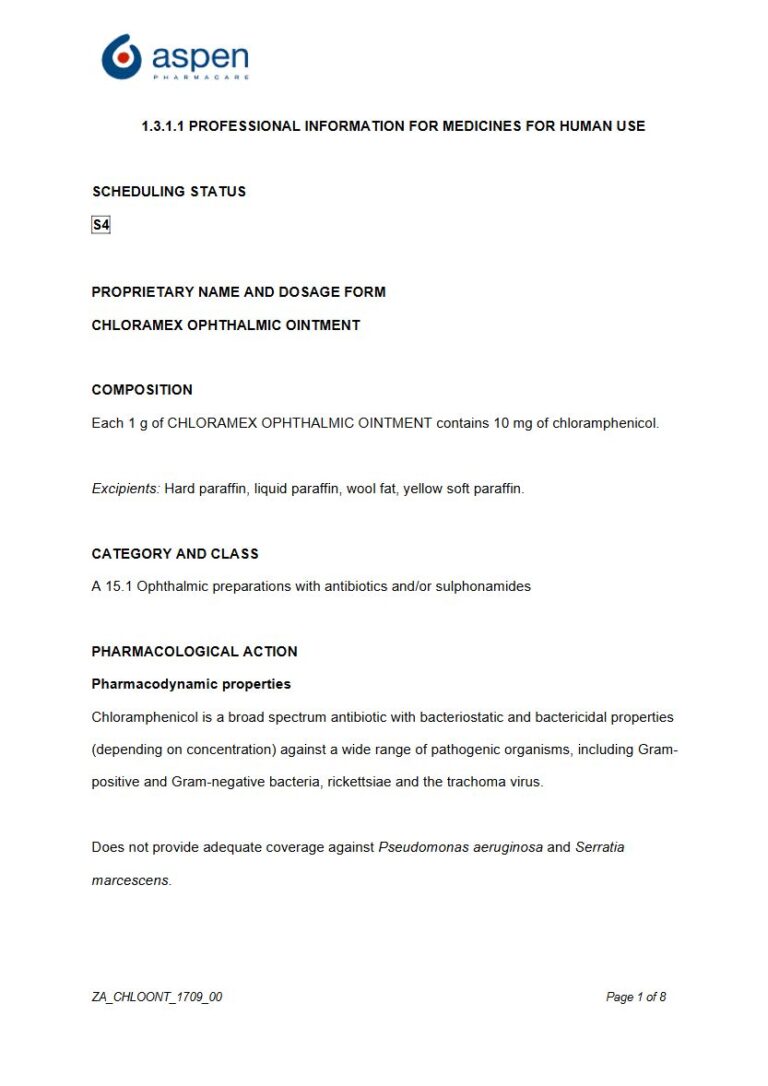
Chloramex 10mg Ointment
PDF Leaflet Revision Date: 29 September 2017
Clinical Summary
Quick overview from the medicine insert
Indication
Superficial infections of the eye and eyelid.
Dosage (summary)
Apply four times daily to the affected area.
Pregnancy & Breastfeeding
Safety in pregnancy and lactation not established; may cross placenta and appear in breast milk.
Key Drug Interactions
- Enhances effects of coumarin anticoagulants and some hypoglycaemics.
- May impair action of oral contraceptives.
Contraindications
- Hypersensitivity to chloramphenicol or excipients.
- History of blood dyscrasias.
Common side effects
- Transient burning, stinging sensations.
- Anaphylaxis, angio-oedema.
Counselling Points
- Consult doctor if no improvement in 48 hours.
- Do not wear contact lenses during treatment.
Serious warnings
- For ophthalmic use only.
- Prolonged use may lead to resistance.
Important Disclaimer
The Chloramex 10mg Ointment professional information leaflet below is the property of Aspen Pharmacare and is provided on Medinsert exactly as issued, with no.. alterations or editorial changes. We make every effort to keep content current by updating documents as soon as new versions become available. Medinsert serves as a trusted access point for healthcare professionals, but does not replace official sources or clinical judgement. For more details, please read our full disclaimer. read more>>
 Healthcare Professionals Only
This content is for registered healthcare professionals
Sign in or create a free account to read the full package insert.
Free for HPCSA-registered professionals. Powered by Medinsert.
Clinical Particulars
Section 4 of the official insert — extracted exactly as issued, no alterations
4.1 Indications
Superficial infections of the eye and eyelid, including conjunctivitis, uveitis, corneitis, blepharitis and trachoma.
4.2 Posology and method of administration
For ophthalmic use only. Eye infections: Draw down the lower lid and squeeze a small amount into the corner of the eye and massage gently over the eye surface. Apply four times daily. Eyelid infections: Apply four times daily to the affected area with the fingertip.
4.3 Contraindications
CHLORAMEX OPHTHALMIC OINTMENT is contraindicated in:
- Patients with hypersensitivity to chloramphenicol or to any of the excipients in CHLORAMEX OPHTHALMIC OINTMENT (see COMPOSITION).
- Patients with a known personal or family history of blood dyscrasias including aplastic anaemia.
4.4 Special warnings and precautions for use
For ophthalmic use only. Do not use if you are allergic to chloramphenicol or any of the ingredients (see CONTRAINDICATIONS). Hypersensitivity reactions including rashes, fever, and angioedema may occur especially after topical use; anaphylaxis has occurred. Jarisch-Herxheimer reactions may also occur. Gastrointestinal symptoms including nausea, vomiting, and diarrhoea can follow oral use. Disturbances of the oral and intestinal flora may cause stomatitis, glossitis, and rectal irritation. Systemically administered chloramphenicol has caused both fatal and non-fatal blood dyscrasias, such as agranulocytosis and aplastic anaemia in a small percentage of cases. It is not considered advisable to use CHLORAMEX OPHTHALMIC OINTMENT in patients with a previous history of such dyscrasia (see CONTRAINDICATIONS). In severe infections the topical use of chloramphenicol, as found in CHLORAMEX OPHTHALMIC OINTMENT, should be supplemented by appropriate systemic treatment. Prolonged use of chloramphenicol, as found in CHLORAMEX OPHTHALMIC OINTMENT, should be avoided as it may increase the likelihood of sensitisation and emergence of resistant organisms. If any new infection appears during treatment, CHLORAMEX OPHTHALMIC OINTMENT should be discontinued and appropriate measures taken. CHLORAMEX OPHTHALMIC OINTMENT should be reserved for use only for infections for which it is specifically indicated. Medical advice should be sought if there is no improvement in the condition after 2 days or if symptoms worsen at any time, if there is eye injury or current use of other eye drops or eye ointment. Patients should be advised to consult their doctor if any of the following apply:
- Disturbed vision
- Severe pain within the eye
- Photophobia
- Eye inflammation associated with a rash on the scalp or face
- The eye looks cloudy
- The pupil of the eye looks unusual
- Suspected foreign body in the eye
Patients should be advised to consult their doctor if any of the following in his/her medical history apply:
- Previous conjunctivitis in the recent past
- Glaucoma
- Dry eye syndrome
- Eye surgery or laser treatment in the last 6 months
If a patient wears contact lenses, advice either from a contact lens practitioner (optician, optometrist) or doctor should be sought, before you use CHLORAMEX OPHTHALMIC OINTMENT. Contact lenses should not be worn during the course of treatment. Soft contact lenses should not be worn for at least 24 hours after finishing using CHLORAMEX OPHTHALMIC OINTMENT.
4.7 Effects on ability to drive and use machines
Since adverse reactions such as transient burning, stinging sensations and blurring of vision have been reported in patients receiving CHLORAMEX OPHTHALMIC OINTMENT, patients should not drive, use machinery or perform any tasks that require concentration, until they are certain that CHLORAMEX OPHTHALMIC OINTMENT does not adversely affect their ability to do so (see SIDE EFFECTS).
4.5 Interactions with other medicines
The concomitant administration of CHLORAMEX OPHTHALMIC OINTMENT with other medicines liable to depress bone marrow function should be avoided. CHLORAMEX OPHTHALMIC OINTMENT is inactivated in the liver and may, therefore, interact with medicines that are metabolised by hepatic microsomal enzymes. CHLORAMEX OPHTHALMIC OINTMENT enhances the effects of coumarin anticoagulants, warfarin, some hypoglycaemics such as chlorpropamide and tolbutamide, and antiepileptics such as phenytoin. The metabolism of CHLORAMEX OPHTHALMIC OINTMENT may be increased by inducers of hepatic enzymes such as phenobarbitone or rifampicin. Since CHLORAMEX OPHTHALMIC OINTMENT is absorbed systemically, the following interactions is a possibility:
- CHLORAMEX OPHTHALMIC OINTMENT may decrease the effects of iron and vitamin B 12 in anaemic patients.
- CHLORAMEX OPHTHALMIC OINTMENT may impair the action of oral contraceptives.
4.6 Fertility, pregnancy and lactation
The safety of CHLORAMEX OPHTHALMIC OINTMENT in pregnancy and lactation has not been established. Pregnancy: Chloramphenicol, as found in CHLORAMEX OPHTHALMIC OINTMENT, may be absorbed systemically following the use of eye ointment and may cross the placenta. Lactation: CHLORAMEX OPHTHALMIC OINTMENT may appear in breast milk.
4.8 Undesirable effects
Blood and the lymphatic system disorders: Less frequent: Bone marrow depression, aplastic anaemia. Immune system disorders: Less frequent: Anaphylaxis, angio-oedema. Nervous system disorders: Less frequent: Transient burning, stinging sensations. Skin and subcutaneous tissue disorders: Less frequent: Urticaria, vesicular and maculopapular dermatitis. General disorders and administration site conditions: Less frequent: Fever.
4.9 Overdose
Symptoms: Accidental ingestion of CHLORAMEX OPHTHALMIC OINTMENT is unlikely to cause systemic toxicity due to the low content of the antibiotic. Treatment: If irritation, pain, swelling, lacrimation or photophobia occur after undesired eye contact, the exposed eye(s) should be irrigated for at least 15 minutes. If symptoms persist after this, an ophthalmological examination should be considered.
