
Kloject 250 Mg/500 Mg Injection
PDF Leaflet Revision Date: 05/02/2021
Clinical Summary
Quick overview from the medicine insert
Indication
Infections caused by penicillinase-producing staphylococci.
Dosage (summary)
IM: 250 mg every 4-6 hours; IV: 500 mg every 4-6 hours.
Onset of Action / Duration
Onset: 1 hour, Duration: 4-6 hours
Special Populations
- Jaundiced neonates
Pregnancy & Breastfeeding
Safety not established; crosses placenta and into breast milk.
Key Drug Interactions
- Bacteriostatic antibacterials
- Anticoagulants
- Oral contraceptives
- Methotrexate
Contraindications
- Hypersensitivity to cloxacillin
- History of penicillin allergy
- Neonates of penicillin-sensitive mothers
Common side effects
- Skin rashes
- Angioedema
- Bronchospasm
- Anaphylaxis
- Convulsions
Counselling Points
- Monitor for allergic reactions
- Take on an empty stomach for better absorption
- Avoid use in certain routes of administration
Serious warnings
- Risk of neurotoxicity in high doses
- Sensitivity reactions may occur
Important Disclaimer
The Kloject 250 Mg/500 Mg Injection professional information leaflet below is the property of Aurogen South Africa and is provided on Medinsert exactly as issued, with no.. alterations or editorial changes. We make every effort to keep content current by updating documents as soon as new versions become available. Medinsert serves as a trusted access point for healthcare professionals, but does not replace official sources or clinical judgement. For more details, please read our full disclaimer. read more>>
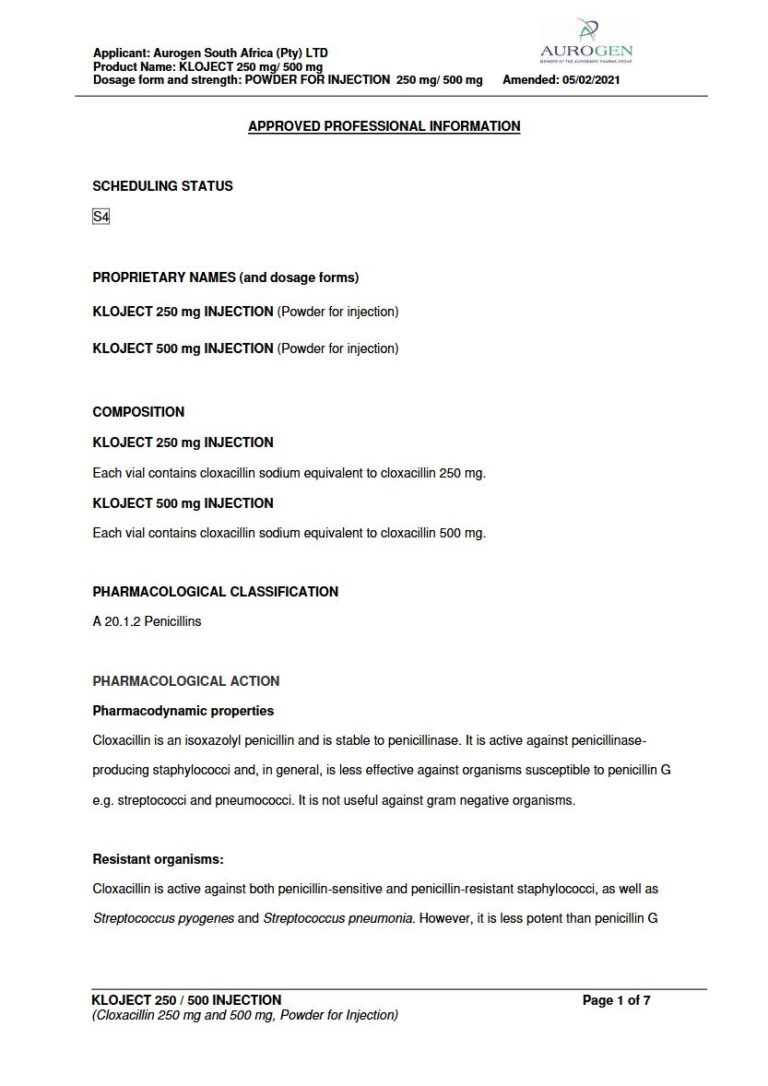 Healthcare Professionals Only
This content is for registered healthcare professionals
Sign in or create a free account to read the full package insert.
Free for HPCSA-registered professionals. Powered by Medinsert.
Clinical Particulars
Section 4 of the official insert — extracted exactly as issued, no alterations
4.1 Therapeutic indications
KLOJECT is indicated for the treatment of infections caused by penicillinase-producing staphylococci that are resistant to benzyl-penicillin, such as in:
- abscesses (skin and soft tissue);
- cellulitis;
- bacteraemia (septicaemia);
- endocarditis;
- pneumonia (respiratory tract);
- osteomyelitis (bone and joints).
4.2 Posology and method of administration
Please note: The reconstituted solution must be shaken well before use.
Route Dosage (for Adults) Administration
- IM Injection 250 mg 4 to 6 hourly The contents of each vial should be dissolved in 1,5 ml of Water for Injections
- Slow IV Injection 500 mg every 4 to 6 hours given over 3 to 4 minutes 500 mg of cloxacillin to be dissolved in 10 to 15 ml Water for Injection.
- IV Infusion 500 mg every 4 to 6 hours Cloxacillin is compatible with (the commonly used I.V. fluids) sodium chloride 0,9 % and dextrose 5 % in water and may be added to the drip container, or preferably, injected directly into the drip tube over a period of 2-3 minutes. All systemic dosages may be doubled in severe infections.
- Intrapleural Injection 500 mg daily 250 mg to 500 mg cloxacillin to be dissolved in 2 u2013 5 ml of Water for Injections.
- Intra-articular Injection 500 mg daily 250 mg to 500 mg cloxacillin to be dissolved in 2 ml to 5 ml of Water for Injections. 0,5% Lidocaine (lignocaine) hydrochloride may be used as a local anaesthetic, if desired.
Dosage for children: 12,5 to 25 mg/kg every 6 hours. Under 2 years: u00bc of adult dose 2 to 10 years: u00bd of adult dose
4.3 Contraindications
Patients with hypersensitivity to cloxacillin or a history of penicillin allergy or to cephalosporins or any other ingredient of KLOJECT. Neonates born of mothers sensitive to penicillin. KLOJECT should not be used as an eye drop or administered by subconjunctival injection. The intrathecal route should be avoided.
4.4 Special warnings and precautions for use
Use with care in jaundiced neonates. Incompatible with aminoglycosides, tetracyclines, erythromycin and polymyxin B.
Sensitivity reactions may include skin rashes, angioedema, bronchospasm, serum sickness and anaphylaxis, and sometimes death within minutes. Treatment with epinephrine (adrenaline), corticosteroids, aminophyllin or antihistamine may be necessary. A generalised sensitivity reaction can develop within a few hours or weeks of commencing treatment, including urticaria, fever, joint pains and eosinophilia. Other allergic reactions include exfoliative dermatitis and other skin reactions, interstitial nephritis and vasculitis. Haemolytic anaemia, leucopenia, prolonged bleeding time and defective platelet function.
Suprainfection with C. albicans, other fungi or organisms resistant to KLOJECT may occur. Care should be taken when administering high doses of KLOJECT especially to patients with impaired renal function as there is a risk of neurotoxicity. Renal and haematological systems should be monitored during prolonged and high dose therapy. Patients with syphilis may exhibit the Jarish u2013 Herxheimer reaction and should also therefore be monitored. A skin test for sensitivity may be used to determine those patients most likely to develop allergic reactions to penicillins.
4.5 Interactions with other medicines
KLOJECT may interact with bacteriostatic antibacterials such as chloramphenicol and tetracyclines. The possibility of a prolonged bleeding time should be borne in mind in patients receiving anticoagulants. KLOJECT may decrease the efficacy of oral contraceptives. KLOJECT may enhance the effects of methotrexate, by decreasing its renal excretion.
4.6 Fertility, pregnancy and lactation
The safety of KLOJECT in pregnancy and lactation has not been established. KLOJECT crosses the placenta and is distributed into breast milk.
4.7 Effects on ability to drive and use machines
The effect on the ability to drive and operate machinery is unknown however care should be taken due to the risk of convulsions.
4.8 Undesirable effects
Immune system disorders: Less frequent: Sensitivity reactions may include skin rashes, angioedema, bronchospasm, serum sickness and anaphylaxis, and sometimes death within minutes. Treatment with epinephrine (adrenaline), corticosteroids, aminophylline or antihistamine may be necessary. Other allergic reactions include exfoliative dermatitis and interstitial nephritis. The following side-effects have been reported and frequencies are unknown: A generalised sensitivity reaction can develop within a few hours or weeks of commencing treatment, including urticaria, fever, joint pains and eosinophilia. Other allergic reactions include other skin reactions and vasculitis.
Blood and the lymphatic system disorders: Less frequent: Leukopenia, prolonged bleeding time and defective platelet function, neutropenia. The following side-effects have been reported and frequencies are unknown: Haemolytic anaemia.
Nervous system disorders: Less frequent: Convulsions (high doses and/or severe renal function).
4.9 Overdose
Following administration of large doses, disturbance of electrolyte balance may occur. Convulsions and other signs of toxicity to the central nervous system may occur with very high doses, particularly when administered intravenously to patients with renal failure. Nephrotoxicity may occur in patients with diminished renal function. Treatment of overdosage is symptomatic and supportive.
