
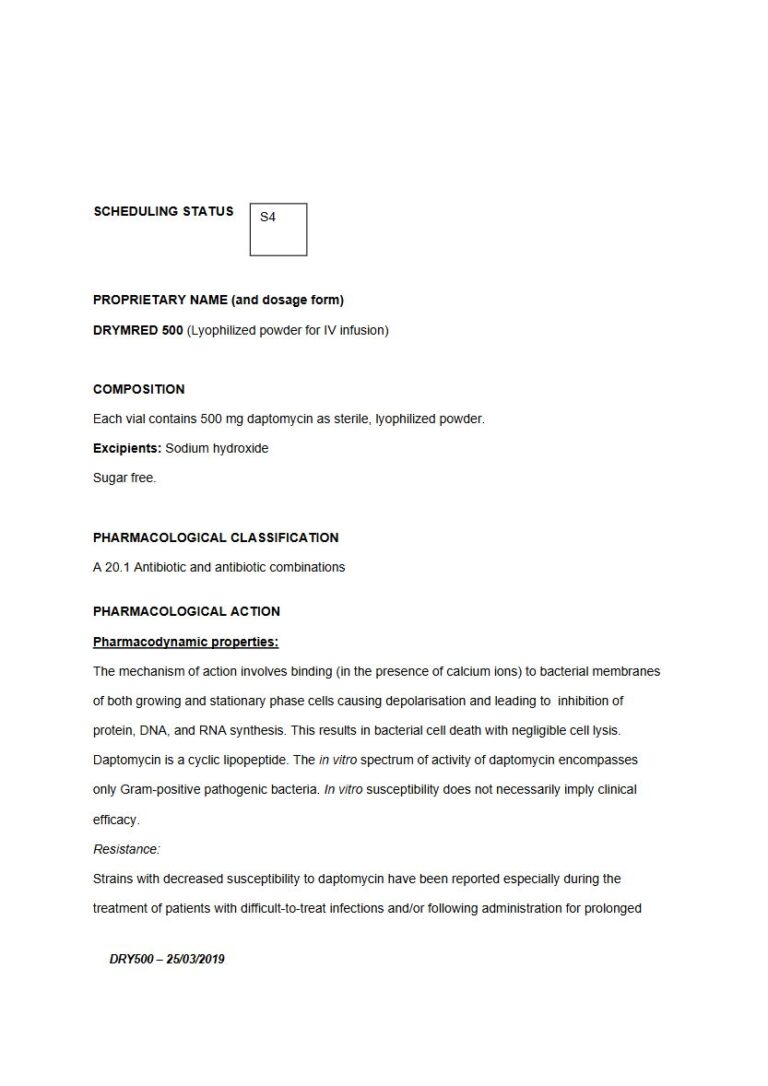
Drymred 500 500 mg (Lyophilized powder for IV infusion
PDF Leaflet Revision Date: 25 March 2019
Clinical Summary
Quick overview from the medicine insert
Indication
Complicated skin and skin structure infections and Staphylococcus aureus bloodstream infections.
Dosage (summary)
4 mg/kg IV daily for cSSSI; 6 mg/kg IV daily for bloodstream infections.
Special Populations
- Renal impairment
- Hepatic impairment
- Elderly
- Obesity
Pregnancy & Breastfeeding
Not established; avoid in pregnancy; caution in breastfeeding.
Key Drug Interactions
- Warfarin
- Tobramycin
- HMG-CoA reductase inhibitors
Contraindications
- Hypersensitivity to daptomycin
Common side effects
- Candida infections
- Anemia
- Diarrhea
- Nausea
- Headache
Counselling Points
- Monitor for muscle pain and CPK levels
- Avoid driving if dizzy
- Report any allergic reactions
Serious warnings
- Not effective for pneumonia
- Risk of myopathy
- Clostridium difficile-associated diarrhea
Important Disclaimer
The Drymred 500 500 mg (Lyophilized powder for IV infusion professional information leaflet below is the property of Dr Reddy’S Laboratories and is provided on Medinsert exactly as issued, with no.. alterations or editorial changes. We make every effort to keep content current by updating documents as soon as new versions become available. Medinsert serves as a trusted access point for healthcare professionals, but does not replace official sources or clinical judgement. For more details, please read our full disclaimer. read more>>
 Healthcare Professionals Only
This content is for registered healthcare professionals
Sign in or create a free account to read the full package insert.
Free for HPCSA-registered professionals. Powered by Medinsert.
Clinical Particulars
Section 4 of the official insert — extracted exactly as issued, no alterations
4.1 Therapeutic indications
DRYMRED 500 is indicated for the following infections in adults:
- Complicated skin and skin structure infections (cSSSI) caused by susceptible isolates of the following Gram-positive microorganisms: Staphylococcus aureus (including methicillin-resistant isolates), Streptococcus pyogenes, Streptococcus agalactiae and Streptococcus dysgalactiae subsp. equisimilis. Combination therapy may be clinically indicated if the documented or presumed pathogens include Gram-negative or anaerobic organisms.
- Staphylococcus aureus bloodstream infections (bacteraemia), including those with right-sided infective endocarditis (SAB/RIE), caused by methicillin-susceptible and methicillin-resistant isolates. Combination therapy may be clinically indicated if the documented or presumed pathogens include Gram-negative or anaerobic organisms.
The efficacy of DRYMRED 500 in patients with left-sided infective endocarditis and in patients with artificial valve endocarditis due to Staphylococcus aureus has not been demonstrated. In a clinical trial of daptomycin in patients with Staphylococcus aureus bloodstream infections, limited data from patients with left-sided infective endocarditis was included and outcomes in these patients were poor. DRYMRED 500 is not indicated for the treatment of pneumonia (also see u201cWARNINGS AND SPECIAL PRECAUTIONSu201d).
4.2 Posology and method of administration
Dosage and administration pertain to adults 18 years and over.
Complicated Skin and Skin Structure Infections (cSSSI): DRYMRED 500 4 mg/kg should be administered once daily over a 30 minute period by IV infusion in 0,9 % sodium chloride injection once every 24 hours for 7 u2013 14 days. DRYMRED 500 should not be dosed more frequently than once a day.
Staphylococcus aureus bloodstream infections (Bacteraemia), including Right-Sided Endocarditis: DRYMRED 500 6 mg/kg should be administered once daily over a 30 minute period by IV infusion in 0,9 % sodium chloride injection once every 24 hours for a minimum of 2 u2013 6 weeks. The duration of treatment may be longer than 14 days in accordance with the perceived risk of complications in the individual patients. DRYMRED 500 should not be dosed more frequently than once a day.
4.3 Contraindications
Known hypersensitivity to daptomycin or to any of the excipients of DRYMRED 500.
4.4 Special warnings and precautions for use
General: If a focus of Staphylococcus aureus infection other than cSSTI or RIE is identified after initiation of DRYMRED 500 therapy, consideration should be given to instituting alternative antibacterial therapy that has been demonstrated to be efficacious in the treatment of the specific type of infection(s) present.
Anaphylaxis/hypersensitivity reactions: Anaphylaxis/hypersensitivity reactions have been reported with daptomycin such as in DRYMRED 500. If an allergic reaction to DRYMRED 500 occurs, discontinue use and institute appropriate therapy.
Pneumonia: It has been demonstrated in clinical studies that daptomycin is not effective in the treatment of pneumonia. DRYMRED 500 is therefore not indicated for the treatment of pneumonia. In Phase III studies of community-acquired pneumonia (CAP), the death rate and rates of serious cardio-respiratory adverse events were higher in DRYMRED 500 treated patients than in comparator treated patients. These differences were due to lack of therapeutic effectiveness of DRYMRED 500 in the treatment of CAP in patients experiencing these adverse events.
RIE due to Staphylococcus aureus: Clinical data on the use of daptomycin to treat RIE due to Staphylococcus aureus are limited to 19 patients. The efficacy of DRYMRED 500 in patients with prosthetic valve infections or with left-sided infective endocarditis due to Staphylococcus aureus has not been demonstrated.
Deep-seated infections: Patients with deep-seated infections should receive any required surgical interventions (e.g. valve replacement surgery, removal of prosthetic devices, debridement) without delay.
Non-susceptible micro-organisms: The use of antibiotics may promote the overgrowth of non-susceptible micro-organisms. If superinfection occurs during therapy, appropriate measures should be taken.
Prescribing DRYMRED 500 in the absence of a proven or strongly suspected bacterial infection is unlikely to provide benefit to the patient and increases the risk of the development of drug-resistant bacteria.
Clostridium difficile-associated diarrhoea: Clostridium difficile-associated diarrhoea (CDAD) has been reported with use of DRYMRED 500, and may range in severity from mild diarrhoea to fatal colitis. If CDAD is suspected or confirmed, DRYMRED 500 may need to be discontinued. Appropriate fluid and electrolyte management, antibiotic treatment of C. difficile, protein supplementation, and surgical evaluation should be instituted as clinically indicated.
Drug-laboratory test interactions: Clinically relevant plasma concentrations of daptomycin have been observed to cause a significant concentration-dependent false prolongation of prothrombin time (PT) and elevation of International Normalised Ratio (INR) when certain recombinant thromboplastin reagents are utilised for the assay.
Creatine phosphokinase and myopathy: Increases in plasma creatine phosphokinase (CPK; MM isoenzyme) levels associated with muscular pains and/or weakness and cases of myositis, myoglobinaemia and rhabdomyolysis have been reported during therapy with DRYMRED 500 (see u201cSIDE-EFFECTSu201d). In clinical studies, marked increases in plasma CPK to > 5 x Upper Limit of Normal (ULN) without muscle symptoms occurred.
- Plasma CPK should be measured at baseline and at regular intervals (at least once weekly) during therapy in all patients.
- CPK should be measured more frequently (e.g. every 2 u2013 3 days at least during the first two weeks of treatment) in patients who are at higher risk of developing myopathy.
- It cannot be ruled out that those patients with CPK greater than 5 times upper limit of normal at baseline may be at increased risk of further increases during daptomycin therapy.
DRYMRED 500 should not be administered to patients who are taking other medicines associated with myopathy.
Patients should be reviewed regularly while on therapy for any signs or symptoms that might represent myopathy. Any patient that develops unexplained muscle pain, tenderness, weakness or cramps should have CPK levels monitored every 2 days. DRYMRED 500 should be discontinued in the presence of unexplained muscle symptoms if the CPK level reaches greater than 5 times upper limit of normal.
Peripheral neuropathy: Patients who develop signs or symptoms that might represent a peripheral neuropathy during therapy with DRYMRED 500 should be investigated and consideration should be given to discontinuation of DRYMRED 500 (see u201cSIDE-EFFECTSu201d).
Eosinophilic pneumonia: Eosinophilic pneumonia has been reported in patients receiving DRYMRED 500. In most reported cases associated with DRYMRED 500, patients developed fever, dyspnoea with hypoxic respiratory insufficiency, and diffuse pulmonary infiltrates. In most of the cases this occurred after more than 2 weeks of treatment with DRYMRED 500 and improved when DRYMRED 500 was discontinued and steroid therapy was initiated. Recurrence of eosinophilic pneumonia upon re-exposure has been reported. Patients who develop these signs and symptoms while receiving DRYMRED 500 should undergo prompt medical evaluation, including, if appropriate, bronchoalveolar lavage, to exclude other causes (e.g. bacterial infection, fungal infection, parasites, other medicines). DRYMRED 500 should be discontinued immediately and treatment with systemic steroids should be initiated when appropriate.
Renal impairment: Renal impairment has been reported during treatment with DRYMRED 500. Severe renal impairment may in itself also pre-dispose to elevations in daptomycin levels which may increase the risk of development of myopathy (see above). Dose adjustment is needed for patients whose creatinine clearance is < 30 ml/min (see u201cDOSAGE AND DIRECTIONS FOR USEu201d and u201cPharmacokinetic properties [special populations]u201d). DRYMRED 500 should only be used in such patients when it is considered that the expected clinical benefit outweighs the potential risk. Caution is advised when administering DRYMRED 500 to patients who have some degree of renal impairment (creatinine clearance < 80 ml/min) before commencing therapy with DRYMRED 500. Regular monitoring of renal function is advised (see u201cPharmacokinetic properties [special populations]u201d). In addition, regular monitoring of renal function is advised during concomitant administration of potentially nephrotoxic agents, regardless of the patientu2019s pre-existing renal function.
Obesity: In obese subjects with Body Mass Index (BMI) > 40 kg/m2 but with creatinine clearance > 70 ml/min, the AUC0-u221e daptomycin was significantly increased (mean 42 % higher) compared with non-obese matched controls. There is limited information on the safety and efficacy of daptomycin in the very obese and so caution is recommended. However, there is currently no evidence that a dose reduction is required.
Persisting or relapsing Staphylococcus aureus bloodstream infection: Patients with persisting or relapsing S. aureus bloodstream infection or poor clinical response should have repeat blood cultures. If a culture is positive for S. aureus, minimum inhibitory concentration (MIC) susceptibility testing of the isolate should be performed using a standardised procedure. Diagnostic evaluation of the patient should be performed to rule out sequestered foci of infection. Appropriate surgical intervention (e.g. debridement, removal of prosthetic devices, valve replacement surgery) and/or consideration of a change in antibiotic regimen may be required.
4.5 Interactions with other medicines
Daptomycin does not induce or inhibit the activities of the following human cytochrome P450 isoforms: 1A2, 2A6, 2C9, 2C19, 2D6, 2E1 and 3A4. In vitro studies, daptomycin was not metabolised by human liver microsomes. It is unlikely that daptomycin will induce or inhibit the metabolism of medicines metabolised by the P450 system.
Interaction studies with aztreonam, tobramycin, warfarin, simvastatin and probenecid showed daptomycin had no effect on the pharmacokinetics of warfarin or probenecid, nor did these medicines alter the pharmacokinetics of daptomycin. The pharmacokinetics of daptomycin were not significantly altered by aztreonam. Although small changes in the pharmacokinetics of daptomycin and tobramycin were observed during co-administration, the changes were not statistically significant. The interaction between daptomycin and tobramycin with a clinical dose of DRYMRED 500 is unknown. Caution is warranted when DRYMRED 500 is co-administered with tobramycin.
Because experience with the concomitant administration of DRYMRED 500 and warfarin is limited, anticoagulant activity in patients receiving DRYMRED 500 and warfarin should be monitored during therapy with DRYMRED 500.
There is limited experience regarding concomitant administration of daptomycin with other medicines that may trigger myopathy (e.g. HMG-CoA reductase inhibitors). However, some cases of marked rises in CPK levels and cases of rhabdomyolysis occurred in patients taking one of these medicines at the same time as daptomycin. It is recommended that other medicines associated with myopathy should if possible be temporarily discontinued during treatment with DRYMRED 500 unless the benefits of concomitant administration outweigh the risk. If co-administration cannot be avoided, CPK levels should be measured more frequently than once weekly and patients should be closely monitored for any signs or symptoms that might represent myopathy (see u201cWARNINGS AND SPECIAL PRECAUTIONSu201d).
Daptomycin is primarily cleared by renal filtration and so plasma levels may be increased during co-administration with medicines that reduce renal filtration (e.g. NSAIDs and COX-2 inhibitors). In addition, there is a potential for a pharmacodynamic interaction to occur during co-administration due to additive renal effects. Therefore, caution is advised when daptomycin is co-administered with any other medicine known to reduce renal filtration.
4.6 Fertility, pregnancy and lactation
Safety in pregnancy and lactation has not been established.
Pregnancy: No clinical data on pregnancies are available for daptomycin. Animal studies do not indicate direct or indirect harmful effects with respect to pregnancy, embryonal/foetal development, parturition or postnasal development. DRYMRED 500 should not be used during pregnancy.
Breast-feeding: In a single human case study, DRYMRED 500 was intravenously administered daily for 28 days to a nursing mother at a dose of 500 mg/day, and samples of the patientu2019s breast milk were collected over a 24-hour period on day 27. The highest measured concentration of daptomycin in the breast milk was 0,045 mcg/ml, which is a low concentration. Therefore, until more experience is gained, breast-feeding should be discontinued when DRYMRED 500 is administered to nursing women.
4.7 Effects on ability to drive and use machines
On the basis of reported adverse reactions, DRYMRED 500 may cause dizziness or vertigo. Patients are advised not to drive or use machinery until their individual susceptibility is known.
4.8 Undesirable effects
Infections and infestations: Frequent: Candida infections, fungal infections, fungaemia, oral candidiasis, osteomyelitis, urinary tract infections, urinary tract infections fungal, vaginal candidiasis. Frequency not known: Clostridium difficile-associated diarrhoea (CDAD).
Blood and the lymphatic system disorders: Frequent: Anaemia. Less frequent: Eosinophilia, leukocytosis, lymphadenopathy, thrombocytopenia, thrombocytosis, thrombocythaemia.
Immune system disorders: Frequency not known: Anaphylaxis, hypersensitivity reactions (including pruritus, hives, shortness of breath, difficulty swallowing, truncal erythema, pulmonary eosinophilia, angioedema, drug rash with eosinophilia and systemic symptoms (DRESS), vesicobullous rash with mucous membrane involvement and sensation of oropharyngeal swelling), infusion reactions (including the following symptoms: tachycardia, wheezing, pyrexia, rigors, systemic flushing, vertigo, syncope and metallic taste).
Metabolism and nutrition disorders: Less frequent: Decreased appetite, hyperglycaemia, hypokalaemia, hypomagnesaemia, electrolyte imbalance.
Psychiatric disorders: Frequent: Anxiety, insomnia. Less frequent: Hallucination, mental status change.
Nervous system disorders: Frequent: Headache, dizziness. Less frequent: Dyskinesia, paraesthesia, taste disorder, tremor. Frequency not known: Peripheral neuropathy.
Eye disorders: Less frequent: Eye irritation, blurred vision.
Ear and labyrinth disorders: Less frequent: Tinnitus, vertigo.
Cardiac disorders: Less frequent: Atrial fibrillation, atrial flutter, cardiac arrest, supraventricular tachycardia, exstrasystole.
Vascular disorders: Frequent: Hypertension, hypotension. Less frequent: Flushing.
Respiratory, thoracic and mediastinal disorders: Less frequent: Cough, dyspnoea. Frequency not known: Eosinophilic pneumonia (see u201cWARNINGS AND SPECIAL PRECAUTIONSu201d).
Gastrointestinal disorders: Frequent: Diarrhoea, nausea, vomiting. Less frequent: Abdominal distension, abdominal pain, constipation, dry mouth, dyspepsia, epigastric discomfort, flatulence, gingival pain, oral hypoaesthesia, loose stools, stomatitis, glossitis.
Hepato-biliary disorders: Frequent: Abnormal liver function tests. Less frequent: Jaundice.
Skin and subcutaneous tissue disorders: Less frequent: Eczema, heat rash, pruritus, pruritus generalised, rash (excluding vesicular), rash vesicular, urticarial. Frequency not known: Acute generalised exanthematous pustulosis.
Musculoskeletal, connective tissue and bone disorders: Less frequent: Arthralgia, back pain, limb pain, muscle cramps, muscle weakness, myalgia, myositis. Frequency not known: Rhabdomyolysis.
Renal and urinary disorders: Less frequent: Proteinuria, renal failure acute, renal impairment, including renal failure and renal insufficiency.
Reproductive system and breast disorders: Less frequent: Vaginitis.
General disorders and administration site conditions: Frequent: Injection site reactions (including infusion site reaction, injection site bruising, injection site burning, injection site inflammation, injection site irritation, injection site oedema, injection site pain, injection site phlebitis, injection site pruritus and injection site thrombosis). Less frequent: Asthenia, chest pain, discomfort (not otherwise specified), oedema, fatigue, jitteriness, pyrexia, rigors, weakness, pain.
Investigations: Frequent: Increased alanine aminotransferase, increased blood creatine phosphokinase. Less frequent: Increased aspartate aminotransferase, increased blood alkaline phosphatase, increased blood bicarbonate, increased blood phosphorus, increased International Normalised Ratio (INR), increased lactate dehydrogenase (LDH), prolonged prothrombin time, increased myoglobin, increased serum creatinine.
4.9 Overdose
Symptoms of overdose may be exaggerated. In the event of overdose, supportive care is advised. Daptomycin is slowly cleared from the body by haemodialysis (approximately 15 % of the administered dose is removed over 4 hours) or by peritoneal dialysis (approximately 11 % of the administered dose is removed over 48 hours).
