
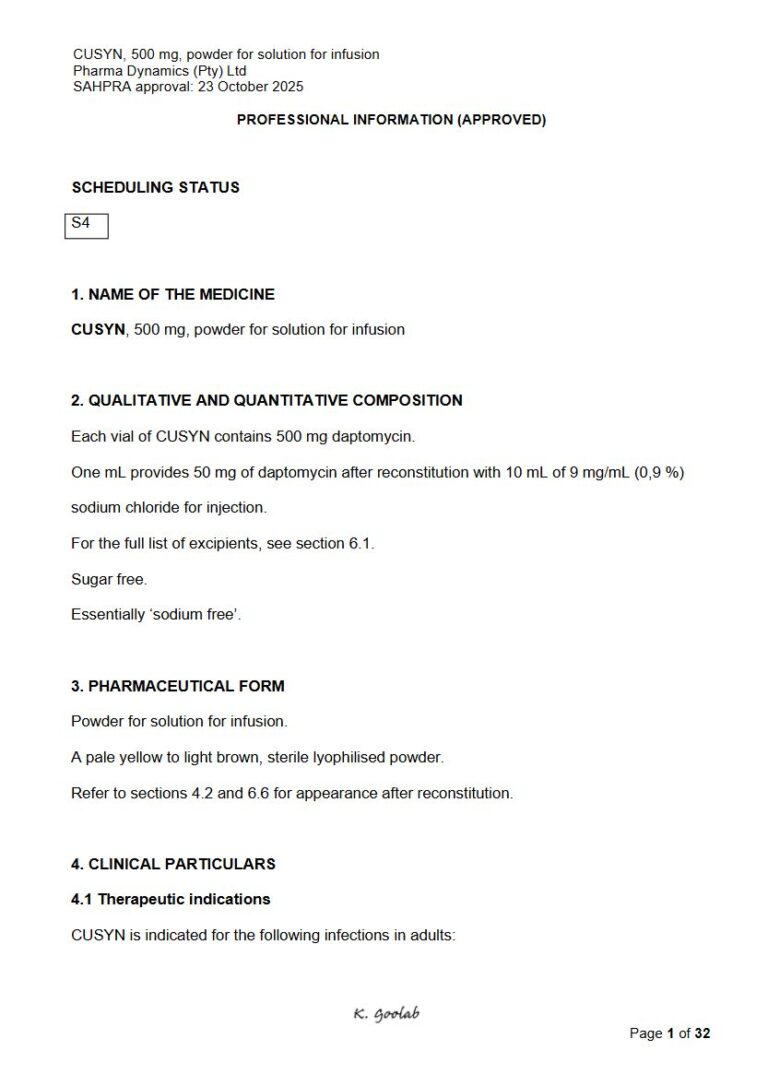
Cusyn 500 mg POWDER FOR SOLUTION FOR INFUSION
PDF Leaflet Revision Date: 23 October 2025
Clinical Summary
Quick overview from the medicine insert
Indication
Indicated for complicated skin infections and Staphylococcus aureus bloodstream infections.
Dosage (summary)
cSSSI: 4 mg/kg IV daily; SAB/RIE: 6 mg/kg IV daily.
Special Populations
- Renal impairment
- Hepatic impairment
- Elderly
Pregnancy & Breastfeeding
Safety in pregnancy and breastfeeding not established.
Key Drug Interactions
- Increased risk of myopathy with statins
- False PT/INR prolongation with certain assays
Contraindications
- Hypersensitivity to daptomycin
- Treatment of pneumonia
Common side effects
- Dizziness
- Nausea
- Rash
- Increased CPK
- Infusion site reactions
Counselling Points
- Monitor for muscle pain and CPK levels
- Avoid driving if dizzy
- Report any allergic reactions immediately
Serious warnings
- Risk of myopathy
- Eosinophilic pneumonia
- Severe cutaneous adverse reactions
Important Disclaimer
The Cusyn 500 mg POWDER FOR SOLUTION FOR INFUSION professional information leaflet below is the property of Pharma Dynamics and is provided on Medinsert exactly as issued, with no.. alterations or editorial changes. We make every effort to keep content current by updating documents as soon as new versions become available. Medinsert serves as a trusted access point for healthcare professionals, but does not replace official sources or clinical judgement. For more details, please read our full disclaimer. read more>>
 Healthcare Professionals Only
This content is for registered healthcare professionals
Sign in or create a free account to read the full package insert.
Free for HPCSA-registered professionals. Powered by Medinsert.
Clinical Particulars
Section 4 of the official insert — extracted exactly as issued, no alterations
4.1 Therapeutic indications
CUSYN is indicated for the following infections in adults:
Complicated skin and skin structure infections (cSSSI) caused by susceptible isolates of the following Gram-positive micro-organisms:
- Staphylococcus aureus (including methicillin-resistant isolates),
- Streptococcus pyogenes,
- Streptococcus agalactiae and
- Streptococcus dysgalactiae subspecies equisimilis.
Combination therapy may be indicated if the documented or presumed pathogens include Gram-negative or anaerobic organisms.
Staphylococcus aureus bloodstream (SAB) infections (bacteraemia), including those with right-sided infective endocarditis (RIE), caused by methicillin-susceptible and methicillin-resistant isolates. Combination therapy may be clinically indicated if the documented or presumed pathogens include Gram-negative or anaerobic organisms.
The efficacy of CUSYN in patients with left-sided infective endocarditis and in patients with artificial valve endocarditis due to Staphylococcus aureus has not been demonstrated. CUSYN is not indicated for the treatment of pneumonia (see section 4.4).
4.2 Posology and method of administration
Dosage and directions for use pertain to adults u2265 18 years.
Posology
Complicated skin and skin structure infections (cSSSI)
CUSYN 4 mg/kg is administered once daily over a 30-minute period by IV infusion in 0,9 % sodium chloride injection, every 24 hours, for 7-14 days. CUSYN should not be dosed more frequently than once a day.
S. aureus bloodstream infections (bacteraemia), including right-sided infective endocarditis (SAB/RIE)
CUSYN 6 mg/kg is administered once daily over a 30-minute period by IV infusion in 0,9 % sodium chloride injection, once every 24 hours, for a minimum of 2-6 weeks. The duration of therapy may need to be longer than 14 days in accordance with the perceived risk of complications in the individual patient. CUSYN should not be dosed more frequently than once a day.
Special populations
Renal impairment
Daptomycin is eliminated primarily by the kidney. CUSYN should only be used in patients with any degree of renal impairment (CrCL < 80 mL/min) when it is considered that the expected clinical benefit outweighs the potential risk. The response to treatment, renal function and creatine phosphokinase (CPK) levels should be closely monitored in all patients with any degree of renal impairment (see section 5.2, Special populations, Creatine phosphokinase and myopathy and section 4.4).
...
4.3 Contraindications
CUSYN is contraindicated:
- hypersensitivity to daptomycin or to any of the ingredients of CUSYN (see section 6.1)
- for the treatment of pneumonia (see section 4.4).
4.4 Special warnings and precautions for use
General
Prescribers must adhere to the principles of antibiotic stewardship. The use of antibiotics may promote the selection of non-susceptible organisms. If super-infection occurs during therapy, appropriate measures should be taken. If a focus of infection other than cSSTI or RIE is identified after initiation of treatment with CUSYN, it should be considered to institute alternative antibacterial therapy that has been demonstrated to be efficacious in the treatment of the specific type of infection(s) present.
Anaphylaxis/hypersensitivity reactions
Anaphylaxis/hypersensitivity reactions have been reported with CUSYN (see section 4.8). If an allergic reaction to CUSYN occurs, its use should be discontinued and appropriate therapy should be instituted.
Pneumonia
CUSYN is not effective in the treatment of pneumonia. CUSYN is therefore not indicated for the treatment of pneumonia (see section 4.3).
...
4.5 Interactions with other medicines
Daptomycin undergoes little to no cytochrome P450 (CYP450)-mediated metabolism. It is unlikely that daptomycin will inhibit or induce the metabolism of medicines metabolised by the P450 system.
There may be an increased risk of myopathy if CUSYN is given concomitantly with other medicines known to have this side effect (e.g. HMG-CoA reductase inhibitors, fibrates and ciclosporin). However, some cases of marked rises in CPK levels and cases of rhabdomyolysis occurred in adult patients taking one of these medicines at the same time as daptomycin. It is recommended that other medicines associated with myopathy should if possible be temporarily discontinued during treatment with CUSYN unless the benefits of concomitant administration outweigh the risk (see sections 4.4 and 4.8).
If co-administration cannot be avoided, CPK levels should be measured more frequently than once weekly and patients should be closely monitored for any signs or symptoms that might represent myopathy (see sections 4.4 and 4.8).
4.6 Fertility, pregnancy and lactation
Pregnancy
Safety in pregnancy has not been established.
Breastfeeding
Safety during breastfeeding has not been established.
Fertility
No clinical data on fertility are available for daptomycin.
4.7 Effects on ability to drive and use machines
Dizziness is a frequent side effect of CUSYN. Patients should be advised not to drive or use machinery if they feel dizzy after being on treatment with CUSYN. On the basis of reported adverse reactions, daptomycin is unlikely to produce an effect on the ability to drive or use machinery.
4.8 Undesirable effects
Summary of the safety profile
During clinical studies, adverse reactions (i.e. considered by the investigator to be possibly, probably, or definitely related to the medicine) were reported at similar frequencies for daptomycin and comparator regimens. The most frequently reported adverse reactions are: Fungal infections, urinary tract infection, candida infection, anaemia, anxiety, insomnia, dizziness, headache, hypertension, hypotension, gastrointestinal and abdominal pain, nausea, vomiting, constipation, diarrhoea, flatulence, bloating and distension, liver function tests abnormal (increased alanine aminotransferase (ALT), aspartate aminotransferase (AST) or alkaline phosphatase (ALP)), rash, pruritus, limb pain, serum creatine phosphokinase (CPK) increased, infusion site reactions, pyrexia, asthenia.
Less frequently reported, but more serious, adverse reactions include hypersensitivity reactions, eosinophilic pneumonia (occasionally presenting as organising pneumonia), DRESS (drug rash with eosinophilia and systemic symptoms), angioedema and rhabdomyolysis.
Tabulated list of adverse effects
...
4.9 Overdose
Signs and symptoms: Refer to section 4.8.
Management of overdose: In the event of overdose, supportive care is advised. Daptomycin is slowly cleared from the body by haemodialysis (approximately 15 % of the administered dose is removed over 4 hours) or by peritoneal dialysis (approximately 11 % of the administered dose is removed over 48 hours).
