
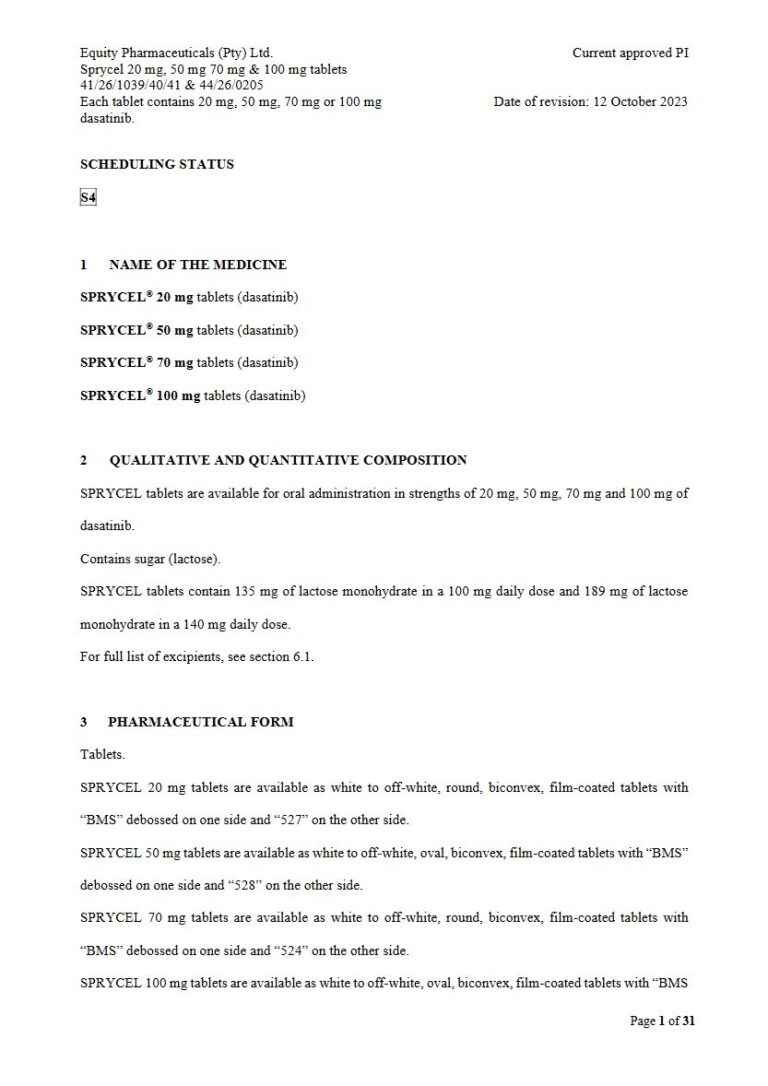
Sprycel 20 mg, 50 mg, 70 mg and 100 mg Tablets.
PDF Leaflet Revision Date: 12 October 2023
Clinical Summary
Quick overview from the medicine insert
Indication
Treatment of adults with Ph+ CML and Ph+ ALL.
Dosage (summary)
Chronic phase CML: 100 mg once daily; Advanced phase CML/Ph+ ALL: 70 mg twice daily.
Special Populations
- Renal impairment
- Hepatic impairment
- Elderly
Pregnancy & Breastfeeding
Not recommended during pregnancy; contraindicated in breastfeeding.
Key Drug Interactions
- CYP3A4 inhibitors
- CYP3A4 inducers
- Grapefruit juice
Contraindications
- Hypersensitivity to dasatinib
- Concomitant use of H2 antagonists or PPIs
Common side effects
- Myelosuppression
- Fluid retention
- Diarrhea
- Nausea
- Fatigue
Counselling Points
- Take with or without food
- Avoid grapefruit
- Monitor for bleeding or fluid retention
Serious warnings
- Myelosuppression
- Severe bleeding events
- Fluid retention
- Cardiac adverse reactions
Important Disclaimer
The Sprycel 20 mg, 50 mg, 70 mg and 100 mg Tablets. professional information leaflet below is the property of Equity Pharmaceuticals and is provided on Medinsert exactly as issued, with no.. alterations or editorial changes. We make every effort to keep content current by updating documents as soon as new versions become available. Medinsert serves as a trusted access point for healthcare professionals, but does not replace official sources or clinical judgement. For more details, please read our full disclaimer. read more>>
 Healthcare Professionals Only
This content is for registered healthcare professionals
Sign in or create a free account to read the full package insert.
Free for HPCSA-registered professionals. Powered by Medinsert.
Clinical Particulars
Section 4 of the official insert — extracted exactly as issued, no alterations
4.1 Therapeutic indications
SPRYCEL is indicated for the treatment of adults with newly diagnosed Philadelphia chromosome-positive (Ph+) chronic myeloid leukaemia (CML) in chronic phase. SPRYCEL is indicated for the treatment of adults with chronic, accelerated, or myeloid or lymphoid blast phase chronic myeloid leukaemia (CML) with resistance or intolerance to prior therapy including imatinib. SPRYCEL is also indicated for the treatment of adults with Philadelphia chromosome-positive acute lymphoblastic leukaemia (Ph+ ALL) with resistance or intolerance to prior therapy.
4.2 Posology and method of administration
Posology
The recommended starting dosage of SPRYCEL for chronic phase CML is 100 mg administered orally once daily. The recommended starting dosage of SPRYCEL for accelerated phase CML, myeloid or lymphoid blast phase CML or Ph+ ALL is 70 mg twice daily, administered orally. Dose increase or reduction is recommended based on individual patient response and tolerability.
Dose escalation:
In clinical trials of CML and Ph+ ALL, dose escalation to a total maximum of 70 mg twice daily (chronic phase CML) or 90 mg twice daily (advanced phase CML or Ph+ ALL) was allowed in patients who did not achieve a haematologic or cytogenetic response at the recommended starting dosage.
Duration of treatment
In clinical studies, treatment with SPRYCEL in adults with chronic phase CML; accelerated, myeloid or lymphoid blast phase (advanced phase) CML; or Ph+ ALL was continued until disease progression or until no longer tolerated by the patient. The effect of stopping treatment on long-term disease outcome after the achievement of a cytogenetic response (including complete cytogenetic response [CCyR]) or major molecular response (MMR and MR4.5) has not been investigated.
4.3 Contraindications
SPRYCEL is contraindicated in patients with hypersensitivity to dasatinib or to any other component of SPRYCEL. The concomitant use of H2 antagonists or proton pump inhibitors with SPRYCEL is not recommended.
4.4 Special warnings and precautions for use
Myelosuppression
Treatment with SPRYCEL is very commonly associated with thrombocytopenia, neutropenia and anaemia, which occur earlier and more frequently in patients with advanced phase CML or Ph+ ALL than in patients with chronic phase CML. In adult patients with advanced phase CML or Ph+ ALL treated with dasatinib as monotherapy, complete blood counts (CBCs) should be performed weekly for the first 2 months, and then monthly thereafter, or as clinically indicated. In adult patients with chronic phase CML, complete blood counts should be performed every 2 weeks for 12 weeks, then every 3 months thereafter or as clinically indicated. Myelosuppression is generally reversible and usually managed by withholding SPRYCEL temporarily or by dose reduction (see section 4.2 and section 4.8).
Bleeding related events
In patients with chronic phase CML, severe haemorrhage occurred in 5 patients receiving SPRYCEL at the recommended dose (n=548). In patients with advanced phase CML or Ph+ ALL, severe (Grade 3 or 4) central nervous system (CNS) haemorrhage, including fatalities, occurred in 1% of patients receiving SPRYCEL at the recommended dose (n=304). Severe gastrointestinal haemorrhage, including fatalities, occurred in 6% of patients and generally required treatment interruptions and transfusions. Other cases of severe haemorrhage occurred in 2% of patients. Most bleeding events in clinical studies were associated with severe thrombocytopenia. Caution should be exercised if patients are required to take medications that inhibit platelet function or anticoagulants.
Fluid Retention
SPRYCEL is associated with fluid retention. After 5 years of follow-up in the Phase III newly diagnosed chronic phase CML study (n=258), severe fluid retention was reported in 13 patients (5%) receiving SPRYCEL. In all patients with newly diagnosed or imatinib resistant or intolerant patients with chronic phase CML (n=548), severe fluid retention occurred in 32 (6%) patients receiving SPRYCEL at the recommended dose. In patients with advanced phase CML or Ph+ ALL receiving SPRYCEL, severe fluid retention was reported in 8% of patients, including severe pleural and pericardial effusion reported in 7% and 1% of patients, respectively. In these patients, severe pulmonary oedema and severe pulmonary hypertension were reported in 1% of patients. Patients who develop symptoms suggestive of pleural effusion or other fluid retention, such as new or worsened dyspnoea on exertion or at rest, pleuritic chest pain, or dry cough should be evaluated promptly with chest X-ray or additional diagnostic imaging as appropriate. Fluid retention events were typically managed by supportive care measures that may include diuretics or short courses of steroids (see section 4.2).
Cardiac Adverse Reactions
SPRYCEL was studied in a randomised trial of 519 patients with newly diagnosed CML in chronic phase, which included patients with prior cardiac disease. The cardiac adverse reactions of congestive heart failure/cardiac dysfunction, pericardial effusion, arrhythmias, palpitations, QT prolongation, and myocardial infarction (including fatal) were reported in patients taking SPRYCEL. Adverse cardiac events were more frequent in patients with risk factors or a previous medical history of cardiac disease. Patients with risk factors or a history of cardiac disease should be monitored carefully for signs or symptoms consistent with cardiac dysfunction and should be evaluated and treated appropriately.
4.5 Interactions with other medicines
Effect of other medicines on SPRYCEL:
Medicines that may increase dasatinib plasma concentrations: CYP3A4 Inhibitors: Dasatinib is a CYP3A4 substrate. Concomitant use of SPRYCEL and medicines that inhibit CYP3A4 (e.g., ketoconazole, itraconazole, erythromycin, clarithromycin, ritonavir, atazanavir, indinavir, nelfinavir, saquinavir, telithromycin, grapefruit juice) may increase exposure to dasatinib and should be avoided. Selection of an alternate concomitant medication with no or minimal CYP3A4 inhibition potential is recommended. If systemic administration of a potent CYP3A4 inhibitor cannot be avoided, the patient should be closely monitored for toxicity (see section 4.2 Dose reduction for concomitant use of strong CYP3A4 inhibitors).
Medicines that may decrease dasatinib plasma concentrations: CYP3A4 Inducers: Medicines that induce CYP3A4 activity (e.g., dexamethasone, phenytoin, carbamazepine, rifampicin, phenobarbital or St. Johnu2019s Wort (Hypericum perforatum)), may reduce exposure to dasatinib. Concomitant use of potent CYP3A4 inducers with SPRYCEL is not recommended. In patients for whom CYP3A4 inducers are indicated, alternative agents with no or minimal CYP3A4 induction potential should be selected.
4.6 Fertility, pregnancy and lactation
Women of childbearing potential / Contraception in males and females
Sexually active male or female patients taking SPRYCEL should use adequate contraception.
Pregnancy
Dasatinib may cause foetal harm when administered to a pregnant woman. There have been post-marketing reports of spontaneous abortion and foetal and infant anomalies from women who have taken SPRYCEL during pregnancy. SPRYCEL is not recommended for use in women who are pregnant or contemplating pregnancy. If SPRYCEL is used during pregnancy, or if the patient becomes pregnant while taking SPRYCEL, the patient should be apprised of the potential hazard to the foetus.
Breastfeeding
Women who are taking SPRYCEL should not breastfeed.
4.7 Effects on ability to drive and use machines
No studies on the effects on the ability to drive and use machines have been performed.
4.8 Undesirable effects
The data described below reflect exposure to SPRYCEL in 324 patients with newly diagnosed chronic phase CML and in 2 388 patients with imatinib resistant or intolerant chronic or advanced phase CML or Ph+ ALL. In the Phase III newly diagnosed chronic phase CML study, the median duration of therapy was approximately 60 months (range 0,03 u2013 72,7 months) for SPRYCEL. The median duration of therapy in 1 618 patients with chronic phase CML was 29 months (range 0 u2013 92,9 months). In 1094 patients with advanced phase CML or Ph+ ALL, the median duration of treatment for patients was 6,2 months (range 0 u2013 93,2 months). In the overall population of 2 712 SPRYCEL-treated subjects, 520 (19%) experienced adverse reactions leading to treatment discontinuation.
4.9 Overdose
Experience with overdose of SPRYCEL in clinical studies is limited to isolated cases. Overdose of 280 mg per day for one week was reported in two patients and both developed a significant decrease in platelet counts. Since SPRYCEL is associated with severe myelosuppression (see section 4.4 Special warnings and precautions for use), patients who ingest more than the recommended dosage should be closely monitored for myelosuppression and appropriate supportive treatment given.
