
Propess 10 Mg
PDF Leaflet Revision Date: 21 May 2025
Clinical Summary
Quick overview from the medicine insert
Indication
Cervical ripening in patients at term (u226537 weeks gestation).
Dosage (summary)
One vaginal delivery system inserted high into the posterior vaginal fornix, removed after 24 hours.
Special Populations
- Women aged 35+
- History of uterine hypertonus
- Multiple pregnancies
Pregnancy & Breastfeeding
Not for use before 37 weeks; limited data on breastfeeding, but expected to be safe.
Key Drug Interactions
- Concurrent use with uterotonic medicines not recommended
- NSAIDs should be stopped before use
Contraindications
- Active labor
- Concurrent uterotonic agents
- Previous major uterine surgery
- Foetal distress
- Placenta praevia
Common side effects
- Hypotension
- Nausea
- Vomiting
- Uterine hyperstimulation
- Foetal heart rate disorders
Counselling Points
- Insert immediately after removal from freezer
- Monitor for uterine contractions
- Report any adverse effects immediately
Serious warnings
- Risk of uterine rupture
- Monitor uterine activity and foetal condition
- Caution in patients with history of uterine surgery
Important Disclaimer
The Propess 10 Mg professional information leaflet below is the property of Ferring and is provided on Medinsert exactly as issued, with no.. alterations or editorial changes. We make every effort to keep content current by updating documents as soon as new versions become available. Medinsert serves as a trusted access point for healthcare professionals, but does not replace official sources or clinical judgement. For more details, please read our full disclaimer. read more>>
 Healthcare Professionals Only
This content is for registered healthcare professionals
Sign in or create a free account to read the full package insert.
Free for HPCSA-registered professionals. Powered by Medinsert.
Clinical Particulars
Section 4 of the official insert — extracted exactly as issued, no alterations
4.1. Therapeutic indications
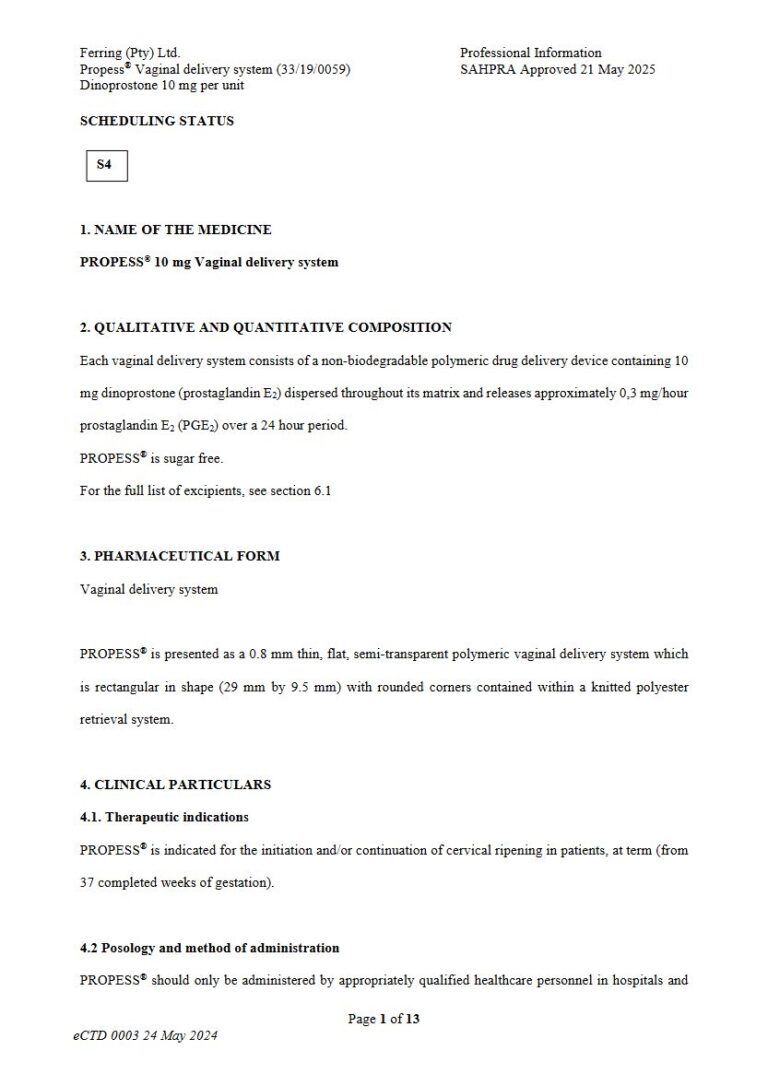
PROPESS u00ae is indicated for the initiation and/or continuation of cervical ripening in patients, at term (from 37 completed weeks of gestation).
4.2 Posology and method of administration
PROPESS u00ae should only be administered by appropriately qualified healthcare personnel in hospitals and clinics with specialised obstetric units with facilities for continuous foetal and uterine monitoring. After insertion, uterine activity and foetal condition must be carefully and regularly monitored.
Posology
One vaginal delivery system is administered high into the posterior vaginal fornix. The vaginal delivery system should be removed after 24 hours irrespective of whether cervical ripening has been achieved. A dosing interval of at least 30 minutes is recommended for the sequential use of uterotonic medicines following the removal of the vaginal delivery system. Only one application of PROPESS u00ae is recommended.
Paediatric population
The safety and efficacy of PROPESS u00ae in pregnant women aged less than 18 years has not been established. No data are available.
Method of administration
Administration PROPESS u00ae should be removed from the freezer just prior to the insertion. No thawing is required prior to use. There is a u201ctear marku201d on the side of the foil sachet. Open the package along the tear mark across the top of the sachet. Do not use scissors or other sharp objects which may cut the retrieval system. The vaginal delivery system should be inserted high into the posterior vaginal fornix using only small amounts of water-soluble lubricants to aid insertion. After the vaginal delivery system has been inserted, the withdrawal tape may be cut with scissors always ensuring there is sufficient tape outside the vagina to allow removal. No attempt should be made to tuck the end of the tape into the vagina as this may make retrieval more difficult. The patient should be recumbent for 20 u2013 30 min. after insertion. As PGE 2 will be released continuously over a period of 24 hours, it is important to monitor uterine contractions and foetal condition at frequent regular intervals.
Removal
The vaginal delivery system can be removed quickly and easily by gentle traction on the retrieval tape. Remove the vaginal delivery system to terminate drug administration when cervical ripening is judged to be complete or for any of the reasons listed below.
- Onset of labour, for the purpose of induction of labour with PROPESS u00ae , the onset of labour is defined as the presence of regular, painful uterine contractions occurring every 3 minutes irrespective of any cervical change. There are two important points to note:
- Once regular, painful contractions have been established with PROPESS u00ae , they will not reduce in frequency or intensity as long as PROPESS u00ae remains in situ because PGE2 is still being administered.
- Patients, particularly multigravidae, may develop regular, painful contractions without any apparent cervical change. Effacement and dilation of the cervix may not occur until uterine activity is established. Because of this, once regular, painful uterine activity is established with PROPESS u00ae in situ, the vaginal delivery system should be removed irrespective of cervical state to avoid the risk of uterine hyperstimulation.
- Spontaneous rupture of the membranes or amniotomy.
- Any suggestion of uterine hyperstimulation or hypertonic uterine contractions.
- Evidence of foetal distress.
- Evidence of maternal systemic PGE2 adverse effects such as nausea, vomiting, hypotension or tachycardia.
- At least 30 minutes prior to starting an intravenous infusion of other uterotonic medicines, as there is a much greater risk of hyperstimulation if the dinoprostone source is not removed before administration of uterotonic medicines.
The opening on one side of the retrieval device is present only to allow the manufacturer to enclose the vaginal delivery system into the retrieval device during manufacture. The vaginal delivery system should NEVER be removed from the retrieval device. Upon removal of the product from the vagina, the vaginal delivery system will have swollen 2 u2013 3 times its original size and be pliable. The whole product should be disposed of as clinical waste.
4.3. Contraindications
PROPESS u00ae should not be used or left in place:
- When labour has started.
- When uterotonic medicines and /or other labour induction agents are being given.
- When strong, prolonged uterine contraction would be inappropriate such as in patients:
- who have had previous major uterine surgery e.g. caesarean section, myomectomy etc. (see section 4.4 and 4.8)
- who have had previous major uterine cervix surgery (e.g. other than biopsies and cervical abrasion) or rupture of the uterine cervix.
- with cephalopelvic disproportion.
- with foetal malpresentation
- with suspicion or evidence of foetal distress
- When there is current pelvic inflammatory disease, unless adequate prior treatment has been instituted.
- When there is hypersensitivity to PGE2 or to any of the excipients listed in section 6.1.
- When there is placenta praevia or unexplained vaginal bleeding during the current pregnancy.
4.4 Special warnings and precautions for use
The condition of the cervix should be assessed carefully before PROPESS u00ae is used. After insertion, uterine activity and foetal condition must be monitored carefully and regularly by appropriately qualified healthcare personnel. PROPESS u00ae must only be used in hospitals and clinics with specialised obstetric units with facilities for continuous foetal and uterine monitoring. If there is any suggestion of maternal or foetal complications or if adverse effects occur, the vaginal delivery system should be removed from the vagina. Uterine rupture has been reported in association with the use of PROPESS u00ae , mainly in patients with contraindicated conditions (see section 4.3). Therefore, PROPESS u00ae should not be administered to patients with a history of previous caesarean section or uterine surgery given the potential risk for uterine rupture and associated obstetrical complications. If uterine contractions are prolonged or excessive, there is the possibility of uterine hypertonus or rupture and the vaginal delivery system should be removed immediately. A second dose of PROPESS u00ae is not recommended, as the effects of a second dose have not been studied.
PROPESS u00ae should be used with caution in patients with a previous history of uterine hypertonus, glaucoma or asthma. The experience of PROPESS u00ae in patients with ruptured membranes is limited. Therefore, PROPESS u00ae should be used with caution in those patients. Since the release of dinoprostone from the delivery system can be affected by the presence of amniotic fluid, special attention should be given to uterine activity and foetal condition. Women aged 35 and over, women with complications during pregnancy, such as gestational diabetes, arterial hypertension and hypothyroidism, and women at gestational age above 40 weeks have a higher post-partum risk for developing disseminated intravascular coagulation (DIC). These factors may additionally enhance the risk of disseminated intravascular coagulation in women with pharmacologically induced labour (see section 4.8). Therefore, uterotonic medicines such as dinoprostone should be used with caution in these women. In the immediate post-partum phase the medical practitioner should look out carefully for early signs of a developing DIC (e.g. fibrinolysis). The medical practitioner should be alert that use of dinoprostone may result in inadvertent abruption of placenta and subsequent embolisation of antigenic tissue causing in rare circumstances the development of Anaphylactoid Syndrome of Pregnancy (Amniotic Fluid Embolism). PROPESS u00ae is not recommended when there is a multiple pregnancy. No studies in multiple pregnancy have been performed. PROPESS u00ae should be used with caution when the woman has had more than three full term deliveries. No studies in woman with more than three full term deliveries have been performed. The use of PROPESS u00ae in patients with diseases which could affect the metabolism or excretion of PGE2, e.g. lung, liver or renal disease, has not been specifically studied. The use of PROPESS u00ae in such patients is not recommended.
4.5 Interaction with other medicines and other forms of interaction
No interaction studies have been performed specifically with PROPESS u00ae. Prostaglandins potentiate the uterotonic effect of uterotonic medicines. Concurrent use of PROPESS u00ae in patients receiving uterotonic medicines is not recommended. Medication with non-steroidal anti-inflammatory medicines, including aspirin, should be stopped before administration of dinoprostone.
4.6 Fertility, pregnancy and lactation
Pregnancy PROPESS u00ae is indicated for the initiation and/or continuation of cervical ripening in patients, at term (from 37 completed weeks of gestation) (see section 4.1). PROPESS u00ae should not be used during pregnancy prior to 37 completed weeks of gestation.
Breastfeeding No studies have been performed to investigate the amount of dinoprostone in colostrum or breast milk following the use of PROPESS u00ae. Dinoprostone may be excreted in colostrum and breast milk, but the level and duration is expected to be very limited and should not hinder breastfeeding. No effects on the breastfed new-borns have been observed in the clinical studies conducted with PROPESS u00ae.
Fertility Not relevant
4.7 Effects on ability to drive and use machines
The effect of PROPESS u00ae on the ability to drive and use machines is unknown.
4.8 Undesirable effects
Summary of safety profile: The table below displays the main ADRs distributed by system organ classes (SOC) and frequency. Further, the ADRs seen during post-marketing experience are mentioned with unknown frequency. Adverse reactions observed in clinical studies are presented according to their incidence, post authorisation reported adverse reactions are presented in the column frequency unknown.
System Organ Class Common ( u2265 1/100 to < 1/10) Uncommon ( u2265 1/1000 and < 1/100) Not known: (cannot be estimated from the available data)
Blood and lymphatic system disorders Disseminated intravascular coagulation Immune system disorders Anaphylactic reaction, hypersensitivity Nervous system disorders Headache Cardiac disorders Foetal heart rate disorder 1* Vascular disorders Hypotension Respiratory, thoracic and mediastinal disorders Neonatal respiratory distress related conditions Gastrointestinal disorders Abdominal pain, nausea, vomiting, diarrhoea Hepato-biliary disorders Neonatal hyper-bilirubinaemia Skin and subcutaneous tissue disorders Pruritus Pregnancy, puerperium and perinatal conditions Abnormal labour affecting foetus 2* , uterine contractions abnormal, uterine tachysystole, uterine hyperstimulation, uterine hypertonus, meconium in amniotic fluid Postpartum haemorrhage, premature separation of placenta, apgar score low, arrested labour, chorioamnionitis, uterine atony Anaphylactoid syndrome of pregnancy, foetal distress syndrome 3* foetal death, stillbirth, neonatal death 4* Reproductive system and breast disorders Vulvovaginal burning sensation Genital oedema General disorders and administration site conditions Febrile disorders Injury, poisoning and procedural complications Uterine rupture 1* u201cFoetal heart rate disorderu201d was in clinical studies reported as u201cfoetal heart rate abnormalitiesu201d, u201cfoetal bradycardiau201d, u201cfoetal tachycardiau201d, u201cunexplained absence of normal variabilityu201d, u201cfoetal heart rate decreasedu201d, u201cfoetal heart rate decelerationu201d, u201cearly or late decelerationsu201d, u201cvariable decelerationsu201d, u201cprolonged decelerationsu201d. 2* u201cAbnormal labour affecting foetusu201d as expression for hyperstimulation syndrome was in clinical studies reported as u201cuterine tachysystoleu201d combined with u201clate decelerationsu201d, u201cfoetal bradycardiau201d, or u201cprolonged decelerationsu201d 3* u201cFoetal distress syndromeu201d was also reported as u201cfoetal acidosisu201d, u201cpathological CTGu201d, u201cfoetal heart rate abnormalitiesu201d, u201cintrauterine hypoxiau201d or u201cthreatening asphyxiau201d. The term itself is unspecific, has a low positive predictive value and is often associated with an infant who is in good condition at birth. 4* Foetal death, stillbirth, and neonatal death have been reported after application of dinoprostone, as contained in PROPESS u00ae , especially following the occurrence of serious events such as uterine rupture (see sections 4.2, 4.3 and 4.4).
Reporting of suspected adverse reactions Reporting suspected adverse reactions after authorisation of the medicine is important. It allows continued monitoring of the benefit/risk balance of the medicine. Healthcare providers are asked to report any suspected adverse reactions to SAHPRA via the Med Safety APP (Medsafety X SAHPRA) and eReporting platform (who-umc.org) found on SAHPRA website.
4.9 Overdose
Overdosage may lead to hyperstimulation of the uterine muscle with or without foetal distress. If foetal distress occurs, remove PROPESS u00ae immediately and manage in accordance with local protocol.
