
Fidursi 120 mg/2,4 ml/500 mg/10 ml Solution
PDF Leaflet Revision Date: 13 January 2026
Clinical Summary
Quick overview from the medicine insert
Indication
Treatment of various cancers including MIBC, NSCLC, SCLC, HCC, BTC, and GC/GEJC.
Dosage (summary)
IV infusion over 60 mins; varies by indication, e.g., 1500 mg every 4 weeks for NSCLC.
Special Populations
- Elderly (u2265 65 years)
- Renal impairment
- Hepatic impairment
Pregnancy & Breastfeeding
Not recommended during pregnancy; avoid breastfeeding during treatment and for 3 months after.
Key Drug Interactions
- No significant drug-drug interactions identified
Contraindications
- Hypersensitivity to durvalumab or excipients
Common side effects
- Cough
- Diarrhoea
- Rash
Counselling Points
- Monitor for immune-mediated reactions
- Avoid pregnancy during treatment
- Inform about potential side effects
Serious warnings
- Immune-mediated pneumonitis
- Hepatitis
- Colitis
- Endocrinopathies
Important Disclaimer
The Fidursi 120 mg/2,4 ml/500 mg/10 ml Solution professional information leaflet below is the property of Astrazeneca Pharmaceuticals and is provided on Medinsert exactly as issued, with no.. alterations or editorial changes. We make every effort to keep content current by updating documents as soon as new versions become available. Medinsert serves as a trusted access point for healthcare professionals, but does not replace official sources or clinical judgement. For more details, please read our full disclaimer. read more>>
 Healthcare Professionals Only
This content is for registered healthcare professionals
Sign in or create a free account to read the full package insert.
Free for HPCSA-registered professionals. Powered by Medinsert.
Clinical Particulars
Section 4 of the official insert — extracted exactly as issued, no alterations
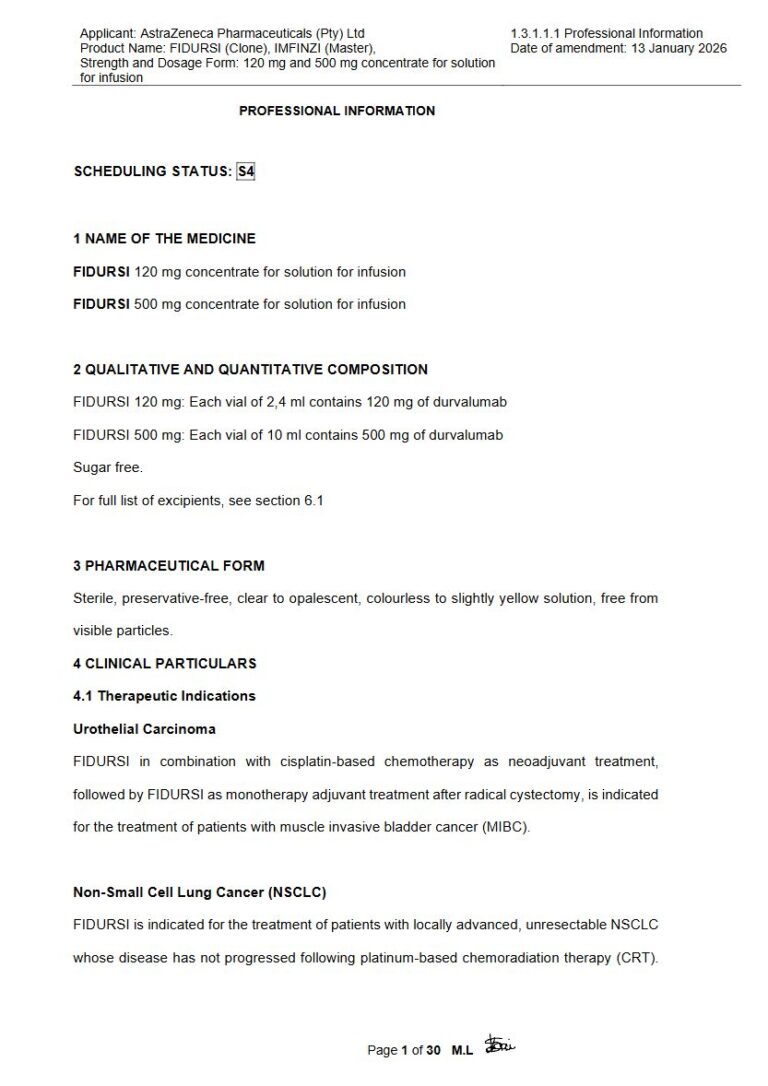
4.1 Therapeutic Indications
Urothelial Carcinoma
FIDURSI in combination with cisplatin-based chemotherapy as neoadjuvant treatment, followed by FIDURSI as monotherapy adjuvant treatment after radical cystectomy, is indicated for the treatment of patients with muscle invasive bladder cancer (MIBC).
Non-Small Cell Lung Cancer (NSCLC)
FIDURSI is indicated for the treatment of patients with locally advanced, unresectable NSCLC whose disease has not progressed following platinum-based chemoradiation therapy (CRT).
FIDURSI in combination with tremelimumab and platinum-based chemotherapy is indicated for the first-line treatment of patients with metastatic NSCLC with no sensitising epidermal growth factor (EGFR) mutations or anaplastic lymphoma kinase (ALK) genomic tumour aberrations.
FIDURSI in combination with chemotherapy as neoadjuvant treatment, followed by FIDURSI as monotherapy after surgery, is indicated for the treatment of patients with resectable (tumours u2265 4 cm and/or node positive) NSCLC and no known EGFR mutations or ALK rearrangements.
Small Cell Lung Cancer (SCLC)
FIDURSI is indicated for the treatment of patients with limited-stage small cell lung cancer (LS-SCLC) whose disease has not progressed following platinum-based chemoradiation therapy (CRT).
FIDURSI in combination with etoposide and either carboplatin or cisplatin is indicated for the first-line treatment of patients with extensive-stage small cell lung cancer (ES-SCLC).
Hepatocellular Carcinoma (HCC)
FIDURSI in combination with tremelimumab is indicated for the treatment of patients with unresectable hepatocellular carcinoma (uHCC).
Biliary Tract Cancer (BTC)
FIDURSI in combination with chemotherapy is indicated for the treatment of patients with locally advanced or metastatic biliary tract cancer (BTC).
Gastric or Gastroesophageal Junction Adenocarcinoma (GC/GEJC)
FIDURSI in combination with FLOT (Fluorouracil, Leucovorin, Oxaliplatin, and Docetaxel) chemotherapy as neoadjuvant and adjuvant treatment, followed by adjuvant FIDURSI monotherapy, is indicated for the treatment of patients with resectable gastric or gastroesophageal junction adenocarcinoma.
4.2 Posology and method of administration
Posology
The recommended dose of FIDURSI depends on the indication as presented in Table 1. FIDURSI is administered as an intravenous infusion over 60 minutes.
Table 1. Recommended dosage of FIDURSI
Indication Recommended FIDURSI dosage Duration of Therapy
- LS-SCLC 1500 mg b every 4 weeks Until disease progression, unacceptable toxicity or a maximum of 24 months.
- Locally Advanced NSCLC 10 mg/kg every 2 weeks or 1500 mg every 4 weeks a,b Until disease progression or unacceptable toxicity
- Metastatic NSCLC During chemotherapy: 1500 mg f,g in combination with tremelimumab 75 mg h and platinum-based chemotherapy i every 3 weeks (21 days) for 4 cycles Post-platinum chemotherapy: 1500 mg g,h every 4 weeks as monotherapy and histology-based pemetrexed maintenance i,j therapy every 4 weeks and, a fifth dose of tremelimumab k,l alongside FIDURSI dose 6 at week 16 Until disease progression or unacceptable toxicity
- Resectable NSCLC 1500 mg o in combination with chemotherapy d,i every 3 weeks for up to 4 cycles prior to surgery, followed by 1500 mg monotherapy every 4 weeks for up to 12 cycles after surgery. Until disease is deemed unresectable, recurrence, unacceptable toxicity, or a maximum of 12 cycles after surgery
- ES-SCLC 1500 mg c in combination with chemotherapy d,e Until disease progression or unacceptable toxicity every 3 weeks (21 days) for 4 cycles, followed by 1500 mg every 4 weeks as monotherapy
- uHCC Single Tremelimumab Regular Interval Durvalumab (STRIDE): 300 mg f tremelimumab as a single priming dose in combination with FIDURSI1 500 mg f,g at Cycle 1/Day 1, followed by FIDURSI as monotherapy every 4 weeks As long as clinical benefit is observed or until unacceptable toxicity
- BTC 1500 mg c in combination with chemotherapy h every 3 weeks (21 days), followed by 1500 mg every 4 weeks as monotherapy Until disease progression or until unacceptable toxicity
- MIBC 1500 mg d in combination with chemotherapy every 3 weeks (21 days) for 4 cycles prior to surgery, followed by 1500 mg d every 4 weeks as monotherapy for up to 8 cycles after surgery. Until disease progression that precludes definitive surgery, recurrence, unacceptable toxicity, or a maximum of 8 cycles after surgery
- GC/GEJC 1500 mg p in combination with FLOT chemotherapy every 4 weeks for up to 2 cycles prior to surgery, followed by 1500 mg p, with FLOT chemotherapy, every 4 weeks for up to 2 cycles and then as 1500 mg p monotherapy every 4 weeks for up to 10 cycles, for a total of up to 12 cycles after surgery Neoadjuvant phase: until disease progression that precludes definitive surgery or unacceptable toxicity Adjuvant phase: until progression or recurrence, unacceptable toxicity, or a maximum of 12 cycles after surgery
a Patients with a body weight of 30 kg or less must receive weight-based dosing, equivalent to FIDURSI 10 mg/kg every 2 weeks or 20 mg/kg every 4 weeks as monotherapy until weight increases to greater than 30 kg
b Patients with a body weight of 30 kg or less must receive weight-based dosing, equivalent to FIDURSI 20 mg/kg every 4 weeks as monotherapy until weight increases to greater than 30 kg
c Patients with a body weight of 30 kg or less must receive weight-based dosing, equivalent to FIDURSI 20 mg/kg in combination with chemotherapy every 3 weeks (21 days) for 4 cycles, followed by 20 mg/kg every 4 weeks as monotherapy until weight increases to greater than 30 kg.
d Administer FIDURSI prior to chemotherapy when given on the same day.
e When FIDURSI is administered in combination with chemotherapy, refer to the Professional Information for etoposide and carboplatin or cisplatin for dosing information.
f Patients with a body weight of 30 kg or less must receive weight-based dosing, equivalent to FIDURSI 20 mg/kg and tremelimumab 4 mg/kg until weight is increases to greater than 30 kg.
g Administer tremelimumab first; followed by FIDURSI and then chemotherapy on the day of dosing, when applicable.
h When FIDURSI is administered in combination with tremelimumab and chemotherapy, refer to the Professional Information for tremelimumab for dosing information.
i When FIDURSI is administered in combination with chemotherapy, refer to the Professional Information for appropriate chemotherapeutic agent for dosing information.
j Based on investigator decision for non-squamous patients who received treatment with pemetrexed and carboplatin/cisplatin.
k in the case of dose delay(s), a fifth dose of tremelimumab can be given after Week 16, alongside FIDURSI.
l If patients receive fewer than 4 cycles of platinum-based chemotherapy, the remaining cycles of tremelimumab (up to a total of 5) alongside FIDURSI should be given during the post-chemotherapy phase.
m Patients with a body weight of 30 kg or less must receive weight-based dosing, equivalent to FIDURSI 20 mg/kg and tremelimumab 4 mg/kg until weight is increases to greater than 30 kg.
n Administer tremelimumab prior to FIDURSI on the same day. When FIDURSI is administered in combination with tremelimumab, refer to the Prescribing Information for tremelimumab dosing information.
o Patients with a body weight of 30 kg or less must receive weight-based dosing of FIDURSI at 20 mg/kg. In combination with chemotherapy, dose at 20 mg/kg every 3 weeks (21 days) prior to surgery, followed by monotherapy at 20 mg/kg every 4 weeks after surgery until weight increases to greater than 30 kg.
p Patients with a body weight of 30 kg or less must receive weight-based dosing of FIDURSI at 20 mg/kg. In combination with FLOT chemotherapy or as monotherapy, dose at 20 mg/kg every 4 weeks until weight increases to greater than 30 kg.
Dose escalation or reduction is not recommended. Dose withholding or discontinuation may be required based on individual safety and tolerability. In general, withhold FIDURSI for severe (Grade 3) immune-mediated adverse reactions. Permanently discontinue FIDURSI for life-threatening (Grade 4) immune-mediated adverse reactions, recurrent severe (Grade 3) immune-mediated reactions that require systemic immunosuppressive treatment, or an inability to reduce corticosteroid dose to 10 mg or less of prednisone or equivalent per day within 12 weeks of initiating corticosteroids.
Guidelines for management of immune-mediated adverse reactions are described in Table 2. Refer to section 4.4, for further monitoring and evaluation information.
4.3 Contraindications
Hypersensitivity to durvalumab or to any of the excipients listed in section 6.1.
4.4 Special warnings and precautions for use
Immune-mediated pneumonitis: Immune-mediated pneumonitis or interstitial lung disease, defined as requiring use of systemic corticosteroids and with no clear alternate aetiology, occurred in patients receiving FIDURSI or FIDURSI in combination with tremelimumab (see section 4.8). Patients should be monitored for signs and symptoms of pneumonitis. Patients with suspected pneumonitis should be evaluated and the diagnosis should be confirmed with radiographic imaging and other infections and disease-related aetiologies (example tuberculosis) excluded and managed as recommended in section 4.2.
Pneumonitis and radiation pneumonitis: Radiation pneumonitis is frequently observed in patients receiving radiation therapy to the lung and the clinical presentation of pneumonitis and radiation pneumonitis is very similar. In the PACIFIC Study, in patients who had completed treatment with concurrent chemoradiation within 1 to 42 days prior to initiation of study treatment, pneumonitis including both immune-mediated pneumonitis and radiation pneumonitis, occurred in patients receiving FIDURSI Pneumonitis or radiation pneumonitis occurred in 161 (33,9 %) patients in the FIDURSI treated group and 58 (24,8 %) in the placebo group; including Grade 3 in 16 (3,4 %) patients on FIDURSI vs. 7 (3,0 %) patients on placebo and Grade 5 in 5 (1,1 %) patients on FIDURSI vs. 4 (1,7 %) patients on placebo. The median time to onset in the FIDURSI treated group was 55 days (range: 1-406 days) vs. 55 days (range: 1-255 days) in the placebo group. In the ADRIATIC Study, in patients who had completed treatment with chemoradiation within 1 to 42 days prior to initiation of study treatment, pneumonitis or radiation pneumonitis occurred in 100 (38,2 %) patients in the FIDURSI treated group and 80 (30,2 %) in the placebo group; including Grade 3 in 8 (3,1 %) patients on FIDURSI vs 6 (2,3 %) patients on placebo, and Grade 5 in 1 (0,4 %) patient on FIDURSI vs 0 patients on placebo.
Immune-mediated hepatitis: Immune-mediated hepatitis, defined as requiring use of systemic corticosteroids and with no clear alternate aetiology, occurred in patients receiving FIDURSI or FIDURSI in combination with tremelimumab (see section 4.8). Patients should be monitored for abnormal liver tests prior to and periodically during treatment with FIDURSI. Immune-mediated hepatitis should be managed as recommended in section 4.2.
Immune-mediated colitis: Immune-mediated colitis or diarrhoea, defined as requiring use of systemic corticosteroids and with no clear alternate aetiology, occurred in patients receiving FIDURSI or FIDURSI in combination with tremelimumab (see section 4.8). Patients should be monitored for signs and symptoms of colitis or diarrhoea and managed as recommended in section 4.2.
Immune-mediated endocrinopathies: Immune-mediated hypothyroidism hyperthyroidism/thyroiditis Immune-mediated hypothyroidism occurred in patients receiving FIDURSI or FIDURSI in combination with tremelimumab (see section 4.8). Patients should be monitored for abnormal thyroid function tests prior to and periodically during treatment and managed as recommended in section 4.2.
Immune-mediated Adrenal insufficiency: Immune-mediated adrenal insufficiency occurred in patients receiving FIDURSI or FIDURSI in combination with tremelimumab (see section 4.8). Patients should be monitored for clinical signs and symptoms of adrenal insufficiency. For symptomatic adrenal insufficiency, patients should be managed as recommended in section 4.2.
Immune-mediated Type 1 diabetes mellitus: Immune-mediated type 1 diabetes mellitus, which can present with diabetic ketoacidosis occurred in patients receiving FIDURSI or FIDURSI in combination with tremelimumab (see section 4.8). Patients should be monitored for clinical signs and symptoms of type 1 diabetes mellitus. For symptomatic type 1 diabetes mellitus, patients should be managed as recommended in section 4.2.
Immune-mediated Hypophysitis/hypopituitarism: Immune-mediated hypophysitis or hypopituitarism occurred in patients receiving FIDURSI or FIDURSI in combination with tremelimumab (see section 4.8). Patients should be monitored for clinical signs and symptoms of hypophysitis or hypopituitarism. For symptomatic hypophysitis or hypopituitarism, patients should be managed as recommended in section 4.2.
Immune-mediated nephritis: Immune-mediated nephritis, defined as requiring use of systemic corticosteroids and with no clear alternate aetiology, occurred in patients receiving FIDURSI or FIDURSI in combination with tremelimumab (see section 4.8). Patients should be monitored for abnormal renal function tests prior to and periodically during treatment with FIDURSI and managed as recommended in section 4.2.
Immune-mediated rash: Immune-mediated rash or dermatitis (including pemphigoid), defined as requiring use of systemic corticosteroids and with no clear alternate aetiology, occurred in patients receiving FIDURSI or FIDURSI in combination with tremelimumab (see section 4.8). Patients should be monitored for signs and symptoms of rash or dermatitis and managed as recommended in section 4.2.
Immune-mediated myocarditis: Immune-mediated myocarditis, which can be fatal, occurred in patients receiving FIDURSI or FIDURSI in combination with tremelimumab (see section 4.8). Patients should be monitored for signs and symptoms of immune-mediated myocarditis and managed as recommended in section 4.2.
Other immune mediated adverse reactions: Given the mechanism of action of FIDURSI or FIDURSI in combination with tremelimumab, other potential immune-mediated adverse reactions may occur. Patients should be monitored for signs and symptoms and managed as recommended in section 4.2. Other immune-mediated adverse reactions are myasthenia gravis, myositis, polymyositis, Guillain-Barru00c8 syndrome, immune thrombocytopenia, pancreatitis, immune-mediated arthritis, uveitis and encephalitis (see section 4.8).
Human Immunodeficiency Virus (HIV): Safety and efficacy in patients with HIV have not been established.
Infusion related reactions: Patients should be monitored for signs and symptoms of infusion related reactions. Severe infusion related reactions have been reported in patients receiving FIDURSI (see section 4.8).
4.5 Interaction with other medicines and other forms of interaction
FIDURSI is an immunoglobulin, therefore no formal pharmacokinetic (PK) medicine-medicine interaction studies have been conducted with FIDURSI. PK drug-drug interaction between durvalumab in combination with tremelimumab was assessed in the HIMALAYA study and no clinically meaningful PK drug-drug interaction was identified.
4.6 Fertility, pregnancy and lactation
Pregnancy
In animal reproduction studies, administration of FIDURSI to pregnant cynomolgus monkeys from the confirmation of pregnancy through delivery at exposure levels approximately 22 times higher than those observed at the clinical dose of 10 mg/kg of FIDURSI (based on AUC) was not associated with maternal toxicity or effects on embryofoetal development, pregnancy outcome or postnatal development. There are no data on the use of FIDURSI in pregnant women. Based on its mechanism of action, FIDURSI has the potential to impact maintenance of pregnancy and may cause foetal harm when administered to a pregnant woman. Human IgG1 is known to cross the placental barrier. FIDURSI is not recommended during pregnancy and in women of childbearing potential not using effective contraception during treatment and for at least 3 months after the last dose.
Lactation
There is no information regarding the presence of FIDURSI in human milk, the absorption and effects on the breastfed infant, or the effects on milk production. Human IgG is excreted in human milk. In animal reproduction studies, administration of FIDURSI to pregnant cynomolgus monkeys was associated with dose-related low level excretion of FIDURSI in breast milk. Because of the potential for adverse reactions in breastfed infants from FIDURSI, advise a lactating woman not to breastfeed during treatment and for at least 3 months after the last dose.
Fertility
There are no data on the potential effects of FIDURSI on fertility in humans. In repeat-dose toxicology studies with FIDURSI in sexually mature cynomolgus monkeys of up to 3 months duration, there were no notable effects on the male and female reproductive organs.
4.7 Effects on ability to drive and use machines
Based on its pharmacodynamic properties, FIDURSI is unlikely to affect the ability to drive and use machines. However, if patients experience adverse reactions affecting their ability to concentrate and react, they should be advised to use caution when driving or operating machinery.
4.8 Undesirable effects
Summary of the safety profile
The safety of FIDURSI as monotherapy is based on pooled data in 3006 patients from 9 studies across multiple tumour types the most frequent adverse reaction were cough, diarrhoea and rash. The safety of FIDURSI in combination with chemotherapy in patients with ES-SCLC is based on data in 265 patients from the CASPIAN study and was consistent with FIDURSI monotherapy and known chemotherapy safety profile. The safety of FIDURSI in combination with chemotherapy as neoadjuvant treatment in patients with resectable NSCLC, is based on data in 401 patients from the AEGEAN study and was consistent with known FIDURSI monotherapy and known chemotherapy safety profiles. The safety of FIDURSI in combination with chemotherapy in patients with BTC is based on data in 338 patients from the TOPAZ-1 study and was consistent with FIDURSI monotherapy and known chemotherapy safety profiles. The safety of FIDURSI in combination with tremelimumab and platinum-based chemotherapy treatment in patients with unresectable NSCLC is based on data in 330 patients from the POSEIDON study and was consistent with known FIDURSI + tremelimumab and known chemotherapy safety profiles. The safety of STRIDE treatment in patients with uHCC is based on data in 462 patients from the HCC pool and was consistent with known FIDURSI + tremelimumab safety profile. The safety of FIDURSI monotherapy in patients with LS-SCLC is based on data in 262 patients from the ADRIATIC study. The safety profile was consistent with FIDURSI monotherapy. The safety of FIDURSI in combination with chemotherapy in patients with MIBC is based on data in 530 patients from the NIAGARA study and was consistent with FIDURSI monotherapy and known chemotherapy safety profiles. The safety of FIDURSI in combination with FLOT chemotherapy as neoadjuvant and adjuvant treatment, followed by adjuvant FIDURSI monotherapy, in patients with GC/GEJC is based on data in 475 patients from the MATTERHORN study and was consistent with FIDURSI monotherapy and known FLOT chemotherapy safety profiles.
Tabulated list of adverse reactions
Adverse reactions are listed according to system organ class in MedDRA. Within each system organ class, the adverse drug reactions are presented in decreasing frequency. The corresponding frequency category is based on the CIOMS III convention and is defined as: very common (u2265 1/10); common (u2265 1/100 to < 1/10); uncommon (u2265 1/1,000 to < 1/100); rare (u2265 1/10,000 to < 1/1000); very rare (< 1/10,000); not determined (cannot be estimated from available data).
Table 3. Adverse drug reactions in patients treated with FIDURSI at 10 mg/kg
System Organ Class Adverse Drug Reaction Frequency of any Grade Frequency of Grade 3-4
- Respiratory, thoracic and mediastinal disorders Cough/ Productive Cough Very common 646 (21,5 %) Uncommon 11 (0,4 %)
- Pneumonitis a Common 114 (3,8 %) Uncommon 26 (0,9 %)
- Dysphonia Common 93 (3,1 %) Rare 2 (<0,1 %)
- Interstitial lung disease Uncommon 18 (0,6 %) Uncommon 4 (0,1 %)
- Hepatobiliary disorders Aspartate aminotransferase increased or Alanine aminotransferase increased a,b Common 244 (8,1 %) Common 69 (2,3 %)
- Hepatitis a,c Uncommon 25 (0,8 %) Uncommon 12 (0,4 %)
- Gastrointestinal disorders Abdominal pain d Very common 383 (12,7 %) Common 53 (1,8 %)
- Diarrhoea Very common 491 (16,3 %) Uncommon 19 (0,6 %)
- Colitis e Uncommon 28 (0,9 %) Uncommon 10 (0,3 %)
- Pancreatitis f Uncommon 6 (0,2 %) Uncommon 5 (0,17 %)
- Endocrine disorders Hypothyroidism g Very common 305 (10,1 %) Uncommon 5 (0,2 %)
- Hyperthyroidism h Common 137 (4,6 %) 0
- Thyroiditis i Uncommon 23 (0,8 %) Rare 2 (<0,1 %)
- Adrenal insufficiency Uncommon 18 (0,6 %) Rare 3 (<0,1 %)
- Hypophysitis/ Hypopituitarism Rare 2 (<0,1 %) Rare 2 (<0,1 %)
- Type 1 diabetes mellitus Rare 1 (<0,1 %) Rare 1 (<0,1 %)
- Diabetes insipidus Rare 1 (<0,1 %) Rare 1 (<0,1 %)
- Eye disorders Uveitis Rare 1 (<0,1 %) 0
- Renal and urinary disorders Blood creatinine increased Common 105 (3,5 %) Rare 3 (<0,1 %)
- Dysuria Common 39 (1,3 %) 0
- Nephritis j Uncommon 9 (0,3 %) Rare 2 (<0,1 %)
- Skin and subcutaneous tissue disorders Rash k Very common 480 (16,0 %) Uncommon 18 (0,6 %)
- Pruritus l Very common 325 (10,8 %) Rare 1 (<0,1 %)
- Night sweats Common 47 (1,6 %) Rare 1 (<0,1 %)
- Dermatitis Uncommon 22 (0,7 %) Rare 2 (<0,1 %)
- Pemphigoid m Rare 3 (<0,1 %) 0
- Cardiac disorders Myocarditis Rare 1 (<0,1 %) Rare 1 (<0,1 %)
- General disorders and administration site conditions Pyrexia Very common 414 (13,8 %) Uncommon 10 (0,3 %)
- Oedema peripheral n Common 291 (9,7 %) Uncommon 9 (0,3 %)
- Infections and infestations Upper respiratory tract infections o Very common 407 (13,5 %) Uncommon 6 (0,2 %)
- Pneumonia a,p Common 269 (8,9 %) Common 106 (3,5 %)
- Oral candidiasis Common 64 (2,1 %) 0
- Dental and oral soft tissue Common 50 (1,7 %) Rare 1 (<0,1 %)
- Influenza Common 47 (1,6 %) Rare 2 (<0,1 %)
- Musculoskeletal and connective tissue disorders Myalgia Common 178 (5,9 %) Rare 2 (<0,1 %)
- Myositis Uncommon 6 (0,2 %) Rare 1 (<0,1 %)
- Polymyositis Not determined r Not determined r
- Immune-mediated arthritis Not determined s Not determined s
- Nervous system disorders Myasthenia gravis Not determined s Not determined s
- Encephalitis Not determined Not determined t
- Guillain-Barru00c8 syndrome a Not determined s Not determined s
- Blood and lymphatic system disorders Immune thrombocytopenia a Rare 2 (<0,1 %) Rare 1 (<0,1 %)
- Injury, poisoning and procedural complications Infusion-related reaction u Common 49 (1,6 %) Uncommon 5 (0,2 %)
a Including fatal outcome.
b Includes alanine aminotransferase increased, aspartate aminotransferase increased, hepatic enzyme increased, and transaminases increased.
c Includes hepatitis, autoimmune hepatitis, hepatitis toxic, hepatocellular injury, hepatitis acute, hepatotoxicity and immune-mediated hepatitis.
d Includes abdominal pain, abdominal pain lower, abdominal pain upper, and flank pain.
e Includes colitis, enteritis, enterocolitis, and proctitis.
f Includes pancreatitis and pancreatitis acute.
g Includes autoimmune hypothyroidism and hypothyroidism.
h Includes hyperthyroidism and Basedow's disease.
i Includes autoimmune thyroiditis, thyroiditis, and thyroiditis subacute.
j Includes autoimmune nephritis, tubulointerstitial nephritis, nephritis, glomerulonephritis and glomerulonephritis membranous.
k Includes rash erythematous, rash generalized, rash macular, rash maculopapular, rash papular, rash pruritic, rash pustular, erythema, eczema and rash.
l Includes pruritus generalized and pruritus.
m Includes pemphigoid, dermatitis bullous and pemphigus. Reported frequency from completed and ongoing trials is uncommon.
n Includes oedema peripheral and peripheral swelling.
o Includes laryngitis, nasopharyngitis, peritonsillar abscess, pharyngitis, rhinitis, sinusitis, tonsillitis, tracheobronchitis, and upper respiratory tract infection.
p Includes lung infection, pneumocystis jirovecii pneumonia, pneumonia, candida pneumonia, pneumonia legionella, pneumonia adenoviral, pneumonia bacterial, pneumonia cytomegaloviral, pneumonia haemophilus, pneumonia pneumococcal and pneumonia streptococcal.
q Includes gingivitis, oral infection, periodontitis, pulpitis dental, tooth abscess and tooth infection.
r Polymyositis (fatal) was observed in a patient treated with FIDURSI from an ongoing sponsored clinical study outside of the pooled dataset: rare in any grade, rare in Grade 3 or 4 or 5.
s Reported frequency from AstraZeneca-sponsored clinical studies outside of the pooled dataset is rare.
t Reported frequency from ongoing AstraZeneca-sponsored clinical studies outside of the pooled dataset is rare and includes two events of encephalitis, one was Grade 5 (fatal) and one was Grade 2.
u Includes infusion-related reaction and urticaria with onset on the day of dosing or 1 day after dosing.
Worsening laboratory abnormalities including increased alanine aminotransferase, increased aspartate aminotransferase, increases blood creatinine and thyroid stimulating hormone (TSH) changes were observed in patients treated with FIDURSI.
4.9 Overdose
There is no specific treatment in the event of FIDURSI overdose, and symptoms of overdose are not established. In the event of an overdose, medical practitioners should follow general supportive measures and should treat symptomatically.
