
Novabe 10 mg Tablets
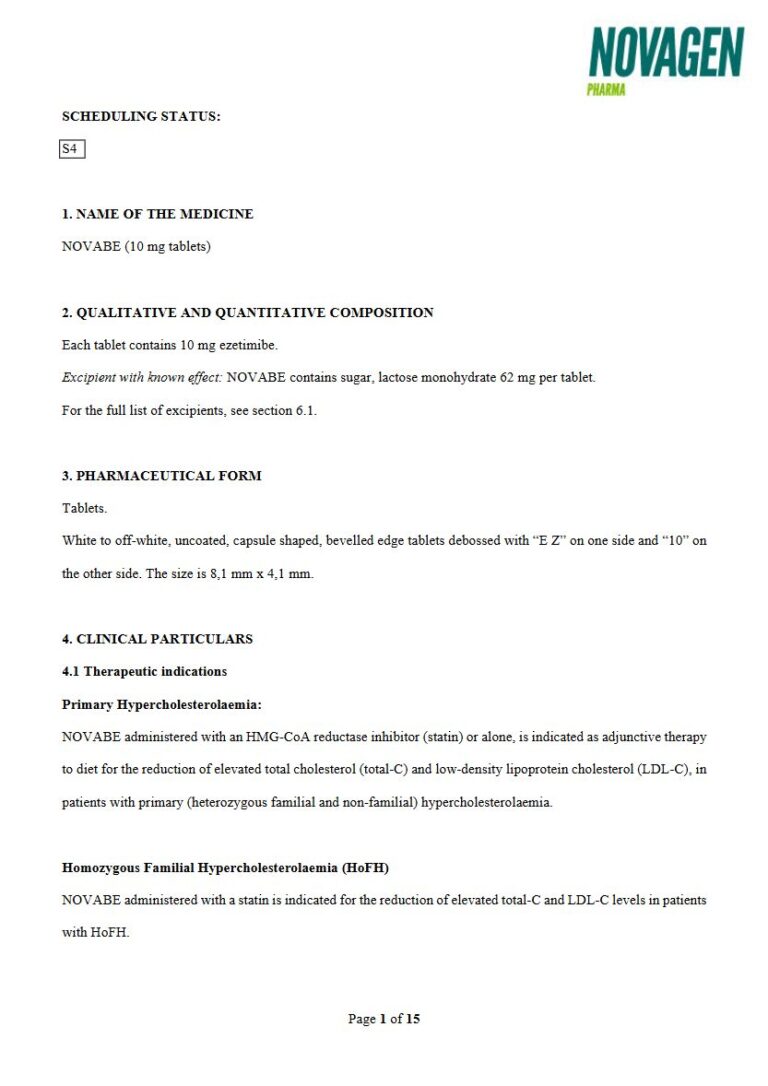
PDF Leaflet Revision Date: 06 April 2022
Clinical Summary
Quick overview from the medicine insert
Indication
Adjunctive therapy for primary hypercholesterolaemia.
Dosage (summary)
10 mg once daily; no adjustment for elderly or mild hepatic impairment.
Special Populations
- Elderly
- Hepatic impairment
- Paediatric patients
Pregnancy & Breastfeeding
Not recommended in pregnancy or lactation due to lack of data.
Key Drug Interactions
- Statins
- Fenofibrate
- Ciclosporin
- Anticoagulants
Contraindications
- Hypersensitivity
- Pregnancy
- Lactation
- Children <10 years
- Moderate to severe hepatic impairment
Common side effects
- Abdominal pain
- Diarrhoea
- Headache
- Myalgia
Counselling Points
- Take with or without food
- Report unexplained muscle pain
- Monitor INR if on anticoagulants
Serious warnings
- Risk of myopathy and rhabdomyolysis
- Monitor liver enzymes with statins
Important Disclaimer
The Novabe 10 mg Tablets professional information leaflet below is the property of Novagen Pharma and is provided on Medinsert exactly as issued, with no.. alterations or editorial changes. We make every effort to keep content current by updating documents as soon as new versions become available. Medinsert serves as a trusted access point for healthcare professionals, but does not replace official sources or clinical judgement. For more details, please read our full disclaimer. read more>>
 Healthcare Professionals Only
This content is for registered healthcare professionals
Sign in or create a free account to read the full package insert.
Free for HPCSA-registered professionals. Powered by Medinsert.
Clinical Particulars
Section 4 of the official insert — extracted exactly as issued, no alterations
4.1 Therapeutic indications
Primary Hypercholesterolaemia: NOVABE administered with an HMG-CoA reductase inhibitor (statin) or alone, is indicated as adjunctive therapy to diet for the reduction of elevated total cholesterol (total-C) and low-density lipoprotein cholesterol (LDL-C), in patients with primary (heterozygous familial and non-familial) hypercholesterolaemia.
Homozygous Familial Hypercholesterolaemia (HoFH) NOVABE administered with a statin is indicated for the reduction of elevated total-C and LDL-C levels in patients with HoFH.
4.2 Posology and method of administration
The patient should be on an appropriate lipid-lowering diet and weight loss programme where indicated and should continue on this diet during treatment with NOVABE. The recommended dose of NOVABE is 10 mg once daily, used alone, with a statin, or with fenofibrate.
Elderly patients No dosage adjustment is required for elderly patients (see section 5.2).
Paediatric patients Children 10 years of age or older: No dosage adjustment is required (see section 5.2). Children under 10 years of age: No clinical data on safety and efficacy are available; therefore, treatment with NOVABE is contraindicated.
Hepatic impairment No dosage adjustment is required in patients with mild hepatic insufficiency (Child Pugh A). Treatment with NOVABE is contraindicated in patients with moderate (Child Pugh B) or severe (Child Pugh C) liver dysfunction due to unknown effects (see section 4.3 and 5.2).
Co - administration with bile acid sequestrants Dosing of NOVABE should occur either 2 or more hours before or 4 or more hours after administration of a bile acid sequestrant.
Method of administration For oral use. NOVABE can be administered any time of the day, with or without food.
4.3 Contraindications
- Hypersensitivity to ezetimibe or to any of the excipients listed in section 6.1.
- Pregnancy, as no clinical data on exposed pregnancies are available.
- Lactation, as it is not known whether ezetimibe is excreted into human breast milk.
- Children below the age of 10 years.
- Moderate (Child Pugh B) to severe hepatic impairment (Child Pugh C).
- NOVABE co-administered with a statin in patients with active liver disease or unexplained persistent elevations in serum transaminases.
4.4 Special warnings and precautions for use
When NOVABE is co-administered with a statin, please refer to the Professional Information for that particular medicine.
Hepatic impairment Due to the unknown effects of the increased exposure to ezetimibe in patients with moderate or severe hepatic insufficiency, NOVABE is contraindicated in these patients (see section 4.3).
Liver enzymes When NOVABE is co-administered with a statin, liver function tests should be performed at initiation of therapy and according to the recommendations of the statin as consecutive transaminase elevations (u2265 3 x ULN) have been observed in co-administration trials (see section 4.8).
Skeletal muscle Cases of myopathy and rhabdomyolysis have been reported. All patients starting therapy with NOVABE must be advised of the risk of myopathy and be told to report promptly any unexplained muscle pain, tenderness or weakness (see section 4.8). NOVABE and any statin the patient is taking concomitantly, should be stopped immediately if myopathy is suspected or diagnosed. The presence of these symptoms and a creatine phosphokinase (CPK) level > 10 x ULN indicates myopathy. Rhabdomyolysis has also occurred, most patients who developed rhabdomyolysis were taking a statin concomitantly with NOVABE. Rhabdomyolysis has been reported very rarely in patients taking NOVABE monotherapy, and also very rarely with the addition of NOVABE to other medicines known to be associated with increased risk of rhabdomyolysis.
Paediatric population Safety and efficacy of NOVABE in patients 6 to 10 years of age with heterozygous familial or non-familial hypercholesterolaemia have not been studied in treatment periods longer than 12 weeks (see section 4.3). NOVABE has not been studied in patients younger than 6 years of age (see section 4.3). Safety and efficacy of NOVABE co-administered with simvastatin in patients 10 to 17 years of age with heterozygous familial hypercholesterolaemia have been evaluated in adolescent boys (Tanner stage II or above) and in girls who were at least one year post-menarche, there was generally no detectable effect on growth or sexual maturation in the adolescent boys or girls, or any effect on menstrual cycle length in girls. However, the effects of ezetimibe for a treatment period > 33 weeks on growth and sexual maturation have not been studied. The safety and efficacy of NOVABE co-administered with doses of simvastatin above 40 mg daily have not been studied in paediatric patients 10 to 17 years of age. The safety and efficacy of NOVABE co-administered with simvastatin have not been studied in paediatric patients < 10 years of age (see section 4.3). The long-term efficacy of therapy with NOVABE in patients below 17 years of age to reduce morbidity and mortality in adulthood has not been studied.
Concomitant use with fibrates The safety and efficacy of NOVABE administered with fibrates have not been established. If cholelithiasis is suspected in a patient receiving NOVABE and fenofibrate, gallbladder investigations are indicated, and this therapy should be discontinued (see section 4.5).
Concomitant use with ciclosporin Caution should be exercised when initiating NOVABE in the setting of ciclosporin. Ciclosporin concentrations should be monitored in patients receiving NOVABE and ciclosporin (see section 4.5).
Anticoagulants If NOVABE is added to warfarin or another coumarin anticoagulant, or fluindione, the International Normalised Ratio (INR) should be appropriately monitored (see section 4.5).
Excipient NOVABE contains lactose monohydrate. Patients with rare hereditary problems of galactose intolerance, total lactase deficiency or glucose-galactose malabsorption should not take NOVABE.
4.5 Interaction with other medicines and other forms of interaction
In preclinical studies, it has been shown that ezetimibe as in NOVABE does not induce cytochrome P450 medicine metabolising enzymes. No clinically significant pharmacokinetic interactions have been observed between ezetimibe as in NOVABE and medicines known to be metabolised by cytochromes P450 1A2, 2D6, 2C8, 2C9, and 3A4, or N-acetyltransferase.
Ezetimibe as in NOVABE had no significant effect on the pharmacokinetics of dapsone, dextromethorphan, digoxin, oral contraceptives (ethinyl estradiol and levonorgestrel), glipizide, tolbutamide, or midazolam during co-administration.
Antacids Concomitant antacid administration decreased the rate of absorption of NOVABE but had no effect on the bioavailability of ezetimibe as in NOVABE. This decreased rate of absorption is not considered clinically significant.
Cholestyramine Concomitant cholestyramine administration decreased the mean area under the curve (AUC) of total ezetimibe (ezetimibe + ezetimibe glucuronide) approximately 55 %. The incremental LDL-C reduction due to adding NOVABE to cholestyramine may be lessened by this interaction.
Fibrates In patients receiving fenofibrate and NOVABE, medical practitioners should be aware of the possible risk of cholelithiasis and gallbladder disease (see sections 4.4 and 4.8). If cholelithiasis is suspected in a patient receiving NOVABE and fenofibrate, gallbladder investigations are advised, and this therapy should be discontinued (see section 4.8). Concomitant fenofibrate or gemfibrozil administration increased total ezetimibe as in NOVABE concentrations (approximately 1,5- and 1,7-fold, respectively). Co-administration of NOVABE with other fibrates has not been studied. Fibrates may increase cholesterol excretion into the bile, leading to cholelithiasis. In animal studies, ezetimibe increased cholesterol in the gallbladder bile but not in all species. A lithogenic risk associated with the therapeutic use of NOVABE cannot be ruled out.
Statins No clinically significant pharmacokinetic interactions were seen when NOVABE was co-administered with atorvastatin, simvastatin, pravastatin, lovastatin, fluvastatin, or rosuvastatin.
Ciclosporin Ciclosporin has been reported to increase the plasma concentration of ezetimibe as in NOVABE and patients receiving both medicines should be carefully monitored.
Anticoagulants Concomitant administration of NOVABE (10 mg once daily) has no significant effect on bioavailability of warfarin and prothrombin time in a study of twelve healthy adult males. However, there have been reports of increased International Normalised Ratio (INR) in patients who were treated concomitantly with NOVABE and warfarin or fluindione. If NOVABE is added to warfarin or fluindione, INR should be appropriately monitored (see section 4.4).
Paediatric population Interaction studies have only been performed in adults.
4.6 Fertility, pregnancy and lactation
Pregnancy The use of NOVABE is not recommended in pregnancy, as no clinical data on exposed pregnancies are available (see section 4.3).
Lactation The use of NOVABE is not recommended during lactation, as it is not known whether NOVABE is excreted into breastmilk (see section 4.3). Studies on rats have shown that ezetimibe is secreted into breast milk.
Fertility No clinical trial data are available on the effects of ezetimibe on human fertility. Ezetimibe had no effect on the fertility of male or female rats.
4.7 Effects on ability to drive and use machines
No studies on the effects on the ability to drive and use machines have been performed. Patients who may experience dizziness should avoid driving vehicles or using machines.
4.8 Undesirable effects
Tabulated summary of adverse reactions NOVABE monotherapy: System organ class Adverse reaction Frequency Investigations ALT and/or AST increased; blood CPK increased; gamma-glutamyl transferase increased; liver function test abnormal Less frequent Respiratory, thoracic and mediastinal disorders Cough Less frequent Gastrointestinal disorders Abdominal pain, diarrhoea, flatulence Frequent Dyspepsia, gastroesophageal reflux disease, nausea Less frequent Musculoskeletal, connective tissue and bone disorders Arthralgia, muscle spasms, neck pain Less frequent Metabolism and nutrition disorders Decreased appetite Less frequent Vascular disorders Hot flush, hypertension Less frequent General disorders and administration site conditions Headache, fatigue Frequent Chest pain, pain. Less frequent Additional adverse reactions with NOVABE co - administered with a statin: System organ class Adverse reaction Frequency Investigations ALT and/or AST increased Frequent Nervous system disorders Headache Frequent Paraesthesia Less frequent Gastrointestinal disorders Dry mouth, gastritis Less frequent Skin and subcutaneous tissue disorders Pruritis, rash, urticaria Less frequent Musculoskeletal and connective tissue disorders Myalgia Frequent Back pain, muscular weakness, pain in extremity Less frequent General disorders and administration site conditions Asthenia, peripheral oedema Less frequent NOVABE co - administration with fenofibrate: Gastrointestinal disorders Abdominal pain. Frequent Post - marketing Experience (with or without a statin): System organ class Adverse reaction Frequency Blood and lymphatic system disorders Thrombocytopaenia Frequency unknown Nervous system disorders Dizziness, paraesthesia Frequency unknown Respiratory, thoracic and mediastinal disorders Dyspnoea Frequency unknown Gastrointestinal disorders Pancreatitis; constipation Frequency unknown Skin and subcutaneous tissue disorders Erythema multiforme Frequency unknown Musculoskeletal and connective tissue disorders Myalgia, myopathy/rhabdomyolysis (see section 4.4) Frequency unknown General disorders and administration site conditions Asthenia Frequency unknown Immune system disorders Hypersensitivity, including rash, urticaria, anaphylaxis and angioedema Frequency unknown Hepato - biliary disorders Hepatitis, cholelithiasis, cholecystitis Frequency unknown Psychiatric disorders Depression Frequency unknown Description of selected adverse reactions NOVABE co - administered with fenofibrate: Clinically important elevations (> 3X ULN, consecutive) in serum transaminases have been reported in patients with mixed hyperlipidaemia treated with NOVABE and fenofibrate. The reported incidence rates for cholecystectomy were higher in patients treated with NOVABE and fenofibrate (see sections 4.4 and 4.5). Paediatric (10 to 17 years of age) patients: Elevations of ALT and/or AST (u2265 3X ULN, consecutive) and CPK (u2265 10X ULN) have been reported in adolescent (10 to 17 years of age) patients with heterozygous familial hypercholesterolaemia treated with NOVABE and simvastatin; no cases of myopathy were reported. Coronary heart disease and ACS event history: A higher incidence of myopathy has been reported in patients treated with ezetimibe and simvastatin compared to simvastatin monotherapy. Myopathy was defined as unexplained muscle weakness or pain with a serum CK u2265 10 times ULN or two consecutive observations of CK u2265 5 and < 10 times ULN. The reported incidence of rhabdomyolysis was higher in simvastatin monotherapy compared to ezetimibe and simvastatin combination treatment. Rhabdomyolysis was defined as unexplained muscle weakness or pain with a serum CK u2265 10 times ULN with evidence of renal injury, u2265 5 times ULN and 3X ULN) have been reported (see section 4.4.). Laboratory values: Monotherapy studies reported elevations in serum transaminases (ALT and/or AST u2265 3 X ULN, consecutive) with NOVABE treatment. A higher incidence of elevations in serum transaminases has been reported in co-administration of NOVABE with a statin compared to a statin alone. These reported elevations were generally asymptomatic, not associated with cholestasis, and returned to baseline after discontinuation of therapy or with continued treatment (see section 4.4.). CPK > 10 X ULN has been reported in patients administered NOVABE alone or with a statin. No excess of myopathy or rhabdomyolysis associated with NOVABE were reported (see section 4.4).
4.9 Overdose
In the event of an overdose, symptomatic and supportive measures should be employed. In clinical study reports, administration of ezetimibe, 50 mg/day to healthy subjects for up to 14 days, or 40 mg/day to patients with primary hypercholesterolaemia for up to 56 days, was generally well tolerated.
