
Fluconazole 2 Mg Solution
PDF Leaflet Revision Date: 13 February 2025
Clinical Summary
Quick overview from the medicine insert
Indication
Treatment of cryptococcal meningitis, systemic candidiasis, and oropharyngeal candidiasis.
Dosage (summary)
Adults: 400 mg on day 1, then 200 mg daily; adjust based on response.
Special Populations
- Renal impairment
- Elderly
Pregnancy & Breastfeeding
Contraindicated in pregnancy and lactation; potential fetal risks.
Key Drug Interactions
- Cisapride
- Terfenadine
- Astemizole
- Pimozide
- Quinidine
- Erythromycin
Contraindications
- Hypersensitivity to fluconazole
- Co-administration with terfenadine at high doses
Common side effects
- Headache
- Nausea
- Abdominal pain
- Diarrhoea
- Rash
Counselling Points
- Monitor for liver function
- Avoid in pregnancy
- Report any rash or allergic reactions
Serious warnings
- QT prolongation
- Hepatotoxicity
- Adrenal insufficiency
Important Disclaimer
The Fluconazole 2 Mg Solution professional information leaflet below is the property of Fresenius Kabi South Africa and is provided on Medinsert exactly as issued, with no.. alterations or editorial changes. We make every effort to keep content current by updating documents as soon as new versions become available. Medinsert serves as a trusted access point for healthcare professionals, but does not replace official sources or clinical judgement. For more details, please read our full disclaimer. read more>>
 Healthcare Professionals Only
This content is for registered healthcare professionals
Sign in or create a free account to read the full package insert.
Free for HPCSA-registered professionals. Powered by Medinsert.
Clinical Particulars
Section 4 of the official insert — extracted exactly as issued, no alterations
4.1 Therapeutic indications
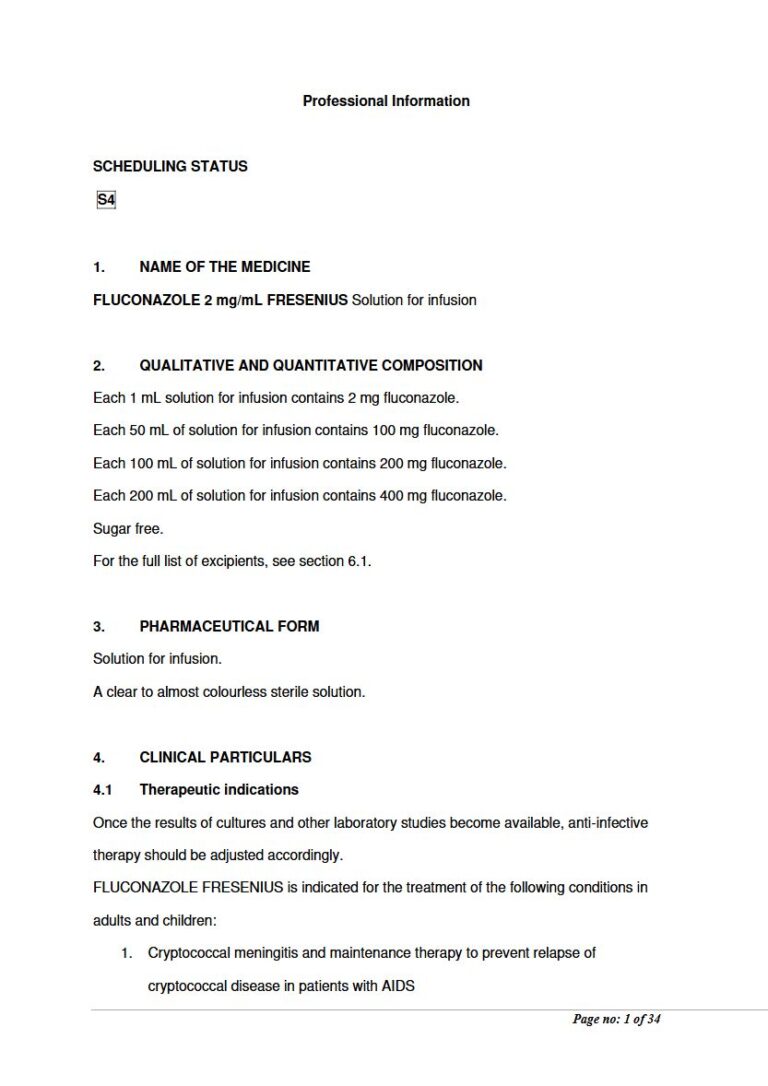
Once the results of cultures and other laboratory studies become available, anti-infective therapy should be adjusted accordingly. FLUCONAZOLE FRESENIUS is indicated for the treatment of the following conditions in adults and children:
- Cryptococcal meningitis and maintenance therapy to prevent relapse of cryptococcal disease in patients with AIDS
- Systemic candidiasis
- Oropharyngeal and oesophageal candidiasis
- Prevention of fungal infections in patients with malignancy who are predisposed to such infections as a result of cytotoxic chemotherapy and radiotherapy.
4.2 Posology and method of administration
Posology Treatment with FLUCONAZOLE FRESENIUS should be initiated by a medical practitioner experienced in the management of invasive fungal infections. The dose is dependent on the type and the severity of the infection. The treatment of infections requiring multiple dosing must be continued until clinical parameters or laboratory results show that the active fungal infection has subsided. An insufficient treatment period may lead to recurrence of the active infection. Patients with AIDS and cryptococcal meningitis or recurrent oropharyngeal candidiasis usually require maintenance therapy to prevent relapse. Fluconazole is also available for oral treatment. The patient should be switched from intravenous to oral administration as soon as possible. It is not necessary to change the daily dose of fluconazole when changing the route of administration from intravenous to oral.
Dosage in adults
- Cryptococcal meningitis: The usual dose is 400 mg on the first day followed by 200 mg once daily. Depending on the clinical response of the patient this dose may be increased to 400 mg daily. Usually, duration of treatment for cryptococcal meningitis is 6 u2013 8 weeks. For the prevention of relapse of cryptococcal meningitis in patients with AIDS, after the patient has received a full course of primary therapy, FLUCONAZOLE FRESENIUS may be administered at a daily dose of 100 to 200 mg until the CD4 count has stabilised at more than 250 cells/mm 3.
- Systemic candidiasis: The usual dose is 400 mg on the first day followed by 200 mg daily. Depending on the clinical response, the dose may be increased to 400 mg daily. Duration of treatment is based upon the clinical response.
- Oropharyngeal candidiasis: The usual dose is 50 to 100 mg once daily for 7 - 14 days. If necessary, treatment can be continued for longer periods in patients with severely compromised immune function. For the prevention of relapse of oropharyngeal candidiasis in patients with AIDS, after the patient has received a full course of primary therapy, FLUCONAZOLE FRESENIUS may be administered at a 150 mg once weekly dose. Oesophageal candidiasis: The recommended dose is 200 mg on the first day, followed by 100 mg to 200 mg once daily. Doses up to 400 mg/day may be used, based on medical judgment of the patientu2019s response to therapy. Patients with oesophageal candidiasis should be treated for a minimum of three weeks and for at least two weeks following resolution of symptoms.
- Prophylaxis against candidiasis: The recommended FLUCONAZOLE FRESENIUS dosage for the prevention of candidiasis is 50 mg to 400 mg once daily, based on the patientu2019s risk for developing fungal infection. For patients at high risk of systemic infection e.g. patients who are anticipated to have profound or prolonged neutropenia, a dose of 400 mg once daily has been used. FLUCONAZOLE FRESENIUS administration should start several days before the anticipated onset of neutropenia and continue for 7 days after the neutrophil count rises above 1 000 cells per mm 3.
Dosage in elderly Where there is no evidence of renal impairment, normal dosage recommendations should be adopted. For patients with renal impairment (creatinine clearance < 50 mL/min) the dosage schedule should be adjusted as described below.
Dosage in renal impairment Fluconazole is predominantly excreted in the urine as unchanged active substance. No adjustments in single dose therapy are necessary. In patients (including the paediatric population) with impaired renal function who will receive multiple doses of FLUCONAZOLE FRESENIUS, an initial dose of 50 mg to 400 mg should be given, based on the recommended daily dose for the indication. After this initial dose, the daily dose (according to indication) should be based on the following table: Dosage and administration of FLUCONAZOLE FRESENIUS Creatinine clearance (mL/min) Percent of recommended dose > 50 100 % u2264 50 (no dialysis) 50 % Regular dialysis 100 % after each dialysis. Patients on regular dialysis should receive 100 % of the recommended dose after each dialysis; on non-dialysis days, patients should receive a reduced dose according to their creatinine clearance. These are suggested dose adjustments based on pharmacokinetics following administration of multiple doses. Further adjustment may be needed depending upon clinical condition.
The patientu2019s creatine clearance can be estimated from the serum creatinine determination in u03bcmol/ L using the modified formula of Cockcroft and Gault: Males: Creatinine clearance CL cr (mL/min): = Bodyweight (kg) x (140 u2013 age in years) Serum creatinine level (S cr in u03bcmol/L) For females multiply the answer by 0,85.
Dosage in children As with similar infections in adults, the duration of treatment is based on the clinical and mycological response. The maximum adult daily dosage should not be exceeded in children. FLUCONAZOLE FRESENIUS is administered as a single daily dose.
- The recommended dosage of FLUCONAZOLE FRESENIUS for oropharyngeal candidiasis in children is 6 mg/kg on the first day, followed by 3 mg/kg once daily. Treatment should be administered for at least 2 weeks to decrease the likelihood of relapse.
- For the treatment of oesophageal candidiasis, the recommended dosage of FLUCONAZOLE FRESENIUS in children is 6 mg/kg on the first day, followed by 3 mg/kg once daily. Doses up to 12 mg/kg/day may be used based on medical judgment of the patientu2019s response to therapy. Patients with oesophageal candidiasis should be treated for a minimum of three weeks and for at least 2 weeks following the resolution of symptoms.
- For the treatment of systemic candidiasis and cryptococcal infection, the recommended dosage is 6 - 12 mg/kg/day, depending on the severity of the disease.
- For the prevention of fungal infections in immunocompromised patients considered at risk as a consequence of neutropenia following cytotoxic chemotherapy or radiotherapy, the dose should be 3 - 12 mg/kg daily, depending on the extent and duration of the induced neutropenia. For children with impaired renal function, see u2018Dosage in renal impairmentu2019 above. For children with impaired renal function the daily dose should be reduced in accordance with the guidelines given for adults, dependent on the degree of renal impairment.
- Dosage in children 4 weeks of age and younger Neonates excrete FLUCONAZOLE FRESENIUS slowly. In the first two weeks of life the same mg/kg dosing as in older children should be used but administered every 72 hours. During weeks 3 and 4 of life the same dose should be given every 48 hours.
Method of administration Only for intravenous use as infusion. FLUCONAZOLE FRESENIUS may be infused at a maximum rate of approximately 200 mg/hour through an existing line with one of the fluids listed in section 6.6.
4.3 Contraindications
- Hypersensitivity to fluconazole or other azole compounds or to any of the excipients of FLUCONAZOLE FRESENIUS (listed in section 6.1).
- Co-administration of terfenadine is contraindicated in patients receiving FLUCONAZOLE FRESENIUS at multiple doses of 400 mg per day or higher based upon results of a multiple dose interaction study. FLUCONAZOLE FRESENIUS should not be co-administered with medicines both known to prolong the QT-interval and metabolised via the cytochrome P450 (CYP) 3A4 such as cisapride, astemizole, erythromycin, pimozide and quinidine (see sections 4.4 and 4.5).
- Pregnancy and lactation (see section 4.6).
4.4 Special warnings and precautions for use
Tinea capitis FLUCONAZOLE FRESENIUS should not be used for tinea capitis. Cryptococcosis The evidence for efficacy of FLUCONAZOLE FRESENIUS in the treatment of cryptococcosis of other sites (e.g. pulmonary and cutaneous cryptococcosis) is limited, which prevents dosing recommendations. Renal system FLUCONAZOLE FRESENIUS should be used with caution in patients with renal dysfunction (see section 4.2). Adrenal insufficiency FLUCONAZOLE FRESENIUS may cause adrenal insufficiency relating to concomitant treatment with prednisone (see section 4.5, u201cThe effect of FLUCONAZOLE FRESENIUS on the metabolism of other medicinesu201d). Ketoconazole is known to cause adrenal insufficiency and this could also, although less frequently seen, be applicable to FLUCONAZOLE FRESENIUS. Hepatobiliary system FLUCONAZOLE FRESENIUS should be administered with caution to patients with liver dysfunction. FLUCONAZOLE FRESENIUS has been associated with cases of serious hepatic toxicity including fatalities, primarily in patients with serious underlying medical conditions. In cases of FLUCONAZOLE FRESENIUS-associated hepatotoxicity, no obvious relationship to total daily dose, duration of therapy, sex or age of patient has been observed. Hepatotoxicity may be reversible on discontinuation of therapy. Patients who develop abnormal liver function tests during FLUCONAZOLE FRESENIUS therapy should be monitored for the development of more serious hepatic injury. The patient should be informed of suggestive symptoms of serious hepatic effect (asthenia, anorexia, persistent nausea, vomiting and jaundice). FLUCONAZOLE FRESENIUS should be discontinued immediately if clinical signs or symptoms consistent with liver disease develop that may be attributable to FLUCONAZOLE FRESENIUS, and the patient should consult a medical practitioner. Dermatological reactions Patients have less frequently developed pruritus, rashes, urticaria, angioedema, dry skin, abnormal odour, exfoliative cutaneous reactions, such as Stevens-Johnson syndrome and toxic epidermal necrolysis during treatment with FLUCONAZOLE FRESENIUS. Drug reaction with eosinophilia and systemic symptoms (DRESS) has been reported. AIDS patients are more prone to the development of severe cutaneous reaction to many medicines. If patients with invasive/systemic fungal infections develop rashes, they should be monitored closely and FLUCONAZOLE FRESENIUS discontinued if bullous lesions or erythema multiforme develop. Hypersensitivity Anaphylaxis has been reported with the use of FLUCONAZOLE FRESENIUS (see sections 4.3 and 4.8). Cardiovascular system FLUCONAZOLE FRESENIUS has been associated with changes on the electrocardiogram such as QT prolongation and torsades de pointes. FLUCONAZOLE FRESENIUS causes QT prolongation via the inhibition of Rectifier Potassium Channel current (I kr). The QT prolongation caused by other medicines (such as amiodarone) may be amplified via the inhibition of cytochrome P450 (CYP) 3A4. There have been cases of QT prolongation and torsades de pointes in patients receiving FLUCONAZOLE FRESENIUS. These reports included seriously ill patients with multiple confounding risk factors, such as structural heart disease, electrolyte abnormalities and concomitant medicines that may have been contributory. Patients with hypokalemia and advanced cardiac failure are at an increased risk for the occurrence of life threatening ventricular dysrhythmias and torsades de pointes. FLUCONAZOLE FRESENIUS should be administered with caution to patients with these potentially pro-dysrhythmic conditions. Co-administration of other medicines known to prolong the QT-interval and which are metabolised via cytochrome P450 (CYP) 3A4 are contraindicated (see sections 4.3 and 4.5). Halofantrine Halofantrine has been shown to prolong QTc interval at the recommended therapeutic dose and is a substrate of CYP3A4. The concomitant use of FLUCONAZOLE FRESENIUS and halofantrine is therefore not recommended (see section 4.5). Cytochrome P450 FLUCONAZOLE FRESENIUS is a moderate CYP2C9 and CYP3A4 inhibitor. FLUCONAZOLE FRESENIUS is also a strong inhibitor of CYP2C19. FLUCONAZOLE FRESENIUS treated patients who are concomitantly treated with medicines with a narrow therapeutic window metabolised through CYP2C9, CYP2C19 and CYP3A4, should be monitored (see section 4.5). Terfenadine The coadministration of FLUCONAZOLE FRESENIUS at doses lower than 400 mg per day with terfenadine should be carefully monitored (see sections 4.3 and 4.5). Porphyria FLUCONAZOLE FRESENIUS is classified as probably porphyrinogenic. Candidiasis Studies have shown an increasing prevalence of infections with Candida species other than C. albicans. These are often inherently resistant (e.g. C. krusei and C. auris) or show reduced susceptibility to FLUCONAZOLE FRESENIUS (C. glabrata). Such infections may require alternative antifungal therapy secondary to treatment failure. Therefore, healthcare providers are advised to take into account the prevalence of resistance in various Candida species to FLUCONAZOLE FRESENIUS. FLUCONAZOLE FRESENIUS contains sodium FLUCONAZOLE FRESENIUS contains 0,15 mmol sodium per mL and should be taken into consideration for patients on a controlled sodium diet. 1 mL of solution for infusion contains 0,15 mmol (3,5 mg) sodium (as chloride), equivalent to 0,175 % of the WHO recommended maximum daily intake of 2 g sodium for an adult. 50 mL solution for infusion contains 7,7 mmol (177 mg) sodium (as chloride), equivalent to 8,85 % of the WHO recommended maximum daily intake of 2 g sodium for an adult. 100 mL solution for infusion contains 15,4 mmol (354 mg) sodium (as chloride), equivalent to 17,7 % of the WHO recommended maximum daily intake of 2 g sodium for an adult. 200 mL solution for infusion contains 30,8 mmol (709 mg) sodium (as chloride), equivalent to 35,45 % of the WHO recommended maximum daily intake of 2 g sodium for an adult.
4.5 Interactions with other medicines
The following combinations are contraindicated:
- Cisapride (CYP3A4 substrate): Cardiovascular effects, including torsades de pointes, have been reported in patients having received concomitant treatment with FLUCONAZOLE FRESENIUS and cisapride. Administration of 200 mg FLUCONAZOLE FRESENIUS once daily concomitantly with cisapride 20 mg four times daily, led to a significant increase in plasma levels of cisapride and prolongation of the QTc-interval. Concurrent treatment with FLUCONAZOLE FRESENIUS and cisapride is contraindicated (see section 4.3).
- Terfenadine: Serious cardiac dysrhythmias secondary to prolongation of the QTc interval in patients receiving azole antifungals in conjunction with terfenadine, may occur. FLUCONAZOLE FRESENIUS taken in doses of 400 mg per day or greater significantly increases plasma levels of terfenadine when taken concomitantly. The combined use of FLUCONAZOLE FRESENIUS at doses of 400 mg or greater with terfenadine is contraindicated (see section 4.3). The co-administration of FLUCONAZOLE FRESENIUS at doses lower than 400 mg per day with terfenadine should be carefully monitored.
- Astemizole: Concomitant administration of FLUCONAZOLE FRESENIUS with astemizole may decrease the clearance of astemizole. Resulting increased plasma concentrations of astemizole can lead to QT prolongation and torsades de pointes. Co-administration of FLUCONAZOLE FRESENIUS and astemizole is contraindicated (see section 4.3).
- Pimozide: Concomitant administration of FLUCONAZOLE FRESENIUS with pimozide may result in inhibition of pimozide metabolism. Increased pimozide plasma concentrations can lead to QT prolongation and torsades de pointes. Co-administration of FLUCONAZOLE FRESENIUS and pimozide is contraindicated (see section 4.3).
- Quinidine: Concomitant administration of FLUCONAZOLE FRESENIUS with quinidine may result in inhibition of quinidine metabolism. Use of quinidine has been associated with QT prolongation and torsades de pointes. Co-administration of FLUCONAZOLE FRESENIUS and quinidine is contraindicated (see section 4.3).
- Erythromycin: Concomitant use of FLUCONAZOLE FRESENIUS and erythromycin has the potential to increase the risk of cardiotoxicity (prolonged QT interval, torsades de pointes) and consequently sudden death. Co-administration of FLUCONAZOLE FRESENIUS and erythromycin is contraindicated (see section 4.3).
The following combination cannot be recommended:
- Halofantrine (CYP3A4 substrate): FLUCONAZOLE FRESENIUS inhibits CYP3A4 and can lead to inhibition of halofantrine metabolism with an increase in halofantrine plasma concentration. Concomitant use of FLUCONAZOLE FRESENIUS and halofantrine has the potential to increase the risk of cardiotoxicity (prolongation of the QT-interval, torsades de pointes) and consequently sudden heart death. This combination should be avoided (see section 4.4).
The following combination should be used with caution:
- Amiodarone: Concomitant administration of FLUCONAZOLE FRESENIUS with amiodarone may increase QT prolongation. Caution must be exercised if the concomitant use of FLUCONAZOLE FRESENIUS and amiodarone is necessary, notably with high dose FLUCONAZOLE FRESENIUS (800 mg) (see section 4.4).
The following medicines should be used with caution, with possible dose adjustments, when administered concomitantly with FLUCONAZOLE FRESENIUS:
The effects of other medicines on FLUCONAZOLE FRESENIUS Hydrochlorothiazide: In a pharmacokinetic interaction study with healthy volunteers who concomitantly received FLUCONAZOLE FRESENIUS and multiple doses of hydrochlorothiazide the plasma concentrations of FLUCONAZOLE FRESENIUS increased by 40 %. An effect of this magnitude may necessitate a change in the FLUCONAZOLE FRESENIUS dose in patients who are concomitantly treated with diuretics. Rifampicin (CYP450 inducer): Concomitant treatment with FLUCONAZOLE FRESENIUS and rifampicin reduced the AUC for FLUCONAZOLE FRESENIUS by 25 % and shortened the half-life of FLUCONAZOLE FRESENIUS by 20 %. An increase in the dose of FLUCONAZOLE FRESENIUS should be considered in combination treatment.
The effect of FLUCONAZOLE FRESENIUS on the metabolism of other medicines FLUCONAZOLE FRESENIUS is a moderate inhibitor of cytochrome P450 (CYP) isoenzyme 2C9 and 3A4. FLUCONAZOLE FRESENIUS is also a strong inhibitor of the isoenzyme CYP2C19. In addition to the observed/documented interactions mentioned below, there is a risk of increased plasma concentration of other medicines metabolised by CYP2C9, CYP2C19 and CYP3A4 co-administered with FLUCONAZOLE FRESENIUS. Therefore, caution should always be observed during combination therapy with such medicines and the patient closely monitored. The enzyme inhibiting effects may persist for 4 u2013 5 days after discontinuation of FLUCONAZOLE FRESENIUS treatment due to the long half-life of fluconazole.
4.6 Fertility, pregnancy and lactation
FLUCONAZOLE FRESENIUS is contraindicated in pregnancy and lactation (see section 4.3). Women of childbearing potential / contraception in males and females Before initiating treatment, the patient should be informed of the potential risk to the foetus. After single dose treatment, a washout period of 1 week (corresponding to 5-6 half-lives) is recommended before becoming pregnant (see section 5.2). For longer courses of treatment, contraception may be considered, as appropriate, in women of childbearing potential throughout the treatment period and for 1 week after the final dose. Pregnancy Observational studies suggest an increased risk of spontaneous abortion in women treated with FLUCONAZOLE FRESENIUS during the first and/or second trimester compared to women not treated with fluconazole or treated with topical azoles during the same period. Available epidemiological studies on cardiac malformations with use of fluconazole during pregnancy provide inconsistent results. However, a meta-analysis of 5 observational studies including several thousand pregnant women exposed to fluconazole during the first trimester finds a 1,8-2 fold increased risk of cardiac malformations when compared to no fluconazole use and/or topical azoles use. Case reports describe a pattern of birth defects among infants whose mothers received high-dose (400 to 800 mg/day) fluconazole during pregnancy for 3 months or more, in the treatment of coccidioidomycosis. The birth defects seen in these infants include brachycephaly, ears dysplasia, giant anterior fontanelles, femoral bowing and radio-humeral synostosis. A causal relationship between fluconazole use and these birth defects is uncertain.
Breastfeeding Fluconazole is secreted into breast milk at concentrations similar to those in plasma. FLUCONAZOLE FRESENIUS should not be used in mothers breastfeeding their infants.
Fertility FLUCONAZOLE FRESENIUS did not affect the fertility of male or female rats.
4.7 Effects on ability to drive and use machines
Patients should be warned about the potential for dizziness or seizures (see section 4.8) while receiving FLUCONAZOLE FRESENIUS and should be advised not to drive or operate machines if any of these symptoms occur.
4.8 Undesirable effects
a) Summary of the safety profile Drug reaction with eosinophilia and systemic symptoms (DRESS) has been reported in association with FLUCONAZOLE FRESENIUS treatment (see section 4.4). The most frequently reported adverse reactions are headache, abdominal pain, diarrhoea, nausea, vomiting, alanine aminotransferase increased, aspartate aminotransferase increased, blood alkaline phosphatase increased, and rash.
b) Tabulated list of adverse reactions System organ class Frequent Less frequent Frequency unknown (cannot be estimated from the available data) Infections and infestations Infection due to resistant microorganisms Blood and the lymphatic system disorders Anaemia Agranulocytosis Leukopenia Neutropenia Thrombocytopenia Immune system disorders Anaphylactic reaction Angioedema Facial oedema Metabolism and nutrition disorders Decreased appetite Hypercholesterolaemia Hypertriglyceridaemia Hypokalaemia Psychiatric disorders Insomnia Somnolence Nervous system disorders Headache Convulsion Seizures Dizziness Paraesthesia Abnormal taste sensation Tremor Ear and labyrinth disorders Vertigo Cardiac disorders Ventricular dysrhythmia (QT prolongation, torsades de pointes) Gastrointestinal disorders Vomiting Nausea Abdominal pain Diarrhoea Dyspepsia Flatulence Anorexia Constipation Dry mouth Hepatobiliary disorders Increase in the serum activities of liver-derived enzymes such as ALP, ALT and AST Cholestasis Total bilirubin increased Jaundice Hepatotoxicity Hepatitis Liver cell necrosis Liver failure with fatal cases*
c) Description of selected adverse reactions In some patients, particularly those with serious underlying diseases such as AIDS and cancer, changes in renal and haematological function test results and hepatic abnormalities have been observed during treatment with FLUCONAZOLE FRESENIUS.
d) Paediatric population The pattern and incidence of adverse reactions and laboratory abnormalities in the paediatric population are comparable to those in adults.
Reporting of suspected adverse reactions Reporting suspected adverse reactions after authorisation of the medicine is important. It allows continued monitoring of the benefit/risk balance of the medicine. Health care providers are requested to report any suspected adverse drug reactions to SAHPRA via the Med Safety APP (Medsafety X SAHPRA) and eReporting platform (who-umc.org) found on SAHPRA website. Healthcare providers are asked to report any suspected adverse drug reactions to the Holder of the Certificate of Registration at the following email address: [email protected] and to the relevant medicineu2019s regulatory authority in the country where the product is marketed.
4.9 Overdose
Symptoms of overdose There have been reports of overdose with FLUCONAZOLE FRESENIUS accompanied by hallucinations and paranoid behaviour.
Treatment of overdose In the event of overdose, supportive measures and symptomatic treatment may be adequate. FLUCONAZOLE FRESENIUS is mainly excreted in the urine. A 3-hour haemodialysis session reduces plasma levels by approximately 50 %. Forced volume diuresis would probably increase the elimination rate.
