
Bondronat 50 mg FC tablets
PDF Leaflet Revision Date: 05 January 2026
Clinical Summary
Quick overview from the medicine insert
Indication
Prevention of skeletal complications in breast cancer with bone metastases.
Dosage (summary)
50 mg daily; adjust for renal impairment.
Special Populations
- Elderly
- Renal impairment
- Hepatic impairment
Pregnancy & Breastfeeding
Contraindicated in pregnancy and lactation due to lack of clinical experience.
Key Drug Interactions
- Calcium supplements
- NSAIDs
- Aminoglycosides
Contraindications
- Hypersensitivity to ibandronic acid
- Hypocalcaemia
- Oesophageal abnormalities
- Inability to sit upright
Common side effects
- Hypocalcaemia
- Oesophagitis
- Dyspepsia
- Nausea
Counselling Points
- Take after overnight fast
- Avoid lying down for 60 mins post-dose
- Report any esophageal symptoms
Serious warnings
- Osteonecrosis of the jaw
- Atypical femur fractures
- Gastrointestinal irritation
Important Disclaimer
The Bondronat 50 mg FC tablets professional information leaflet below is the property of Adcock Ingram and is provided on Medinsert exactly as issued, with no.. alterations or editorial changes. We make every effort to keep content current by updating documents as soon as new versions become available. Medinsert serves as a trusted access point for healthcare professionals, but does not replace official sources or clinical judgement. For more details, please read our full disclaimer. read more>>
 Healthcare Professionals Only
This content is for registered healthcare professionals
Sign in or create a free account to read the full package insert.
Free for HPCSA-registered professionals. Powered by Medinsert.
Clinical Particulars
Section 4 of the official insert — extracted exactly as issued, no alterations
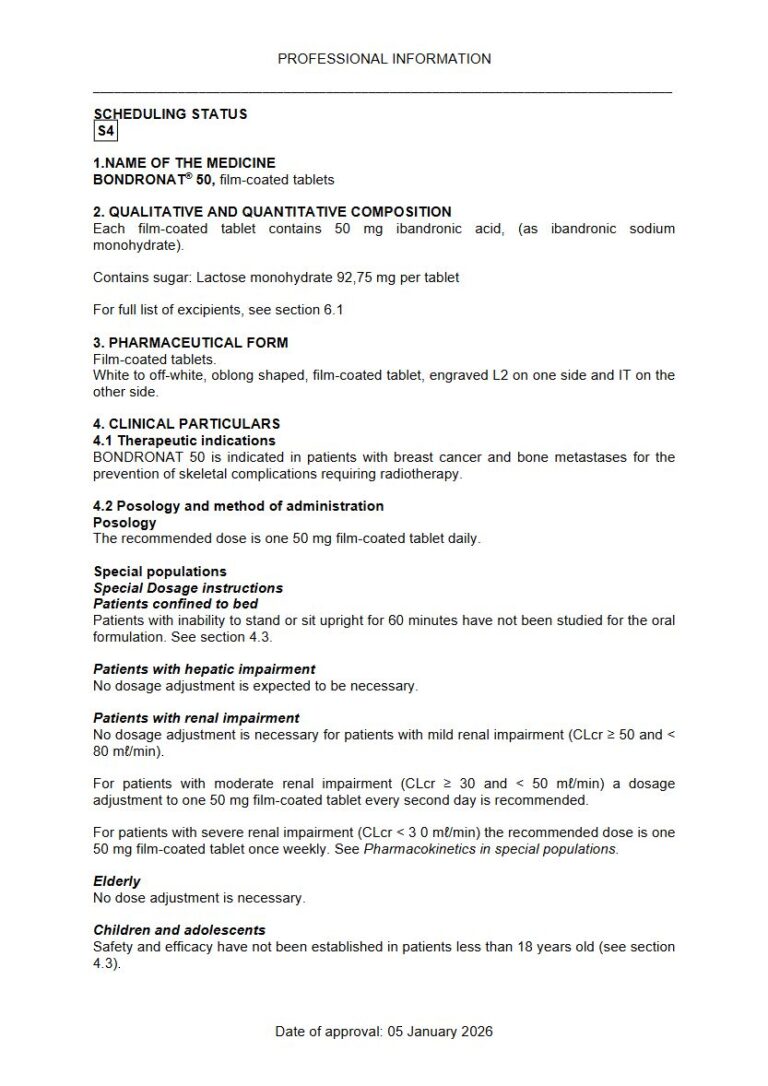
4.1 Therapeutic indications
BONDRONAT 50 is indicated in patients with breast cancer and bone metastases for the prevention of skeletal complications requiring radiotherapy.
4.2 Posology and method of administration
Posology
The recommended dose is one 50 mg film-coated tablet daily.
Special populations
Special Dosage instructions
Patients confined to bed
Patients with inability to stand or sit upright for 60 minutes have not been studied for the oral formulation. See section 4.3.
Patients with hepatic impairment
No dosage adjustment is expected to be necessary.
Patients with renal impairment
No dosage adjustment is necessary for patients with mild renal impairment (CLcr u2265 50 and < 80 mu2113/min). For patients with moderate renal impairment (CLcr u2265 30 and < 50 mu2113/min) a dosage adjustment to one 50 mg film-coated tablet every second day is recommended. For patients with severe renal impairment (CLcr < 30 mu2113/min) the recommended dose is one 50 mg film-coated tablet once weekly. See Pharmacokinetics in special populations.
Elderly
No dose adjustment is necessary.
Children and adolescents
Safety and efficacy have not been established in patients less than 18 years old (see section 4.3).
Method of administration
For oral use. BONDRONAT 50 should be taken after an overnight fast (at least 6 hours) and 30 - 60 minutes before the first food or drink of the day. Medicinal products and supplements (including calcium) should similarly be avoided prior to taking BONDRONAT 50 tablets. Fasting should be continued for 30 - 60 minutes after taking the tablet. Plain water may be taken at any time during the course of BONDRONAT 50 treatment.
u2022 The tablets should be swallowed whole with a full glass of plain water (180 to 240 mu2113) while the patient is standing or sitting in an upright position.
u2022 Patients should not lie down for 60 minutes after taking BONDRONAT 50.
u2022 Patients should not chew or suck the tablet because of a potential for oropharyngeal ulceration.
u2022 Plain water is the only drink that should be taken with BONDRONAT 50. Please note that some mineral waters may have a higher concentration of calcium and therefore should not be used.
4.3 Contraindications
BONDRONAT 50 is contraindicated in patients with:
u2022 Known hypersensitivity to ibandronic acid, or other bisphosphonates or to any of the excipients listed in section 6.1.
u2022 Hypocalcaemia, see section 4.4.
u2022 Abnormalities of the oesophagus which delay oesophageal emptying such as stricture or achalasia, see section 4.4.
u2022 Inability to stand or sit upright for at least 60 minutes, see sections 4.2 and 4.4.
u2022 BONDRONAT 50 should not be used during pregnancy and lactation due to a lack of clinical experience, see section 4.6.
u2022 BONDRONAT 50 should not be used in children, due to lack of clinical experience, see section 4.2.
4.4 Special warnings and precautions for use
Patients with disturbances of bone and mineral metabolism
Hypocalcaemia and other disturbances of bone and mineral metabolism should be effectively treated before starting BONDRONAT 50 therapy. Adequate intake of calcium and vitamin D is important in all patients. Patients should receive supplemental calcium and/or vitamin D if dietary intake is inadequate.
Gastrointestinal irritation
Orally administered bisphosphonates may cause local irritation of the upper gastrointestinal mucosa. Because of these possible irritant effects and a potential for worsening of the underlying disease, caution should be used when BONDRONAT 50 is given to patients with active upper gastrointestinal problems (e.g. known Barrettu2019s oesophagus, dysphagia, other oesophageal diseases, gastritis, duodenitis or ulcers). Adverse experiences such as oesophagitis, oesophageal ulcers and oesophageal erosions, in some cases severe and requiring hospitalisation, rarely with bleeding or followed by oesophageal stricture or perforation, have been reported in patients receiving treatment with oral bisphosphonates. The risk of severe oesophageal adverse experiences appears to be greater in patients who do not comply with the dosing instruction and/or who continue to take oral bisphosphonates after developing symptoms suggestive of oesophageal irritation. Patients should pay particular attention and be able to comply with the dosing instructions, see section 4.2.
Medical practitioners should be alert to any signs or symptoms signalling a possible oesophageal reaction and patients should be instructed to discontinue BONDRONAT 50 and seek medical attention if they develop dysphagia, odynophagia, retrosternal pain or new or worsening heartburn.
While no increased risk was observed in controlled clinical trials there have been post-marketing reports of gastric and duodenal ulcers with oral BONDRONAT 50 use, some severe and with complications.
Acetylsalicylic acid and NSAIDs
Since Acetylsalicylic acid and NSAIDs are associated with gastrointestinal irritation, caution should be taken during concomitant oral medication with BONDRONAT 50.
Osteonecrosis of the jaw
Osteonecrosis of the jaw (ONJ) has been reported very rarely in the post marketing setting in patients receiving BONDRONAT 50 for oncology indications (see section 4.8). The start of treatment or of a new course of treatment should be delayed in patients with unhealed open soft tissue lesions in the mouth. A dental examination with preventive dentistry and an individual benefit-risk assessment is recommended prior to treatment with BONDRONAT 50 in patients with concomitant risk factors. The following risk factors should be considered when evaluating a patientu2019s risk of developing ONJ:
u2022 Potency of the medicinal product that inhibit bone resorption (higher risk for highly potent compounds), route of administration (higher risk for parenteral administration) and cumulative dose of bone resorption therapy.
u2022 Cancer, co-morbid conditions (e.g. anaemia, coagulopathies, infection), smoking.
u2022 Concomitant therapies: corticosteroids, chemotherapy, angiogenesis inhibitors, radiotherapy to head and neck.
u2022 Poor oral hygiene, periodontal disease, poorly fitting dentures, history of dental disease, invasive dental procedures e.g. tooth extractions.
All patients should be encouraged to maintain good oral hygiene, undergo routine dental check-ups, and immediately report any oral symptoms such as dental mobility, pain or swelling, or non-healing of sores or discharge during treatment with BONDRONAT 50. While on treatment, invasive dental procedures should be performed only after careful consideration and be avoided in close proximity to BONDRONAT 50 administration. The management plan of the patients who develop ONJ should be set up in close collaboration between the treating physician and a dentist or oral surgeon with expertise in ONJ. Temporary interruption of BONDRONAT 50 treatment should be considered until the condition resolves and contributing risk factors are mitigated where possible.
Osteonecrosis of the external auditory canal
Osteonecrosis of the external auditory canal has been reported with bisphosphonates (including BONDRONAT 50), mainly in association with long-term therapy. Possible risk factors for osteonecrosis of the external auditory canal include steroid use and chemotherapy and/or local risk factors such as infection or trauma. Other risk factors include repetitive minor trauma (e.g. habitual cotton bud use). The possibility of osteonecrosis of the external auditory canal should be considered in patients receiving bisphosphonates who present with ear symptoms including chronic ear infections.
Atypical fractures of the femur
Atypical subtrochanteric and diaphyseal femoral fractures have been reported with bisphosphonate therapy, primarily in patients receiving long-term treatment for osteoporosis. These transverse or short oblique fractures can occur anywhere along the femur from just below the lesser trochanter to just above the supracondylar flare. These fractures occur after minimal, or no trauma and some patients experience thigh or groin pain, often associated with imaging features of stress fractures, weeks to months before presenting with a completed femoral fracture. Fractures are often bilateral; therefore, the contralateral femur should be examined in bisphosphonate-treated patients who have sustained a femoral shaft fracture. Poor healing of these fractures has also been reported. Discontinuation of bisphosphonate therapy in patients suspected to have an atypical femur fracture should be considered pending evaluation of the patient, based on an individual benefit-risk assessment. During bisphosphonate treatment patients should be advised to report any thigh, hip or groin pain and any patient presenting with such symptoms should be evaluated for an incomplete femur fracture (see section 4.8).
Atypical fractures of other long bones
Atypical fractures of other long bones, such as the ulna and tibia have also been reported in patients receiving long-term treatment. As with atypical femoral fractures, these fractures occur after minimal, or no trauma and some patients experience prodromal pain prior to presenting with a completed fracture. In cases of ulna fracture, this may be associated with repetitive stress loading associated with the long-term use of walking aids (see section 4.8).
Renal function
Clinical studies have rarely shown any evidence of deterioration in renal function with long term BONDRONAT 50 therapy. Nevertheless, according to clinical assessment of the individual patient, it is recommended that renal function, serum calcium, phosphate and magnesium should be monitored in patients treated with BONDRONAT 50.
Sugars
BONDRONAT 50 tablets contain lactose monohydrate. Patients with rare hereditary problems of galactose intolerance, total lactase deficiency or glucose-galactose malabsorption should not take BONDRONAT 50.
4.5 Interaction with other medicines and other forms of interaction
Medicine - Food Interactions
Products containing calcium and other multivalent cations (such as aluminium, magnesium, iron), including milk and food, are likely to interfere with absorption of BONDRONAT 50 tablets. Therefore, with such products, including food, intake must be delayed 30 - 60 minutes following oral administration. Bioavailability was reduced by approximately 75 % when BONDRONAT 50 tablets were administered 2 hours after a standard meal. Therefore, it is recommended that the tablets should be taken after an overnight fast (at least 6 hours) and fasting should continue for at least 30 - 60 minutes after the dose has been taken. See section 4.2.
Medicine - Interactions
Melphalan/prednisolone
When co-administered with melphalan/prednisolone in patients with multiple myeloma, no interaction was observed.
Tamoxifen or hormone replacement therapy (oestrogen)
Other interaction studies in postmenopausal women have demonstrated the absence of any interaction potential with tamoxifen or hormone replacement therapy (oestrogen).
H2-antagonists or other medicinal products that increase gastric pH
In healthy male volunteers and postmenopausal women, IV ranitidine caused an increase in ibandronic acid bioavailability of about 20 % (which is within the normal variability of the bioavailability of ibandronic acid), probably as a result of reduced gastric acidity. However, no dosage adjustment is required when BONDRONAT 50 is administered with H2-antagonists or other medicines that increase gastric pH.
Interactions with other medicinal products
In relation to disposition, no interactions of clinical significance are likely. Ibandronic acid is eliminated by renal secretion only and does not undergo any biotransformation. The secretory pathway does not appear to include known acidic or basic transport systems involved in the excretion of other active substances. In addition, ibandronic acid does not inhibit the major human hepatic P450 isoenzymes and does not induce the hepatic cytochrome P450 system in rats. Plasma protein binding is low at therapeutic concentrations and ibandronic acid is therefore unlikely to displace other active substances.
Aminoglycosides
Caution is advised when BONDRONAT 50 50 mg tablets are administered with aminoglycosides, since both medicines can lower serum calcium levels for prolonged periods. Attention should also be paid to the possible existence of simultaneous hypomagnesaemia. In clinical studies, BONDRONAT 50 has been administered concomitantly with commonly used anticancer medicines, diuretics, antibiotics and analgesics without clinically apparent interactions occurring.
Acetylsalicylic acid and NSAIDs
Since Acetylsalicylic acid, Nonsteroidal Anti-Inflammatory medicinal products (NSAIDs) and bisphosphonates are associated with gastrointestinal irritation, caution should be taken during concomitant administration (see section 4.4).
4.6 Fertility, pregnancy and lactation
BONDRONAT 50 should not be used during pregnancy and lactation (see section 4.3).
Pregnancy
BONDRONAT 50 should not be used during pregnancy. There are no adequate data from the use of ibandronic acid in pregnant women. Studies in rats have shown some reproductive toxicity. The potential risk for humans is unknown. Ibandronic acid crosses the placenta.
Breastfeeding
It is not known whether ibandronic acid is excreted in human milk. Studies in lactating rats have demonstrated the presence of ibandronic acid in the milk following intravenous administration. Consequently, caution should be exercised when prescribing BONDRONAT 50 to breastfeeding women. BONDRONAT 50 should not be used during lactation.
Fertility
There are no data on the effects of ibandronic acid in humans. In reproductive studies in rats by the oral route, ibandronic acid decreased fertility. In studies in rats using the intravenous route, ibandronic acid decreased fertility at high daily doses.
4.7 Effects on ability to drive and use machines
On the basis of the pharmacodynamic and pharmacokinetic profile and reported adverse reactions, it is expected that BONDRONAT 50 has no or negligible influence on the ability to drive and use machines.
4.8 Undesirable effects
a) Summary of the safety profile
The most serious reported adverse reactions are anaphylactic reaction/shock, atypical fractures of the femur, osteonecrosis of the jaw, gastrointestinal irritation, and ocular inflammation (see paragraph u201cDescription of selected adverse reactionsu201d and section 4.4). Treatment was most frequently associated with a decrease in serum calcium to below normal range (hypocalcaemia), followed by dyspepsia.
b) Tabulated list of adverse reactions
Table 1 lists adverse reactions from 2 pivotal phase III studies (Prevention of skeletal events in patients with breast cancer and bone metastases: 286 patients treated with Bondronat 50 mg administered orally), and from post-marketing experience. Adverse reactions are listed according to MedDRA system organ class and frequency category. Frequency categories are defined using the following convention: very common (>1/10), common (u2265 1/100 to < 1/10), uncommon (u2265 1/1,000 to < 1/100), rare (u2265 1/10,000 to < 1/1,000), very rare (<1/10,000), not known (cannot be estimated from the available data). Within each frequency grouping, adverse reactions are presented in order of decreasing seriousness.
Table 1: Adverse Drug Reactions Reported for Oral Administration of BONDRONAT 50
System Organ Class Frequency Adverse reaction
Blood and lymphatic system disorders Uncommon Anaemia
Immune system disorders Very rare Hypersensitivity u2020 , bronchospasm u2020 , angioedema u2020 , Anaphylactic reaction/shock u2020** Not Known Asthma exacerbation
Metabolism and nutrition disorders Common Hypocalcaemia**
Nervous system disorders Uncommon Paraesthesia, dysgeusia (taste perversion)
Eye disorders Rare Ocular Inflammation (such as uveitis, episcleritis and scleritis) u2020**
Gastrointestinal disorders Common Oesophagitis, abdominal pain, dyspepsia, nausea Uncommon Abdominal pain, dry mouth, diarrhoea, duodenal ulcer, constipation, haemorrhage, dysphagia, gastritis, anorexia
Skin and subcutaneous tissues disorders Uncommon Pruritus Very rare Stevens-Johnson Syndrome u2020 , Erythema multiforme u2020 , Dermatitis bullous u2020
Musculoskeletal and connective tissue disorders Rare Atypical subtrochanteric and diaphyseal femoral fracturesu2020 Very rare Osteonecrosis of jaw u2020** , Osteonecrosis of the external auditory canal (bisphosphonate class adverse reaction) u2020 Not known Atypical fractures of long bones other than the femur
Renal and urinary disorders Uncommon Azotaemia (uraemia), increased creatinine
General disorders and administration site conditions Common Asthenia Uncommon Chest pain, influenza-like illness, malaise, pain
Investigations Uncommon Increased blood parathyroid hormone **See further information below u2020Identified in post-marketing experience.
c) Description of selected adverse reactions
Hypocalcaemia
Decreased renal calcium excretion may be accompanied by a fall in serum phosphate levels not requiring therapeutic measures. The serum calcium level may fall to hypocalcaemic values.
Osteonecrosis of jaw (ONJ)
Cases of osteonecrosis of the jaw have been reported, predominantly in cancer patients treated with medicinal products that inhibit bone resorption, such as ibandronic acid (see section 4.4.) Cases of ONJ have been reported in the post marketing setting for ibandronic acid.
Atypical subtrochanteric and diaphyseal femoral fractures
Although the pathophysiology is uncertain, evidence from epidemiological studies suggests an increased risk of atypical subtrochanteric and diaphyseal femoral fractures with long-term bisphosphonate therapy for postmenopausal osteoporosis, particularly beyond three to five years of use. The absolute risk of atypical subtrochanteric and diaphyseal long bone fractures (bisphosphonate class adverse reaction) remains very low.
Ocular inflammation
Ocular inflammation events such as uveitis, episcleritis and scleritis have been reported with ibandronic acid. In some cases, these events did not resolve until the ibandronic acid was discontinued.
Anaphylactic reaction/shock
Cases of anaphylactic reaction/shock, including fatal events, have been reported in patients treated with intravenous ibandronic acid.
Reporting of suspected adverse reactions
Reporting suspected adverse reactions after authorisation of the medicine is important. It allows continued monitoring of the benefit/risk balance of the medicine. Health care providers are requested to report any suspected adverse drug reactions to SAHPRA via the Med Safety APP (Medsafety X SAHPRA) and eReporting platform (who-umc.org) found on SAHPRA website. Reporting can also be done directly to Adcock Ingram Limited at [email protected].
4.9 Overdose
No specific information is available on the treatment of overdosage with BONDRONAT 50. However, oral overdosage may result in upper gastrointestinal events, such as upset stomach, heartburn, oesophagitis, gastritis or ulcer. Milk or antacids should be given to bind BONDRONAT 50. Owing to the risk of oesophageal irritation, vomiting should not be induced and the patient should remain fully upright.
