
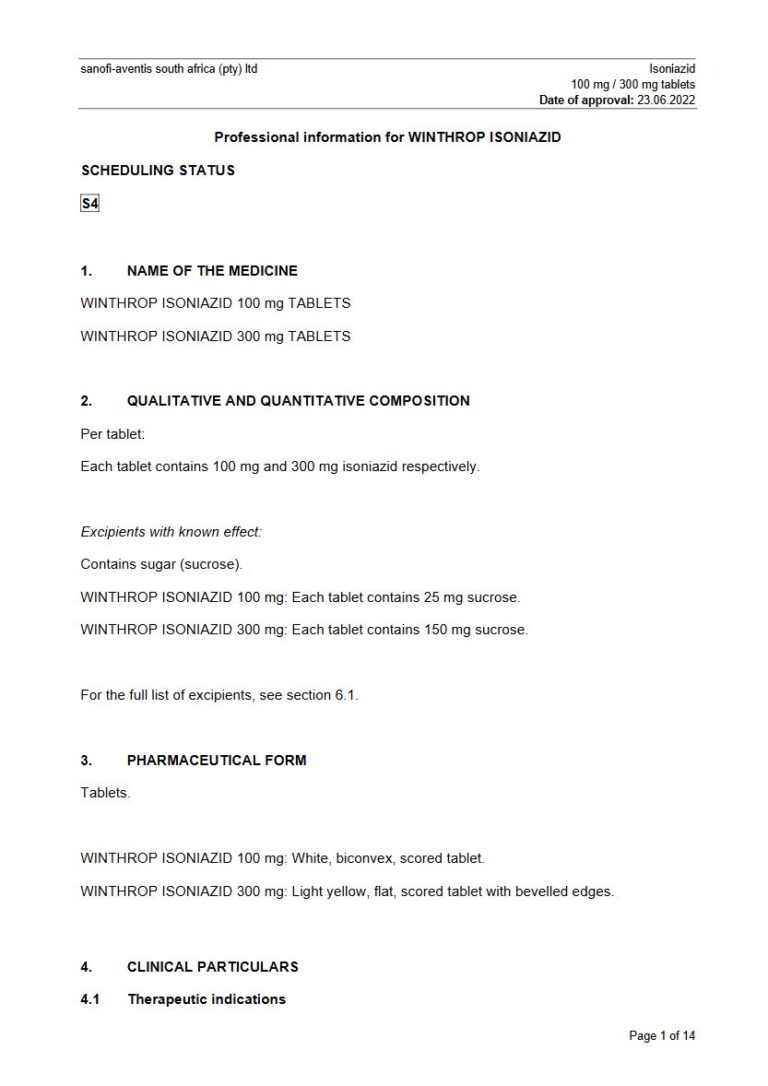
Winthrop Isoniazid 100 mg & 300 mg Tablets
PDF Leaflet Revision Date: 23 June 2022
Clinical Summary
Quick overview from the medicine insert
Indication
Prophylaxis and treatment of tuberculosis.
Dosage (summary)
Adults: 3-5 mg/kg (max 300 mg); Children: 10-20 mg/kg.
Special Populations
- Hepatic impairment
- Renal impairment
- Elderly
Pregnancy & Breastfeeding
Not established; avoid in pregnancy and lactation.
Key Drug Interactions
- Antiepileptics
- Oral anticoagulants
- Alcohol
- Aluminium-containing antacids
Contraindications
- Hypersensitivity to isoniazid
- Drug-induced liver disease
Common side effects
- Hepatotoxicity
- Dizziness
- Nausea
- Rash
Counselling Points
- Take on an empty stomach
- Monitor for liver symptoms
- Avoid alcohol
Serious warnings
- Severe hepatitis risk
- SJS and TEN
- DRESS syndrome
Important Disclaimer
The Winthrop Isoniazid 100 mg & 300 mg Tablets professional information leaflet below is the property of Sanofi-Aventis South Africa and is provided on Medinsert exactly as issued, with no.. alterations or editorial changes. We make every effort to keep content current by updating documents as soon as new versions become available. Medinsert serves as a trusted access point for healthcare professionals, but does not replace official sources or clinical judgement. For more details, please read our full disclaimer. read more>>
 Healthcare Professionals Only
This content is for registered healthcare professionals
Sign in or create a free account to read the full package insert.
Free for HPCSA-registered professionals. Powered by Medinsert.
Clinical Particulars
Section 4 of the official insert — extracted exactly as issued, no alterations
4.1 Therapeutic indications
WINTHROP ISONIAZID is indicated alone for the prophylaxis of tuberculosis and in conjunction with other antituberculosis medicines for the prophylaxis and treatment of tuberculosis.
4.2 Posology and method of administration
Official guidance should always be consulted when selecting the dose regimens to be used for adults and children (according to age and body weight), the duration of therapy and the total content of the combination treatment program.
Monotherapy:
Adults: Recommended dose: 3 to 5 mg per kg body mass in single or divided doses up to a maximum of 300 mg.
Children: The usual daily dose for children aged three months and above is from 10 to 20 mg per kg body mass in single or divided doses.
Administration: Should be taken preferably on an empty stomach (at least 30 minutes before a meal or 2 hours after a meal). If aluminium-containing antacids are taken, they must be taken at least one hour after isoniazid.
4.3 Contraindications
Hypersensitivity to isoniazid or to any of the ingredients in WINTHROP ISONIAZID (see section 6.1). Hypersensitivity to other medication such as ethionamide, pyrazinamide and niacin which is chemically related to isoniazid. Drug-induced liver disease.
4.4 Special warnings and precautions for use
The risk-benefit ratio should be considered when the following medical problems exist:
- alcoholism,
- hepatic or renal function impairment,
- convulsive disorders,
- diabetes mellitus,
- history of psychosis.
Use of WINTHROP ISONIAZID should be carefully monitored in patients with current chronic liver disease or severe renal dysfunction.
Hepatotoxicity: Severe and sometimes fatal hepatitis associated with WINTHROP ISONIAZID therapy may occur and may develop even after many months of treatment. Transient elevation of liver enzymes occurs in 10 % of patients. Overt hepatitis occurs in less than 1 % but may be fatal. The risk of developing hepatitis is age-related and there is an increased risk of hepatitis in patients over 35 years, slow acetylators and those who consume alcohol on a daily basis. Therefore, patients should be monitored for the prodromal symptoms of hepatitis; such as fatigue, weakness, malaise, anorexia, nausea or vomiting. If these symptoms appear or if signs suggestive of hepatic damage (e.g. raised liver enzyme levels) are detected, WINTHROP ISONIAZID should be discontinued promptly, since continued use in these cases has been reported to cause a more severe form of liver damage. Liver function tests should be performed before the start of therapy weekly in the first month and then monthly during treatment. A moderate increase in transaminase levels ( 5 x normal value) immediate discontinuation of treatment is required until normalisation of the results of biological tests, after which the antituberculosis treatment is resumed.
Stevens-Johnson syndrome (SJS) and toxic epidermal necrolysis (TEN): Cases of severe cutaneous reactions including Stevens-Johnson syndrome (SJS) and toxic epidermal necrolysis (TEN), some with a fatal outcome, have been reported with the use of WINTHROP ISONIAZID (see section 4.8). Patients should be advised of the signs and symptoms and monitored closely for skin reactions. If signs or symptoms of SJS or TEN (e.g. progressive skin rash often with blisters or mucosal lesions) develops, the patient should be advised to consult their doctor immediately. WINTHROP ISONIAZID should be permanently discontinued if an alternative aetiology for the signs and symptoms cannot be established.
Drug reaction with eosinophilia and systemic symptoms (DRESS): Severe, systemic hypersensitivity reactions, including fatal cases, such as drug reaction with eosinophilia and systemic symptoms (DRESS) syndrome have been observed during treatment with antituberculosis therapy (see section 4.8). It is important to note that early manifestations of hypersensitivity, such as fever, lymphadenopathy or biological abnormalities (including eosinophilia, liver abnormalities) may be present even though rash is not evident. If such signs or symptoms are present, the patient should be advised to consult their doctor immediately. WINTHROP ISONIAZID should be discontinued if an alternative aetiology for the signs and symptoms cannot be established.
Monitoring: Adults treated for tuberculosis with WINTHROP ISONIAZID should have baseline measurements of hepatic enzymes, bilirubin, serum creatinine, a complete blood count, and a platelet count (or estimate). In children, routine monitoring of liver enzymes is not necessary unless the child has risk factors for hepatotoxicity. Patients should be evaluated at least monthly during therapy and should be questioned specifically about symptoms associated with adverse reactions. All patients with abnormalities should have follow-up, including laboratory testing, if necessary. However, because there is a higher frequency of isoniazid-associated hepatitis among persons older than 35 years of age, liver function tests should be performed periodically. Other factors associated with an increased risk of hepatitis include daily use of alcohol and chronic liver disease.
Epilepsy: Particular caution should be exercised in patients with epilepsy.
Psychosis, bleeding and neuritis: Increased supervision is needed in patients with psychosis, a marked tendency to bleeding or neuritis.
Pyridoxine supplementation: Patients who are at risk of neuropathy or pyridoxine deficiency, including those who are diabetic, alcoholic, elderly, malnourished, uraemic, who have human immunodeficiency virus (HIV) infection or women who are pregnant (see section 4.6), should receive pyridoxine, usually at a dose of 10 mg daily, with doses of 100 u2013 200 mg daily for treatment if peripheral neuritis develops.
Porphyria: Use with caution in porphyria.
Hyperglycaemia and intolerance to sucrose: WINTHROP ISONIAZID contains sucrose. Sucrose may have an effect on the glycaemic control of patients with diabetes mellitus. Patients with rare hereditary problems of fructose intolerance, glucose-galactose malabsorption or sucrase-isomaltase insufficiency should not take WINTHROP ISONIAZID.
4.5 Interaction with other medicines and other forms of interaction
Medicine interactions: WINTHROP ISONIAZID inhibits the metabolism of medicines in the liver, thereby exacerbating the effects and toxicity. These include antiepileptic medicines carbamazepine, ethosuximide, primidone and phenytoin, oral anticoagulants, certain benzodiazepine derivatives (diazepam and triazolam), alfentanil and theophylline.
Para-aminosalicylic acid may increase the plasma concentration and elimination half-life of WINTHROP ISONIAZID by competing for acetylating enzymes.
Cytochrome P-450 enzyme interaction: Isoniazid is known to inhibit certain cytochrome P-450 enzymes. Therefore, caution should be used when prescribing WINTHROP ISONIAZID with medicines metabolised by cytochrome P-450. To maintain optimum therapeutic blood levels, dosages of medicines metabolized by these enzymes may require adjustment when starting or stopping WINTHROP ISONIAZID.
Concurrent use of paracetamol, rifampicin and other hepatotoxic medication, may increase the potential for isoniazid-induced hepatotoxicity.
Alcohol increases toxicity (including hepatotoxicity) of WINTHROP ISONIAZID.
Aluminium containing antacids may delay and decrease absorption and serum concentrations of isoniazid, therefore it is recommended to administer WINTHROP ISONIAZID 1 hour before taking antacids (see section 4.2).
Prednisolone may increase hepatic metabolism and/or excretion of WINTHROP ISONIAZID.
Concurrent use of cycloserine, disulfiram and other neurotoxic medicines may increase the potential for central nervous system (CNS) toxicity.
Interactions with ketoconazole and miconazole have been reported. WINTHROP ISONIAZID can reduce plasma concentration of ketoconazole.
False positive reactions with copper sulphate urine glucose tests may occur.
Treatment with higher doses of WINTHROP ISONIAZID can cause deficiency of pyridoxine (vitamin B 6 ) in the body and therefore increased occurrence of some undesirable effects. Therefore, concurrent use of pyridoxine is recommended (see section 4.4 above).
Food interaction: lsoniazid is an inhibitor of monoamine oxidase (MAO) and diamine oxidase (DAO), and hence can reduce tyramine and histamine metabolism respectively. Patients should therefore be advised against ingesting foods rich in tyramine (e.g. cheese, red wine) and/or histamine (e.g. some fish such as skipjack tuna, mackerel, salmon) during treatment with WINTHROP ISONIAZID as this may lead to symptoms such as itching of the skin, palpitations, tachycardia, tachypnoea, conjunctival irritation, chills or headache, sweating, severe flushing and hypotension.
4.6 Fertility, pregnancy and lactation
Safety in pregnancy and lactation has not been established. WINTHROP ISONIAZID should not be used during pregnancy and lactation.
4.7 Effects on ability to drive and use machines
WINTHROP ISONIAZID may cause undesirable effects which may reduce the capacity for the completion of certain tasks (e.g. dizziness, vertigo or optic neuritis (see section 4.8)). Patients should be informed not to drive or operate machinery if they experience these symptoms.
4.8 Undesirable effects
Blood and lymphatic system disorders: Frequency unknown: eosinophilia, agranulocytosis, thrombocytopenia, anaemia (including aplastic, haemolytic and sideroblastic anaemia), lymphadenopathy
Immune system disorders: Less frequent: hypersensitivity reactions (including erythema multiforme), Frequency unknown: anaphylactic reactions
Endocrine disorders: Frequency unknown: gynaecomastia
Metabolism and nutrition disorders: Frequency unknown: pellagra, anorexia, hyperglycaemia, metabolic acidosis
Psychiatric disorders: Frequency unknown: substance-induced psychotic disorder
Nervous system disorders: Frequency unknown: headache, dizziness, toxic encephalopathy, optic neuritis, atrophy, memory impairment. Polyneuropathy, presenting as paraesthesia, muscle weakness, loss of tendon reflexes, ataxia, convulsions, peripheral neuropathy (pyridoxine supplementation prevents the development of peripheral neuritis, as well as most other nervous system dysfunctions (see section 4.4)).
Ear and labyrinth disorders: Frequency unknown: vertigo
Vascular disorders: Frequency unknown: vasculitis (associated with positive antinuclear antibodies)
Gastrointestinal disorders: Less frequent: pancreatitis, Frequency unknown: nausea, vomiting, dry mouth, constipation, epigastric distress
Hepatobiliary disorders: Frequency unknown: jaundice, severe and sometimes fatal hepatitis, abnormal liver function
Skin and subcutaneous tissue disorders: Less frequent: rash (including a pellagra-like dermatitis in malnourished patients, that responds to niacin) Frequency unknown: drug reaction with eosinophilia and systemic symptoms (DRESS) syndrome, toxic epidermal necrolysis (TEN), Stevens-Johnson syndrome (SJS) (see section 4.4), acne, exfoliative dermatitis, pemphigus, pruritus, eczema, purpura, alopecia
Musculoskeletal and connective tissue disorders: Less frequent: systemic lupus erythematosus-like syndrome
Renal and urinary disorders: Frequency unknown: urinary retention
General disorders and administration site conditions: Frequency unknown: fever
Reporting of suspected adverse reactions: Reporting suspected adverse reactions after authorisation of WINTHROP ISONIAZID is important. It allows continued monitoring of the benefit/risk balance of WINTHROP ISONIAZID. Health care providers are asked to report any suspected adverse reactions to: u2022 The Pharmacovigilance Unit at Sanofi: [email protected] (email) or 011 256-3700 (tel), or u2022 SAHPRA via the u201c 6.04 Adverse Drug Reaction Reporting Form u201d, found online under SAHPRAu2019s publications: https://www.sahpra.org.za/Publications/Index/8.
4.9 Overdose
Symptoms of WINTHROP ISONIAZID overdose includes slurred speech, metabolic acidosis, hyperglycaemia, hallucinations, respiratory and CNS depression, convulsions and coma. Treatment consists of symptomatic and supportive therapy.
