
Jadelle 2 X 75 mg Implants
PDF Leaflet Revision Date: 23 May 2025
Clinical Summary
Quick overview from the medicine insert
Indication
Contraception.
Dosage (summary)
Two implants inserted sub-dermally, effective for up to 5 years.
Special Populations
- Paediatric population
- Women over 60 kg
Pregnancy & Breastfeeding
Remove implants if pregnancy occurs; do not use during breastfeeding until 6 weeks postpartum.
Key Drug Interactions
- Phenytoin
- Carbamazepine
- Rifampicin
- St. John's wort
Contraindications
- Hypersensitivity to levonorgestrel
- Undiagnosed abnormal vaginal bleeding
- Acute liver disease
- History of thromboembolic disease
Common side effects
- Headache
- Nausea
- Dizziness
- Weight gain
- Irregular menstrual bleeding
Counselling Points
- Keep insertion area dry for 3 days
- Monitor for mood changes
- Use additional contraception if switching from other hormonal methods
Serious warnings
- Efficacy decreases after 4 years
- Risk of thromboembolic events
- Mood changes and depression
Important Disclaimer
The Jadelle 2 X 75 mg Implants professional information leaflet below is the property of Bayer and is provided on Medinsert exactly as issued, with no.. alterations or editorial changes. We make every effort to keep content current by updating documents as soon as new versions become available. Medinsert serves as a trusted access point for healthcare professionals, but does not replace official sources or clinical judgement. For more details, please read our full disclaimer. read more>>
 Healthcare Professionals Only
This content is for registered healthcare professionals
Sign in or create a free account to read the full package insert.
Free for HPCSA-registered professionals. Powered by Medinsert.
Clinical Particulars
Section 4 of the official insert — extracted exactly as issued, no alterations
4.1 Therapeutic indication
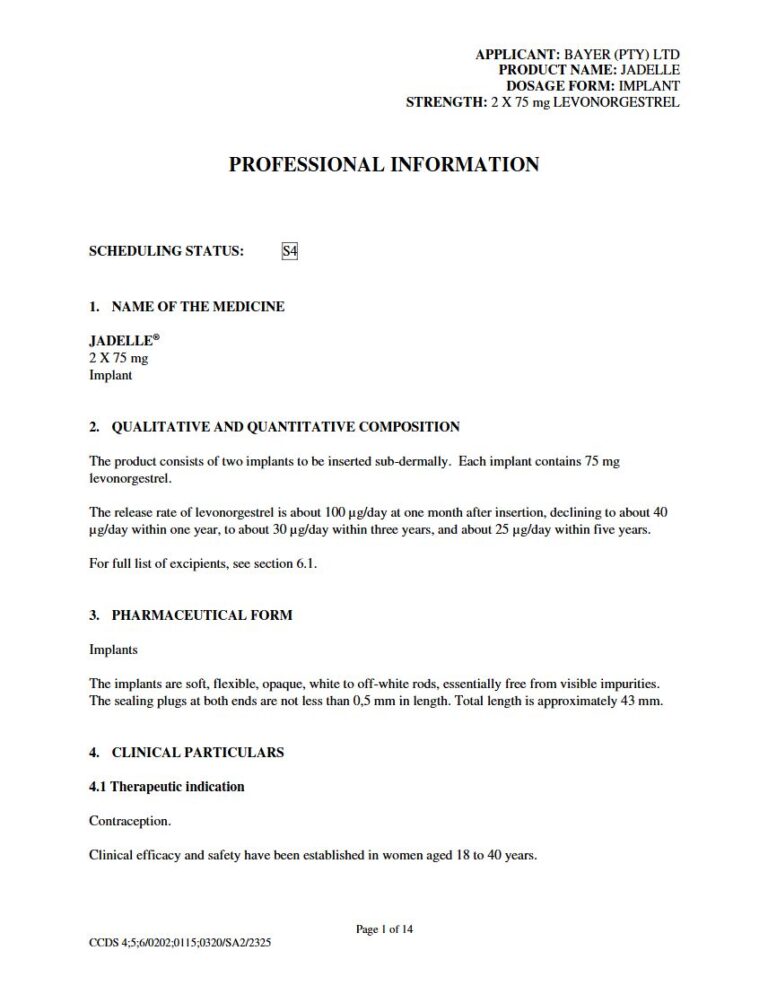
Contraception. Clinical efficacy and safety have been established in women aged 18 to 40 years.
4.2 Posology and method of administration
For sub-cutaneous use. JADELLE is a contraceptive method for long-term (up to five years) use. Clinical trials have shown the contraceptive efficacy of JADELLE implants to decrease after the fourth year of use in heavier women. Consequently, the removal of JADELLE implants and their change into new implants could be considered after 4 years of use, especially in women weighing over 60 kg (see u201c section 4.4 u201d and u201c section 5.2 u201d). The serum levonorgestrel concentration is lower at the end of the implant use and it is inversely related to body weight. The user must be informed that JADELLE implants may be removed at her request at any time.
Special populations
Paediatric population
There is no relevant indication for use of JADELLE before menarche. JADELLE is delivered in a sterile package containing two implants. Training is required for the insertion and removal procedures, which should preferably be done by a health care professional, and instructions must be followed closely. The implants are inserted with the inserter just beneath the skin.
Important: The disposable JADELLE trocar is for single use only. After insertion the trocar must be discarded of in an appropriate sharps container. Strict asepsis must be observed here. The implants are inserted in the inner aspect of the upper left arm in right-handed women and in the right arm in left-handed women, approximately 8 cm above the fold in the elbow. Before insertion, the skin is cleaned with an antiseptic and the insertion area anaesthetised. An incision of 3 mm is made in the skin with the scalpel that is attached to the body protecting the inserter. The implants are placed with the inserter sub-dermally, in the shape of a V opening towards the shoulder. Proper insertion will facilitate later removal and result in minimal scarring.
After insertion of the second implant, the edges of the incision are pressed together, closed with a skin closure, and dressed. Advise the patient to keep the insertion area dry for 3 days and give her a copy of the patient information leaflet, in which you have entered the date of insertion and the date of the first control visit. The gauze and the bandage may be removed as soon as the incision has healed, usually after 3 to 5 days.
Insertion instructions: Please refer to the Insertion/removal instruction leaflet.
Starting the use of JADELLE: No preceding hormonal contraceptive use in the past month. JADELLE should be inserted within 7 days from the onset of normal menstrual bleeding. Pregnancy must be reliably excluded before insertion and an additional non-hormonal contraceptive method used for at least 7 days after the insertion.
Changing from a combined hormonal contraceptive (combined oral contraceptive/COC), vaginal ring or transdermal patch: JADELLE should preferably be inserted on the day after the last active tablet of the previous combined oral contraceptive but at the latest on the day after the tablet free interval or on the day after the 7th day of the placebo tablet period. In case a vaginal ring or transdermal patch has been used, JADELLE should preferably be inserted on the day of removal of the last ring or patch of a cycle pack, but at the latest when the next application would have been due.
Changing form another progestogen-only method (minipill, injection, implant): The woman may switch any day from the minipill, from another implant on the day of its removal, and from an injectable when the next injection is due.
Following first-trimester abortion: JADELLE may be inserted immediately. When doing so, no additional contraceptive measures are needed.
Following delivery or second-trimester abortion: JADELLE may be inserted immediately after childbirth or second-trimester abortion for women who are not breastfeeding. If inserted later than 21 days after childbirth, pregnancy should be reliably excluded, and additional non-hormonal contraceptive precautions taken for a minimum of 7 days after the insertion. Breastfeeding women should not start to use the JADELLE method earlier than six weeks after delivery.
Removal of JADELLE: JADELLE implants may be removed at any time for medical or personal reasons but must be removed after 5 years form the insertion at the latest. The implants may be removed at any time of the menstrual cycle. Loss of contraceptive effect occurs practically immediately, and another contraceptive method should be applied unless pregnancy is desired. When starting the removal of implants, the skin is cleaned, and a local anaesthetic is infiltrated under the implant ends. A skin incision of 4 mm is made with a scalpel below the bottom of the V. The implants are removed using a small (e.g. mosquito) forceps. The implants should be removed very gently. This will take more time than the insertion. The implants may be nicked, cut or broken off during removal. If removal proves difficult or both implants cannot be removed, the patient should be asked to return for a second visit after the removal area has healed. A non-hormonal method of contraception should be used until both implants have been completely removed. If the patient wishes to continue using the method, a new set of JADELLE implants may be inserted through the same incision, either in the same or the opposite direction.
After the procedure is completed, close the incision, and bandage it as after insertion. The arm should be kept dry for a few days. Measure the length of the removed implants to make sure the patient had two JADELLE implants and no other contraceptive implants. The length should be 43 mm. If the patient wishes to continue using the method, a new set of JADELLE implants can be inserted through the same incision, in the same or the opposite direction. Removal instructions: Please refer to the Insertion/removal instruction leaflet.
4.3 Contraindication
- Hypersensitivity to levonorgestrel or any other component of JADELLE.
- Undiagnosed abnormal vaginal bleeding.
- Diagnosed or suspected sex hormone dependent neoplasia.
- Acute liver disease.
- Benign or malignant liver tumour.
- History of venous and arterial thromboembolic disease.
- Pregnancy and lactation for the first 6 weeks post-delivery (see u201csection4.6u201d)
4.4 Special warnings and precautions for use
Clinical trials have shown the contraceptive efficacy of JADELLE implants to decrease after the fourth year of use. Consequently, the removal of JADELLE implants and their change into new implants should take place after four years of use, especially with women weighing over 60 kg (see u201c section 5 u201d). The serum levonorgestrel concentration is lower at the end of the implant use and it is inversely related to body weight.
Expulsion of an implant may occur before the insertion area has healed if the implants have been inserted very near the skin surface or too close to the incision or when the insertion site is infected. An expelled implant must always be replaced by a new, sterile implant.
Reports have been published on slight displacement of similar levonorgestrel implants, most of which have involved minor changes in the position of the implants. Infrequent reports on significant displacement (a few to several centimetres) have been received. Some of these cases have been associated with pain or discomfort. In the event of displacement, the removal technique may have to be modified and may involve additional incisions or visits.
Altered serum lipoprotein levels have been observed in clinical trials on JADELLE. Although statistically significant decreases in total cholesterol, HDL (high-density lipoprotein), LDL (low-density lipoprotein) and triglycerides have been detected, all mean values have remained within the normal ranges. The long-term clinical significance of these changes has not yet been determined.
The effects of JADELLE on clotting factors have varied. In patients with a history of thromboembolic disease, JADELLE should not be used (see u201c section 4.3 u201d).
Cases of stroke, myocardial infraction, pulmonary embolism, and deep venous thrombosis have been reported in users of levonorgestrel implants. Patients who develop thrombotic or embolic disease should have their JADELLE implants removed. Thrombophlebitis and superficial phlebitis have occurred more commonly in the arm of insertion. Some cases have been associated with trauma to that arm.
Special caution should be observed in prescribing JADELLE implants for patients with recognised risk factors for or any predisposition to arterial disease (see u201c section 4.3 u201d).
If a sustained hypertension develops during the use of JADELLE, or if a significant increase in blood pressure does not adequately respond to antihypertensive therapy, the use of JADELLE should be discontinued.
If a patient has a history of or develops focal or crescendo type migraine or exhibits worsening of such migraine during the use of JADELLE, consideration should be given to remove the JADELLE implants.
Contact lens wearers who develop visual changes or changes in lens tolerance should be assessed by an ophthalmologist. The patients may be advised to stop wearing contact lenses for a while or completely.
Altered glucose tolerance and insulin sensitivity in oral glucose tolerance test have been reported in users of JADELLE. Diabetic patients using JADELLE should be carefully monitored.
A gain in weight is possible during the use of JADELLE.
If cholestatic hepatitis or jaundice develops in a patient with JADELLE, the implants must be removed. Mild or moderate transient rise in total serum bilirubin is usual at the start of the implant use. An increased risk of cholelithiasis has been reported during the use of other levonorgestrel implants of similar type. Levonorgestrel metabolism may be slower than normal in patients with impaired liver function.
Mood changes and depression are side effects reported with the use of hormonal contraceptives including JADELLE. There is some evidence that hormonal contraceptive use may be associated with severe depression and a higher risk of suicidal thoughts/behaviour (e.g. talking about suicide, withdrawing from social contact, having mood swings, being preoccupied with death or violence, feeling hopeless about a situation, increasing use of alcohol/drugs, doing self-destructive things, personality changes) and suicide. Prescribers should inform their patients to contact their doctor for advice if they experience mood changes and depression whilst on treatment with JADELLE.
Steroid contraceptives may cause some degree of fluid retention, which may result in weight gain. JADELLE should be prescribed with caution to patients with conditions that might be aggravated by fluid retention, and their condition should be monitored closely during the use of JADELLE.
Idiopathic intracranial hypertension has been reported in users of levonorgestrel implants such as JADELLE. This diagnosis should be considered if persistent headache and/or visual disturbances occur in a woman with JADELLE, particularly if the patient is obese or has recently gained weight. If idiopathic intracranial hypertension is diagnosed, JADELLE should be removed.
JADELLE implants affect the menstrual bleeding pattern in most women. Irregular, prolonged, and inter-menstrual bleeding, spotting and amenorrhoea have been reported. In general, such irregularities decrease with continuing use. Significant blood loss leading to anaemia is rare, and average concentrations of haemoglobin normally rise slightly in JADELLE users.
Since some users of JADELLE experience periods of amenorrhoea, missed menstrual periods should not be relied on as the sole means of diagnosing pregnancy. A pregnancy test should be performed whenever pregnancy is suspected. Six or more weeks of amenorrhoea after a period of regular menses may indicate pregnancy. The implants should be removed if pregnancy occurs.
Ectopic pregnancy occurs at a rate less than 1 per 1000 women-years, with levonorgestrel implants. If a woman using JADELLE presents with lower abdominal pain or is found to be pregnant, she should be examined to exclude ectopic pregnancy.
Follicles develop during the use of JADELLE, but their atresia may be delayed, and they may continue to grow beyond the normal size. In most women, such enlarged follicles will disappear spontaneously. However, they may twist or rupture, causing abdominal pain. Even in the presence of symptoms, conservative management is indicated but ectopic pregnancy must be excluded. Surgical intervention is rarely warranted.
Cases of autoimmune diseases such as scleroderma, systemic lupus erythematosus (SLE) or rheumatoid arthritis have been reported in users of levonorgestrel implants. During pregnancy and during the use of sex steroids, the following conditions have been observed: cholestatic icterus and/or itching, cholelithiasis, haemolytic-uremic syndrome, herpes gestationis (skin auto-immune disease), and hearing loss associated with otosclerosis.
A meta-analysis of epidemiological studies reported that there is a slightly increased relative risk (RR = 1,24) of having breast cancer diagnosed in women who are currently using combined oral contraceptives (COCs). The increased risk gradually disappears during the course of 10 years after cessation of COC use. The risk of having breast cancer diagnosed in progestin-only contraceptive users is possibly of a similar magnitude to that associated with combined oral contraceptives.
Before initiating or reinstituting treatment, a complete medical and family history should be taken. Blood pressure should be measured, and a physical examination should be performed, guided by the contra- indications and warnings for use. The woman should also be instructed to carefully read the user leaflet and to adhere to the advice given and to contact her physician if any problems occur at the insertion area. The frequency and nature of examinations should be based on established practice guidelines and be adapted to the needs of an individual woman.
The insertion area should be examined at every control visit. If undiagnosed, persistent, or recurrent vaginal bleeding occurs, appropriate measures should be taken to rule out malignancy. Women with a family history of breast cancer or who have benign breast nodules or mastopathy should be monitored with particular care.
Large and small surgical procedures: JADELLE implants do not contain oestrogen and, therefore, the use of JADELLE, as well as of other similar contraceptives, may usually be continued during surgical procedures. However, if a high risk of thrombosis exists, consideration should be given to appropriate prophylactic measures. Due to a risk of thromboembolism, the removal of implants may be considered either in connection with surgery or with prolonged immobilisation for some other reason. There is no confirmed evidence of an increased risk of gynaecological cancers associated with the use of hormonal contraceptives. Clinical surveillance of all women using JADELLE is, nevertheless, recommended.
Herbal preparations containing St Johnu2019s wort, hypericum perforatum, should not be used while using JADELLE due to the risk of decreased plasma concentrations and reduced clinical effects of levonorgestrel (see u201c section 4.5 u201d).
4.5 Interaction with other medicines and other forms of interaction
Effects of other medicinal products on JADELLE Interactions can occur with medicines that induce microsomal enzymes, which can result in increased clearance of sex hormones, and which may lead to changes in the uterine bleeding profile and/or contraceptive failure. Women on treatment with any of these medicines should temporarily use a barrier method in addition to JADELLE or choose another method of contraception. The barrier method should be used during the time of concomitant medicine administration and for 28 days after their discontinuation.
Substances increasing the clearance of levonorgestrel, as contained in JADELLE (diminished efficacy of JADELLE by enzyme induction), e.g.: Phenytoin, barbiturates, primidone, carbamazepine, rifampicin, efavirenz and possibly also oxcarbazepine, topiramate, bosentan, felbamate, griseofulvin and products containing St. Johnu2019s wort.
Enzyme induction can be observed after a few days of treatment. Maximal enzyme induction is generally seen within a few weeks. After the cessation of medicine therapy enzyme induction may be sustained for about 4 weeks.
Substances with variable effects on the clearance of levonorgestrel: When co-administered with sex hormones, many HIV/HCV protease inhibitors and non-nucleoside reverse transcriptase inhibitors can increase or decrease plasma concentrations of the progestin (decrease [e.g., nelfinavir, ritonavir, darunavir/ritonavir, (fos)amprenavir/ritonavir, lopinavir/ ritonavir, and tipranavir/ritonavir, nevirapine, efavirenz] or increase [e.g., indinavir and atazanavir/ritonavir, etravirine]). These changes may be clinically relevant in some cases.
Substances decreasing the clearance of levonorgestrel (enzyme inhibitors) Strong and moderate CYP3A4 inhibitors such as azole antifungals (e.g. itraconazole, voriconazole, fluconazole), verapamil, macrolides (e.g. clarithromycin, erythromycin), diltiazem and grapefruit juice can increase plasma concentrations of the progestin.
Effects of JADELLE on other medicinal products JADELLE may affect the metabolism of other medicines. Accordingly, plasma and tissue concentrations may either increase (e.g. cyclosporin) or decrease (e.g. lamotrigine).
Other forms of interaction Laboratory tests The use of contraceptive steroids may influence the results of certain laboratory tests, including biochemical parameters of liver, thyroid, adrenal and renal function, plasma levels of (carrier) proteins, e.g. corticosteroid binding globulin and lipid/lipoprotein fractions, parameters of carbohydrate metabolism and parameters of coagulation and fibrinolysis. Changes generally remain within the normal laboratory range.
4.6 Fertility, pregnancy, and lactation
Pregnancy The implants should be removed if pregnancy occurs during treatment with JADELLE. Animal studies have shown that high doses of progestogenic substances may cause masculinisation of female foetuses.
Breastfeeding Levonorgestrel passes into breast milk. Breastfeeding mothers should not start using JADELLE until 6 weeks post-partum.
4.7 Effects on ability to drive and use machines
No studies on the effect on the ability to drive and use machines have been performed. JADELLE may cause dizziness (see u201csection 4.8). Patients who experience dizziness should avoid driving or using machines until they are certain that JADELLE does not adversely affect their ability to do so.
4.8 Undesirable effects
Summary of the safety profile The following side effects have been reported during clinical trials with JADELLE: Very common undesirable effects (occurring in more than 10 % of users): headache, nervousness, dizziness, nausea, changed menstrual bleeding (frequent, irregular or prolonged menstrual bleeding, spotting amenorrhoea), cervicitis, vaginal bleeding, genital pruritus, pelvic pain, breast pain, weight gain.
Tabulated list of the adverse reactions
SOC Very common (u2265 1/10) Common (u2265 1/100, < 1/10) Uncommon (u2265 1/1000, < 1/100) Rare (u2265 1/10 000, < 1/1000)
Psychiatric disorders Mood changes Depression Changes in libido Nervous system disorders Headache Nervousness Dizziness Migraine Cardiac disorders Palpitations Chest pain Vascular disorders Hypertension Varicose veins Respiratory, thoracic and mediastinal disorders Dyspnoea Gastrointestinal disorders Nausea Abdominal discomfort
Skin and subcutaneous tissue disorders Acne Contact dermatitis Alopecia Hypertrichosis Rash Pruritus Skin discolouration Renal and urinary disorders Urinary tract symptoms Reproductive system and breast disorders Changed menstrual bleeding (frequent, irregular, or prolonged menstrual bleeding, spotting, amenorrhoea) Cervicitis Vaginal discharge Genital pruritus Pelvic pain Breast pain Vaginitis Ovarian cysts Benign breast nodules Breast discharge General disorders and administrative site conditions Weight gain Itching at insertion site General pain Fatigue Back pain Weight loss Bruising at insertion site Infection at the implant site Expulsion of implant Arm pain Numbness Tingling and scarring Difficulty in removal of the implant Hyperpigmentation over the implant site
Description of selected adverse reactions Expulsion or displacement of JADELLE may be possible (see also u201c section 4.4 u201d). Limited blistering, ulceration and sloughing have been observed rarely. During the use of other levonorgestrel implants of similar types as JADELLE, very rare cases of cholestatic hepatitis, jaundice, bilirubinaemia, and thromboembolic complications have been reported (see also u201c section 4.4 u201d)
Post marketing reported side effects The following side effects have been reported with the post marketing use of hormonal contraceptives: Severe depression with a higher risk of suicidal thoughts/behaviour and suicide. The most serious adverse effects associated with the use of hormonal contraceptives are also listed in section 4.4.
Reporting of suspected adverse reactions Reporting suspected adverse reactions after authorisation of the medicine is important. It allows continued monitoring of the benefit/risk balance of the medicine. Health care providers are requested to report any suspected adverse drug reactions to SAHPRA via the Med Safety APP (Medsafety X SAHPRA) and eReporting platform (who-umc.org) found on SAHPRA website. Alternatively, you can report to Bayer SafeTrack site (https://www.safetrack-public.bayer.com).
4.9 Overdose
There is no experience of overdose with JADELLE. In overdose, side effects can be precipitated and/or be of increased severity (see section 4.8). Treatment is symptomatic and supportive.
