
Mirena 52 mg Intrauterine delivery system (IUS)
PDF Leaflet Revision Date: 09 September 2025
Clinical Summary
Quick overview from the medicine insert
Indication
Contraception, idiopathic menorrhagia, endometrial protection during oestrogen therapy.
Dosage (summary)
One unit inserted into the uterine cavity, effective for five years.
Onset of Action / Duration
Onset: Immediate, Duration: 5 years
Special Populations
- Geriatric patients
- Renal impairment
- Hepatic impairment
Pregnancy & Breastfeeding
Contraindicated in pregnancy; minimal transfer to breast milk.
Key Drug Interactions
- Phenytoin
- Carbamazepine
- Rifampicin
- Azole antifungals
Contraindications
- Hypersensitivity
- Pregnancy
- Pelvic inflammatory disease
- Cervical dysplasia
- Liver disease
Common side effects
- Headache
- Nausea
- Acne
- Bleeding changes
- Ovarian cysts
Counselling Points
- Monitor for signs of expulsion
- Report severe headaches or jaundice
- Regular follow-up exams recommended
Serious warnings
- Risk of perforation
- Increased risk of ectopic pregnancy
- Sepsis risk after insertion
Important Disclaimer
The Mirena 52 mg Intrauterine delivery system (IUS) professional information leaflet below is the property of Bayer and is provided on Medinsert exactly as issued, with no.. alterations or editorial changes. We make every effort to keep content current by updating documents as soon as new versions become available. Medinsert serves as a trusted access point for healthcare professionals, but does not replace official sources or clinical judgement. For more details, please read our full disclaimer. read more>>
 Healthcare Professionals Only
This content is for registered healthcare professionals
Sign in or create a free account to read the full package insert.
Free for HPCSA-registered professionals. Powered by Medinsert.
Clinical Particulars
Section 4 of the official insert — extracted exactly as issued, no alterations
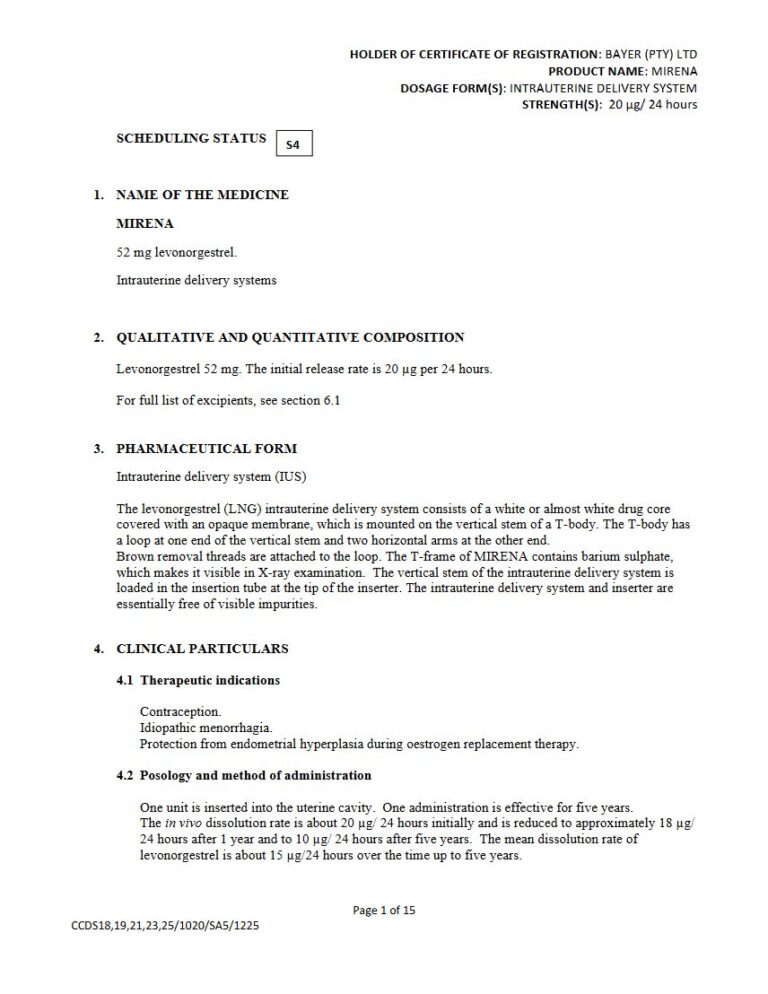
4.1 Therapeutic indications
Contraception.
Idiopathic menorrhagia.
Protection from endometrial hyperplasia during oestrogen replacement therapy.
4.2 Posology and method of administration
One unit is inserted into the uterine cavity. One administration is effective for five years. The in vivo dissolution rate is about 20 u03bcg/ 24 hours initially and is reduced to approximately 18 u03bcg/ 24 hours after 1 year and to 10 u03bcg/ 24 hours after five years. The mean dissolution rate of levonorgestrel is about 15 u03bcg/24 hours over the time up to five years.
In women under hormonal replacement therapy, MIRENA can be used in combination with oral or transdermal oestrogen preparations without progestogens. MIRENA, when inserted according to the insertion instructions, has a failure rate of approximately 0,2 % at 1 year and accumulative failure rate of approximately 0,7 % at 5 years. The failure rate may increase in case of expulsion or perforation.
Method of administration
Instructions for use/handling: MIRENA is supplied in a sterile pack which should not be opened until required for insertion. The exposed product should be handled with aseptic precautions. If the seam of the sterile package is broken, the product should be discarded. Special instructions for insertion are in the package. Because the insertion technique is different from other intrauterine devices, special emphasis should be given to training in the correct insertion technique.
Insertion and removal/replacement: Before insertion, the woman must be informed of the efficacy, risks and side effects of MIRENA. A physical examination including pelvic examination, and examination of the breasts should be conducted. Cervical smear should be performed, as needed, according to healthcare professionalu2019s evaluation. Pregnancy and sexually transmitted diseases should be excluded, and genital infections have to be successfully treated. For timing of insertion to exclude pregnancy see u201csection 4.2u201d. The position of the uterus and the size of the uterine cavity should be determined. Fundal positioning of MIRENA is particularly important in order to ensure uniform exposure of the endometrium to the progestogen, prevent expulsion and maximise efficacy. Therefore, the instructions for the insertion should be followed carefully.
The woman should be re-examined 4 to 12 weeks after insertion and once a year thereafter, or more frequently if clinically indicated. In women of fertile age MIRENA is to be inserted into the uterine cavity within seven days of the onset of menstruation. In this case no back up contraception is needed. MIRENA can be inserted at any time during the cycle if the physician can be reasonably certain (as defined by the World Health Organisation) that the woman is not pregnant. If insertion is more than seven days since menstrual bleeding started, a barrier method of contraception should be used, or the patient should abstain from vaginal intercourse for the next seven days to prevent pregnancy. Consider the possibility of ovulation and conception before using this product. Mirena is not suitable for use as post-coital contraceptive (see u201csection 4.4.u201d)
MIRENA can be replaced by a new system at any time in the cycle. The system can also be inserted immediately after first trimester abortion. Postpartum insertion should be delayed until the uterus is involuted, however not earlier than six weeks after delivery. If involution is substantially delayed, consider waiting until 12 weeks postpartum. It is recommended that MIRENA should only be inserted by medical practitioners/ healthcare professionals who are experienced in MIRENA insertion and/ or have undergone sufficient training for MIRENA insertion. In case of a difficult insertion and/or exceptional pain or bleeding during or after insertion, the possibility of perforation should be considered and appropriate steps should be taken, such as physical examination and ultrasound.
When used for endometrial protection during oestrogen replacement therapy, MIRENA can be inserted at any time in an amenorrhoeic woman, or during the last days of menstruation or withdrawal bleeding. Because irregular bleeding/spotting is common during the first months of therapy, it is recommended to exclude endometrial pathology before insertion of MIRENA. If the woman continues the use of MIRENA inserted earlier for contraception, endometrial pathology has to be excluded in case bleeding disturbances appear after commencing oestrogen replacement therapy. If bleeding irregularities develop during a prolonged treatment, appropriate diagnostic measures should also be taken.
MIRENA is removed by gently pulling on the threads with forceps. If the threads are not visible and the system is in the uterine cavity, it may be removed using a narrow tenaculum. This may require dilatation of the cervical canal. If dilation is required, consider using analgesics and/or a paracervical block. The system should be removed after five years. If the user wishes to continue using the same method, a new system can be inserted at the same time. If pregnancy is not desired, the removal should be carried out within 7 days of the onset of menstruation in women of fertile age, provided the woman is experiencing regular menses. If the system is removed at some other time during the cycle or the woman does not experience regular menses and the woman has had intercourse within a week, she is at risk of pregnancy. To ensure continuous contraception, a new system should be immediately inserted, or an alternative contraceptive method should have been initiated. After removal of MIRENA, the system should be checked to be intact. During difficult removals, single cases have been reported of the hormone cylinder sliding over the horizontal arms and hiding them together inside the cylinder. This situation does not require further intervention once completeness of MIRENA has been ascertained. The knobs of the horizontal arms usually prevent complete detachment of the cylinder from the T-body.
Insertion and removal may be associated with some pain and bleeding. The procedure may precipitate fainting as a vasovagal reaction, or a seizure in an epileptic woman.
Insertion instructions: See separate enclosed insertion instruction leaflet.
Important: Should you suspect that the system is not in the correct position, remove it and insert a new one.
4.3 Contraindications
Hypersensitivity to the active substance or to any of the excipients.
Known or suspected pregnancy (see u201csection 4.6u201d);
Current or recurrent pelvic inflammatory disease;
Lower genital tract infection;
Postpartum endometritis;
Septic (infected) abortion during the past three months;
Cervicitis;
Cervical dysplasia;
Uterine or cervical malignancy;
Undiagnosed abnormal uterine bleeding;
Progestogen-dependent tumours;
Congenital or acquired uterine anomaly including fibroids if they distort the uterine cavity;
Conditions associated with increased susceptibility to infections;
Acute liver disease or liver tumour.
4.4 Special warning and precautions for use
MIRENA should be used with caution and only after specialist consultation; alternatively, removal of the system should be considered, if any of the following conditions exist or arise for the first time:
- migraine, focal migraine with asymmetrical visual loss or other symptoms indicating transient cerebral ischaemia;
- severe headache;
- jaundice;
- marked increase of blood pressure;
- severe arterial disease such as stroke or myocardial infarction.
There is no consensus about the possible role of progestogens, as in MIRENA, in patients with varicose veins and superficial thrombophlebitis in the causation of venous thromboembolism. MIRENA should be used with caution in women who have congenital heart disease or valvular heart disease at risk of infective endocarditis. Low dose levonorgestrel may affect glucose tolerance, and the blood glucose concentration should be monitored in diabetic users of MIRENA. The available data are not sufficient to confirm or refute a risk for breast cancer when MIRENA is used in the indication protection from endometrial hyperplasia during oestrogen replacement therapy.
Oligo/amenorrhoea: In women of fertile age, oligomenorrhoea and amenorrhoea develops in 57 % and 16 % of women respectively. The possibility of pregnancy should be considered if menstruation does not occur within 6 weeks of the onset of previous menstruation. A repeated pregnancy test is not necessary in amenorrhoea subjects unless indicated by other signs of pregnancy.
When MIRENA is used in combination with continuous oestrogen replacement therapy, a non-bleeding pattern gradually develops in most women during the first year.
Pelvic infection: The insertion tube helps to reduce contamination of MIRENA with micro-organisms during the insertion. The highest rate of pelvic infections occurs during the first month after insertion and decreases later. Severe infections or sepsis (including group A streptococcal sepsis) can occur following IUD insertion such as MIRENA, If the woman experiences recurrent endometritis or pelvic infections or if an acute infection is severe or does not respond to treatment within a few days, MIRENA must be removed.
Bacteriological examinations are indicated, and monitoring is recommended, even with discrete symptoms indicative of infections.
Expulsion: Symptoms of the partial or complete expulsion of MIRENA may include bleeding or pain. However, the system can be expelled from the uterine cavity without the woman noticing it leading to loss of contraceptive protection. As MIRENA decreases menstrual flow, increase of menstrual flow may be indicative of an expulsion.
Risk of expulsion in increased in:
- Women with history of heavy menstrual bleeding
- Women with greater than normal BMI at the time of insertion; this risk increases gradually with increasing BMI
Counsel the woman on possible signs of expulsion and instruct her on how to check the threads of MIRENA. Advise her to contact her doctor if the threads cannot be felt and avoid intercourse or use a barrier contraceptive (such as condoms) until the location of Mirena has been confirmed. Partial expulsion may decrease the effectiveness of MIRENA. A partially expelled MIRENA should be removed. A new system can be inserted at the time of removal, provided that pregnancy has been excluded.
Perforation: Perforation or penetration of the uterine corpus or cervix by MIRENA may occur, most often during insertion, although it may not be detected until sometime later, and may decrease the effectiveness of MIRENA. If this occurs MIRENA must be removed. In a large European prospective comparative non-interventional cohort study in IUD users (N = 61448 women), with a 1-year observational period, the incidence perforation was 1,3 (95 % CI: 1,1 to 1,6) per 1000 insertions. Extending the observational period to 5 years in a subgroup of this study (N= 39 009 women using MIRENA or Copper IUD), the incidence of perforation detected at any time during the entire 5-year period was 2.0 (95 % CI: 1.6 to 2.5) per 1 000 insertions. Breastfeeding at the time of insertion and insertion up to 36 weeks after giving birth were associated with an increased risk of perforation (see Table 1). These risk factors were confirmed in the subgroup followed up for 5 years.
4.5 Interaction with other medicines and other forms of interaction
Interactions can occur with drugs that induce or inhibit microsomal enzymes, which can result in increased or decreased clearance of sex hormones.
Substances increasing the clearance of levonorgestrel, e.g.: Phenytoin, barbiturates, primidone, carbamazepine, rifampicin, and possibly also oxcarbazepine, topiramate, felbamate, griseofulvin, and products containing St. Johnu2019s wort. The influence of these drugs on the contraceptive efficacy of MIRENA is not known, but it is not believed to be of major importance due to the local mechanism of action.
Substances with variable effects on the clearance of levonorgestrel: When co-administered with sex hormones, many HIV/HCV protease inhibitors and nonnucleoside reverse transcriptase inhibitors can increase or decrease plasma concentrations of the progestin.
Substances decreasing the clearance of levonorgestrel (enzyme inhibitors), e.g.: Strong and moderate CYP3A4 inhibitors such as azole antifungals (e.g. fluconazole, itraconazole, ketoconazole, voriconazole), verapamil, macrolides (e.g. clarithromycin, erythromycin), diltiazem and grapefruit juice can increase plasma concentrations of the progestin.
4.6 Fertility, pregnancy and lactation
Pregnancy: The use of MIRENA during an existing or suspected pregnancy is contraindicated (see u201csection 4.3u201d). If the woman becomes pregnant when using MIRENA, removal of the system is recommended since any intrauterine contraceptive left in situ may increase the risk of abortion and preterm labour. Removal of MIRENA or probing of the uterus may result in spontaneous abortion. If the intrauterine contraceptive cannot be gently removed, termination of pregnancy may be considered. If the woman wishes to continue the pregnancy and the system cannot be withdrawn, she should be informed about the risks and the possible consequences of premature birth to the infant. The course of such a pregnancy should be closely monitored. Ectopic pregnancy should be excluded. The woman should be instructed to report all symptoms that suggest complications of the pregnancy, like cramping abdominal pain with fever.
There have been isolated cases of masculinization of the external genitalia of the female foetus following local exposure to levonorgestrel during pregnancy with MIRENA in place.
Breastfeeding: About 0.1 % levonorgestrel dose is transferred to the infant during breastfeeding. Progestogen-only methods do not appear to affect the quantity or quality of breast milk. Non-hormonal contraceptive methods/devices are the methods of choice during lactation. However, if progestogen only contraception is judged as appropriate for lactating women, MIRENA may be used. Uterine bleeding has been reported in women using MIRENA during lactation.
Fertility: Upon removal of MIRENA, women usually return to their normal fertility.
4.7 Effects on ability to drive and use machines
Not known
4.8 Undesirable effects
a) Summary of the safety profile
The majority of women experience changes in menstrual bleeding pattern after insertion of MIRENA. During the first 90 days, prolonged bleeding is experienced by 22 % and irregular bleeding by 67 % of women after postmenstrual insertion of MIRENA, decreasing to 3 % and 19 % at the end of the first year of use, respectively. Amenorrhoea increases from 0 % to 16 % and infrequent bleeding increases from 11 % to 57 % from the first 90 days until the end of the first year of use respectively.
When MIRENA is used in combination with continuous oestrogen replacement therapy, a non-bleeding pattern gradually develops in most women during the first year.
Adverse events reported in clinical studies: The adverse drug reaction frequencies were observed in the clinical trials in the indication contraception and idiopathic menorrhagia/ heavy menstrual bleeding, including 5091 women and 12,101 woman-years. Adverse reactions in clinical trials in the indication protection from endometrial hyperplasia during oestrogen replacement therapy (including 514 women and 1218,9 woman-years) were observed at a similar frequency unless specified by footnotes.
System Organ Class
Very Common u22651/ 10
Common u2265 1/100, < 1/10
Uncommon u2265 1/1000, < 1/100
Rare u2265 1/10000, <1/1000
Unknown
Immune system disorder: Hypersensitivity including rash, urticaria and angioedema.
Psychiatric disorders: Depressed mood/ Depression
Nervous system disorders: Headache, Migraine
Gastrointestinal disorders: Abdominal/ pelvic pain, Nausea
Skin and subcutaneous tissue disorders: Acne, Hirsutism, Alopecia
Musculoskeletal connective tissue and bone disorders: Back pain**
Reproductive system and breast disorders: Bleeding changes including increased and decreased menstrual bleeding, spotting, oligomenorrhoea and amenorrhoea, vulvovaginitis*, Genital discharge, Upper genital tract infection, Ovarian cyst, Dysmenorrhoea, breast pain**, Intra-uterine contraceptive device expelled (complete and partial), Uterine perforation***
Investigations: Blood pressure increased
* Endometrial protection trials: u201ccommonu201d
** Endometrial protection trials: u201cvery commonu201d
*** The frequency is based on a large prospective comparative non-interventional cohort study in IUD users which showed that breastfeeding at the time of insertion and insertion up to 36 weeks after giving birth are independent risk factors for perforation (see u201csection 4.4.u201d).
When a woman becomes pregnant with MIRENA in situ, the relative risk of ectopic pregnancy is increased. The removal threads may be felt by the partner during intercourse. The risk of breast cancer is unknown when MIRENA is used in the indication protection from endometrial hyperplasia during oestrogen replacement therapy. Cases of breast cancer have been reported (frequency unknown, see u201csection 4.4.u201d).
Injury, poisoning and procedural complications: The following adverse drug reactions have been reported in connection with the insertion or removal procedure of MIRENA: Procedural pain, procedural bleeding, insertion-related vasovagal reaction with dizziness or syncope. The procedure may precipitate a seizure in epileptic patients.
Infections and infestations: Cases of sepsis (including group A streptococcal sepsis) have been reported following IUD insertion (see u201csection 4.4.u201d).
e) Other special populations
Post marketing side effects: The following adverse reactions have been identified during post approval use of MIRENA: Immune system disorders: Hypersensitivity including rash, urticarial and angioedema. Investigations: Blood pressure increased. Infections and infestations: Cases of sepsis (including group A streptococcal sepsis) have been reported following IUD insertion (see u201csection 4.4.u201d). Because these reactions are reported voluntarily from a population of uncertain size, it is not always possible to reliably estimate their frequency or establish a causal relationship to exposure to the medicine.
Reporting of suspected adverse reactions: Reporting suspected adverse reactions after authorisation of the medicine is important. It allows continued monitoring of the benefit/risk balance of the medicine. Health care providers are requested to report any suspected adverse drug reactions to SAHPRA via the Med Safety APP (Medsafety X SAHPRA) and eReporting platform (who-umc.org) found on SAHPRA website. Alternatively, you can report to Bayer SafeTrack site (https://www.safetrack-public.bayer.com).
4.9 Overdose
Not relevant
