
Kyleena 19,5 mg Intrauterine devices.
PDF Leaflet Revision Date: 12 May 2023
Clinical Summary
Quick overview from the medicine insert
Indication
Contraception for up to 5 years in women 18 years and older.
Dosage (summary)
Inserted into the uterine cavity; can be replaced at any time in the cycle.
Special Populations
- Paediatric patients
- Geriatric patients
- Hepatic impairment
- Renal impairment
Pregnancy & Breastfeeding
Contraindicated in pregnancy; minimal transfer to breast milk, no adverse effects on infant.
Key Drug Interactions
- Phenytoin
- Carbamazepine
- Rifampicin
- St. John's wort
Contraindications
- Hypersensitivity to levonorgestrel
- Pregnancy
- Pelvic inflammatory disease
- Cervical neoplasm
- Uterine malignancy
- Acute liver disease
Common side effects
- Changes in menstrual bleeding
- Headache
- Abdominal pain
- Acne
- Device expulsion
Counselling Points
- Check for threads regularly
- Report heavy or irregular bleeding
- Monitor for signs of infection
Serious warnings
- Risk of ectopic pregnancy
- Pelvic infection
- Perforation risk during insertion
Important Disclaimer
The Kyleena 19,5 mg Intrauterine devices. professional information leaflet below is the property of Bayer and is provided on Medinsert exactly as issued, with no.. alterations or editorial changes. We make every effort to keep content current by updating documents as soon as new versions become available. Medinsert serves as a trusted access point for healthcare professionals, but does not replace official sources or clinical judgement. For more details, please read our full disclaimer. read more>>
 Healthcare Professionals Only
This content is for registered healthcare professionals
Sign in or create a free account to read the full package insert.
Free for HPCSA-registered professionals. Powered by Medinsert.
Clinical Particulars
Section 4 of the official insert — extracted exactly as issued, no alterations
4.1 Therapeutic indications
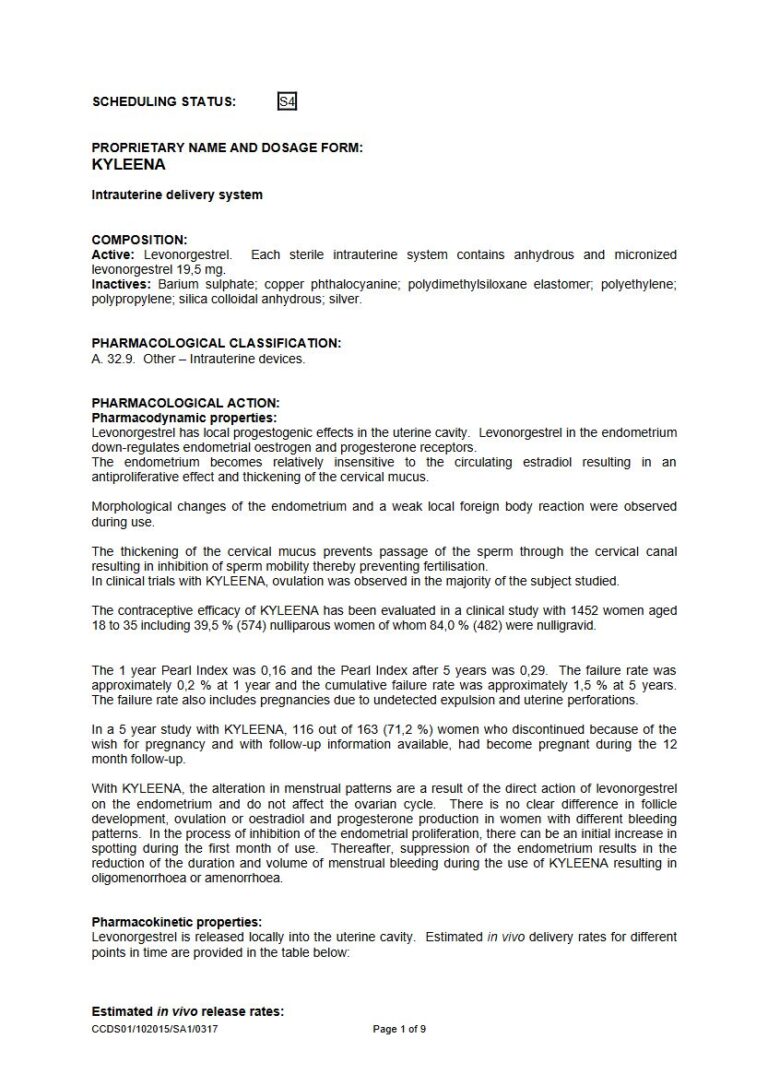
Contraception for up to 5 years in women 18 years and older.
4.2 Posology and method of administration
KYLEENA is to be inserted into the uterine cavity within seven days of the onset of menstruation. KYLEENA can be replaced by a new system at any time in the cycle. KYLEENA can also be inserted immediately after first trimester abortion. Postpartum insertions should be postponed until the uterus is fully involuted, however not earlier than six weeks after delivery. If involution is substantially delayed, consider waiting until 12 weeks postpartum.
4.3 Contraindications
- Hypersensitivity to levonorgestrel or any of the ingredients of KYLEENA
- Pregnancy
- Acute or recurrent pelvic inflammatory disease or conditions associated with increased risk of pelvic infections, including gonorrhoea and other sexually transmitted infections
- Acute cervicitis or vaginitis
- Postpartum endometritis or infected abortion during the past three months
- Cervical neoplasm
- Uterine or cervical malignancy
- Progestogen-dependent tumours
- Abnormal uterine bleeding of unknown aetiology
- Congenital or acquired uterine anomaly including fibroids which would interfere with insertion and/or retention of the intrauterine system (i.e. if they distort the uterine cavity)
- Acute liver disease or liver tumour.
4.4 Special warnings and precautions for use
Before insertion, the woman must be informed of the benefits and risks of KYLEENA. A physical examination including pelvic examination, examination of the breast and a cervical smear should be conducted. Cervical smear should be performed as needed, according to Healthcare Professionalu2019s evaluation. Pregnancy and sexually transmitted diseases should be excluded. Genital infections should be successfully treated prior to insertion. The position of the uterus and the size of the uterine cavity should be determined. Fundal positioning of KYLEENA is important in order to maximise the efficacy and reduce the risk of expulsion. The instruction for the insertion should be followed carefully. It is recommended that KYLEENA should only be inserted by healthcare professionals who are experienced in IUS insertion and have undergone training on the KYLEENA insertion procedure.
KYLEENA may be used with caution after specialist consultation, or removal of the system should be considered, if any of the following conditions exist or arise for the first time:
- migraine, focal migraine with asymmetrical visual loss or other symptoms indicating transient cerebral ischemia
- severe headache
- jaundice
- marked increase in blood pressure
- severe arterial disease such as stroke or myocardial infarction.
KYLEENA may be used with caution in women who have congenital heart disease or valvular heart disease at risk of infective endocarditis. Low-dose levonorgestrel may affect glucose tolerance, and the blood glucose concentration should be monitored in diabetic users of KYLEENA.
Infrequent bleeding and/or amenorrhoea develop gradually. By the end of the fifth year about 26,4 % and 22,6 % of the users develop infrequent bleeding and/or amenorrhoea, respectively. Pregnancy should be considered if menstruation does not occur within six weeks of the onset of previous menstruation. A repeated pregnancy test is not necessary in subjects who remain amenorrhoeic unless indicated by other signs of pregnancy.
Irregular bleeding and spotting are common in the first month after insert of KYLEENA. If bleeding becomes heavier and/or more irregular over time, appropriate diagnostic measures should be taken as irregular bleeding may be a symptom of endometrial polyps, hyperplasia or cancer.
4.5 Interactions with other medicines
Interactions can occur with medicines that induce hepatic microsomal enzymes, which can result in increased clearance of sex hormones. Substances increasing the clearance of levonorgestrel, e.g. Phenytoin, barbiturates, primidone, carbamazepine, rifampicin; possibly also oxcarbazepine, topiramate, felbamate, griseofulvin and products containing St. Johnu2019s wort. The influence of these medicines on the contraceptive efficacy of KYLEENA is not known, but is not believed to be of major importance due to the local mechanism of action.
Substance with variable effects on the clearance of levonorgestrel, e.g.: When co-administered with sex hormones, many HIV/HIC protease inhibitors and non-nucleoside reverse transcriptase inhibitors can increase or decrease plasma concentration of levonorgestrel.
4.6 Fertility, pregnancy and lactation
The insertion of KYLEENA in pregnant women is contraindicated (see u201cContraindicationsu201d). If the woman becomes pregnant when using KYLEENA, removal of the system is recommended since any intrauterine contraceptive left in situ may increase the risk of abortion and preterm labour. Removal of KYLEENA or probing of the uterus may result in spontaneous abortion. Ectopic pregnancy should be excluded. If the woman wishes to continue the pregnancy and the system cannot be withdrawn, the woman should be informed about the risks and the possible consequences of premature birth to the infant. The course of such a pregnancy should be closely monitored. The woman should be instructed to report all symptoms that suggest complications of the pregnancy, like cramping abdominal pain with fever.
Because of the intrauterine administration and local exposure to levonorgestrel, the possible occurrence of virilising effects in a female foetus should be taken into consideration. Clinical experience of the outcome of pregnancies under KYLEENA treatment is limited.
In general, there appear to be no deleterious effects on infant growth or development when using any progestogen-only method after six weeks post-partum. KYLEENA does not affect the quantity or quality of breast milk. About 0,1 % of the levonorgestrel dose passes into the breast milk in nursing mothers.
The use of LNG-IUS does not alter the course of future fertility. Upon removal of the LNG-IUS, women usually return to their normal fertility (see section u201cPharmacodynamic propertiesu201d).
4.7 Effects on ability to drive and use machines
KYLEENA has no known influence on the ability to drive or use machine.
4.8 Undesirable effects
The majority of women experience changes in menstrual bleeding pattern after insertion of KYLEENA. Over time, the frequency of amenorrhoea and infrequent bleeding increases, and the frequency of prolonged, irregular and frequent bleeding decreases. If bleeding becomes heavier and/or more irregular over time, appropriate diagnostic measures should be taken as irregular bleeding may be a symptom of endometrial polyps, hyperplasia or cancer.
The following bleeding patterns were observed in clinical trials with KYLEENA:
Bleeding patterns by 90-day reference period.
| KYLEENA | First 90 days | Second 90 days | End of year 1 | End of year 3 | End of year 5 |
|---|---|---|---|---|---|
| Amenorrhoea | < 1% | 5 % | 12 % | 20 % | 23 % |
| Infrequent bleeding | 10 % | 20 % | 26 % | 26 % | 26 % |
| Frequent bleeding | 25 % | 10 % | 4 % | 2 % | 2 % |
| Prolonged* bleeding | 57 % | 14 % | 6 % | 2 % | 1 % |
| Irregular bleeding | 43 % | 25 % | 17 % | 10 % | 9 % |
* Subjects with prolonged bleeding may also be included in one of the other categories (excl. amenorrhoea).
The frequencies of the side effects reported with KYLEENA are summarised in the table below. Within each frequency grouping, side effects are presented in order of decreasing seriousness. The frequencies are crude incidences of the events observed in clinical trials in the indication contraception, including 1697 women and 5225, 52 women-years on KYLEENA. Frequencies are defined as: very common (u2265 1/10), common (u2265 1/100 to < 1/10), uncommon (u2265 1/1000 to < 1/100), rare (u2265 1/10000 to < 1/1000), very rare (< 1/10000)
| System organ class | Very common | Common | Uncommon | Rare | |
|---|---|---|---|---|---|
| Psychiatric disorders | depressed mood/ depression | ||||
| Nervous system disorders | Headache | Migraine | |||
| Gastrointestinal disorders | Abdominal/pelvic pain | Nausea | |||
| Skin and subcutaneous tissue disorders | Acne/Seborrhoea | Alopecia | Hirsutism | ||
| Reproductive system and breast disorders | Bleeding changes including increased and decreased menstrual bleeding, spotting, oligomenorrhoea and amenorrhoea | *Ovarian cyst | Vulvovaginitis infection | dysmenorrhoea | breast pain/discomfort |
| Device expulsion (complete and partial) | genital discharge | perforation |
*Ovarian cysts had to be reported as side effects if they were abnormal, non-functional cysts and/ or had a diameter > 3 cm on ultrasound examination.
**This frequency is based on clinical trials that excluded breastfeeding women. In a large prospective comparative non-interventional cohort study with women using another LNG-IUS and copper IUDs, the frequency of perforation in women who were breastfeeding or had an insertion up to 36 weeks after delivery was u201cuncommonu201d (see section u201cWarnings and Special precautionsu201d). Hypersensitivity including rash, urticaria and angioedema may occur. Morphological changes of the endometrium and a weak local foreign body reaction were observed during use. If a woman becomes pregnant while using KYLEENA, the relative risk of ectopic pregnancy is increased. The removal threads may be felt by the partner during intercourse. The following side effects have been reported in connection with the insertion or removal procedure of KYLEENA: Procedural pain, procedural bleeding, insertion-related vasovagal reaction with dizziness or syncope. The procedure may precipitate a seizure in an epileptic patient. For IUDs (including group A streptococcal sepsis) have been reported following insertion (see section u201cWarnings and Special precautionsu201d).
4.9 Overdose
Not relevant.
