
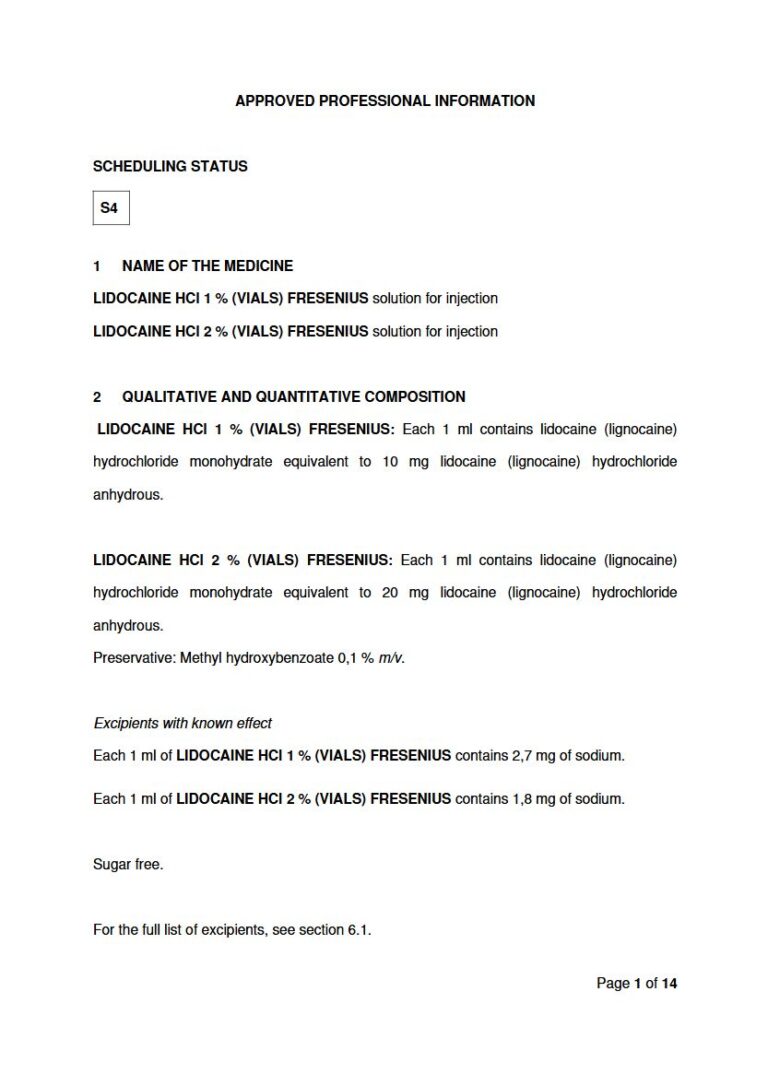
Lidocaine Hcl 1 %/2 %/10 mg/20 mg Solution
PDF Leaflet Revision Date: 07 July 2023
Clinical Summary
Quick overview from the medicine insert
Indication
Local anaesthetic for infiltration, field block, and nerve block.
Dosage (summary)
Dose varies by procedure; max 300 mg/24 hours.
Onset of Action / Duration
Onset: Rapid, Duration: Intermediate
Special Populations
- Elderly
- Debilitated patients
- Children
- Hepatic impairment
- Renal impairment
Pregnancy & Breastfeeding
Avoid in early pregnancy; crosses into breast milk.
Key Drug Interactions
- Other local anaesthetics
- Antidysrhythmics (e.g., mexiletine)
- Muscle relaxants
- Beta-blockers
- CYP1A2 inhibitors
Contraindications
- Hypersensitivity to lidocaine
- Hypovolaemia
- Complete heart block
- Bradycardia
- Myasthenia gravis
- Porphyria
Common side effects
- Hypotension
- Bradycardia
- Nausea
- Dizziness
- Allergic reactions
Counselling Points
- Avoid driving until fully recovered
- Report any unusual symptoms immediately
- Use caution in patients with cardiac issues
Serious warnings
- Risk of cardiovascular depression
- Monitor blood pressure during spinal anaesthesia
- Potential for serious neurological complications
Important Disclaimer
The Lidocaine Hcl 1 %/2 %/10 mg/20 mg Solution professional information leaflet below is the property of Fresenius Kabi Manufacturing Sa and is provided on Medinsert exactly as issued, with no.. alterations or editorial changes. We make every effort to keep content current by updating documents as soon as new versions become available. Medinsert serves as a trusted access point for healthcare professionals, but does not replace official sources or clinical judgement. For more details, please read our full disclaimer. read more>>
 Healthcare Professionals Only
This content is for registered healthcare professionals
Sign in or create a free account to read the full package insert.
Free for HPCSA-registered professionals. Powered by Medinsert.
Clinical Particulars
Section 4 of the official insert — extracted exactly as issued, no alterations
4.1 Therapeutic indications
LIDOCAINE HCl 1 % AND 2 % (VIALS) FRESENIUS is used as a local anaesthetic in infiltration, field block and nerve block. As a local anaesthetic it has an action of intermediate duration which can be increased by adding adrenaline (epinephrine).
4.2 Posology and method of administration
Posology
As local anaesthetic the dose is dependent of the area to be anaesthetised and it is given subcutaneously or intramuscularly:
- Infiltration anaesthesia - a 0,5 to 1,0 % solution is used.
- Field block anaesthesia - as for infiltration anaesthesia.
- Nerve block anaesthesia - depending upon which nerves or plexuses, the type of fibres - a 1 to 2 % solution is used.
- Epidural anaesthesia - determined by the segmental level of anaesthesia required. The volume of anaesthetic required is determined by which nerve fibres are to be blocked, what level of anaesthesia is required and whether adrenaline is used. The addition of adrenaline 1:200 000 is often used to increase the duration of anaesthesia.
The maximum 24-hour dose is 300 mg of LIDOCAINE HCl 1 % AND 2 % (VIALS) FRESENIUS.
Method of Administration
It is recommended that a needle not larger than 21 gauge is used to reduce fragmentation of the rubber stopper.
4.3 Contraindications
- Contraindicated in patients that are hypersensitive to lidocaine (lignocaine) hydrochloride or other amide type local anaesthetics or to any of the excipients listed in 6.1.
- LIDOCAINE HCl 1 % AND 2 % (VIALS) FRESENIUS should not be given to patients with:
- Hypovolaemia
- Complete heart block or other conduction disturbances
- Bradycardia
- Cardiac decompensation or hypotension unrelated to treatable tachydysrhythmias
- Myasthenia gravis
- Porphyria.
4.4 Special warnings and precautions for use
Should not be given intravenously. Doses should be reduced in elderly and debilitated patients and in children. LIDOCAINE HCl 1 % AND 2 % (VIALS) FRESENIUS should be used with caution in patients with epilepsy, myasthenia gravis, cardiac conduction disturbances (see section 4.3), congestive heart failure, bradycardia, severe shock, impaired respiratory function or impaired renal function with a creatinine clearance of less than 10 ml/minute. Lidocaine (lignocaine) is metabolised in the liver, and it should be used with caution in patients with impaired hepatic function. Lower doses should be used in congestive cardiac failure and following cardiac surgery. Hypokalaemia, hypoxia and disorders of acid-base balance should be corrected before treatment with LIDOCAINE HCl 1 % AND 2 % (VIALS) FRESENIUS.
Facilities for resuscitation should be available when administering LIDOCAINE HCl 1 % AND 2 % (VIALS) FRESENIUS. The effect of LIDOCAINE HCl 1 % AND 2 % (VIALS) FRESENIUS may be reduced if the injection is made into an inflamed or infected area. Intra-articular administration of LIDOCAINE HCl 1 % AND 2 % (VIALS) FRESENIUS may cause chondrotoxicity. Certain local anaesthetic procedures may be associated with serious adverse reactions, regardless of the local anaesthetic medicine used.
- Central nerve blocks may cause cardiovascular depression, especially in the presence of hypovolaemia, and therefore epidural anaesthesia should be used with caution in patients with impaired cardiovascular function.
- Blood pressure should be monitored during spinal anaesthesia. Epidural anaesthesia may lead to hypotension and bradycardia. This risk can be reduced by preloading the circulation with crystalloidal or colloidal solutions. Hypotension should be treated promptly.
- Paracervical block can sometimes cause foetal bradycardia or tachycardia, and careful monitoring of the foetal heart rate is necessary.
- Injections in the head and neck regions may be made inadvertently into an artery, causing cerebral symptoms even at low doses.
- Retrobulbar injections may rarely reach the cranial subarachnoid space, causing serious/severe reactions, including cardiovascular collapse, apnoea, convulsions and temporary blindness.
- Retro- and peribulbar injections of local anaesthetics carry a low risk of persistent ocular motor dysfunction. The primary causes include trauma and/or local toxic effects on muscles and/or nerves.
- The severity of such tissue reactions is related to the degree of trauma, the concentration of the local anaesthetic and the duration of exposure of the tissue to the local anaesthetic. For this reason, as with all local anaesthetics, the lowest effective concentration and dose of local anaesthetic should be used.
- LIDOCAINE HCl 1 % AND 2 % (VIALS) FRESENIUS may increase creatinine phosphokinase concentrations which can interfere with the diagnosis of acute myocardial infarction. LIDOCAINE HCl 1 % AND 2 % (VIALS) FRESENIUS is considered to be unsafe in patients with porphyria.
- LIDOCAINE HCl 1 % AND 2 % (VIALS) FRESENIUS is not recommended for use in neonates. The optimum serum concentration of lidocaine (lignocaine) required to avoid toxicity, such as convulsions and cardiac dysrhythmias, in this age group is not known.
4.5 Interaction with other medicines and other forms of interaction
Effects of LIDOCAINE HCl 1 % AND 2 % (VIALS) FRESENIUS on other medicines
LIDOCAINE HCl 1 % AND 2 % (VIALS) FRESENIUS should be used with caution in patients receiving other local anaesthetics or medicines structurally related to amide-type local anaesthetics (e.g., antidysrhythmic medicine, such as mexiletine), since the systemic toxic effects are additive. Specific interaction studies with lidocaine (lignocaine) and class III antidysrhythmic medicines (e.g., amiodarone) have not been performed, but caution is advised. There may be an increased risk of enhanced and prolonged neuromuscular blockade in patients treated concurrently with muscle relaxants (e.g., suxamethonium).
Effects of other medicines on LIDOCAINE HCl 1 % AND 2 % (VIALS) FRESENIUS
The clearance of lidocaine (lignocaine), as in LIDOCAINE HCl 1 % AND 2 % (VIALS) FRESENIUS, may be reduced by beta-adrenoceptor blocking medicines (e.g., propranolol) and by cimetidine, requiring a reduction in the dosage of LIDOCAINE HCl 1 % AND 2 % (VIALS) FRESENIUS. Increase in serum levels of LIDOCAINE HCl 1 % AND 2 % (VIALS) FRESENIUS may also occur with antiviral medicine (e.g., amprenavir, atazanavir, darunavir, lopinavir). There may be an increased risk of ventricular dysrhythmia in patients treated concurrently with antipsychotics which prolong or may prolong the QT interval (e.g., pimozide, sertindole, olanzapine, quetiapine, zotepine), or 5HT3 antagonists (e.g., tropisetron, dolasetron). While adrenaline (epinephrine) when used in conjunction with LIDOCAINE HCl 1 % AND 2 % (VIALS) FRESENIUS might decrease vascular absorption, it greatly increases the danger of ventricular tachycardia and fibrillation if accidentally injected intravenously. Cardiovascular collapse has been reported following the use of bupivacaine in patients on treatment with verapamil and timolol; lidocaine (lignocaine), as in LIDOCAINE HCl 1 % AND 2 % (VIALS) FRESENIUS, is closely related to bupivacaine. Concomitant use of quinupristin/dalfopristin should be avoided. Hypokalaemia produced by acetazolamide, loop diuretics and thiazides antagonise the effect of LIDOCAINE HCl 1 % AND 2 % (VIALS) FRESENIUS, if administered concomitantly (see section 4.4). Inhibition of CYP1A2 by fluvoxamine considerably reduces elimination of lidocaine (lignocaine), as in LIDOCAINE HCl 1 % AND 2 % (VIALS) FRESENIUS and increases the risk of lidocaine (lignocaine) toxicity. Concomitant use of both fluvoxamine and a CYP3A4 inhibitor such as erythromycin can further increase concentration of LIDOCAINE HCl 1 % AND 2 % (VIALS) FRESENIUS. Because lidocaine (lignocaine), as in LIDOCAINE HCl 1 % AND 2 % (VIALS) FRESENIUS, possesses a narrow therapeutic window, doses of LIDOCAINE HCl 1 % AND 2 % (VIALS) FRESENIUS may need to be adjusted accordingly. Conversely, reduced serum concentrations of LIDOCAINE HCl 1 % AND 2 % (VIALS) FRESENIUS may result from medicines that may stimulate the hepatic metabolism of lidocaine (lignocaine) (e.g., phenytoin, oral HRT).
Narcotics are probably proconvulsant and this would support the evidence that lidocaine (lignocaine), as in LIDOCAINE HCl 1 % AND 2 % (VIALS) FRESENIUS, reduces the seizure threshold to fentanyl in man. Opioid-antiemetic combination sometimes used for sedation in children could reduce the convulsant threshold to lidocaine (lignocaine), as in LIDOCAINE HCl 1 % AND 2 % (VIALS) FRESENIUS and increase the CNS depressant effect. Lidocaine (lignocaine), as in LIDOCAINE HCl 1 % AND 2 % (VIALS) FRESENIUS, is markedly bound to u03b1-l-acid glycoprotein (AAG). AAG concentrations may be reduced by oestrogens leading to a higher free fraction of lidocaine (lignocaine), as in LIDOCAINE HCl 1 % AND 2 % (VIALS) FRESENIUS, in women than in men and the free fraction is further increased during pregnancy and in women taking oral contraceptives or HRT.
4.6 Fertility, pregnancy and lactation
Pregnancy
LIDOCAINE HCl 1 % AND 2 % (VIALS) FRESENIUS crosses the placenta and blood-brain barrier and should not be administered during early pregnancy. Foetal intoxication has occurred following the use of lidocaine (lignocaine), as in LIDOCAINE HCl 1 % AND 2 % (VIALS), in labour (see section 4.8). Lidocaine (lignocaine) given by epidural or paracervical block, especially in large doses, or by local perineal infiltration prior to delivery crosses rapidly into the foetal circulation. Elevated lidocaine (lignocaine) levels may persist in the newborn for at least 48 hours after delivery. Foetal bradycardia or neonatal bradycardia, hypotonia or respiratory depression may occur.
Breastfeeding
LIDOCAINE HCl 1 % AND 2 % (VIALS) FRESENIUS is distributed into breast milk. Small amounts of lidocaine (lignocaine) are secreted into breast milk and the possibility of an allergic reaction in the infant, albeit remote, should be borne in mind when using lidocaine (lignocaine) in nursing mothers.
4.7 Effects on ability to drive and use machines
When outpatient anaesthesia affects areas of the body involved in driving or operating machinery, patients should be advised to avoid these activities until normal function is fully restored.
4.8 Undesirable effects
a) Summary of the safety profile
In common with other local anaesthetics, adverse reactions to LIDOCAINE HCl 1 % AND 2 % (VIALS) FRESENIUS are rare and are usually the result of raised plasma concentrations due to accidental intravascular injection, excessive dosage or rapid absorption from highly vascular areas, or may result from a hypersensitivity, idiosyncrasy or diminished tolerance on the part of the patient. Systemic toxicity mainly involves the central nervous system and/or the cardiovascular system (see section 4.9). Following regional blockade as when LIDOCAINE HCl 1 % AND 2 % (VIALS) FRESENIUS is injected intrathecally or extrad urally, hypotension, hypoventilation, Horneru2019s syndrome and hypoglycaemia may be seen. The degree of these effects will depend on the dose and the height of the block. Urinary retention may occur following sacral or lumbar epidural block. It should not outlast the duration of the block. Apnoea and hemiparesis may occur following stellate ganglion block. The probable cause is a direct injection of lidocaine (lignocaine) into the vertebral or carotid arteries.
b) Tabulated summary of adverse reactions
4.9 Overdose
See symptoms mentioned under section 4.8. Treatment is symptomatic and supportive.
