
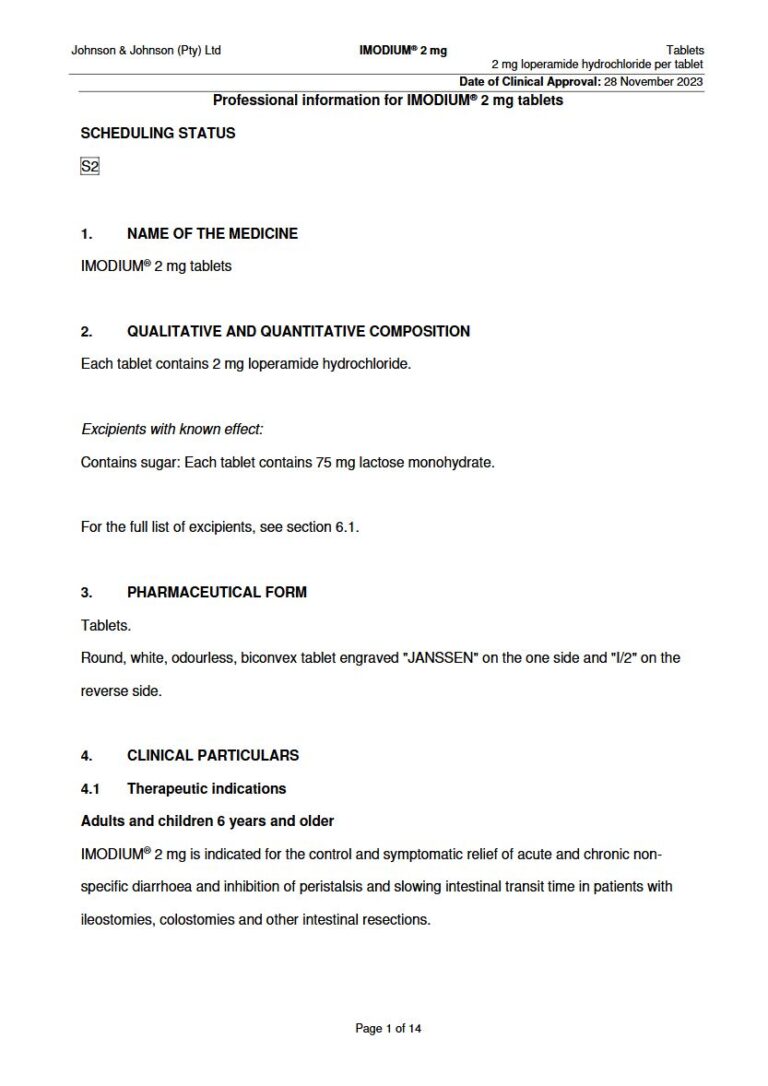
Imodium 2 mg Tablets.
PDF Leaflet Revision Date: 28 November 2023
Clinical Summary
Quick overview from the medicine insert
Indication
Control and symptomatic relief of acute and chronic non-specific diarrhoea.
Dosage (summary)
Adults: 2 tablets (4 mg) initially, then 1 tablet (2 mg) after each loose stool. Max: 6-8 tablets (12-16 mg) daily. Children 6+: 1 tablet (2 mg) initially, then 1 tablet after each loose stool.
Special Populations
- Elderly
- Renal impairment
- Hepatic impairment
Pregnancy & Breastfeeding
Safety during pregnancy not established; not recommended during breastfeeding.
Key Drug Interactions
- Quinidine
- Ritonavir
- Itraconazole
- Gemfibrozil
- Ketoconazole
Contraindications
- Hypersensitivity to loperamide
- Infants under 2 years
- Acute dysentery
- Acute ulcerative colitis
- Bacterial enterocolitis
- Pseudomembranous colitis
Common side effects
- Constipation
- Flatulence
- Headache
- Nausea
- Dizziness
Counselling Points
- Stop if no improvement in 48 hours
- Hydration is important
- Use caution when driving or operating machinery
Serious warnings
- Risk of toxic megacolon
- CNS toxicity in hepatic impairment
- QT prolongation in overdose
Important Disclaimer
The Imodium 2 mg Tablets. professional information leaflet below is the property of Johnson and is provided on Medinsert exactly as issued, with no.. alterations or editorial changes. We make every effort to keep content current by updating documents as soon as new versions become available. Medinsert serves as a trusted access point for healthcare professionals, but does not replace official sources or clinical judgement. For more details, please read our full disclaimer. read more>>
 Healthcare Professionals Only
This content is for registered healthcare professionals
Sign in or create a free account to read the full package insert.
Free for HPCSA-registered professionals. Powered by Medinsert.
Clinical Particulars
Section 4 of the official insert — extracted exactly as issued, no alterations
4.1 Therapeutic indications
Adults and children 6 years and older IMODIUM u00ae 2 mg is indicated for the control and symptomatic relief of acute and chronic non-specific diarrhoea and inhibition of peristalsis and slowing intestinal transit time in patients with ileostomies, colostomies and other intestinal resections.
Children below 6 years of age IMODIUM u00ae 2 mg is indicated for inhibition of peristalsis and slowing intestinal transit time.
4.2 Posology and method of administration
IMODIUM u00ae should not be used in infants under 2 years. The tablets, however, are not suited for children under 6 years of age.
Acute non-specific diarrhoea Adults and children of 6 years and older: 2 tablets (4 mg) for adults, or 1 tablet (2 mg) for children as an initial dose followed by 1 tablet (2 mg) after each subsequent loose stool. Do not exceed the following maximum daily dosages.
- WEIGHT IN KILOGRAMS (kg) MAXIMUM DAILY DOSE
- From 14 kg 2 tablets (4 mg)
- From 20 kg 3 tablets (6 mg)
- From 27 kg 4 tablets (8 mg)
- From 34 kg 5 tablets (10 mg)
- From 40 kg 6 tablets (12 mg)
- From 47 kg 7 tablets (14 mg)
- From 54 kg 8 tablets (16 mg)
Important : STOP IMODIUM u00ae 2 mg as soon as diarrhoea is under control. In acute diarrhoea, if clinical improvement is not observed within 48 hours, the administration of IMODIUM u00ae 2 mg should be discontinued, and patients should be advised to consult their doctor.
Chronic non-specific diarrhoea (consult your doctor) With individually adjusted dosage it is usually possible to obtain a virtually normal bowel movement. The initial dose is 2 tablets (4 mg) daily for adults and 1 tablet (2 mg) daily for children of 6 years and over. The initial dose should be adjusted until 1 u2013 2 solid stools per day are obtained. This is usually achieved on a maintenance dose of 1 u2013 6 tablets (2 u2013 12 mg) daily. If constipation occurs, the dosage should be decreased.
Special populations Elderly No dose adjustment is required for the elderly. Renal impairment No dose adjustment is required for patients with renal impairment. Hepatic impairment Although no pharmacokinetic data are available in patients with hepatic impairment, IMODIUM u00ae 2 mg should be used with caution in such patients because of reduced first pass metabolism (see section 4.4 below).
4.3 Contraindications
- IMODIUM u00ae 2 mg is contraindicated in patients with a known hypersensitivity to loperamide hydrochloride or to any of the other ingredients in IMODIUM u00ae 2 mg (see section 6.1).
- IMODIUM u00ae 2 mg is contraindicated in infants below 2 years of age.
- IMODIUM u00ae 2 mg should not be used as the primary therapy in patients with acute dysentery, which is characterised by blood in stools and high fever.
- IMODIUM u00ae 2 mg tablets should not be used in:
- patients with acute ulcerative colitis,
- patients with bacterial enterocolitis caused by invasive organisms including Salmonella, Shigella, and Campylobacter,
- patients with pseudomembranous colitis associated with the use of broad-spectrum antibiotics.
In general, IMODIUM u00ae 2 mg should not be used when inhibition of peristalsis is to be avoided due to the possible risk of significant sequelae including ileus, megacolon and toxic megacolon. IMODIUM u00ae 2 mg must be discontinued promptly when constipation, abdominal distension or ileus develop.
4.4 Special warnings and precautions for use
Treatment of diarrhoea with IMODIUM u00ae 2 mg is only symptomatic. Whenever an underlying aetiology can be determined, specific treatment should be given when appropriate (or when indicated).
In patients with diarrhoea, especially in infants, fluid and electrolyte depletion may occur. In such cases administration of appropriate fluid and electrolyte replacement (oral rehydration therapy (ORT)) is the most important measure. IMODIUM u00ae 2 mg should not be given to children less than 6 years of age without medical prescription and supervision. IMODIUM u00ae 2 mg is not recommended for routine use in acute or chronic diarrhoea in children under the age of 6 years (see section 4.3).
In acute diarrhoea, if clinical improvement is not observed within 48 hours, the administration of IMODIUM u00ae 2 mg should be discontinued, and patients should be advised to consult their doctor.
Patients with acquired immunodeficiency syndrome (AIDS) treated with IMODIUM u00ae 2 mg for diarrhoea should have therapy stopped at the earliest signs of abdominal distension. There have been reports of constipation with an increased risk of toxic megacolon in AIDS patients with infectious colitis from both viral and bacterial pathogens treated with IMODIUM u00ae 2 mg.
Although no pharmacokinetic data are available in patients with hepatic impairment, IMODIUM u00ae 2 mg should be used with caution in such patients because of reduced first pass metabolism. IMODIUM u00ae 2 mg must be used with caution in patients with hepatic impairment as it may result in a relative overdose leading to central nervous system (CNS) toxicity.
Abuse and misuse of loperamide, as an opioid substitute, have been described in individuals with opioid addiction (see section 4.9). Cardiac events including QT interval and QRS complex prolongation and torsades de pointes have been reported in association with overdose. Some cases had a fatal outcome (see section 4.9). Overdose can unmask existing Brugada syndrome. Patients should not exceed the recommended dose and/or the recommended duration of treatment.
IMODIUM u00ae 2 mg contains lactose monohydrate. Patients with rare hereditary problems of galactose intolerance, the total lactase deficiency, or glucose-galactose malabsorption should not take IMODIUM u00ae 2 mg.
4.5 Interaction with other medicines and other forms of interaction
Non-clinical data have shown that loperamide is a P-glycoprotein substrate. In two separate studies, concomitant administration of loperamide (16 mg single dose) with quinidine, or ritonavir, which are both P-glycoprotein inhibitors, resulted in a 2 to 3-fold increase in loperamide plasma levels with concomitant administration with quinidine, but not with ritonavir; there was evidence of respiratory suppression. The clinical relevance of this pharmacokinetic interaction with P-glycoprotein inhibitors, when loperamide is given at recommended dosages (2 mg, up to 16 mg maximum daily dose), is unknown.
The concomitant administration of loperamide (4 mg single dose) and itraconazole, an inhibitor of CYP3A4 and P-glycoprotein, resulted in a 3 to 4-fold increase in loperamide plasma concentrations. In the same study a CYP2C8 inhibitor, gemfibrozil, increased loperamide by approximately 2-fold. The combination of itraconazole and gemfibrozil resulted in a 4-fold increase in peak plasma levels of loperamide and a 13-fold increase in total plasma exposure. These increases were not associated with CNS effects as measured by psychomotor tests (i.e., subjective drowsiness and the Digit Symbol Substitution Test).
The concomitant administration of loperamide (16 mg single dose) and ketoconazole, an inhibitor of CYP3A4 and P-glycoprotein, resulted in a 5-fold increase in loperamide plasma concentrations. This increase was not associated with increased pharmacodynamic effects as measured by pupillometry.
Concomitant treatment with oral desmopressin resulted in a 3-fold increase of desmopressin plasma concentrations, presumably due to slower gastrointestinal motility. It is expected that medicines with similar pharmacological properties may potentiate loperamideu2019s effect and that medicines that accelerate gastrointestinal transit may decrease its effect.
4.6 Fertility, pregnancy and lactation
Pregnancy The safety of use during pregnancy has not been established.
Breastfeeding Small amounts of loperamide may appear in human breast milk. Therefore, IMODIUM u00ae 2 mg is not recommended during breastfeeding.
Fertility The effect on human fertility has not been evaluated.
4.7 Effects on ability to drive and use machines
Tiredness, dizziness, or drowsiness may occur in the setting of diarrhoeal syndromes treated with IMODIUM u00ae 2 mg. Therefore, it is advisable to use caution when driving a car or operating machinery (see section 4.8).
4.8 Undesirable effects
Summary of the safety profile The most commonly reported adverse reactions in patients with acute diarrhoea were constipation, flatulence, headache and nausea. In patients with chronic diarrhoea, the most commonly reported adverse reactions were flatulence, constipation, nausea and dizziness.
Adverse events in patients with acute diarrhoea Nervous system disorders: Frequent: headache Less frequent : dizziness Gastrointestinal disorders: Frequent: constipation, dry mouth, flatulence, abdominal cramp, colic, nausea Less frequent: abdominal pain, vomiting, abdominal discomfort, upper abdominal pain, abdominal distension Skin and subcutaneous tissue disorders: Less frequent: rash
Adverse events in patients with chronic diarrhoea Nervous system disorders: Frequent: dizziness, headache Gastrointestinal disorders: Frequent: constipation, nausea, vomiting, headache, meteorism, abdominal pain, abdominal cramp, colic, flatulence Less frequent: dry mouth, abdominal discomfort, dyspepsia
Adverse events in patients with acute or chronic diarrhoea Gastrointestinal disorders: Frequent: nausea, constipation, abdominal cramp Adverse event in paediatric patients (under 12 years) with acute diarrhoea Nervous system disorders: Less frequent: somnolence, dizziness, headache Gastrointestinal disorders: Frequent: vomiting Less frequent: nausea, abdominal pain, constipation Skin and subcutaneous tissue disorders: Less frequent: rash
Post-marketing experience Immune system disorders: Less frequent: allergic reactions, hypersensitivity reactions including anaphylactic shock and anaphylactoid reactions Psychiatric disorders: Less frequent: drowsiness Nervous system disorders: Less frequent: abnormal coordination, depressed level of consciousness, hypertonia, loss of consciousness, somnolence, stupor Eye disorders: Less frequent: miosis Gastrointestinal disorders: Less frequent: ileus (including paralytic ileus), megacolon including toxic megacolon, glossodynia Skin and subcutaneous tissue disorders: Less frequent: urticaria, pruritus, angioedema, and bullous eruptions, including Stevens-Johnson Syndrome, erythema multiforme and toxic epidermal necrolysis Renal and urinary disorders: Less frequent: urinary retention General disorders and administration site disorders: Less frequent: fatigue.
A number of the adverse events reported during the clinical investigations and post-marketing experience with IMODIUM u00ae 2 mg are also frequent symptoms of the underlying diarrheal syndrome (abdominal pain/discomfort, nausea, vomiting, dry mouth, tiredness, drowsiness, dizziness, constipation, and flatulence). These symptoms may be difficult to distinguish from undesirable medicine effects. An increased risk of abdominal pain, including pancreatitis has been reported.
Reporting of suspected adverse reactions: Reporting suspected adverse reactions after authorisation of IMODIUM u00ae 2 mg. is important. It allows continued monitoring of the benefit/risk balance of IMODIUM u00ae 2 mg. Health care providers are asked to report any suspected adverse reactions to SAHPRA via the u201c6.04 Adverse Drug Reactions Reporting Formu201d, found online under SAHPRAu2019s publications: https://www.sahpra.org.za/Publications/Index/8. For further information, please contact the Johnson & Johnson call centre on 0860 410032 (landline).
4.9 Overdose
Signs and symptoms: In case of overdose (including relative overdose due to hepatic dysfunction), central nervous system depression (e.g. stupor, coordination abnormality, somnolence, miosis, muscular hypertonia and respiratory depression), urinary retention, constipation and paralytic ileus may occur. Children may be more sensitive to central nervous system effects of loperamide than adults. Convulsions have been reported in children under the age of 2 years. See section 4.3. Excessive inhibition of peristalsis with nausea and dryness of the mouth.
In individuals who have intentionally ingested overdoses of loperamide HCl, QT interval and QRS complex prolongation and/or serious ventricular dysrhythmias, including Torsade de Pointes, have been observed (see section 4.4). Fatal cases have also been reported. Abuse, misuse and/or overdose with excessively large doses of loperamide, may unmask Brugada syndrome. Upon cessation, cases of drug withdrawal syndrome, have been observed in individuals abusing, misusing or intentionally overdosing with excessively large doses of loperamide.
Treatment: Treatment is symptomatic and supportive. Naloxone can be given as an antidote. Since the duration of action of IMODIUM u00ae 2 mg is longer than that of naloxone (1 to 3 hours) repeated treatment with naloxone might be indicated. Therefore, the patient should be monitored closely for at least 48 hours in order to detect possible central nervous system depression.
