
Alrex Eye drops
Clinical Summary
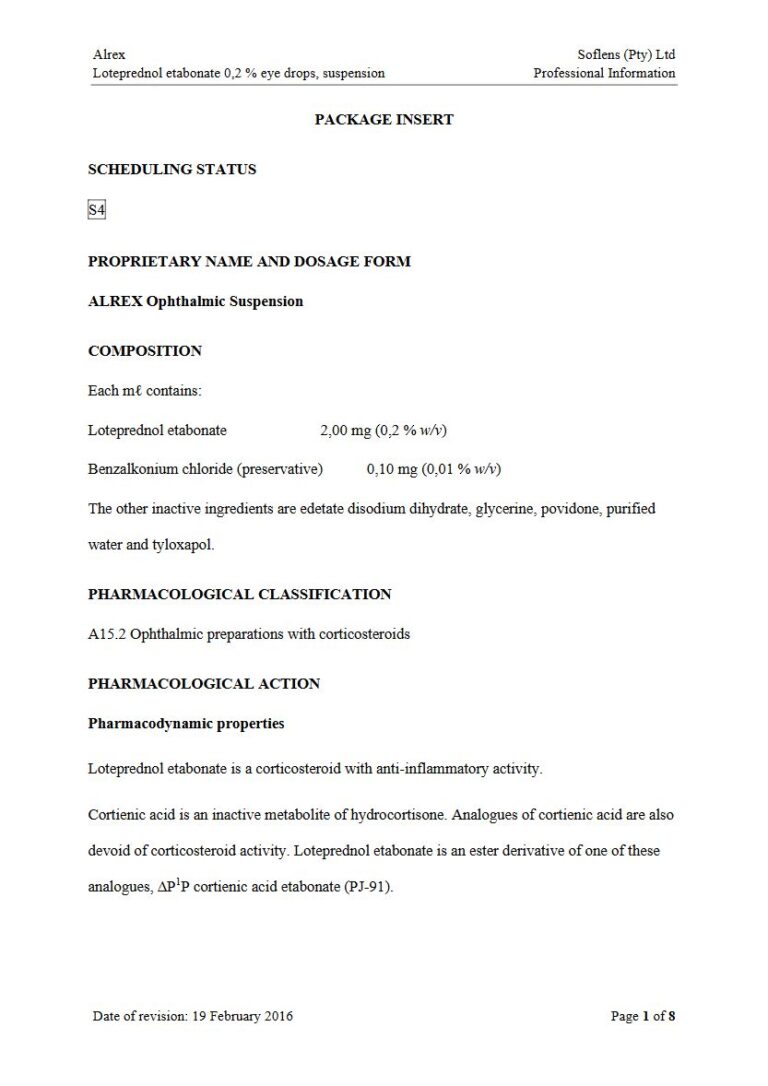
Quick overview from the medicine insert
Indication
Management of inflammation and pain associated with ocular surgery, and for the treatment of allergic conjunctivitis.
Dosage (summary)
Instill 1 to 2 drops in the affected eye(s) 4 times daily, tapering as needed.
Onset of Action / Duration
Onset within hours; duration of effect may last up to 12 hours.
Special Populations
- Elderly patients
- Patients with hepatic impairment
- Patients with renal impairment
Pregnancy & Breastfeeding
Use with caution during pregnancy and lactation; consult a healthcare provider.
Key Drug Interactions
- May interact with other topical ophthalmic medications; administer at least 5 minutes apart.
Contraindications
- Hypersensitivity to Loteprednol Etabonate or any component of the formulation.
- Active ocular infections (viral, bacterial, or fungal).
Common side effects
- Burning or stinging sensation upon instillation
- Increased intraocular pressure
- Conjunctival hyperemia
- Dry eyes
Counselling Points
- Instruct patients on proper eye drop administration technique.
- Advise patients to avoid touching the dropper tip to any surface to prevent contamination.
- Inform patients to report any persistent eye discomfort or changes in vision.
Serious warnings
- Prolonged use may lead to increased intraocular pressure and potential development of glaucoma.
- Caution in patients with a history of herpes simplex keratitis.
Important Disclaimer
The Alrex Eye drops professional information leaflet below is the property of Soflens and is provided on Medinsert exactly as issued, with no.. alterations or editorial changes. We make every effort to keep content current by updating documents as soon as new versions become available. Medinsert serves as a trusted access point for healthcare professionals, but does not replace official sources or clinical judgement. For more details, please read our full disclaimer. read more>>
 Healthcare Professionals Only
This content is for registered healthcare professionals
Sign in or create a free account to read the full package insert.
Free for HPCSA-registered professionals. Powered by Medinsert.
Clinical Particulars
Section 4 of the official insert — extracted exactly as issued, no alterations
4.1 Indications
ALREX is indicated for the short-term (6 weeks) symptomatic treatment of seasonal allergic conjunctivitis in adults.
4.2 Posology and method of administration
SHAKE VIGOROUSLY BEFORE USING. Apply one to two drops into the conjunctival sac of the affected eye(s) four times daily. During the initial treatment within the first week, the dosing may be increased up to one drop every hour, if necessary. If signs and symptoms fail to improve after 2 days, the patient should be re-evaluated. If this product is used for 10 days or longer, intraocular pressure should be monitored. Treatment should not exceed six weeks. If more than one topical ophthalmic product is being used, the medicinal products should be administered at least 10 minutes apart.
4.3 Contraindications
ALREX is contraindicated in:
- individuals with known hypersensitivity to loteprednol, other corticosteroids or to any other ingredients of ALREX
- viral diseases of the cornea and conjunctiva including epithelial herpes simplex keratitis (dendritic keratitis), vaccinia, varicella
- untreated purulent ocular infections
- eyes with suspected or confirmed infections
- amoebic infections
- mycobacterial infections
- fungal diseases of ocular structures
- glaucoma (see WARNINGS AND SPECIAL PRECAUTIONS)
- children under the age of 18 years
- pregnancy and lactation (see PREGNANCY AND LACTATION)
Paediatric use: Safety and effectiveness in paediatric patients have not been established.
4.4 Special warnings and precautions for use
As the possibility of adverse effects on the corneal permeability, and the danger of disruption of the corneal epithelium with prolonged or repeated usage of benzalkonium chloride preserved ophthalmological preparations, cannot be excluded, regular ophthalmological examination is required. Caution should be exercised in the use of benzalkonium chloride preserved topical medication over an extended period in patients with extensive ocular surface disease. Do not wear soft contact lenses when using ALREX. Prolonged use of ALREX may result in glaucoma with damage to the optic nerve, defects in visual acuity and fields of vision, and in posterior subcapsular cataract formation. ALREX should not be used in the presence of glaucoma (see CONTRAINDICATIONS). Prolonged use of ALREX may suppress the host response and thus increase the possibility of secondary ocular infections. In those diseases causing thinning of the cornea or sclera, perforations have been known to occur with the use of topical steroids. In acute purulent conditions of the eye, ALREX may mask the infection or enhance existing infection (see CONTRAINDICATIONS). If signs and symptoms fail to improve after 2 days, the patient should be re-evaluated. If this product is used for 10 days or longer, intraocular pressure should be monitored. This product is sterile when packaged. Do not allow the dropper tip to touch any surface, as this may contaminate the suspension. ALREX should be discarded 28 days after opening.
4.5 Interactions with other medicines
Since loteprednol etabonate is barely detected in plasma levels following the topical administration of ALREX, it is not expected to affect the pharmacokinetics of systemically administered medicines. The potential of ALREX eye suspension to increase the intraocular pressure may be adversely affected by systemically administered medicines with anticholinergic activity. In patients receiving concomitant ocular hypotensive therapy, the addition of ALREX may increase intraocular pressure and decrease the apparent ocular hypotensive effect of these medications. Concurrent administration of cycloplegics may increase the risk of raised intra-ocular pressure. Co-treatment with CYP3A inhibitors, including cobicistat-containing products, is expected to increase the risk of systemic side-effects. The combination should be avoided unless the benefit outweighs the increased risk of systemic corticosteroid side-effects, in which case patients should be monitored for systemic corticosteroid side-effects.
4.6 Fertility, pregnancy and lactation
Pregnancy: Safety in pregnancy has not been established, and it should therefore not be used during this period.
Lactation: Mothers using ALREX should not breastfeed their babies. There is insufficient data to support the safe use of ALREX eye drops in lactating women. Therefore such use is contra-indicated.
4.7 Effects on ability to drive and use machines
Use of ALREX may cause abnormal or blurred vision. Patients should not drive or operate machinery until their vision is clear.
4.8 Undesirable effects
The following adverse events were reported as related to the treatment with loteprednol etabonate (0,005 % - 0,5 %) during clinical trials:
Common (u22651/100, <1/10): Vision disorders: Increased intraocular pressure, itchy eyes, conjunctival hyperaemia, epiphora, burning/stinging, foreign body sensation, abnormal vision, eye discharge, dry eyes, photophobia, eye discomfort, chemosis and blurred vision. Body as a whole u2013 general disorders: Headache.
Uncommon (u22651/1 000, <1/100): Vision disorders: Eyelid erythema, eye pain, anterior chamber cells, eyelid abnormality, iritis, uveitis, corneal abnormality, eye irritation, ciliary flush, keratitis, anterior chamber flare, keratic precipitate, macular oedema, papilla, conjunctival oedema, eye disorder, fluorescein staining, hyphema, anterior chamber inflammation, ophthalmitis, sticky eye, anterior chamber synechia. Skin and appendages disorders: Rash, urticaria. Central & peripheral nervous system disorders: Nervousness. Special senses other, disorders: Taste disturbances. Gastro-intestinal disorders: Diarrhoea, nausea, vomiting. Cardiovascular disorders, general: Migraine. Respiratory system disorders: Rhinitis, pharyngitis, increased cough. Urinary system disorders: Urinary tract infection. Body as a whole u2013 general disorders: Asthenia, chest pain, chills, facial oedema, fever, pain.
The following additional adverse events were spontaneously reported as related to the use of ALREX: Vision disorders: Conjunctivitis, glaucoma, lacrimation discharge, mydriasis, vitreous disorder, corneal lesion, cataract, abnormal accommodation, corneal opacity, corneal ulcer, visual field defect, vitreous discharge. Skin and appendages disorders: Herpes simplex, sweating, pruritus, skin discolouration. Musculoskeletal system disorders: Spasms. Central & peripheral nervous system disorders: Dizziness, paraesthesia, tremor, anxiety, insomnia. Special senses other, disorders: Otitis media, parosmia, discharge from the ear, ear pain. Psychiatric disorders: Depression. Gastro-intestinal disorders: Dyspepsia. Metabolic and nutritional disorders: Glycosuria. Cardiovascular disorders, general: Palpitations, vasodilation, hypertension, tachycardia. Respiratory system disorders: Lung disorder, voice alteration, laryngismus, asthma, dyspnoea, laryngitis, lung discharge. Body as a whole u2013 general disorders: Allergic reaction, aggravated reaction, abnormalities of the hair, feeling abnormal, anorexia, malaise, photosensitivity.
Reactions associated with ophthalmic steroids such as ALREX include elevated intra-ocular pressure in steroid responsive patients, which may be associated with optic nerve damage, visual acuity and field defects, posterior subcapsular cataract formation, secondary ocular infection from pathogens including herpes simplex and perforation of the globe where there is thinning of the cornea or sclera.
4.9 Overdose
No case of overdose has been reported. Acute over dosage is unlikely to occur via the ophthalmic route.
