
Asacol 1600mg MR Tablets
Clinical Summary
Quick overview from the medicine insert
Indication
Treatment of mild to moderate ulcerative colitis and Crohn's disease.
Dosage (summary)
1600 mg taken orally three times daily, preferably after meals.
Onset of Action / Duration
Onset of action may take several weeks; full therapeutic effect may take up to 8 weeks.
Special Populations
- Elderly patients may require dose adjustment.
- Patients with renal impairment should be monitored closely.
- Patients with hepatic impairment should be assessed for dosage adjustment.
Pregnancy & Breastfeeding
Use during pregnancy only if clearly needed; Mesalazine is excreted in breast milk, caution is advised.
Key Drug Interactions
- May interact with other drugs that affect renal function.
- Caution with concomitant use of non-steroidal anti-inflammatory drugs (NSAIDs).
Contraindications
- Hypersensitivity to Mesalazine or any component of the formulation.
- Severe renal impairment.
- Active gastrointestinal bleeding.
Common side effects
- Abdominal pain
- Diarrhea
- Nausea
- Headache
- Rash
- Elevated liver enzymes
Counselling Points
- Advise patients to maintain adequate hydration.
- Instruct patients to report any signs of allergic reactions.
- Inform patients about the importance of adherence to therapy.
Serious warnings
- Monitor for signs of renal impairment during treatment.
- Use with caution in patients with a history of gastrointestinal obstruction.
- Discontinue if severe skin reactions occur.
Important Disclaimer
The Asacol 1600mg MR Tablets professional information leaflet below is the property of Equity Pharmaceuticals and is provided on Medinsert exactly as issued, with no.. alterations or editorial changes. We make every effort to keep content current by updating documents as soon as new versions become available. Medinsert serves as a trusted access point for healthcare professionals, but does not replace official sources or clinical judgement. For more details, please read our full disclaimer. read more>>
 Healthcare Professionals Only
This content is for registered healthcare professionals
Sign in or create a free account to read the full package insert.
Free for HPCSA-registered professionals. Powered by Medinsert.
Clinical Particulars
Section 4 of the official insert — extracted exactly as issued, no alterations
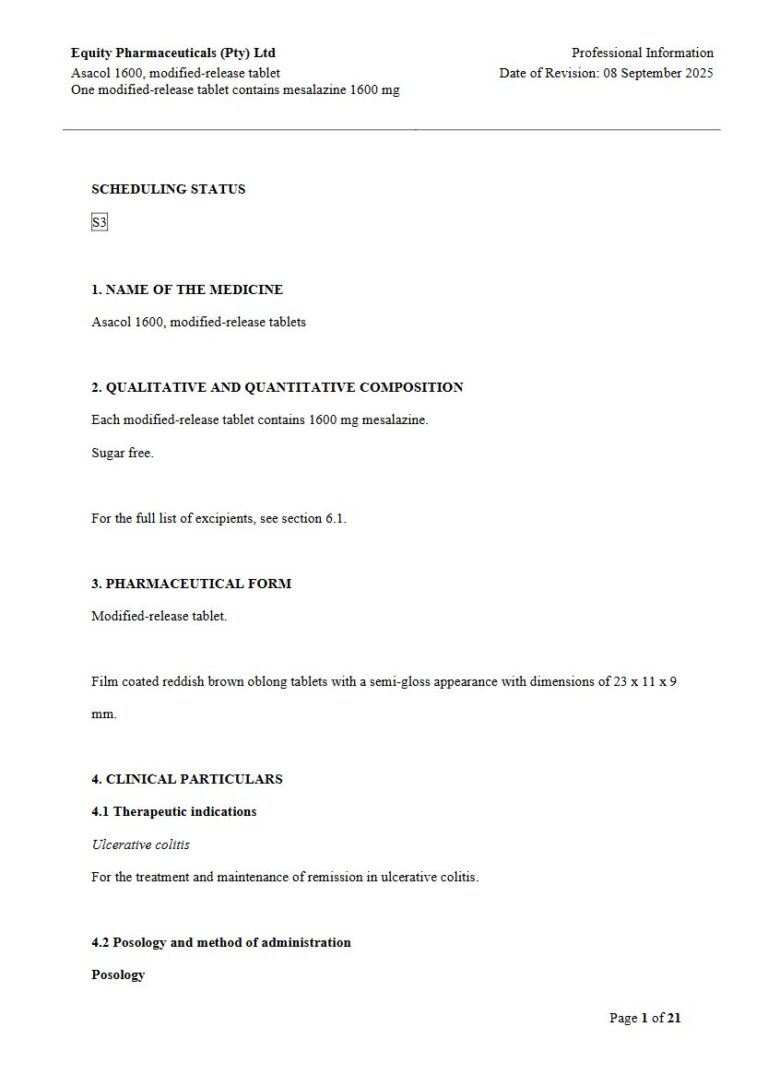
4.1 Therapeutic indications
Ulcerative colitis
For the treatment and maintenance of remission in ulcerative colitis.
4.2 Posology and method of administration
Posology
Adults, including the elderly (> 65 years)
The dose should be adjusted to the severity of the disease and tolerance. Acute disease: In the event of exacerbation, the dose can be increased to 4800 mg daily, once daily or in 2 u2013 3 divided doses. Once clinical remission is achieved, the dose should gradually be decreased to maintenance dose. Continued therapy should be carefully considered in subjects not responding by week 8. Maintenance treatment: 1600 mg once daily. Other oral mesalazine formulations are available if an alternative dose for maintenance treatment is considered more appropriate.
Elderly population
No studies have been carried out in older people.
Paediatric population
The safety and efficacy of Asacol 1600 in children and adolescents aged younger than 18 years of age has not been established.
Method of administration
Oral. The tablets must be swallowed whole with a glass of water. They must not be chewed, crushed or broken before swallowing. The tablets can be taken with or without food. If one or more doses have been missed, the next dose is to be taken as usual.
4.3 Contraindications
- Hypersensitivity to salicylates (including mesalazine) or to any of the excipients listed in section 6.1;
- severe liver impairment;
- severe renal impairment (GFR < 30 mL/min/1.73 m2).
4.4 Special warnings and precautions for use
Blood tests (differential blood count; liver function parameters such as ALT or AST; serum creatinine) and urinary status (dip-sticks) should be determined prior to and during treatment, at the discretion of the treating medical practitioner. As a guideline, follow-up tests are recommended 14 days after commencement of treatment, then a further two to three tests at intervals of 4 weeks. If the findings are normal, follow-up tests should be carried out every 3 months. If additional symptoms occur, these tests should be performed immediately.
Renal impairment
Asacol 1600 should not be used in patients with renal impairment. Asacol-induced renal toxicity shall be suspected if the renal function is impaired during the treatment and the treatment should be stopped immediately. It is recommended that the renal function is monitored prior to and repeatedly whilst on Asacol 1600 therapy.
Nephrolithiasis
Cases of nephrolithiasis have been reported with the use of Asacol 1600 including stones with a 100 % mesalazine content. It is recommended to ensure adequate fluid intake during treatment.
Mesalazine, as contained in ASACOL 1600, may produce red-brown urine discoloration after contact with sodium hypochlorite bleach (e.g., in toilets cleaned with sodium hypochlorite contained in certain bleaches).
Severe cutaneous adverse reactions
Severe cutaneous adverse reactions (SCARs), including drug reaction with eosinophilia and systemic symptoms (DRESS), Stevens-Johnson Syndrome (SJS) and toxic epidermal necrolysis (TEN), have been reported in association with mesalazine, as in ASACOL 1600, treatment. Mesalazine, as in ASACOL 1600, should be discontinued, at the first appearance of signs and symptoms of severe skin reactions, such as skin rash, mucosal lesions, or any other sign of hypersensitivity.
Blood dyscrasia
Serious blood dyscrasia has been reported. Asacol 1600 therapy should be stopped immediately if there is a suspicion or evidence of blood dyscrasia (signs of unexplained bleeding, bruising, purpura, anaemia, persistent fever or sore throat), and the patient should seek immediate medical advice.
Liver impairment
There have been reports of increased liver enzyme levels in patients taking preparations containing mesalazine. Caution is recommended if Asacol 1600 is administered to patients with liver impairment.
Cardiac hypersensitivity reactions
Asacol-induced hypersensitivity reactions (myo- and pericarditis) have been reported rarely with Asacol 1600. In case of a suspected cardiac hypersensitivity, Asacol 1600 must not be reintroduced. Caution should be taken in patients with previous myo- or pericarditis of allergic background regardless of its origin.
Idiopathic intracranial hypertension
Idiopathic intracranial hypertension (pseudotumor cerebri) has been reported in patients receiving mesalazine, as contained in ASACOL 1600. Patients should be warned for signs and symptoms of idiopathic intracranial hypertension, including severe or recurrent headache, visual disturbances or tinnitus. If idiopathic intracranial hypertension occurs, discontinuation of mesalazine, as in ASACOL 1600, should be considered.
Pulmonary disease
Patients with pulmonary disease, in particular asthma, should be very carefully monitored during treatment with Asacol 1600.
Hypersensitivity to sulphasalazine
In patients with a history of adverse drug reactions to sulphasalazine, therapy should be kept under close medical supervision. Treatment must be stopped immediately if acute symptoms of intolerance occur such as abdominal cramps, acute abdominal pain, fever, severe headache and rash.
Gastric and duodenal ulcers
Caution is recommended when treating patients with active gastric or duodenal ulcer.
Elderly patients
Asacol 1600 should be administered with caution in elderly patients, it should only be given to patients with normal to moderate renal impairment, see section 4.3.
Paediatric population
There is only limited documentation for an effect in children, see section 4.2.
4.5 Interaction with other medicines and other forms of interaction
No interaction studies have been performed. There is evidence that mesalazine might decrease the anticoagulant effect of warfarin. Caution is recommended for the concomitant use of mesalazine with known nephrotoxic agents, including non-steroidal anti-inflammatory drugs (NSAIDs) and azathioprine, or methothrexate as these may increase the risk of renal adverse reactions. A possible increase in the myelosuppressive effects of azathioprine, 6-mercaptopurine or thioguanine in patients who are concomitantly treated with any of these preparations, should be taken into account. Life-threatening infection can occur. Patients should be closely observed for signs of infection and myelosuppression. Haematological parameters, especially the leukocyte, thrombocyte and lymphocyte cell counts should be monitored regularly (weekly), especially at initiation of such combination therapy, see section 4.4.
4.6 Fertility, pregnancy and lactation
Pregnancy
There are no adequate data on the use of Asacol 1600 in pregnant women. However, data on a limited number of exposed pregnancies indicate no adverse effect of mesalazine on pregnancy or on the foetus/newborn child. To date, no other relevant epidemiologic data are available.
In one single case after long-term use of a high dose of mesalazine (2 - 4 g, orally) during pregnancy, renal failure in a neonate was reported. Animal studies on oral mesalazine do not indicate direct or indirect harmful effects with respect to pregnancy, embryonic/foetal development, parturition or postnatal development. Asacol 1600 should only be used during pregnancy if the potential benefit outweighs the possible risk.
Breastfeeding
N-acetyl-5-aminosalicylic acid and to a lesser degree mesalazine are excreted in breast milk. The clinical significance of this has not been determined. Only limited experience during lactation in women is available to date. Hypersensitivity reactions such as diarrhoea in the infant cannot be excluded. Therefore, Asacol 1600 should only be used during breast-feeding if the potential benefit outweighs the possible risk. If the infant develops diarrhoea, breast-feeding should be discontinued.
Fertility
No effects on fertility have been observed.
4.7 Effects on ability to drive and use machines
No studies on the effects on the ability to drive and use machines have been performed. Asacol 1600 may influence the ability to drive and use of machines.
4.8 Undesirable effects
a) Summary of the safety profile
Organ specific adverse drug reactions affecting the heart, lungs, liver, kidneys, pancreas, skin and subcutaneous tissue have been reported. Headache (1.7 %), haematuria (1.7 %), abdominal pain (1.5 %), ulcerative colitis (1.5 %) and proteinuria (1.5 %) are the most commonly reported drug related adverse events in the clinical development programme. Treatment must be stopped immediately if acute symptoms of intolerance occur such as abdominal cramps, acute abdominal pain, fever, severe headache and rash. Severe cutaneous adverse reactions (SCARs), including drug reaction with eosinophilia and systemic symptoms (DRESS), Stevens-Johnson Syndrome (SJS) and toxic epidermal necrolysis (TEN), have been reported in association with mesalazine, as in ASACOL 1600, treatment (see section 4.4).
b) Tabulated summary of adverse reactions
Common (u2265 1/100 to < 1/10), uncommon (u2265 1/1,000 to < 1/100), rare (u2265 1/10,000 to < 1/1,000), very rare (< 1/10,000), not known (cannot be estimated from the available data).
4.9 Overdose
Mesalazine is an aminosalicylate, and signs of salicylate toxicity include tinnitus, vertigo, headache, confusion, drowsiness, pulmonary oedema, dehydration as a result of sweating, diarrhoea and vomiting, hypoglycaemia, hyperventilation, disruption of electrolyte balance and blood-pH and hyperthermia. Conventional therapy for salicylate toxicity may be beneficial in the event of acute overdosage. Hypoglycaemia, fluid and electrolyte imbalance should be corrected by the administration of appropriate therapy. Adequate renal function should be maintained.
