
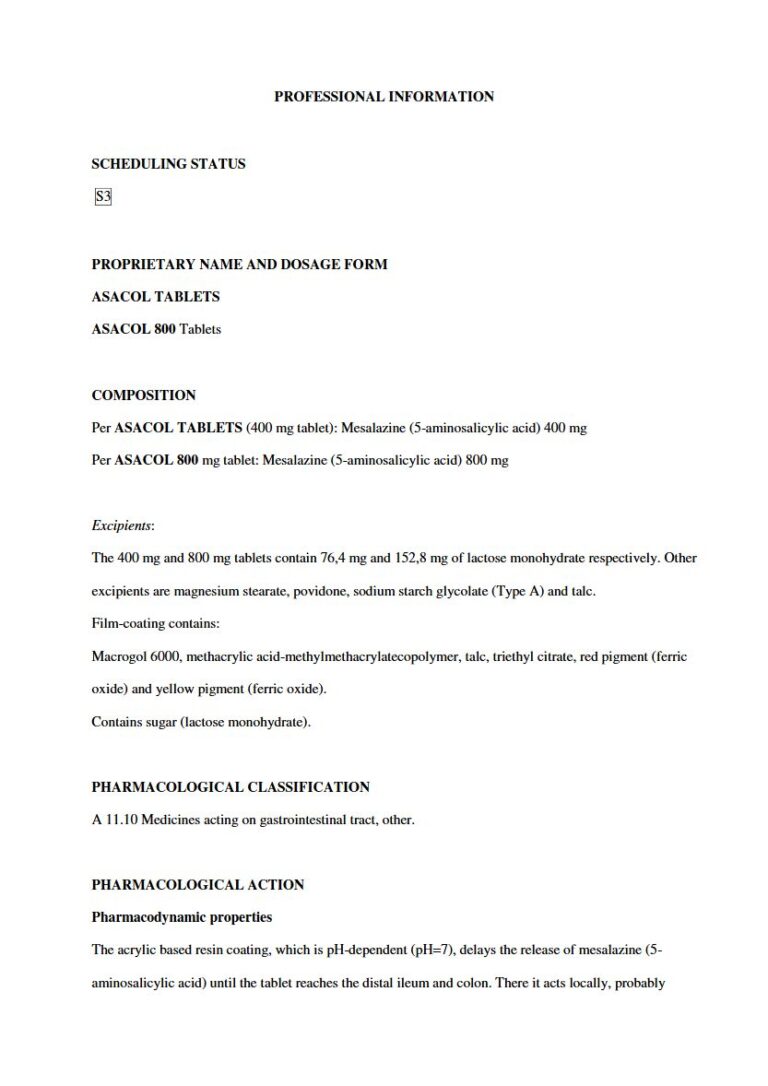
Asacol Tablets
Clinical Summary
Quick overview from the medicine insert
Indication
Treatment of mild to moderate ulcerative colitis and Crohn's disease.
Dosage (summary)
400 mg to 800 mg taken orally, three times daily, depending on the severity of the condition.
Onset of Action / Duration
Onset of action may take several weeks; full therapeutic effect may take up to 8 weeks.
Special Populations
- Elderly patients
- Patients with renal impairment
- Patients with hepatic impairment
Pregnancy & Breastfeeding
Use during pregnancy only if clearly needed; caution is advised during lactation as mesalazine is excreted in breast milk.
Key Drug Interactions
- May interact with other medications that affect renal function.
- Caution with NSAIDs due to potential increased risk of renal toxicity.
Contraindications
- Hypersensitivity to mesalazine or any component of the formulation.
- Severe renal impairment.
Common side effects
- Abdominal pain
- Diarrhea
- Nausea
- Headache
- Rash
Counselling Points
- Take with food to minimize gastrointestinal upset.
- Ensure adequate hydration during treatment.
- Report any signs of allergic reactions or severe gastrointestinal symptoms.
Serious warnings
- Monitor renal function regularly during treatment.
- Use with caution in patients with a history of asthma or hypersensitivity.
Important Disclaimer
The Asacol Tablets professional information leaflet below is the property of Equity Pharmaceuticals and is provided on Medinsert exactly as issued, with no.. alterations or editorial changes. We make every effort to keep content current by updating documents as soon as new versions become available. Medinsert serves as a trusted access point for healthcare professionals, but does not replace official sources or clinical judgement. For more details, please read our full disclaimer. read more>>
 Healthcare Professionals Only
This content is for registered healthcare professionals
Sign in or create a free account to read the full package insert.
Free for HPCSA-registered professionals. Powered by Medinsert.
Clinical Particulars
Section 4 of the official insert — extracted exactly as issued, no alterations
4.1 Therapeutic indications
Ulcerative Colitis : ASACOL is used for the treatment and maintenance of remission in ulcerative colitis.
4.2 Posology and method of administration
The tablets should be swallowed whole with a glass of water one hour before food intake. They must not be chewed, crushed or broken before swallowing. If one or more doses have been missed, the next dose is to be taken as usual.
ADULTS: Ulcerative Colitis: ASACOL 400 mg: Induction of remission : 2,4 g (six tablets) once daily or divided in 2 - 3 times daily. If required, the dose may be increased to 4,8 g (twelve tablets) divided in 2 - 3 times daily. 2,4 g may be taken once daily or in divided doses. Above 2,4 g should be taken in divided doses. Maintenance of remission : 1,6 to 2,4 g (4 to 6 tablets) once daily or divided in 2 - 3 times daily. The dose can be adjusted in accordance with the response to the treatment.
ASACOL 800 mg: u2022 Mild acute disease : 2,4 g (three tablets) once daily or divided in 2 - 3 times daily, with concomitant corticosteroid therapy where clinically indicated. u2022 Moderate acute disease : 2,4 g to 4,8 g (three to six tablets) divided in 2 - 3 times daily, with concomitant corticosteroid therapy where clinically indicated. 2,4 g may be taken once daily or in divided doses. Above 2,4 g should be taken in divided doses. u2022 Maintenance therapy : 1,6 g to 2,4 g (two to three tablets) taken once daily or in divided doses. The maximum adult dose should not exceed six tablets a day and not exceed 3 tablets taken together at any one time.
ELDERLY: The normal adult dosage may be used unless renal or liver function is severely impaired (see CONTRAINDICATIONS and WARNINGS AND SPECIAL PRECAUTIONS).
4.3 Contraindications
Hypersensitivity to mesalazine or to any of the other ingredients of ASACOL tablets
Sensitivity to salicylates
Severe renal impairment (GFR less than 30 mu2113 per minute)
Severe liver impairment
Gastric and duodenal ulcers
Bleeding tendency
4.4 Special warnings and precautions for use
Blood tests (differential blood count, liver function parameters such as ALT or AST; serum creatinine) and urinary status (dip sticks) should be determined prior to and during treatment, at the discretion of the treating medical practitioner. As a guideline, follow-up tests are recommended 14 days after commencement of treatment and then every 4 weeks for the following 12 weeks. If the findings are normal, follow-up tests should be carried out every three months. If additional signs appear, these tests should be performed immediately.
Renal impairment: Not recommended in patients with renal impairment. Caution should be exercised in patients with a raised blood urea or proteinuria. The possibility of ASACOL-induced nephrotoxicity should be suspected in patients developing impairment of renal function during treatment. Treatment with ASACOL should be stopped immediately if there is evidence of renal impairment and patients should seek immediate medical advice.
Liver impairment: There have been reports of increased liver enzyme levels in patients taking ASACOL. Caution is advised if ASACOL is given to patients with liver impairment (see CONTRAINDICATIONS).
Blood dyscrasia: Serious blood dyscrasia has been reported. Treatment with ASACOL should be stopped immediately if a blood dyscrasia (signs of unexplained bleeding, haematoma, purpura, anaemia, persistent fever or sore throat) is suspected or present and patients should seek immediate medical advice (see SIDE EFFECTS).
Pulmonary disease: Patients with pulmonary disease, in particular asthma, should be very carefully monitored during a course of treatment with ASACOL tablets.
Cardiac hypersensitivity reactions: Mesalazine-induced cardiac hypersensitivity reactions (myo- and pericarditis) have been reported with ASACOL. In case of previous mesalazine-induced cardiac hypersensitivity ASACOL must not be reintroduced. Caution should be used in patients with previous myo- or pericarditis of allergic background regardless of its origin.
Hypersensitivity to Sulphasalazine: In patients with a history of hypersensitivity to sulphasalazine, therapy should be initiated only under close medical supervision. Treatment must be stopped immediately if acute symptoms of intolerance occur such as cramps, abdominal pain, fever, severe headache or rash.
Tablets in stool: A limited number of reports of intact tablets in the stool have been received. What appear to be intact tablets may in some cases represent largely empty shells of the tablet coating. ASACOL tablets release their content in the lower gut even if the coating does not dissolve entirely. Once pH 7,0 is reached, cracks in the coating are sufficient for the release of mesalazine from the tablets. This process is irreversible from here on and mesalazine will therefore be released continuously, independent of intestinal pH. If tablets are observed in the stool repeatedly, the patient should consult his/her medical practitioner.
Elderly patients: Use in elderly patients should be handled with caution and ASACOL should only be prescribed to patients having a normal renal and hepatic function (see CONTRAINDICATIONS).
Paediatric patients: There is only limited documentation for an effect in children (age 6 - 18 years).
Gastric and duodenal ulcers: In case of existing gastric or duodenal ulcers treatment should begin with caution based on theoretical grounds.
Co-administration of immunosuppressive agents such as azathioprine or 6-MP can precipitate leucopenia (see INTERACTIONS).
Concurrent use of NSAIDs or azathioprine may increase the risk of renal reactions (see INTERACTIONS).
4.5 Interactions with other medicines
ASACOL should not be given with preparations which lower stool pH, e.g. lactulose, and which prevent release of the active ingredient.
Sulphasalazine decreases the absorption of digoxin. There are no data on interaction of digoxin with ASACOL.
There is weak evidence that ASACOL might decrease the anticoagulant effect of warfarin, frequent INR monitoring is advisable.
ASACOL can increase the immunosuppressive effects of azathioprine, 6-mercaptopurine or thioguanine. Life-threatening infection can occur. Patients should be closely observed for signs of infection and immunosuppression. Haematological parameters, such as leukocyte and lymphocyte cell counts should be monitored regularly (weekly), especially at initiation of such combination therapy (see WARNINGS AND SPECIAL PRECAUTIONS). If white blood cells are stable after 1 month, testing every 4 weeks for the following 12 weeks followed by 3 monthly monitoring intervals appears to be justified.
The concurrent use of known nephrotoxic medicines, such as NSAIDs or azathioprine, may increase the risk of renal reactions. However, no adverse events proving such interactions have been reported (see WARNINGS AND SPECIAL PRECAUTIONS).
The uricosuric activity of sulfinpyrazone, and the diuretic effect of furosemide can be reduced.
4.6 Fertility, pregnancy and lactation
Safety in pregnancy and lactation has not been established.
4.7 Effects on ability to drive and use machines
ASACOL tablets may influence the ability to drive and use machines. The tablets contain lactose monohydrate. Patients with the rare hereditary conditions of galactose intolerance, e.g. galactosaemia, Lapp lactase deficiency, glucose-galactose malabsorption should not take ASACOL.
4.8 Undesirable effects
Side effects are presented by system organ class according to the following frequencies:
Very common: u2265 10 % patients
Common: u2265 1 % and < 10 % patients
Uncommon: u2265 0,1 % and < 1 % patients
Rare: u2265 0,01 % and < 0,1 % patients
The only very common side effect was headache, which occurred in approximately 17,8 % of patients. The following common side effects were reported: nausea (8,4 %), dyspepsia (7,5 %), abdominal pain (4,3 %), dizziness (4,0 %), rash (2,8 %), vomiting (2,5 %), arthralgia (2,3 %), diarrhoea (1,8 %) and fever (1,7 %).
Tabulated summary of side effects:
System Organ Class Common Uncommon Rare Very rare Frequency not known
Blood and the lymphatic system disorders anaemia eosinophilia (as part of an allergic reaction) altered blood counts (aplastic anaemia, agranulocytosis, pancytopenia, neutropenia, leucopenia, thrombocytopenia) bone marrow depression, blood disorder
Immune system disorders hypersensitivity reactions such as allergic exanthema, drug fever, lupus erythematosus syndrome, pancolitis
Nervous system disorders paraesthesia tinnitus headache, dizziness peripheral neuropathy vertigo
Cardiac disorders myocarditis, pericarditis
Respiratory, thoracic and mediastinal disorders allergic and fibrotic lung reactions (including dyspnoea, cough bronchospasm, alveolitis, pulmonary eosinophilia, lung infiltration, pneumonitis), interstitial pneumonia, eosinophilic pneumonia, lung disorder pleurisy pneumonia, chest pain
Gastrointestinal disorders dyspepsia abdominal pain, diarrhoea, flatulence, nausea, vomiting acute pancreatitis exacerbation of the symptoms of colitis
Hepato-biliary disorders changes in liver function parameters (increase in transaminases and cholestasis parameters), hepatitis, cholestatic hepatitis hepatic function abnormal/ abnormal liver function tests, increased blood bilirubin
Skin and subcutaneous tissue disorders rash pruritus, urticaria photo= sensitivity* alopecia Stevens Johnson syndrome, erythema multiforme, bulbous skin reactions
Musculoskeletal, connective tissue and bone disorders myalgia, arthralgia lupus-like syndrome with pericarditis and pleuropericarditis as prominent symptoms as well as rash and arthralgia
Renal and urinary disorders impairment of renal function including acute and chronic interstitial nephritis, renal insufficiency, nephrotic syndrome and renal failure which may be reversible on early withdrawal
Reproductive system and breast disorders oligospermia (reversible)
General disorders and administrative site conditions pyrexia, chest pain intolerance to mesalazine with C-reactive protein increased and/or exacerbation of symptoms of underlying disease
Investigations increased blood creatinine, amylase, red blood cell sedimentation rate, lipase and BUN decreased weight and creatinine clearance
Description of selected adverse reactions: An unknown number of the above mentioned undesirable effects are probably associated to the underlying IBD rather than ASACOL medicine. This holds true especially for gastrointestinal undesirable effects, arthralgia, and alopecia. To avoid blood dyscrasia resulting from developing bone marrow depression patients should be monitored with care (see WARNINGS AND SPECIAL PRECAUTIONS). Under co-administration of mesalazine contained in ASACOL with myelosuppressive drugs, such as azathioprine, or 6-MP, or thioguanine, life-threatening infection can occur (see INTERACTIONS).
*Photosensitivity: More severe reactions are reported in patients with pre-existing skin conditions such as atopic dermatitis and atopic eczema.
Paediatric population: There is only limited safety experience with the use of ASACOL tablets in the paediatric population. It is expected that the target organs of possible adverse reactions in the paediatric population are the same as for adults (heart, lungs, liver, kidneys, pancreas, skin and subcutaneous tissue).
4.9 Overdose
Symptoms of overdosage include that of salicylism: mixed acidosis-alkalosis, hyperventilation, pulmonary oedema, dehydration as a result of sweating and vomiting, and hypoglycaemia. There is no specific antidote. Treatment is symptomatic and supportive.
