
Abitrexate Tablets
Clinical Summary
Quick overview from the medicine insert
Indication
Treatment of certain types of cancer, severe psoriasis, and rheumatoid arthritis.
Dosage (summary)
Initial dose varies based on condition; typically, 7.5 mg to 25 mg once weekly for rheumatoid arthritis, and higher doses for cancer treatment.
Onset of Action / Duration
Onset of action may take several weeks; full therapeutic effect may take 6 to 8 weeks.
Special Populations
- Elderly patients may have increased sensitivity.
- Patients with renal impairment require dose adjustments.
- Patients with hepatic impairment should be closely monitored.
Pregnancy & Breastfeeding
Methotrexate is contraindicated in pregnancy due to risk of fetal harm; it is also excreted in breast milk and should be avoided during lactation.
Key Drug Interactions
- NSAIDs may increase the risk of methotrexate toxicity.
- Penicillins can decrease renal clearance of methotrexate.
- Live vaccines should be avoided during treatment.
Contraindications
- Pregnancy and lactation.
- Severe renal impairment.
- Active infections.
- Hypersensitivity to methotrexate.
Common side effects
- Nausea and vomiting.
- Mucositis.
- Hepatotoxicity.
- Bone marrow suppression.
- Pulmonary toxicity.
Counselling Points
- Advise patients to maintain adequate hydration.
- Instruct patients to report any signs of infection or unusual bleeding.
- Discuss the importance of regular blood tests to monitor liver function and blood counts.
Serious warnings
- Use with caution in patients with pre-existing liver disease.
- Monitor for signs of pulmonary toxicity.
- Avoid alcohol consumption due to increased risk of liver damage.
Important Disclaimer
The Abitrexate Tablets professional information leaflet below is the property of Teva and is provided on Medinsert exactly as issued, with no.. alterations or editorial changes. We make every effort to keep content current by updating documents as soon as new versions become available. Medinsert serves as a trusted access point for healthcare professionals, but does not replace official sources or clinical judgement. For more details, please read our full disclaimer. read more>>
 Healthcare Professionals Only
This content is for registered healthcare professionals
Sign in or create a free account to read the full package insert.
Free for HPCSA-registered professionals. Powered by Medinsert.
Clinical Particulars
Section 4 of the official insert — extracted exactly as issued, no alterations
4.1 Therapeutic indications
u2022 Lymphoblastic leukaemia in children and meningeal leukemia.
u2022 Choriocarcinoma and related trophoblastic tumours of women.
u2022 Women with non-metastatic trophoblastic disease, hydatidiform mole and chorioadenoma destruens.
u2022 Carcinomas of the breast, tongue, pharynx and testes (in conjunction with chlorambucil and dactinomycin).
u2022 Carcinoma of the lung and osteogenic sarcomas (high dose ABITREXATE with folinic acid rescue).
u2022 Treatment of severe psoriasis (see WARNINGS AND SPECIAL PRECAUTIONS).
u2022 Prevention of graft-versus-host reactions that result from marrow transplantation.
u2022 Dermatomyositis, rheumatoid arthritis (not adequately responding to other therapy), Wegeneru2019s granulomatosis and pityriasis rubra pilaris.
4.2 Posology and method of administration
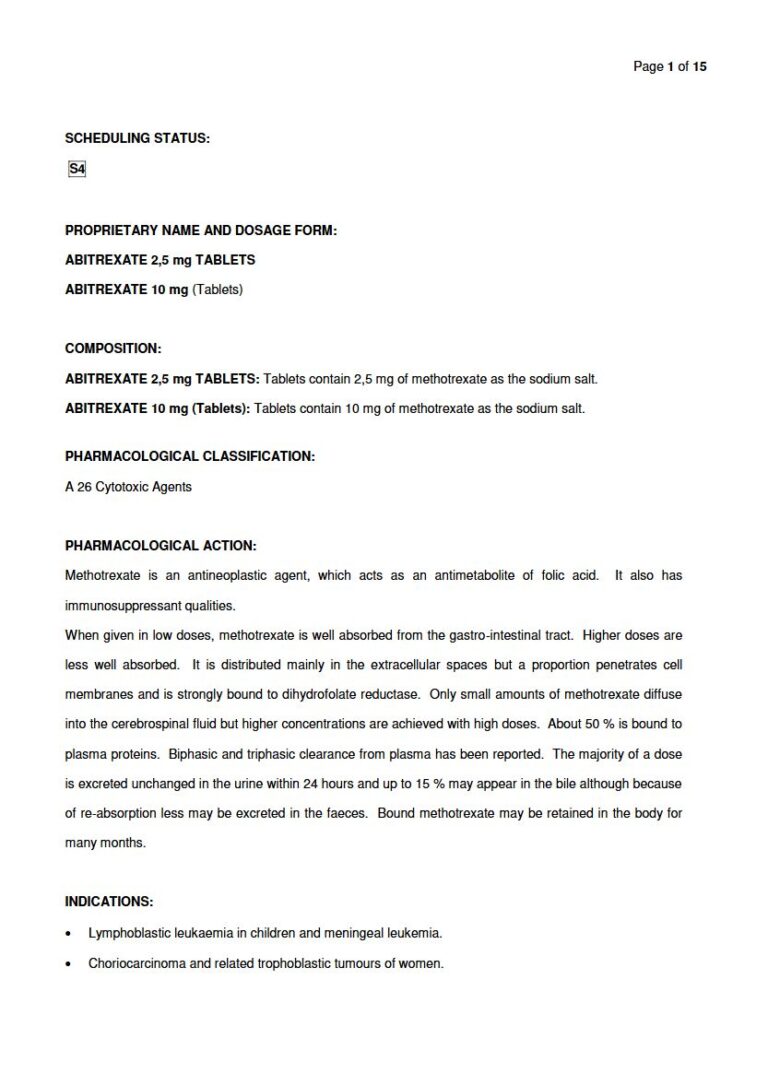
ABITREXATE may be given by mouth. The dose of ABITREXATE, the dosage frequency, the total dose and combination with other cytostatic medicine and/or folinic acid are subject to frequent modification as scientific knowledge improves.
Lymphoblastic leukaemia: When used for induction, ABITREXATE in doses of 3,3 mg/m2 in combination with prednisone 60 mg/m2 given daily produced remission in 50 % of patients treated, usually within a period of 4 to 6 weeks. ABITREXATE alone or in combination with other agents appears to be the medicine of choice for securing maintenance of medicine-induced remissions. When remission is achieved and supportive care has produced general clinical improvement, maintenance therapy is initiated, as follows: ABITREXATE is administered twice weekly either by mouth or intramuscularly in doses of 30 mg/m2. It has also been given in doses of 2,5 mg/kg intravenously every 14 days. If and when relapse does occur, reinduction of remission can again usually be obtained by repeating the initial induction regime.
Meningeal leukaemia: Some patients with leukaemia are subject to leukaemic invasion of the central nervous system. This may manifest characteristic signs or symptoms or may remain silent and be diagnosed only by examination of the cerebrospinal fluid which contains leukaemic cells in such cases. Therefore, the CSF should be examined in all leukaemic patients. Since passage of ABITREXATE from blood serum to the cerebrospinal fluid is minimal, for adequate therapy the medicine is administered intrathecally. A common approach is to treat such patients as may actually manifest leukaemic involvement by direct intrathecal installation of ABITREXATE.
Intrathecal administration: NOTE: For convenience, and to minimize the risk of overdosage, it is recommended that vials containing 50 mg of preservative-free ABITREXATE be used for intrathecal administration. Administration is at intervals of 2 to 5 days and is usually repeated until the cell count of the cerebrospinal fluid returns to normal. At this point one additional dose is advised. Large doses may cause convulsions.
The following dosage regimen is based on age instead of body surface area:
- Age (years) Dose (mg)
- < 1 1
- 2 3 or older 6 8 10 12
Similar doses are given prophylactically to patients with lymphoblastic leukaemia, often in association with cranial irradiation. ABITREXATE in intravenous doses of about 500 mg/m2 followed by folinic acid rescue, may also produce effective concentrations in the CSF.
Choriocarcinoma and similar trophoblastic diseases: Doses of 15 to 30 mg daily by mouth or intramuscularly for 5 days, at intervals of 1 to 2 weeks for 3 to 5 courses. Alternatively, 0,25 to 1 mg per kg body-weight up to a maximum of 60 mg has been given intramuscularly every 48 hours for 4 doses, followed by folinic acid rescue, and repeated at intervals of 7 days. Since hydatidiform mole may precede or be followed by choriocarcinoma, prophylactic chemotherapy with ABITREXATE has been recommended. Chorioadenoma destruens is considered to be an invasive form of hydatidiform mole. ABITREXATE administered in these disease states in doses similar to those recommended for choriocarcinoma.
Breast carcinoma: Prolonged cyclic combination chemotherapy with cyclophosphamide, ABITREXATE and fluorouracil has given good results when used as adjuvant treatment to radical mastectomy in primary breast cancer with positive axillary lymph nodes. ABITREXATE dosage was 40 mg/m2 intravenously on the first and eighth days. Combination chemotherapy may be necessary in patients with metastases. A range of doses of ABITREXATE has been used in the management of solid tumours. Very high doses have been given by intravenous infusion, followed by folinic acid, in patients with osteogenic sarcoma and carcinoma of the lung and the head and neck.
Psoriasis: ABITREXATE has been given by mouth, intramuscularly, and intravenously in the treatment of psoriasis. Single weekly doses of 10 to 25 mg may be given by mouth or injection. Alternatively, 2,5 mg has been administered by mouth every 12 hours for 3 doses or every 8 hours for 4 doses each week or 2,5 mg may be given daily by mouth for 5 days out of 7. High-dose therapy: High dose therapy should be used only by qualified specialists in a suitable hospital setting.
4.3 Contraindications
uf0a7 Hypersensitivity to methotrexate.
uf0a7 ABITREXATE is contraindicated in pregnancy and lactation. (See PREGNANCY AND LACTATION).
uf0a7 ABITREXATE is contraindicated in patients with psoriasis or rheumatoid arthritis with serious renal or liver disorders, bone marrow hypoplasia, leucopenia, thrombocytopenia, anaemia, and alcohol abuse.
uf0a7 Safety and efficacy in children have not been established other than in cancer chemotherapy.
4.4 Special warnings and precautions for use
ABITREXATE should be administered under the supervision of a medical doctor experienced in the use of chemotherapeutic agents. ABITREXATE is an irritant; avoid contact with skin and mucous membranes. While in general a low dose of ABITREXATE is applied in the treatment of psoriasis and rheumatoid arthritis, as compared to the doses used in antineoplastic therapy, intoxication and death may occur. In the treatment of psoriasis and rheumatoid arthritis, ABITREXATE should be restricted to severe recalcitrant, disabling psoriasis which is not adequately responsive to other forms of therapy, but only when the diagnosis has been established by biopsy and/or dermatological consultation. Patients should be fully informed on the risks of ABITREXATE therapy and should be instructed to report any manifestation of toxicity immediately. It is recommended to carry out a liver biopsy in psoriasis and rheumatoid arthritis patients after a total cumulative dose of 1,5 g. Fibrosis of intermediate revering or any cirrhosis usually requires discontinuation of therapy. Although mild changes usually are no reason to avoid or discontinue therapy, ABITREXATE should be used with care in patients. The combined administration of ABITREXATE and other potentially hepatotoxic drugs and alcohol should be avoided. During the use of ABITREXATE the following laboratory tests are generally advised: hemograms, counting of the platelets and haematocrit; renal function tests and urine analysis; liver enzyme determination; chest X-ray is recommended. During the treatment of psoriasis, it is recommended to repeat these tests regularly: monthly haematology, every 1 to 3 months for liver and kidney function. Usually during antineoplastic treatment, a more frequent control procedure is applied. On treatment initiation or a dose modification or during periods with an enhanced risk on increased methotrexate blood levels (e.g. in case of dehydration), a more frequent control is to be done. A relationship between abnormal liver function tests and fibrosis or cirrhosis of the liver has not been established. Transient deviation in liver function tests has often been observed after ABITREXATE administration and usually do not lead to therapy modification. Impairment in liver function just prior to administration and/or serum albumin level decreased may indicate serious liver toxicity and require further examination. Lung function tests may be useful in case an ABITREXATE induced lung disease is suspected, in particular when initial base line values are available. ABITREXATE induced lung disease is a potentially dangerous condition which may occur at any moment during therapy with dosages higher than 7,5 mg weekly. The condition is not always completely reversible. Pulmonary symptoms (in particular a dry, non-productive cough) may require treatment interruption and thorough examination. In the treatment of ABITREXATE induced (interstitial) pneumonitis after immediate discontinuation of therapy, corticosteroid treatment is indicated. In case of occurrence of lung toxicity re-initiation of therapy is contra-indicated. ABITREXATE should be used with extreme care in patients with infection, peptic ulcer, ulcerative colitis, debility and in the very young or aged. Diarrhoea and ulcerative stomatitis require discontinuation of treatment because of the risk of haemorrhagic enteritis and death by intestinal perforation. In case of severe leucopenia occurring during treatment bacterial infections could set in. When infection occurs, discontinuation of ABITREXATE and adequate antibacterial therapy is indicated. In case of severe bone marrow depression blood or thrombocytes transfusion may be necessary. Special care should be taken in the patients with decreased renal function, and with reduced doses, as the ABITREXATE elimination time is increased in renal dysfunction. At the onset of nephrotoxicity also immediate discontinuation of therapy is indicated. During ABITREXATE therapy and until at least three months after treatment with ABITREXATE contraceptive precautions should be taken by both female and male patients. Thus far there are no indications for an increased risk of carcinogenicity in humans undergoing prolonged therapy, such as psoriasis patients. The data on the carcinogenicity risk in case of use of ABITREXATE by rheumatoid arthritis patients are limited. Lymphomas may develop in patients treated with low dose ABITREXATE. Spontaneous remission may occur when ABITREXATE therapy is stopped; therefore, treatment with oncolytics is not necessarily indicated. First, it is necessary to stop ABITREXATE treatment, when this adverse event occurs. If remission fails to appear, an adequate treatment has to be started. ABITREXATE should be used with great care in patients with hepatic or renal impairment. It should also be used cautiously in alcoholics or those with ulcerative disorders of the gastro-intestinal tract. With high-dose regimens, plasma concentrations of ABITREXATE and urinary excretion should be monitored. Precipitation of ABITREXATE or its metabolites in the renal tubules may be prevented by alkalinisation of the urine using sodium bicarbonate, maintaining an adequate urine flow, and the withholding of therapy until pleural or ascitic effusions, which may act as a deport for methotrexate, have been drained. It is essential that examinations of blood and tests of renal and liver function should be made before, during and after each course of treatment with ABITREXATE. If there is a severe fall in the white cell or platelet counts, ABITREXATE should be withdrawn. When concurrent administration of ABITREXATE and radiotherapy takes place there can be an increased risk of necrosis of soft tissue. Periodic evaluation by specific cognitive tests to detect early signs of cognitive impairment is advised in children.
4.5 Interactions with other medicines
The effects of ABITREXATE may be enhanced by concurrent administration of aminobenzoic acid, chloramphenicol, phenylbutazone, phenytoin, probenecid, salicylates, sulphonamides, doxorubicin, bleomycin, cyclophosphamide, aminoglycosides, allopurinol, vincristine, hydrocortisone, prednisone, asparaginase, cytosine arabinoside and tetracyclines. Non-steroidal anti-inflammatory drugs (NSAIDS) should not be administered prior to or simultaneously with high dose ABITREXATE treatment (>10 mg methotrexate per week). Increased serum levels of ABITREXATE have been reported at simultaneous administration of some NSAIDS with high dose ABITREXATE resulting in death by serious haematologic or gastrointestinal toxicity. NSAIDS, salicylates and other weak organic acids, like probenecid, can lower tubular secretion of ABITREXATE resulting in increased toxicity. Use of ABITREXATE with these drugs should be made carefully under strict supervision. The potential toxicity of ABITREXATE is increased in particular at simultaneous use of NSAIDS when also diuretics are used. In rheumatology, a combination therapy of low-dose ABITREXATE and NSAID is commonly used. Care should be taken in combining high dose ABITREXATE with potentially nephrotoxic therapy (e.g. cisplatin). Oral antibiotics (including tetracyclines, chloramphenicol and non-absorbable broad-spectrum antibiotics) may influence the intestinal flora and inhibit ABITREXATE (re) absorption. Interaction with therapeutic radiation may occur. In combination with other cytostatic drugs pharmacodynamic interactions may occur; resulting in increased therapeutic activity and increased toxicity. No vaccination with live virus vaccines should be performed in patients receiving ABITREXATE. Partial or total protection can be obtained through inactivated vaccines. In some cases, a potentiation of the bone marrow suppression in patients treated with ABITREXATE by trimethoprim/sulphamethoxazole has been reported, probably by additional folic acid antagonism. The combined use of ABITREXATE and sulphonamides is therefore strongly advised against. Vitamin preparations containing folic acid or folic acid derivatives may decrease the effect of systemically administered ABITREXATE. Preliminary human and animal studies have shown that after intravenous administration of calcium folinate a small amount penetrates into the cerebrospinal fluid, predominantly as 5-methyltetrahydrofolate, and this amount is a factor 1 to 3 lower than the normal ABITREXATE concentration after intrathecal administration. Nevertheless high doses of calcium folinate may lower the effectivity of intrathecally administered ABITREXATE. Folate deficiencies may increase ABITREXATE toxicity.
4.6 Fertility, pregnancy and lactation
ABITREXATE must not be used during pregnancy and in lactation. See CONTRAINDICATIONS and SIDE EFFECTS (Urogenital and Other disorders).
4.7 Effects on ability to drive and use machines
Not specified in the provided text.
4.8 Undesirable effects
In general, the incidence and severity of acute side effects is related to the dosage and frequency of administration. The most frequent adverse effects are ulcerative stomatitis, leucopenia, nausea and gastrointestinal problems. Other frequently occurring side effects are feeling unwell, inexplicable fatigue, chills and fever, dizziness and reduced resistance to diseases.
The undesirable effects with methotrexate are summarized by organ system.
Gastrointestinal disorders: Frequent: Gingivitis, pharyngitis, stomatitis, anorexia, nausea, vomiting, diarrhoea, heamatemesis, melena, gastrointestinal ulceration, bleeding and enteritis. When vomiting, diarrhoea, or stomatitis occurs, with possible dehydration, ABITREXATE treatment should be discontinued until recovery. ABITREXATE should be used with extreme care in case of peptic ulceration or ulcerative colitis.
Haematological (Blood disorders): Frequent: ABITREXATE may suppress haematopoiesis and cause anaemia, leucopenia and/or thrombocytopenia. In patients with existing haematopoietic insufficiencies ABITREXATE should be used with care, or not at all. In psoriasis, treatment should be discontinued immediately in case of a significant drop in the blood count. In the treatment of neoplasia, ABITREXATE may only be continued if the possible cure justifies the risk of serious myelosuppression. Myelosuppression may also occur after intrathecal administration of ABITREXATE. Patients with serious granulocytopenia and fever should undergo immediate examination and usually require parenteral broad spectrum antibiotics.
Hepato-biliary disorders: Less frequent: ABITREXATE may cause acute (increase in transaminases) or chronic (fibrosis and cirrhosis) hepatotoxicity. Chronic toxicity is potentially lethal. It usually occurs after chronic use (mostly 2 years or longer) and after a total dose of at least 1,5 g. In studies with psoriasis patients, hepatotoxicity appeared to be determined by the total cumulative dose. The effect is potentiated by alcoholism, obesity, diabetes and advanced age. A correct correlation has not yet been determined. Information on progression and reversibility of lesions is not available. Care should be taken in the presence of existing liver damage or decreased liver function. Liver function tests, including serum albumin should be carried out regularly prior to administration. Test results are often normal in cases of fibrosis and cirrhosis. These conditions can only be diagnosed by biopsy. In case of psoriasis and rheumatoid arthritis it is recommended to perform a liver biopsy after a total cumulative dose of 1,5 g. Intermediate fibrosis or any cirrhosis usually prompts discontinuation of the therapy. Although mild changes usually are no reason to avoid or discontinue ABITREXATE treatment, the drug should be used with care.
Immune system disorders: Less frequent: ABITREXATE should be used with extreme care in case of active infection and usually is contra-indicated in patients with immunodeficiency syndromes. During an ABITREXATE treatment immunisation may not be effective. Immunisation with live vaccine is usually not recommended. Disseminated vaccinia infections have been reported after a small pox immunization in patients undergoing ABITREXATE treatment. Hypogammaglobulinaemia has been observed less frequently.
Nervous system disorders: Less frequent: Headache, drowsiness, blurred vision, aphasia, hemiparesis, paresis and convulsions have been reported after ABITREXATE administration. There are reports of leucoencephalopathy after intravenous administration of ABITREXATE to patients who underwent craniospinal irradiation. Neurotoxic reactions are especially associated with the intrathecal use of methotrexate. Chronic leucoencephalopathy was also reported in patients with osteosarcoma who were administered high dosages of ABITREXATE with calcium folinate rescue therapy, even without cranial irradiation. Discontinuation of ABITREXATE treatment does not always result in complete recovery. A transient acute neurological syndrome has been observed in patients who underwent high dose ABITREXATE treatment. The clinical manifestations may consist of abnormal behaviour, focal sensomotoric phenomena, and abnormal reflexes. The exact cause of these symptoms is unknown. After intrathecal administration of ABITREXATE, the possible toxic side effects pertaining to the central nervous system may be classified in the following way: chemical arachnoiditis with symptoms such as headache, backache, neck stiffness and fever; paresis, usually transient, with paraplegia involving one or more spinal nerve roots; leucoencephalopathy with confusion, agitation, somnolence, ataxia, dementia and sometimes serious conclusions.
Respiratory (Pulmonary) disorders: Less frequent: Death by interstitial pneumonitis has been reported and chronic interstitial obstructive lung disease sometimes occurred. Pulmonary symptoms (in particular a dry, non-productive cough) or a non-specific pneumonitis during the ABITREXATE treatment may indicate a potentially dangerous lesion and require discontinuation of the treatment and a thorough examination. Although symptoms may be varying, a patient with ABITREXATE induced lung disease typically shows fever, cough, dyspnoea, hypoxemia and infiltration in lung radiography. An infection should be excluded. This condition may occur at any dosage. ABITREXATE related lung pathology has rarely been described after intrathecal administration of ABITREXATE. At the onset of ABITREXATE induced lung disease, the re-administration of ABITREXATE is contra-indicated.
Urogenital disorders: Frequent: Serious nephropathy or renal insufficiency, azotemia, cystitis and haematuria, defective oogenesis or spermatogenesis, transient oligospermia, menstrual dysfunction and vaginal discharge, infertility, abortion, foetal deviations, suppression of spermatogenesis, loss of libido, and impotence may occur. High dosages of ABITREXATE may cause renal toxicity and acute renal insufficiency. Nephrotoxicity is usually caused by the deposition of ABITREXATE and 7-hydroxymethotrexate in the renal tubuli.
Skin and subcutaneous tissue disorders: Less frequent: Erythema, pruritis, urticaria, photosensitivity, depigmentation, alopecia, ecchymosis, telangiectasia, acne, furunculosis. Psoriatic lesions may worsen by exposure to UV-radiation. Radiation dermatitis and sunburn may flare up by ABITREXATE administration. A few cases of toxic epidermal necrolysis and Steven Johnson syndrome were reported.
Other disorders: Less frequent: Other rare adverse effects related to or ascribed to the use of ABITREXATE are arthralgia/myalgia, diabetes, osteoporosis, lymphomas, opportunistic infections, vasculitis, and sudden death. Incidental cases of anaphylactic reactions have been reported. Also pancytopenia and sudden increase in the number of rheumatoid nodules have been reported in patients with rheumatoid arthritis. Fatalities have occurred. Neurotoxic reactions are especially associated with the intrathecal use of ABITREXATE. Teratogenic effects and foetal deaths have been reported.
4.9 Overdose
See SIDE EFFECTS & WARNINGS AND SPECIAL PRECAUTIONS. Folinic acid neutralises the immediate toxic effect of ABITREXATE on the bone marrow and is given by mouth, intramuscularly, by intravenous bolus injection, or by infusion as calcium folinate. When overdosage is suspected, the dose of calcium folinate should be at least as high as that of ABITREXATE and should be administered within the first hour; further doses are given as required. When average doses of ABITREXATE have an adverse effect, the equivalent of 12 mg of folinic acid may be given intramuscularly every 6 hours for 4 doses. The majority of a dose is excreted unchanged in the urine within 24 hours. Bound ABITREXATE may be retained in the body for many months. Treatment is symptomatic and supportive.
