
Mycophenolate Teva 250 Mg/500 Mg Tablets
PDF Leaflet Revision Date: 29 March 2022
Clinical Summary
Quick overview from the medicine insert
Indication
Prophylaxis of organ rejection in transplant patients.
Dosage (summary)
Adults: 1 g twice daily for renal; 1.5 g twice daily for cardiac and hepatic transplants.
Special Populations
- Elderly
- Renal impairment
- Hepatic impairment
Pregnancy & Breastfeeding
Contraindicated in pregnancy and breastfeeding; teratogenic effects noted.
Key Drug Interactions
- Ciclosporin
- Antibiotics
- Proton pump inhibitors
- Rifampicin
Contraindications
- Hypersensitivity
- Pregnancy
- Breastfeeding
- Women not using contraception
Common side effects
- Diarrhoea
- Leucopenia
- Sepsis
- Vomiting
Counselling Points
- Use effective contraception
- Report signs of infection
- Avoid live vaccines
Serious warnings
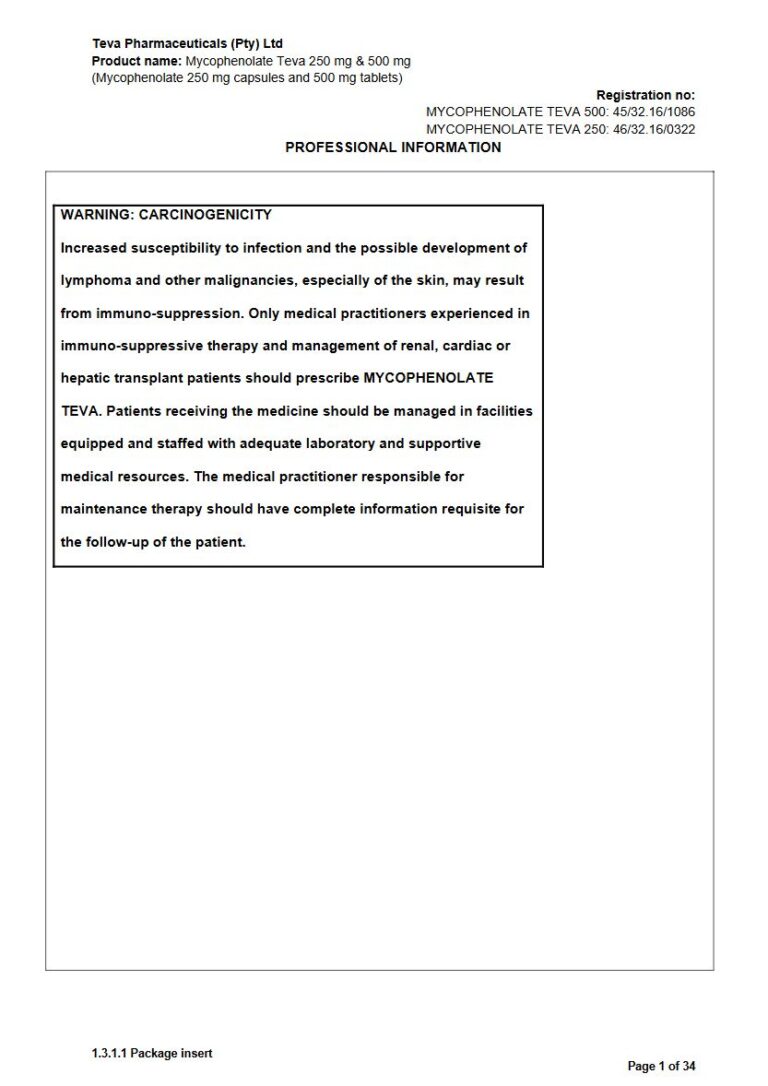
- Increased risk of malignancies
- Opportunistic infections
- Teratogenic effects
Important Disclaimer
The Mycophenolate Teva 250 Mg/500 Mg Tablets professional information leaflet below is the property of Teva Pharmaceuticals and is provided on Medinsert exactly as issued, with no.. alterations or editorial changes. We make every effort to keep content current by updating documents as soon as new versions become available. Medinsert serves as a trusted access point for healthcare professionals, but does not replace official sources or clinical judgement. For more details, please read our full disclaimer. read more>>
 Healthcare Professionals Only
This content is for registered healthcare professionals
Sign in or create a free account to read the full package insert.
Free for HPCSA-registered professionals. Powered by Medinsert.
Clinical Particulars
Section 4 of the official insert — extracted exactly as issued, no alterations
4.1 Therapeutic indications
MYCOPHENOLATE TEVA is indicated for the prophylaxis of organ rejection in patients receiving allogeneic renal, hepatic or cardiac transplants. MYCOPHENOLATE TEVA should be used concomitantly with ciclosporin and corticosteroids.
4.2 Posology and method of administration
Posology:
Dosage for prophylaxis of renal rejection:
Adults: The initial dose of MYCOPHENOLATE TEVA should be given orally, within 72 hours following transplantation. The recommended dose is 1,0 g, administered twice a day (daily dose of 2 g) is recommended for renal transplant patients. Although a dose of 1,5 g, administered twice daily (daily dose of 3 g), was used in clinical trials and was shown to be safe and effective, no efficacy advantage could be established for renal transplant patients. Patients receiving 2 g per day of MYCOPHENOLATE TEVA, demonstrated an overall better safety profile than patients receiving 3 g per day of MYCOPHENOLATE TEVA.
Children (aged 3 months to 18 years): Patients with a body surface area of 1,25 to 1,5 m2 may be prescribed MYCOPHENOLATE TEVA capsules at a dose of 750 mg twice daily (1,5 g daily dose). Patients with a body surface area > 1,5 m2 may be prescribed MYCOPHENOLATE TEVA tablets at a dose of 1 g twice daily (2 g daily dose).
Standard dosage for prophylaxis of cardiac rejection:
Adults: A dose of 1,5 g administered orally, twice a day (daily dose of 3 g), is recommended for use in cardiac transplant patients. The initial dose should be given within 5 days following transplantation.
Children: No data are available for paediatric cardiac transplant patients.
Standard dosage for prophylaxis of hepatic rejection:
Adults: Administration should be initiated as soon as possible after transplantation. A dose of 1,5 g administered orally, twice a day (daily dose of 3 g), is recommended for use in hepatic transplant patients.
Children: No data are available for paediatric hepatic transplant patients.
Standard dosage for treatment of first or refractory renal rejection:
Adults: A dose of 1,5 g administered orally, twice a day (daily dose of 3 g), is recommended for management of first or refractory renal rejection.
Children: No data are available for treatment of first or refractory renal rejection in paediatric renal transplant patients.
Special dosage instructions:
Use in severe renal impairment: In patients with severe chronic renal impairment (glomerular filtration rate < 25 ml/min/1,73 m2), outside of the immediate post-transplant period, doses greater than 1 g, administered twice a day, should be avoided. These patients should also be carefully observed. No data are available for cardiac or hepatic transplant patients with severe chronic renal impairment.
Patients with delayed renal graft function post-transplant: No dose adjustments are needed in patients experiencing delayed renal graft function post-operatively.
Patients with hepatic impairment: No dose adjustments are needed for renal transplant patients with severe hepatic parenchymal disease. No data are available for cardiac transplant patients with severe hepatic parenchymal disease.
Elderly: The recommended dose of 1 g, administered twice a day for renal transplant patients and 1,5 g twice a day for cardiac and hepatic transplant patients, is appropriate for elderly patients. See section 4.4.
Other considerations for use: If neutropenia develops (absolute neutrophil count < 1,3 x 10³/u03bcl), dosing with MYCOPHENOLATE TEVA should be interrupted or the dose reduced.
Method of administration: MYCOPHENOLATE TEVA tablets and capsules should be taken on an empty stomach. Because mycophenolate mofetil has demonstrated teratogenic effects in rats and rabbits, MYCOPHENOLATE TEVA tablets and capsules should not be crushed or opened, to avoid inhalation or direct contact with skin or mucous membranes of the powder contained in MYCOPHENOLATE TEVA tablets/capsules. If such occurs, wash thoroughly with soap and water; rinse eyes with plain water.
4.3 Contraindications
- Hypersensitivity to mycophenolate mofetil or mycophenolic acid or any of the excipients of MYCOPHENOLATE TEVA.
- Pregnancy and breastfeeding.
- Women of childbearing potential not using highly effective methods of contraception.
- Women of childbearing potential without providing a pregnancy test result to rule out unintended use in pregnancy.
4.4 Special warnings and precautions for use
Malignancies: Patients treated with MYCOPHENOLATE TEVA as part of an immuno-suppressive regimen have an increased risk of developing lymphomas and other malignancies, particularly of the skin. The risk seems to be related to both the intensity and duration of immuno-suppression rather than to the use of any specific medicine. (See boxed warning included at the start of the package insert). Lymphoproliferative disease or lymphoma developed in 0,6 % of patients receiving mycophenolate (2 g or 3 g daily) in combination with other immunosuppressants in controlled clinical trials of renal (2 g data), cardiac and hepatic transplant patients followed for at least 1 year. Non-melanoma skin carcinomas occurred in 3,6 % of patients; other types of malignancy occurred in 1,1 % of patients. To minimise any risk of skin cancer, exposure to sunlight and UV light should be limited by wearing protective clothing and using sunscreen with a high protection factor.
Opportunistic infections: Patients on MYCOPHENOLATE TEVA are at increased risk of opportunistic infections; the risk increased with total immunosuppressive load. Such infections include latent viral reactivation, such as hepatitis B or hepatitis C reactivation and infections caused by polyomaviruses (BK virus associated nephropathy, JC virus associated progressive multifocal leukoencephalopathy PML). Cases of hepatitis due to reactivation of hepatitis B or hepatitis C have been reported in carrier patients treated with immunosuppressants. These infections are often related to a high total immunosuppressive burden and may lead to serious or fatal conditions that physicians should consider in the differential diagnosis in immunosuppressed patients with deteriorating renal function or neurological symptoms. MYCOPHENOLATE TEVA has a cytostatic effect on B- and T-lymphocytes, therefore an increased severity of COVID-19 may occur, and appropriate clinical action should be considered.
The most common opportunistic infections in patients receiving mycophenolate (2 g or 3 g daily) with other immunosuppressants in controlled clinical trials of renal (2 g data), cardiac and hepatic transplant patients followed for at least 1 year were candida mucocutaneous, cytomegalovirus (CMV) viraemia/syndrome and Herpes simplex. The proportion of patients with CMV viraemia/syndrome was 13,5 %. There have been reports of hypogammaglobulinaemia in association with recurrent infections in patients receiving mycophenolate mofetil as contained in MYCOPHENOLATE TEVA in combination with other immunosuppressants. In some of these cases switching MYCOPHENOLATE TEVA to an alternative immunosuppressant resulted in serum IgG levels returning to normal. Patients on MYCOPHENOLATE TEVA who develop recurrent infections should have their serum immunoglobulins measured. In cases of sustained, clinically relevant hypogammaglobulinaemia, appropriate clinical action should be considered taking into account the potent cytostatic effects that mycophenolic acid has on T- and B- lymphocytes. There have been published reports of bronchiectasis in adults and children who received mycophenolate mofetil as in MYCOPHENOLATE TEVA in combination with other immunosuppressants. In some of these cases switching mycophenolate mofetil to another immunosuppressant resulted in improvement in respiratory symptoms. The risk of bronchiectasis may be linked to hypogammaglobulinaemia or to a direct effect on the lung. There have also been isolated reports of interstitial lung disease and pulmonary fibrosis, some of which were fatal (see section 4.8). It is recommended that patients who develop persistent pulmonary symptoms, such as cough and dyspnoea, are investigated.
Blood and immune system: Patients treated with MYCOPHENOLATE TEVA should be closely monitored for neutropenia. The development of neutropenia can possibly be related to treatment with MYCOPHENOLATE TEVA, the use of concomitant medicines, viral infections, or a combination of these causes. Cytopenias, including leucopenia, anaemia, thrombocytopenia and pancytopenia, are known risks associated with MYCOPHENOLATE TEVA and may lead or contribute to the occurrence of infections and haemorrhages. Agranulocytosis and neutropenia have been reported; therefore, regular monitoring of patients taking MYCOPHENOLATE TEVA is advised. Patients treated with MYCOPHENOLATE TEVA should have complete blood counts done, weekly during the first month, twice monthly for the second and third months of treatment, then monthly throughout the first year of treatment. If neutropenia develops (absolute neutrophil count < 1,3 x 10³/u03bcl) dosing with MYCOPHENOLATE TEVA should be interrupted, or the dose of MYCOPHENOLATE TEVA should be reduced, and these patients should be monitored carefully. Cases of pure red cell aplasia (PRCA) have been reported in patients treated with mycophenolate mofetil as in MYCOPHENOLATE TEVA in combination with other immunosuppressants. The mechanism for mycophenolate mofetil induced PRCA is unknown. PRCA may resolve with dose reduction or cessation of MYCOPHENOLATE TEVA therapy. Changes to MYCOPHENOLATE TEVA therapy should only be undertaken under appropriate supervision in transplant recipients in order to minimise the risk of graft rejection (see section 4.8). Isolated cases of abnormal neutrophil morphology, including the acquired Pelger-Huet anomaly, have been observed in patients treated with mycophenolate mofetil. These changes are not associated with impaired neutrophil function. These changes may suggest a u2018left shiftu2019 in the maturity of neutrophils in haematological investigations, which may be mistakenly interpreted as a sign of infection in immunosuppressed patients such as those that receive MYCOPHENOLATE TEVA.
Patients treated with MYCOPHENOLATE TEVA should be instructed to immediately report any evidence of infection, unexpected bruising, bleeding, or any other manifestation consistent with bone marrow depression that they may experience.
Live vaccinations: Patients should be made aware that during treatment with MYCOPHENOLATE TEVA, vaccinations may be less effective and the use of live attenuated vaccines should be avoided due to the increased risk of infection. Influenza vaccination with killed virus may be of value.
Gastrointestinal disorders: Patients with active serious digestive system disease should be treated with caution with MYCOPHENOLATE TEVA due to the increased risk of digestive system adverse events, including infrequent cases of gastrointestinal ulceration, haemorrhage or perforation associated with MYCOPHENOLATE TEVA administration. Mouth, oesophageal, gastric, duodenal, and intestinal ulcers often complicated by haemorrhage, as well as hematemesis, melaena, and haemorrhagic forms of gastritis and colitis have been reported. Endoscopic investigation of patients with mycophenolate mofetil-related diarrhoea have revealed isolated cases of intestinal villous atrophy. MYCOPHENOLATE TEVA should be avoided in patients with rare hereditary deficiency of hypoxanthine-guanine phosphoribosyl-transferase (HGPRT) such as Lesch-Nyhan and Kelley-Seegmillar syndrome as mycophenolic acid (MPA) is a selective, non-competitive and reversible inhibitor of inosine monophosphate dehydrogenase (IMPDH).
Renal impairment: In renal transplant patients with severe chronic renal impairment administration of doses greater than 1 g twice daily should be avoided and they should be carefully monitored. No dosage adjustment is recommended in patients with delayed renal graft function post-transplant, however, they should be carefully monitored as increased mycophenolic acid glucuronide (MPAG) concentrations have been reported as well as increased incidence of some adverse events (anaemia, thrombocytopenia, hyperkalaemia) as compared with patients without delayed graft function.
4.5 Interactions with other medicines
Caution should be exercised when switching combination therapy from regimens containing immunosuppressants, which interfere with MPA enterohepatic recirculation e.g. ciclosporin to others devoid of this effect e.g. tacrolimus, sirolimus, belatacept, or vice versa, as this might result in changes of MPA exposure. Medicines which interfere with MPAu2019s enterohepatic cycle (e.g. cholestyramine, antibiotics), should be used with caution due to their potential to reduce the plasma level and efficacy of MYCOPHENOLATE TEVA (see also section 4.5). Therapeutic monitoring of MPA may be appropriate when switching combination therapy (e.g. from ciclosporin to tacrolimus or vice versa) or to ensure adequate immunosuppression in patients with high immunological risk (e.g. risk of rejection, treatment with antibiotics, addition or removal of an interacting medicine). It is recommended that MYCOPHENOLATE TEVA should not be administered concomitantly with azathioprine because such concomitant administration has not been studied. The risk/benefit ratio of MYCOPHENOLATE TEVA in combination with tacrolimus or sirolimus has not been established (see also section 4.5).
4.6 Fertility, pregnancy and lactation
MYCOPHENOLATE TEVA is contraindicated in pregnancy and in breastfeeding mothers. MYCOPHENOLATE TEVA therapy must not be initiated until a negative pregnancy test has been obtained to rule out unintended use in pregnancy. Women of childbearing potential should use two reliable forms of contraception simultaneously, including at least one highly effective method, before beginning MYCOPHENOLATE TEVA therapy, during therapy, and for six weeks following discontinuation of therapy; unless abstinence is the chosen method of contraception. Two complementary forms of contraception simultaneously are preferred. Sexually active men are recommended to use condoms during treatment with MYCOPHENOLATE TEVA and for at least 90 days after cessation of MYCOPHENOLATE TEVA treatment. Condom use applies both for reproductively competent and vasectomised men; because the risks associated with the transfer of seminal fluid also apply to men who have had a vasectomy. Female partners of male patients are recommended to use highly effective contraception during treatment and for a total of 90 days after the last dose of MYCOPHENOLATE TEVA. (See boxed warning at the start of this leaflet). Patients should be instructed to consult their medical practitioner immediately should pregnancy occur. Female patients of reproductive potential must be made aware of the increased risk of pregnancy loss and congenital malformations at the beginning of MYCOPHENOLATE TEVA treatment and must be counselled regarding pregnancy prevention and planning. Before starting MYCOPHENOLATE TEVA, women of childbearing potential should have two negative serum or urine pregnancy tests with a sensitivity of at least 25 mIU/ml in order to exclude unintended exposure of the embryo to mycophenolate. It is recommended that the second test should be performed 8-10 days after the first test. For transplants from deceased donors, if it is not possible to perform two tests 8-10 days apart before treatment starts (because of the timing of transplant organ availability), a pregnancy test must be performed immediately before starting treatment and a further test performed 8-10 days later. Pregnancy tests should be repeated as clinically required (e.g. after any gap in contraception is reported). Results of all pregnancy tests should be discussed with the patient. MYCOPHENOLATE TEVA is powerfully teratogenic and mutagenic. Congenital malformations and spontaneous abortions have been reported with use of mycophenolate in pregnancy. The following malformations were reported:
- facial malformations such as cleft lip, cleft palate, micrognathia and hypertelorism of the orbits
- abnormalities of the ear (e.g. abnormally-formed or absent external/middle ear), external auditory canal atresia (middle ear) and eye (e.g. coloboma, microphthalmos)
- malformations of the fingers (e.g. polydactyly, syndactyly, brachydactyly)
- cardiac abnormalities such as atrial and ventricular septal defects
- oesophageal malformations (e.g. oesophageal atresia)
- nervous system malformations (such as spina bifida)
- renal abnormalities.
- microphthalmia;
- congenital choroid plexus cyst;
- septum pellucidum agenesis;
- olfactory nerve agenesis.
4.7 Effects on ability to drive and use machines
MYCOPHENOLATE TEVA frequently causes dizziness and somnolence and may also cause confusion, tremor and hypotension. Therefore, patients should be advised not to drive, operate complex machinery or engage in other potentially hazardous activities until it is known whether MYCOPHENOLATE TEVA affects their ability to perform these activities.
4.8 Undesirable effects
The principal adverse reactions associated with the administration of MYCOPHENOLATE TEVA include diarrhoea, leucopenia, sepsis and vomiting and there is evidence of a higher frequency of certain types of infections. See section 4.4. The following has been reported for MYCOPHENOLATE TEVA when used in combination with ciclosporin and corticosteroids:
SYSTEM ORGAN CLASS FREQUENCY ADVERSE EVENTS
Infections and infestations Frequent Sepsis, gastrointestinal candidiasis, urinary tract infection, herpes simplex, herpes zoster, pneumonia, influenza, respiratory tract infection, respiratory moniliasis, gastrointestinal infection, candidiasis, gastroenteritis, infection, bronchitis, pharyngitis, sinusitis, fungal skin infections, skin candida, vaginal candidiasis, rhinitis, abscess, cellulitis, bacterial infections, fungal infections, viral infections
Less frequent Protozoal infections
Neoplasms benign, malignant and unspecified (incl. cysts and polyps) Frequent Skin cancer, benign neoplasm of skin, non-melanoma skin carcinomas, cysts (including lymphocele and hydrocele)
Less frequent Lymphoma, lymphoproliferative disorder
Blood and lymphatic system disorders Frequent Leucopenia, thrombocytopenia, anaemia (including hypochromic anaemia), pancytopenia, leucocytosis, haemorrhage, ecchymosis, polycythaemia, petechial, increased prothrombin time, increased thromboplastin time
Less frequent Pure red cell aplasia, bone marrow failure, pseudolymphoma
Immune system disorders Frequent Hypersensitivity
Less frequent Hypogammaglobulinaemia
Endocrine disorders Frequent Diabetes mellitus, parathyroid disorder (elevated PTH level), Cushingu2019s syndrome, hypothyroidism
Metabolism and nutrition disorders Frequent Acidosis, hyperkalaemia, hypokalaemia, hyperglycaemia, hypomagnesaemia, hypocalcaemia, hypercholesterolaemia, hyperlipidaemia, hypophosphataemia, hyperuricaemia, gout, anorexia, weight decreased, elevated blood urea, elevated creatinine, elevated enzyme levels (lactic dehydrogenase, AST and ALT), hypervolaemia, hyponatraemia, hypoproteinaemia, dehydration, alkalosis, hypochloraemia, hypoxia, respiratory acidosis, thirst
Psychiatric disorders Frequent Agitation, confusional state, depression, anxiety, abnormal thinking, insomnia, emotional lability, hallucinations, delirium, psychosis
Nervous system disorders Frequent Convulsion, hypertonia, tremor, somnolence, myasthenic syndrome, dizziness, headache, paraesthesia, dysgeusia, neuropathy, vertigo, hyperaesthesia
Eye disorders Frequent Amblyopia, cataract, conjunctivitis, abnormal vision, eye haemorrhage
Ear and labyrinth disorders Frequent Ear pain, deafness, tinnitus
Cardiac disorders Frequent Tachycardia, dysrhythmia, bradycardia, cardiac failure, pericardial effusion, angina pectoris, atrial fibrillation, cardiac arrest, pulmonary hypertension
Vascular disorders Frequent Hypotension, hypertension, vasodilatation, postural hypotension, thrombosis, syncope, vasospasm, increased venous pressure
Less frequent Lymphocele
Respiratory, thoracic and mediastinal disorders Frequent Pleural effusion, dyspnoea, cough, asthma, atelectasis, pulmonary oedema
Less frequent Bronchiectasis, interstitial lung disease, pulmonary fibrosis
Gastrointestinal disorders Frequent Vomiting, abdominal pain, diarrhoea, nausea, gastrointestinal haemorrhage, peritonitis, ileus, colitis, gastric ulcer, duodenal ulcer, gastritis, oesophagitis, stomatitis, constipation, dyspepsia, flatulence, enlarged abdomen, hernia, oral moniliasis, cholangitis, gingivitis, gum hyperplasia, melaena, dysphagia, mouth ulceration, rectal disorder, decreased appetite, abdominal distension
Less frequent Eructation, pancreatitis
Hepatobiliary disorders Frequent Hepatitis, jaundice, hyperbilirubinaemia, ascites, blood alkaline phosphatase increased, hepatic enzyme increased, blood lactate dehydrogenase increased
Skin and subcutaneous tissue disorders Frequent Skin hypertrophy (including actinic keratosis), rash, acne, alopecia, pruritus, sweating, hirsutism, skin ulcer, facial oedema
Musculoskeletal and connective tissue disorders Frequent Arthralgia, pelvic pain, neck pain, leg cramps, myalgia, osteoporosis, muscular weakness
Renal and urinary disorders Frequent Renal impairment, haematuria, renal tubular necrosis, abnormal kidney function (decrease in renal function, elevated serum creatinine), oliguria, albuminuria, dysuria, hydronephrosis, pyelonephritis, urinary frequency, nocturia, renal failure, urinary incontinence, urinary retention, scrotal oedema, blood creatinine increased, blood urea increased, renal impairment
Reproductive system and breast disorders Frequent Impotence
General disorders and administration site conditions Frequent Oedema, pyrexia, chills, pain (includes abdominal, back and chest), malaise, asthenia, pallor, hernia
Less frequent De novo purine synthesis inhibitors-associated acute inflammatory syndrome.
4.9 Overdose
Overdosage with MYCOPHENOLATE TEVA may result in over suppression of the immune system and increase susceptibility to infections and bone marrow suppression. If neutropenia develops, dosing with MYCOPHENOLATE TEVA should be interrupted or the dose reduced (see section 4.4). MPA cannot be removed by haemodialysis. However, at high MPAG plasma concentrations (> 100 mg/ml) small amounts of MPAG are removed. MPA can be removed by bile acid sequestrants, such as cholestyramine which would increase excretion of MYCOPHENOLATE TEVA.
