
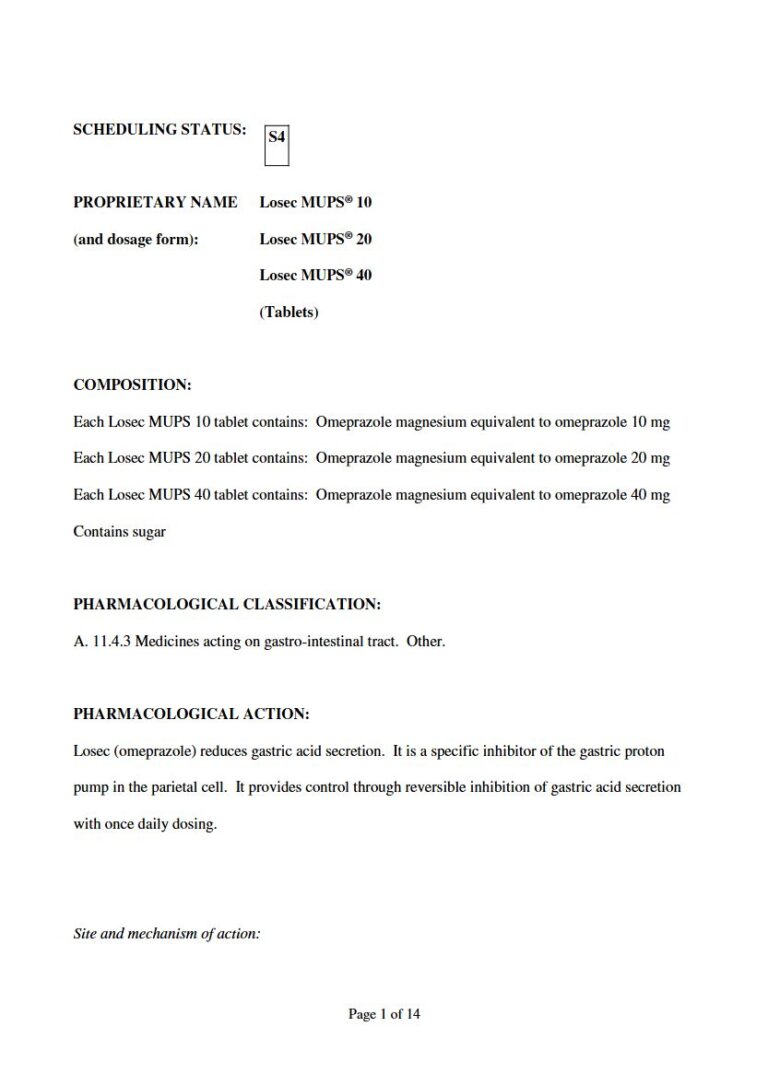
Losec 10mg. 20mg. 40mg Tablet
PDF Leaflet Revision Date: 28 March 2002
Clinical Summary
Quick overview from the medicine insert
Indication
Treatment of duodenal and gastric ulcers, reflux oesophagitis, and H. pylori eradication.
Dosage (summary)
20 mg once daily for duodenal ulcer; 10-40 mg for other indications.
Onset of Action / Duration
Onset: 4 days, Duration: 24 hours
Special Populations
- Elderly
- Impaired renal function
- Impaired hepatic function
Pregnancy & Breastfeeding
Safety in pregnancy and lactation not established.
Key Drug Interactions
- Warfarin
- Phenytoin
- Diazepam
- Ketoconazole
- Itraconazole
Contraindications
- Hypersensitivity to ingredients
Common side effects
- Diarrhoea
- Headache
- Skin rash
- Nausea
- Abdominal pain
Counselling Points
- Take in the morning with water
- Do not chew or crush tablets
- Monitor for severe side effects
Serious warnings
- May mask symptoms of malignancy
- Not for mild gastrointestinal complaints
Important Disclaimer
The Losec 10mg. 20mg. 40mg Tablet professional information leaflet below is the property of Astrazeneca Pharmaceuticals and is provided on Medinsert exactly as issued, with no.. alterations or editorial changes. We make every effort to keep content current by updating documents as soon as new versions become available. Medinsert serves as a trusted access point for healthcare professionals, but does not replace official sources or clinical judgement. For more details, please read our full disclaimer. read more>>
 Healthcare Professionals Only
This content is for registered healthcare professionals
Sign in or create a free account to read the full package insert.
Free for HPCSA-registered professionals. Powered by Medinsert.
Clinical Particulars
Section 4 of the official insert — extracted exactly as issued, no alterations
4.1 INDICATIONS
Adults: Losec MUPS tablets are indicated for the treatment of duodenal ulcer including prevention of relapse, gastric ulcer, reflux oesophagitis, including long term management of patients with reflux oesophagitis, Zollinger-Ellison Syndrome, and for the symptomatic relief of heartburn in patients with gastroesophageal reflux disease and the short term relief of functional dyspepsia.
Losec MUPS tablets are indicated for H. pylori-positive duodenal ulcers, as part of the eradication programme with appropriate antibiotics.
Treatment of NSAID associated gastric and/or duodenal ulcer and erosions and a reduction of the risk to develop gastric and/or duodenal ulcer/erosions and a risk of reduction for relapse of a previously healed gastric and/or duodenal ulcer/erosions in patients on NSAIDs treatment.
Children: Short term (up to 3 months) treatment of severe ulcerative reflux oesophagitis resistant to previous medical treatment.
4.2 CONTRA-INDICATIONS
Hypersensitivity to any of the ingredients. Safety in pregnancy and lactation has not been established.
4.3 DOSAGE AND DIRECTIONS FOR USE
Oral administration: Losec MUPS tablets are recommended to be given in the morning and swallowed whole with half a glass of liquid. The tablets should not be chewed or crushed.
For patients with swallowing difficulties the tablets may be dispersed in half a glass of non-carbonated water or fruit juices. Stir until the tablets disintegrate and drink the liquid with the pellets immediately or within 30 minutes. Rinse the glass with half a glass of fluid and drink. The pellets must not be chewed or crushed.
Duodenal ulcer: The recommended dosage is 20 mg once daily for two to four weeks. In some duodenal ulcer patients refractory to other treatment regimens, 40 mg once daily may be effective. For the prevention of relapse in patients with duodenal ulcer the recommended dose is 10 mg once daily. If needed the dose can be increased to 20-40 mg once daily.
Losec MUPS tablets are indicated for H. pylori-positive duodenal ulcers, as part of the eradication programme with appropriate antibiotics.
For NSAID associated duodenal ulcers, see u201cNSAID associated gastroduodenal lesionsu201d.
Gastric ulcer and reflux oesophagitis: The recommended dosage is 20 mg once daily for four to eight weeks. In some patients with gastric ulcer or reflux oesophagitis refractory to other treatment regimens, 40 mg once daily may be effective. For the long term management of patients with reflux oesophagitis, the recommended dose is 10 mg once daily. If needed the dose can be increased to 20-40 mg once daily. In patients with severe or symptomatic recurrent reflux oesophagitis treatment can be continued with Losec MUPS at a dosage of 20 mg once daily.
For NSAID associated gastric ulcers, see u201cNSAID associated gastroduodenal lesionsu201d.
Severe ulcerative reflux oesophagitis in children from one year and older: The recommended dosage regime is: Weight: 10-20 kg Losec MUPS 10 mg once daily > 20 kg Losec MUPS 20 mg once daily If needed, dosage may be increased to 20 mg and 40 mg respectively.
NSAID associated gastroduodenal lesions: NSAID associated gastric ulcers, duodenal ulcers or gastroduodenal erosions in patients with or without continued NSAID treatment, the recommended dosage of Losec MUPS is 20 mg once daily. Symptom resolution is rapid and in most patients healing occurs within 4 weeks. For those patients who may not be fully healed after the initial course, healing usually occurs during a further 4 weeks treatment period. For the prevention of NSAID associated gastric ulcers, duodenal ulcers, gastroduodenal erosions and dyspeptic symptoms, the recommended dosage of Losec MUPS is 20 mg once daily.
Symptomatic gastroesophageal reflux disease: The recommended dosage is 20 mg daily. Patients may respond adequately to 10 mg daily, and therefore individual dose adjustment should be considered. If symptom control has not been achieved after four weeks treatment with 20 mg daily, further investigation is recommended.
Functional dyspepsia: For the relief of symptoms in patients with epigastric pain/discomfort with or without heartburn, the recommended dosage is 20 mg once daily. Patients may respond adequately to 10 mg daily and therefore this dose could be considered as a starting dose. If symptom control has not been achieved after 2 weeks treatment with 20 mg daily, further investigation is recommended.
Zollinger-Ellison Syndrome: The recommended initial dosage is 60 mg once daily. The dosage should be adjusted individually and treatment continued as long as is clinically indicated. Patients with severe disease have been effectively controlled on Losec MUPS with more than 90 % maintained on doses of 20 mg to 120 mg daily. With doses above 80 mg daily, the dose should be divided and given twice daily.
Children: There is very limited experience with Losec MUPS in children.
Elderly: No dose adjustment is necessary in the elderly.
Impaired renal function: No dose adjustment is required in patients with impaired renal function.
Impaired hepatic function: As bioavailability and plasma half-life of omeprazole are increased in patients with impaired hepatic function, a daily dose of 10-20 mg is generally sufficient. The long term safety of Losec MUPS in patients with renal and hepatic impairment has not been established.
4.4 WARNINGS
Losec MUPS is not indicated for mild gastrointestinal complaints such as nervous dyspepsia. Prior to treatment the possibility of malignancy or gastric ulcer or a malignant disease of the oesophagus should be excluded as the treatment with Losec MUPS may alleviate the symptoms of malignant ulcers and can thus delay diagnosis.
4.5 SIDE-EFFECTS AND SPECIAL PRECAUTIONS
Skin rash, urticaria and pruritus have been reported, usually resolving after discontinuation of treatment. In addition photosensitivity, bullous eruption, erythema multiforme, Stevens-Johnson Syndrome, toxic epidermal necrolysis (TEN), angioedema and alopecia have been reported in isolated cases. Diarrhoea and headache have been reported and may be severe enough to require discontinuation of therapy in a small number of patients. In the majority of cases the symptoms resolved after discontinuation of therapy. Other gastrointestinal reactions have included constipation, diarrhoea, nausea/vomiting, flatulence and abdominal pain. Dry mouth, stomatitis and candidiasis have been reported as isolated cases. Paraesthesia has been reported. Dizziness, light-headedness and feeling faint have been associated with treatment, but all usually resolve on cessation of therapy. Also reported are somnolence, insomnia and vertigo. Reversible mental confusion, agitation, depression and hallucinations have occurred predominantly in severely ill patients.
Arthritic and myalgic symptoms have been reported and have usually resolved when therapy is stopped. In isolated cases, the following have been reported: blurred vision, taste disturbance, aggression, peripheral oedema, hyponatraemia, increased sweating, gynaecomastia, leukopenia, thrombocytopenia, agranulocytosis, pancytopenia, anaphylactic shock, malaise, fever, bronchospasm, encephalopathy in patients with pre-existing severe liver disease, hepatitis with or without jaundice, less frequently interstitial nephritis and hepatic failure. Increases in liver enzymes have been observed.
Other effects related to acid inhibition: During long term treatment gastric glandular cysts have been reported in somewhat increased frequency. These changes are a physiological consequence of pronounced inhibition of acid secretion, are benign and appear to be reversible. Decreased gastric acidity increases gastric counts of bacteria normally present in the gastrointestinal tract. Treatment with omeprazole may lead to slightly increased risk of gastrointestinal infections such as Salmonella and Campylobacter. In the presence of any alarm symptom (e.g. significant unintentional weight loss, recurrent vomiting, dysphagia, haematemesis or melaena) and when gastric ulcer is suspected or present, malignancy should be excluded, as treatment may alleviate symptoms and delay diagnosis.
4.6 INTERACTIONS
The absorption of some medicines may be altered due to the decreased intragastric acidity. The absorption of ketoconazole and itraconazole can decrease during omeprazole treatment. Losec MUPS can prolong the elimination of diazepam, warfarin and phenytoin, medicines that are metabolised by oxidation in the liver. Monitoring of patients receiving warfarin or phenytoin is recommended and a reduction of warfarin or phenytoin dose may be necessary when omeprazole is added to treatment. However concomitant treatment with Losec MUPS 20 mg daily did not change the blood concentration of phenytoin in patients on continuous treatment with phenytoin. Similarly concomitant treatment with Losec MUPS 20 mg daily did not change coagulation time in patients on continuous treatment with warfarin. There is no evidence of an interaction with theophylline, propranolol, metoprolol, lignocaine, quinidine, amoxicillin, erythromycin, budesonide, piroxicam, diclofenac, naproxen or antacids, but there may be interactions with other drugs also metabolised via the cytochrome P450 enzyme system. The absorption of Losec MUPS is not affected by alcohol or food. Plasma concentrations of omeprazole and clarithromycin may be increased during concomitant administration but there is no interaction with metronidazole or amoxicillin. Simultaneous treatment with omeprazole and digoxin in healthy subjects led to a 10% increase in the bioavailability of digoxin as a consequence of the increased intragastric pH.
4.7 KNOWN SYMPTOMS OF OVERDOSAGE AND PARTICULARS OF ITS TREATMENT
Rare reports have been received of overdosage with omeprazole. In the literature doses of up to 560 mg have been described and occasional reports have been received when single oral doses have reached up to 2 400 mg omeprazole (120 times the usual recommended clinical dose). Nausea, vomiting, dizziness, abdominal pain, diarrhoea and headache have been reported from overdosage with omeprazole. Also apathy, depression and confusion have been described in single cases. The symptoms described in connection with omeprazole overdosage have been transient, and no serious outcome due to omeprazole has been reported. The rate of elimination was unchanged (first order kinetics) with increased doses and no specific treatment has been needed. Treatment is symptomatic and supportive.
