
Dermadine Oral Antiseptic 100 ml Solution.
PDF Leaflet Revision Date: 10 February 2026
Clinical Summary
Quick overview from the medicine insert
Indication
Relief of painful infections and inflammatory conditions of the mouth and pharynx.
Dosage (summary)
Dilute 1:2 for mouthwash; full strength for infections, rinse for 30 seconds, repeat hourly.
Special Populations
- Children under 3 years
Pregnancy & Breastfeeding
Not to be used in pregnancy or breastfeeding.
Key Drug Interactions
- Interferes with thyroid function tests
- Avoid with lithium therapy
Contraindications
- Hypersensitivity to povidone-iodine
- Pregnant or lactating women
- Hyperthyroidism
Common side effects
- Headache
- Nausea
- Vomiting
- Hypersensitivity
- Local irritation
Counselling Points
- Do not swallow
- Consult doctor if severe symptoms occur
- Store below 25 u00b0C
Serious warnings
- May cause thyroid function test interference
- Discontinue if irritation occurs
Important Disclaimer
The Dermadine Oral Antiseptic 100 ml Solution. professional information leaflet below is the property of Cipla Medpro and is provided on Medinsert exactly as issued, with no.. alterations or editorial changes. We make every effort to keep content current by updating documents as soon as new versions become available. Medinsert serves as a trusted access point for healthcare professionals, but does not replace official sources or clinical judgement. For more details, please read our full disclaimer. read more>>
 Healthcare Professionals Only
This content is for registered healthcare professionals
Sign in or create a free account to read the full package insert.
Free for HPCSA-registered professionals. Powered by Medinsert.
Clinical Particulars
Section 4 of the official insert — extracted exactly as issued, no alterations
4.1 Therapeutic indications
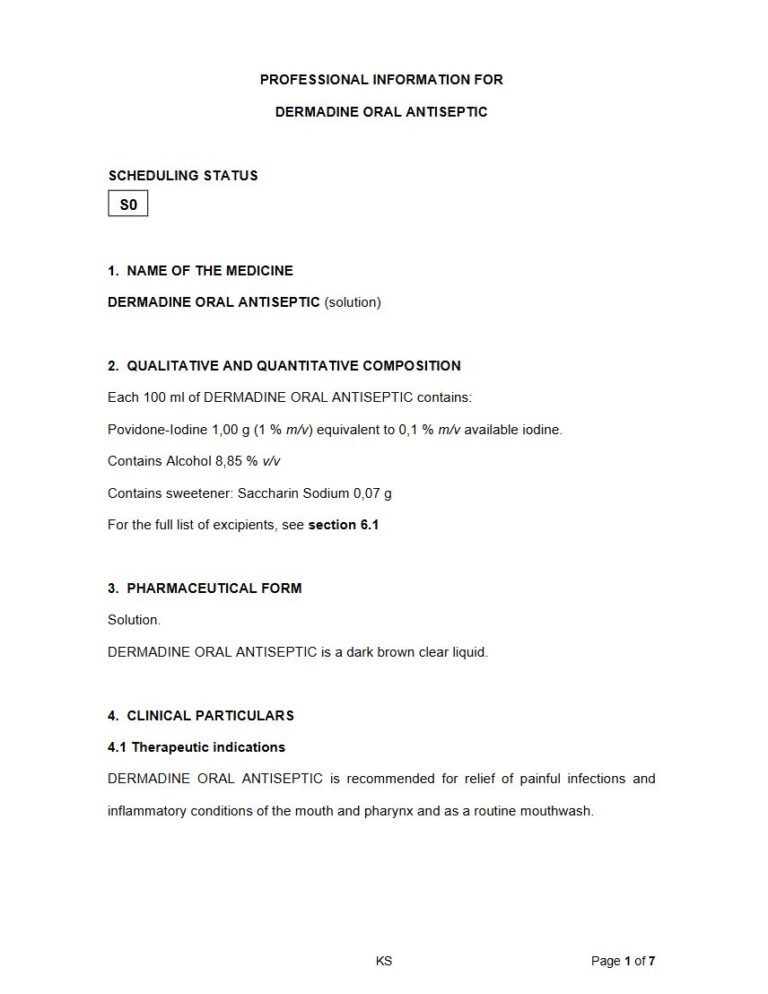
DERMADINE ORAL ANTISEPTIC is recommended for relief of painful infections and inflammatory conditions of the mouth and pharynx and as a routine mouthwash.
Infections: Aphthous ulcers, gingivitis, stomatitis and pharyngitis due to superficial infections. It is also recommended for use prophylactically during and after oral surgery.
4.2 Posology and method of administration
DERMADINE ORAL ANTISEPTIC should not be swallowed.
As a mouthwash: Dilute one part of DERMADINE ORAL ANTISEPTIC with two parts of water, rinse mouth thoroughly and spit out, or use as directed by doctor or dentist.
For infections of mouth and throat: Use full strength and rinse or gargle for thirty seconds then spit out, repeat hourly, or as directed by doctor or dentist.
Paediatric population
For children under 3 years: Dilute one part DERMADINE ORAL ANTISEPTIC with three parts water and paint the mouth with the aid of a cotton bud.
4.3 Contraindications
DERMADINE ORAL ANTISEPTIC is contraindicated in:
- patients with known hypersensitivity to povidone-iodine or to any of the excipients used in the formulation of DERMADINE ORAL ANTISEPTIC (see section 6.1).
- patients with non-toxic nodular colloid goitre should not use povidone-iodine.
- pregnant or lactating women.
- patients with hyperfunction of the thyroid (hyperthyroidism), other manifested thyroid diseases (thyroid disorder) should not use povidone-Iodine.
4.4 Special warnings and precautions for use
Certain individuals may become sensitized to povidone-iodine. If irritation, swelling or redness occurs, discontinue treatment and consult your doctor. If severe or persistent sore throat, or sore throat accompanied by high fever, headache, nausea and vomiting occur, consult your doctor promptly as these symptoms may indicate a serious condition. Absorption of povidone-iodine may interfere with thyroid function tests. Regular or prolonged use should be avoided in patients with thyroid disorders.
4.5 Interaction with other medicinal products and other forms of interaction
Absorption of iodine from DERMADINE ORAL ANTISEPTIC may interfere with thyroid function tests and can make a planned treatment of the thyroid with iodine (radioiodine therapy) impossible. After the end of the treatment an appropriate interval should be allowed before a new scintigram is carried out.
Regular or prolonged use should be avoided in patients receiving concomitant lithium therapy.
4.6 Fertility, pregnancy and lactation
Pregnancy: Not to be used in pregnancy.
Breastfeeding: Not to be used during breastfeeding.
4.7 Effects on ability to drive and use machines
The effects on ability to drive and use machines has not been established.
4.8 Undesirable effects
System Organ Class Frequency unknown
- Nervous system disorders: Headache
- Gastrointestinal disorders: Nausea, vomiting
- Skin and subcutaneous tissue disorders: Hypersensitivity and local irritation may occur, for example urticaria, pruritus, erythema, small blisters, angioedema, or similar manifestations.
- General disorders and administration site conditions: Irritation, swelling, redness
- Investigations: Interference with thyroid function tests.
Reporting of suspected adverse reactions
Reporting suspected adverse reactions after authorisation of the medicine is important. It allows continued monitoring of the benefit/risk balance of the medicine. Health care providers are requested to report any suspected adverse drug reactions to SAHPRA via the Med Safety APP (Medsafety X SAHPRA) and eReporting platform (who-umc.org) found on the SAHPRA website, or to Cipla Medpro (Pty) Ltd. by email: [email protected] or telephone: 080 222 6662 (toll free).
4.9 Overdose
Should ingestion occur, systemic effects such as metabolic acidosis, hypernatraemia and renal impairment may occur. Symptoms of acute poisoning are a disagreeable metallic taste, vomiting, abdominal pain and diarrhoea. Anuria may occur 1 to 3 days later; death may be due to circulatory failure, oedema of the glottis resulting in asphyxia, aspiration pneumonia or pulmonary oedema. Oesophageal stricture may occur if the patient survives the acute stage. For treatment of acute poisoning, supply patient with draughts of milk and starch mucilage. A doctor should be consulted without delay. Treatment is symptomatic and supportive.
