
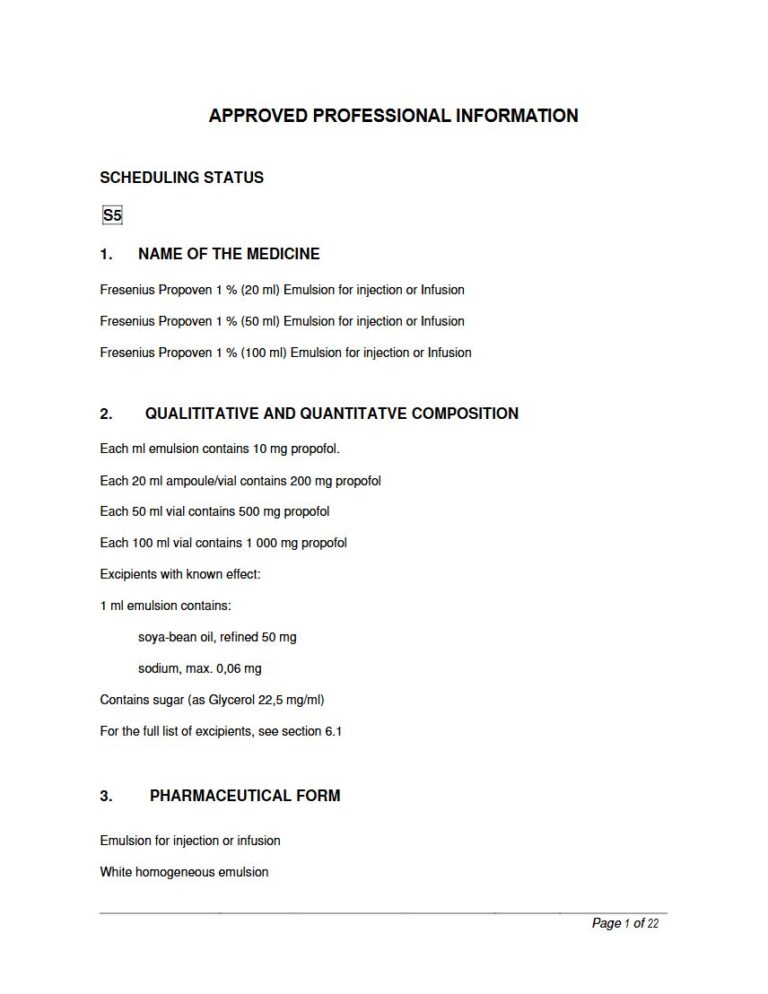
Fresenius Propoven 1 %/20 ml/50 ml/100 ml Injection
PDF Leaflet Revision Date: 10 June 2022
Clinical Summary
Quick overview from the medicine insert
Indication
Short-acting intravenous general anaesthetic.
Dosage (summary)
Induction: 1.5-2.5 mg/kg; Maintenance: 4-12 mg/kg/h.
Onset of Action / Duration
Onset: 30-40 secs, Duration: 4-6 mins.
Special Populations
- Elderly
- Renal impairment
- Hepatic impairment
- Cardiac insufficiency
Pregnancy & Breastfeeding
Not established in pregnancy; excreted in breast milk, discard for 24 hours post-administration.
Key Drug Interactions
- Benzodiazepines may prolong effects.
- Concomitant CNS depressants increase sedation.
- Rifampicin may cause hypotension.
Contraindications
- Hypersensitivity to propofol or excipients.
- Allergy to soya or peanut.
- Children under 3 years.
- Sedation in patients under 16 in ICU.
Common side effects
- Hypotension
- Respiratory depression
- Nausea
- Bradycardia
Counselling Points
- Avoid alcohol for 24 hours post-administration.
- Do not drive or operate machinery for 24 hours.
- Monitor for signs of hypotension and airway obstruction.
Serious warnings
- Propofol infusion syndrome may occur.
- Monitor for respiratory depression.
- Risk of abuse and dependence.
Important Disclaimer
The Fresenius Propoven 1 %/20 ml/50 ml/100 ml Injection professional information leaflet below is the property of Fresenius Kabi South Africa and is provided on Medinsert exactly as issued, with no.. alterations or editorial changes. We make every effort to keep content current by updating documents as soon as new versions become available. Medinsert serves as a trusted access point for healthcare professionals, but does not replace official sources or clinical judgement. For more details, please read our full disclaimer. read more>>
 Healthcare Professionals Only
This content is for registered healthcare professionals
Sign in or create a free account to read the full package insert.
Free for HPCSA-registered professionals. Powered by Medinsert.
Clinical Particulars
Section 4 of the official insert — extracted exactly as issued, no alterations
4.1 Therapeutic indications
Fresenius Propoven 1 % is a short-acting intravenous general anaesthetic medicine for:
- Induction and maintenance of general anaesthesia as part of a balanced anaesthetic technique.
- Sedation of artificially ventilated patients in the Intensive Care Unit (ICU) for a period of up to 72 hours.
- Conscious sedation for surgical and diagnostic procedures in adults, provided that there are adequate facilities for monitoring of haemodynamic and oxygenation parameters and if administered by a qualified anaesthetist.
4.2 Posology and method of administration
Fresenius Propoven 1 % must only be given in hospitals or adequately equipped day therapy units by medical practitioners trained in anaesthesia or in the care of patients in intensive care. Circulatory and respiratory functions should be constantly monitored and facilities for maintenance of patient airways, artificial ventilation and other resuscitation facilities should be immediately available at all times.
The dose of Fresenius Propoven 1 % emulsion should be individualized based on the response of the patient and premedication used. Supplementary analgesic medicines are generally required in addition to Fresenius Propoven 1 %.
General anaesthesia in adults:
Induction of anaesthesia: For induction of anaesthesia Fresenius Propoven 1 % should be titrated (u00b1 20 u2013 40 mg Fresenius Propoven 1 % every 10 seconds) against the response of the patient until clinical signs show the onset of anaesthesia. Most adult patients aged less than 55 years are likely to require 1,5 to 2,5 mg Fresenius Propoven 1 %/kg body weight. In patients over this age and in patients of ASA (American Society of Anaesthesiologists) grades III and IV, especially those with impaired cardiac function, the requirements will generally be less and the total dose of Fresenius Propoven 1 % may be reduced to a minimum of 1 mg/kg body weight. Lower rates of administration of Fresenius Propoven 1 % should be used (u00b1 2 ml (20 mg Fresenius Propoven 1 %) every 10 seconds).
Maintenance of anaesthesia: Anaesthesia can be maintained by administering Fresenius Propoven 1 % either by continuous infusion or repeat bolus injections. For maintenance of anaesthesia generally doses of 4 u2013 12 mg Fresenius Propoven 1 % /kg body weight/h should be given. A reduced maintenance dose of u00b1 4 mg Fresenius Propoven 1 % /kg body weight/h may be sufficient during less stressful surgical procedures such as minimal invasive surgery. In elderly patients, patients in unstable general conditions, patients with impaired cardiac function or hypovolaemic patients and patients of ASA grades III and IV, the dosage of Fresenius Propoven 1 % may be reduced further depending on the severity of the patientu2019s condition and on the performed anaesthetic technique. For maintenance of anaesthesia using repeat bolus injections dose increments of 25 to 50 mg Fresenius Propoven 1 % (= 2,5 u2013 5 ml Fresenius Propoven 1 %) should be given according to clinical requirements. Rapid bolus administration (single or repeated) should not be used in the elderly as this may lead to cardiopulmonary depression.
General anaesthesia in children:
Induction of anaesthesia: Fresenius Propoven 1 % is not recommended for neonates below the age of 1 month. Fresenius Propoven 1 % should be titrated slowly until the clinical signs show the onset of anaesthesia. The dosage should be adjusted for age and/or body weight. Children over 8 years of age are likely to require u00b1 2,5 mg Fresenius Propoven 1 %/kg body weight for induction of anaesthesia. Under this age the dose requirement may be higher. The initial dose should be 3 mg Fresenius Propoven 1 % /kg body weight. If necessary, additional doses in steps of 1 mg Fresenius Propoven 1 %/kg body weight can be administered. Lower doses are recommended for young patients at increased risk (ASA grades III and IV). Administration of Fresenius Propoven 1 % by a Target Controlled Infusion (TCI) system is not advised for induction of general anaesthesia in children.
Maintenance of anaesthesia: Fresenius Propoven 1 % is not recommended for children (neonates). For maintenance of anaesthesia using continuous infusion doses of 9 u2013 15 mg Fresenius Propoven 1 %/kg body weight/h should be given. Younger children may need higher dosage requirements, within the range of recommended dosages, when compared with older paediatric patients. There is no data on maintenance of anaesthesia with repeated injections of Fresenius Propoven 1 % in children. Dosage should be adjusted individually, and particular attention paid to the need for adequate analgesia. A maximum duration of use of u00b1 60 minutes should not be exceeded except where there is a specific indication for longer use e.g. malignant hyperthermia where volatile substances must be avoided. Administration of Fresenius Propoven 1 % by a Target Controlled Infusion (TCI) system is not advised for maintenance of general anaesthesia in children.
Sedation in adults during intensive care: When used to provide sedation during intensive care, it is recommended that Fresenius Propoven 1 % should be given by continuous infusion. The dose should be adjusted according to the depth of sedation required. Usually satisfactory sedation is achieved with administration rates in the range of 0,3 to 4,0 mg Fresenius Propoven 1 %/kg body weight/h. Rates of infusion greater than 4 mg Fresenius Propoven 1 %/kg body weight/h are not recommended. Fresenius Propoven 1 % must not be used for sedation in intensive care of patients 16 years of age or younger. Administration of Fresenius Propoven 1 % by a Target Controlled Infusion (TCI) system is not advised for sedation in the Intensive Care Unit.
Conscious sedation for surgical and diagnostic procedures: To provide sedation for surgical and diagnostic procedures rates of administration should be individualized and titrated to clinical response. Most patients will require 0,5 u2013 1 mg/kg over 1 to 5 minutes to initiate sedation. Maintenance of sedation may be accomplished by titrating Fresenius Propoven 1 % to the desired level of sedation u2013 most patients will require 1,5 to 4,5 mg/kg/hr. In addition to the infusion, bolus administration of 10 to 20 mg may be used if a rapid increase in the depth of sedation is required. In patient in ASA grades 3 and 4 the rate of administration and dosage may need to be reduced. Fresenius Propoven 1 % must not be used for sedation for diagnostic and surgical procedures in patients of 16 years of age or younger.
Method of administration: For intravenous use. Fresenius Propoven 1 % can be used for infusion undiluted or diluted with dextrose 5 % intravenous infusion solution or sodium chloride 0,9 % intravenous infusion solution only, in glass infusion bottles. Containers should be shaken before use. Use only homogeneous preparations and undamaged containers.
Prior to use, the ampoule neck or rubber membrane should be cleaned using an alcohol spray or a swab dipped in alcohol. After use, tapped containers must be discarded. Fresenius Propoven 1 % is a lipid containing emulsion without antimicrobial preservatives and may support rapid growth of micro-organisms. The emulsion must be drawn aseptically into a sterile syringe or giving set immediately after opening the ampoule or breaking the vial seal. Administration must commence without delay. Asepsis must be maintained for both Fresenius Propoven 1 % and infusion equipment throughout the infusion period. Co-administration of other medicines or fluids added to the Fresenius Propoven 1 % infusion line must occur close to the cannula site using a Y-piece connector or a three-way valve. Fresenius Propoven 1 % must not be mixed with other solutions for infusion or injection. But 5 % m/v glucose solution, 0,9 % m/v sodium chloride solution or 0,18 % m/v sodium chloride and 4 % m/v glucose solution may be administered via suitable appendages at the cannula site. Fresenius Propoven 1 % must not be administered via a microbiological filter. Fresenius Propoven 1 % and any infusion equipment containing Fresenius Propoven 1 % are for single administration in an individual patient. After use remaining solution of Fresenius Propoven 1 % must be discarded. Infusion of undiluted Fresenius Propoven 1 %: When Fresenius Propoven 1 % is infused undiluted, it is recommended that equipment such as burettes, drop counters, syringe pumps or volumetric infusion pumps should always be used to control infusion rates. Administration of Fresenius Propoven 1 % by Target Controlled Infusion (TCI) in adults Fresenius Propoven 1 % may also be used by Target Controlled Infusion (TCI). Due to the different algorithms available on the market for dosage recommendations please refer to the instructions for use leaflet of the device manufacturer. Administration of Fresenius Propoven 1 % via a TCI system is restricted to induction and maintenance of general anaesthesia in adults. It is not recommended for use in children or in ICU sedation or sedation for surgical and diagnostic procedures.
As usual for fat emulsions, the infusion of Fresenius Propoven 1 % via one infusion system must not exceed 12 hours. After 12 hours, the infusion system and reservoir of Fresenius Propoven 1 % must be discarded or replaced if necessary. Infusion of diluted Fresenius Propoven 1 %: When Fresenius Propoven 1 % is infused diluted, it is recommended that equipment such as burettes, drop counters or volumetric infusion pumps should always be used to control infusion rates and to avoid the risk of accidentally uncontrolled infusion of large volumes of diluted Fresenius Propoven 1 %. This risk must be taken into account when the decision for the maximum dilution in the burette is made. The maximum dilution must not exceed 1 part Fresenius Propoven 1 % with 4 parts of 5 % m/v glucose solution or 0,9 % m/v sodium chloride solution (minimum concentration 2 mg Fresenius Propoven 1 %/ml). The mixture should be prepared aseptically (controlled and validated conditions preserved) immediately prior to administration and must be administered within 6 hours after preparation. Fresenius Propoven 1 % must not be mixed with other solutions for infusion or injection. However, co-administration of a 5 % m/v glucose solution, 0,9 % m/v sodium chloride solution or 0,18 % m/v sodium chloride and 4 % m/v glucose solution with Fresenius Propoven 1 % is permitted via a Y-piece connector close to the injection site. To reduce pain at the injection site, lidocaine may be injected immediately before the use of Fresenius Propoven 1 % or Fresenius Propoven 1 % may be mixed, immediately before use, with preservative-free lidocaine injection (20 parts of Fresenius Propoven 1 % with up to 1 part of lidocaine injection solution) under controlled and validated aseptic conditions. The mixture must be administered within 6 hours of preparation. Muscle relaxants like atracurium and mivacurium should only be administered after flush of the same infusion site used for Fresenius Propoven 1 %. Duration of administration: The duration of administration must not exceed 72 hours.
4.3 Contraindications
Fresenius Propoven 1 % is contra-indicated:
- In patients with a known hypersensitivity to propofol or to any of the excipients of Fresenius Propoven 1 % (listed in section 6.1).
- In patients who are allergic to soya or peanut.
- Fresenius Propoven 1 % is not recommended in children under the age of 3 years.
- Sedation in children and adolescents 16 years of age and younger in intensive care. (See section 4.4).
- Sedation of children of all ages with croup or epiglottitis receiving intensive care (see section 4.4).
Fresenius Propoven 1 % should be given by those trained in anaesthesia (or, where appropriate, doctors trained in the care of patients in intensive care). Respiration will be depressed and must be monitored to ensure adequate gas exchange. Special care should be exercised when used with other respiratory depressants. Patients should be constantly monitored and facilities for maintenance of a patient airway, artificial ventilation and oxygen enrichment and other resuscitative facilities should be readily available at all times. Fresenius Propoven 1 % should not be administered by the person conducting the diagnostic or surgical procedure. Abuse of and dependence on propofol, predominantly by healthcare professionals, have been reported. The administration of Fresenius Propoven 1 % without airway care may result in fatal respiratory complications. When Fresenius Propoven 1 % is administered for conscious sedation, for surgical and diagnostic procedures, patients should be continually monitored for early signs of hypotension, airway obstruction and oxygen desaturation. When Fresenius Propoven 1 % is used for sedation during operative procedures, involuntary patient movements may occur. During procedures requiring immobility these movements may be hazardous to the operative site.
An adequate period is needed prior to discharge of the patient to ensure full recovery after use of Fresenius Propoven 1 %. The use of propofol, as in Fresenius Propoven 1 %, may be associated with the development of a period of post-operative unconsciousness, which may be accompanied by an increase in muscle tone. This may or may not be preceded by a period of wakefulness. Although recovery is spontaneous, appropriate care of an unconscious patient should be administered. Interference with daily activities may continue for up to 24 hours and no legal/contractual decisions should be entered into for 24 hours after receiving anaesthetic/conscious sedation. Alcohol use should also be avoided for the same time period. Propofol induced impairment is not generally detectable beyond 12 hours. The effects of propofol, the procedure, concomitant medications, the age and the condition of the patient should be considered when advising patients on:
- The advisability of being accompanied on leaving the place of administration
- The timing of recommencement of skilled or hazardous tasks such as driving
- The use of other medicines that may sedate (e.g., benzodiazepines, opiates, alcohol).
Delayed epileptiform attacks may occur even in non-epileptic patients, the delay period ranging from a few hours to several days.
Special patient groups
Cardiac, circulatory or pulmonary insufficiency and hypovolaemia: Caution should be applied in patients with cardiac, respiratory, renal or hepatic impairment or in hypovolaemic or debilitated patients. Propofol clearance is blood flow dependent, therefore, concomitant administration of medicines which reduces cardiac output will also reduce propofol clearance. Cardiac, circulatory or pulmonary insufficiency and hypovolaemia should be compensated before administration of Fresenius Propoven 1 %.
Fresenius Propoven 1 % should not be administered in patients with advanced cardiac failure or other severe myocardial disease except with extreme caution and intensive monitoring. Due to a higher dosage in patients with severe overweight the risk of haemodynamic effects on the cardiovascular system should be taken into consideration. The risk of relative vagotonia may be increased because Fresenius Propoven 1 % lacks vagolytic activity. It has been associated with reports of bradycardia (occasionally profound) and also asystole. The intravenous administration of an anticholinergic [agent] medicine before induction, or during maintenance of anaesthesia should be considered, especially in situations where vagal tone is likely to predominate, or when Fresenius Propoven 1 % is used in conjunction with other medicines likely to cause a bradycardia. Routine premedication with anticholinergic medicines is not advised.
Epilepsy: When Fresenius Propoven 1 % is administered to an epileptic patient, there may be a risk of convulsion. Fresenius Propoven 1 % should therefore be used with caution in patients with epilepsy. In epileptic patients delayed epileptiform attacks may occur, the delay period ranging from a few hours to several days. Before anaesthesia of an epileptic patient, it should be checked that the patient has received antiepileptic treatment. Although several studies have demonstrated efficacy in treating status epilepticus, administration of Fresenius Propoven 1 % in epileptic patients may also increase the risk of seizure. Use of Fresenius Propoven 1 % is not recommended with electroconvulsive therapy.
Patients with disorders of fat metabolism: Appropriate care should be applied in patients with disorders of fat metabolism, patients predisposed to fat embolism and in other conditions where lipid emulsions must be used with caution. Lipids should be monitored in the Intensive Care Unit treatment after 3 days. Blood lipid levels should be monitored if Fresenius Propoven 1 % is administered to patients thought to be at particular risk of fat overload. Administration of Fresenius Propoven 1 % should be adjusted appropriately if the monitoring indicates that fat is being inadequately cleared from the body. If patients receive parenteral nutrition, it is necessary to take account of the amount of lipid infusion as part of the Fresenius Propoven 1 % formulation (1,0 ml of Fresenius Propoven 1% contains 0,1 g of fat).
Patients with high intracranial pressure: Special care and close monitoring should be exercised in patients with a high intracranial pressure and a low mean arterial pressure as there is a risk of a significant decrease of the intracerebral pressure.
Mitochondrial disease: Caution should be taken when treating patients with mitochondrial disease. These patients may be susceptible to exacerbations of their disorder when undergoing anaesthesia, surgery and ICU care. Maintenance of normothermia, provision of carbohydrates and good hydration are recommended for such patients. The early presentations of mitochondrial disease exacerbation and of the u2018propofol infusion syndromeu2019 may be similar.
Use in children: The safety of Fresenius Propoven 1 % for sedation in children younger than 16 years of age has not been demonstrated (see section 4.3). Serious undesirable effects with sedation in patients younger than 16 years of age have been reported during unlicensed use. In particular these effects concerned metabolic acidosis, hyperlipidaemia, rhabdomyolysis and/or cardiac failure. These effects were most frequently seen in children with respiratory tract infections who received dosages in excess of those advised in adults for sedation.
4.4 Special warnings and precautions for use
Advisory statements concerning ICU management (Propofol infusion syndrome): Use of propofol emulsion infusions (including Fresenius Propoven 1 %) for ICU sedation has been associated with a constellation of metabolic derangements and organ system failures that may result in death. Reports have been received of combinations of the following: metabolic acidosis, rhabdomyolysis, hyperkalaemia, hepatomegaly, renal failure, hyperlipidaemia, cardiac dysrhythmia, Brugada-type ECG (elevated ST-segment and coved T-wave) and rapidly progressive cardiac failure usually unresponsive to inotropic supportive treatment (see SIDE EFFECTS). Combinations of these events have been referred to as the u201cpropofol infusion syndromeu201d. These events were mostly seen in patients with serious head injuries and children with respiratory tract infections who received dosages in excess of those advised in adults for sedation in the ICU. The following appear to be the major risk factors for the development of these events: decreased oxygen delivery to tissues; serious neurological injury and/or sepsis; high dosages of one or more of the following pharmacological substances - vasoconstrictors, steroids, inotropes and/or propofol (as in Fresenius Propoven 1 %, usually at dose rates greater than 4 mg/kg/h for more than 48 hours). Prescribers should be alert to these events in patients with the above risk factors and [promptly consider decreasing or stopping] immediately discontinue Fresenius Propoven 1 % when the above signs develop. All sedative and therapeutic medicines used in the ICU, should be titrated to maintain optimal oxygen delivery and haemodynamic parameters. Patients with raised intracranial pressure (ICP) should be given appropriate treatment to support the cerebral perfusion pressure during these treatment modifications.
Treating medical practitioners are reminded if possible, not to exceed the dosage of 4 mg/kg/h.
Additional precautions: Fresenius Propoven 1 % contains no antimicrobial preservatives and supports growth of micro-organisms. When Fresenius Propoven 1 % is to be aspirated, it must be drawn aseptically into a sterile syringe or giving set immediately after opening the ampoule or breaking the vial seal. Administration must commence without delay. Asepsis must be maintained for both Fresenius Propoven 1 % and infusion equipment throughout the infusion period. Any infusion fluids added to the Fresenius Propoven line must be administered close to the cannula site. Fresenius Propoven 1 % must not be administered via a microbiological filter. Fresenius Propoven 1 % is for single use in an individual patient. In accordance with established guidelines for other lipid emulsions, a single infusion of Fresenius Propoven 1 % must not exceed 12 hours. At the end of the procedure or at 12 hours, whichever is the sooner, both the reservoir of Fresenius Propoven 1 % and the infusion line must be discarded and replaced as appropriate.
Pain on the injection site: To reduce pain on the injection site during induction of anaesthesia, lidocaine can be injected prior to the administration of the Fresenius Propoven 1 % emulsion. The part of Fresenius Propoven 1 % used for induction may be mixed with lidocaine in the ratio of 20 parts Fresenius Propoven 1% with up to 1 part of 1 % lidocaine injection, immediately prior to administration. (See also u201cDOSAGE AND DIRECTIONS FOR USE u2013 Infusion of diluted Fresenius Propoven 1 %u201d).
Information on some of the ingredients: Fresenius Propoven 1 % contains soybean oil, which might cause severe allergic reactions. Fresenius Propoven 1 % contains less than 1 mmol (23 mg) sodium per 100 ml, i.e. essentially u201dsodium - freeu201d.
4.5 Interactions with other medicines
Fresenius Propoven 1 % has been used in association with spinal and epidural anaesthesia and with commonly used premedicants, neuromuscular blocking medicines, inhalational medicines and analgesics; no pharmacological incompatibility has been encountered. Fresenius Propoven 1 % must never be injected into the epidural or spinal space. Lower doses of Fresenius Propoven 1 % may be required where general anaesthesia or sedation is used as an adjunct to regional anaesthetic techniques. Profound hypotension has been reported following anaesthetic induction with propofol in patients treated with rifampicin. Concomitant use of benzodiazepines, parasympatholytic medicines (anticholinergics) or inhalational anaesthetics has been reported to prolong the anaesthesia and to reduce the respiratory rate. After additional premedication with opioids, the sedative effects of Fresenius Propoven 1 % may be intensified and prolonged, and there may be a higher incidence and longer duration of apnoea. It should be taken into consideration that concomitant use of Fresenius Propoven 1 % with medicines used for premedication, inhalation medicines or analgesics may potentiate anaesthesia and cardiovascular side effects. Concomitant use of central nervous system depressants (e.g. alcohol, general anaesthetics, narcotic analgesics) will result in intensification of their sedative effects. When Fresenius Propoven 1 % is used with centrally depressant medicines administered parenterally, severe respiratory and cardiovascular depression may occur. The dosage of Fresenius Propoven 1 % should be reduced if used with nitrous oxide or halogenated anaesthetics. After administration of fentanyl, the blood level of propofol may be temporarily increased with an increase in the rate of apnoea. Bradycardia and cardiac arrest may occur after treatment with suxamethonium or neostigmine.
4.6 Fertility, pregnancy and lactation
Pregnancy: The safety of Fresenius Propoven 1 % during pregnancy has not been established. Fresenius Propoven 1 % crosses the placenta and can cause neonatal depression.
Breastfeeding: Fresenius Propoven 1 % is excreted in small amounts into the milk. Therefore, mothers should stop breastfeeding and discard breast milk for 24 hours after administration of Fresenius Propoven 1 %.
4.7 Effects on ability to drive and use machines
Patients should be advised that performance at skilled tasks, such as driving and operating machinery, may be impaired for some time after general anaesthesia. After administration of Fresenius Propoven 1 %, the patient should be kept under observation for an appropriate period of time. The patient should not be allowed to go home unaccompanied and should be instructed to avoid consumption of alcohol.
4.8 Undesirable effects
Frequently observed undesirable effects of Fresenius Propoven 1 % are hypotension and respiratory depression. These effects depend on the Fresenius Propoven 1 % dose administered but also on the type of premedication and other concomitant medicine. Specifically, the following side effects have been observed:
Infections and infestations: Frequency unknown: Postsurgical infection, infection.
Immune system disorders: Less frequent: Anaphylaxis, which may include angioedema, bronchospasm, erythema and hypotension. Frequency not known: Anaphylactoid reactions.
Metabolism and nutritional disorder: Frequency not known: Metabolic acidosis, hyperkalaemia, hyperlipidaemia.
Psychiatric disorders: Less frequent: Euphoria. Frequency not known: Medicine abuse and dependence, excitation.
Nervous system disorders: Frequent: Headache during recovery phase, involuntary movements. Less frequent: Epileptiform movements, including convulsions and opisthotonus during induction, maintenance and recovery, vertigo, shivering and sensation of cold during recovery, post-operative unconsciousness delayed epileptiform attacks, the delay period ranging from a few hours to several days.
Cardiac disorders: Frequent: During induction of anaesthesia: bradycardia, tachycardia. Less frequent: Pulmonary oedema, premature ventricular contractions, premature atrial contractions, syncope, abnormal ECG and ST-segment depression. Frequency not known: Dysrhythmia, cardiac failure (see u201cPropofol infusion syndromeu201d under u201csection 4.4 - Advisory statements concerning ICU managementu201d ) during the recovery period.
Vascular disorders: Frequent: Hypotension (see section 4.4, hot flushes). Less frequent: Thrombosis and phlebitis. Frequency unknown: Hypertension.
Respiratory, thoracic and mediastinal disorders: Frequent: During induction of anaesthesia: hyperventilation, transient apnoea, coughing, singultus (hiccups), respiratory depression (dose dependant).
Gastrointestinal disorders: Frequent: Nausea or vomiting during the recovery period. Less frequent: Pancreatitis.
Hepatobiliary disorders: Frequency not known: Hepatomegaly.
Musculoskeletal and connective tissue disorders: Frequency not known: Rhabdomyolysis (at doses in excess of 4 mg/kg/h).
Skin and subcutaneous tissue disorders: Less frequent: Severe tissue responses after accidental paravenous application.
Renal and urinary disorders: Less frequent: Discolouration of urine following prolonged administration of Fresenius Propoven 1 %. Frequency unknown: Renal failure (see section 4.4).
Reproductive system and breast disorders: Less frequent: Sexual disinhibition. Frequency unknown: Priapism.
General disorders and administration site conditions: Frequent: Local pain occurring during the initial injection (see section 4.4). Less frequent: Tissue necrosis following accidental extravascular administration. Frequency not known: Local pain and swelling following accidental extravascular administration, infusion syndrome (which may be fatal, particularly in children; see section 4.4).
Investigations: Frequency not known: Brugada-type ECG.
Injury, poisoning and procedural complications: Less frequent: Post-operative fever.
Reporting of suspected adverse reactions: Reporting suspected adverse reactions after authorisation of the medicine is important. It allows continued monitoring of the benefit/risk balance of the medicine. Healthcare providers are asked to report any suspected adverse reactions to SAHPRA via the u201c6.04 Adverse Drug Reactions Reporting Formu201d, found online under SAHPRAu2019s publications: https://www.sahpra.org.za/Publications/Index/8.
4.9 Overdose
Symptoms of overdose may be an exacerbation of undesirable effects. Overdose is likely to cause cardiovascular and respiratory depression. Respiratory depression is treated with artificial ventilation. Cardiovascular depression may require lowering the patientu2019s head and administering plasma volume substitutes and vasopressive medicines.
