
Norvir 100 mg TABLET, Powder for Oral Suspension
PDF Leaflet Revision Date: 24 January 2025
Clinical Summary
Quick overview from the medicine insert
Indication
Used as a pharmacokinetic enhancer of certain antiretroviral protease inhibitors.
Dosage (summary)
Adults: Consult specific protease inhibitor guidelines. Pediatric: 400 mg/mu00b2 twice daily, max 600 mg.
Special Populations
- Renal impairment
- Hepatic impairment
Pregnancy & Breastfeeding
Contraindicated in pregnancy and lactation; safety not established.
Key Drug Interactions
- CYP3A4 inhibitors
- Sedative/hypnotics
- Antidysrhythmics
Contraindications
- Hypersensitivity to ritonavir
- Severe liver disease
- Rifampicin regimens
Common side effects
- Nausea
- Diarrhea
- Vomiting
- Abdominal pain
- Taste perversion
Counselling Points
- Take with food
- Monitor for liver function
- Avoid St. John's Wort
Serious warnings
- Serious hepatic reactions
- Pancreatitis risk
- Diabetes mellitus
Important Disclaimer
The Norvir 100 mg TABLET, Powder for Oral Suspension professional information leaflet below is the property of AbbVie and is provided on Medinsert exactly as issued, with no.. alterations or editorial changes. We make every effort to keep content current by updating documents as soon as new versions become available. Medinsert serves as a trusted access point for healthcare professionals, but does not replace official sources or clinical judgement. For more details, please read our full disclaimer. read more>>
 Healthcare Professionals Only
This content is for registered healthcare professionals
Sign in or create a free account to read the full package insert.
Free for HPCSA-registered professionals. Powered by Medinsert.
Clinical Particulars
Section 4 of the official insert — extracted exactly as issued, no alterations
4.1 Therapeutic indications
NORVIR is used as a pharmacokinetic enhancer of certain other antiretroviral protease inhibitors.
4.2 Posology and method of administration
NORVIR oral powder and tablets are administered orally and should preferably be given with food. Norvir Oral Powder when reconstituted with water, the colour may range from white to yellow. NORVIR should be initiated by medical practitioners /physicians who are experienced in the treatment of HIV Infection.
ADULTS When NORVIR is used as a pharmacokinetic enhancer for another antiretroviral protease inhibitor, the professional information of the particular protease inhibitor should be consulted.
Paediatric Patients NORVIR should be used in combination with other antiretroviral medicines. The recommended dosage of NORVIR is 400 mg/m2 of body surface area twice daily by mouth and should not exceed 600 mg twice daily. NORVIR should be started at 250 mg/m2 and increased at two to three day intervals by 50 mg/m2 twice daily. If patients do not tolerate the maximum daily dose due to adverse events, the highest tolerated dose should be used for maintenance therapy in combination with other antiretroviral medicines. When possible, dose should be administered using a calibrated dosing syringe.
Paediatric Dosage Guidelines for NORVIR Oral Powder (prepared as 100 mg/10 mL)*u2020
Body Surface Area (m2)* Twice daily dose 250 mg/m2 Twice daily dose 300 mg/m2 Twice daily dose 350 mg/m2 0,25 6,4 mL (62,5 mg) 7,6 mL (76 mg) 8,8 mL (88 mg) 0,50 12,6 mL (126 mg) 15 mL (150 mg) 17,6 mL (176 mg) 0,75 18,8 mL (188 mg) 22,6 mL (226 mg) 26,4 mL (262,5 mg) 1,00 25,0 mL (250 mg) 30,0 mL (300 mg) 35,0 mL (350 mg) 1,25 31,4 mL (312,5 mg) 37,6 mL (376 mg) 43,8 mL (438 mg) 1,50 37,6 mL (376 mg) 45,0 mL (450 mg) 52,6 mL (526 mg) *When mixed with 9,4 mL of liquid the concentration of the suspension is 10 mg/mL.
u2020In some instances, the volumes and/or doses have been adjusted to ensure the recommended final dose and dosing volume. Body Surface Area can be calculated with the following equations: BSA (m2)= u221a Height (cm) x Weight (kg) 3600 OR u00bd BSA (m2) = Height (cm) x Weight (kg) 3600
To calculate the volume to be administered (in mL) for intermediate body surface areas not included in the above table, the body surface area should be multiplied by a factor of: 25 for a dose of 250 mg/m2; 30 for 300 mg/m2; and 35 for 350 mg/m2.
Method of administration The recommended dose of NORVIR oral powder by mouth should either be sprinkled on soft food such as apple sauce or dessert pudding or mixed with a suitable liquid such as water, chocolate milk, or infant formula. For doses of 100, 200, 300, 400, 500, 600 mg: u2022 Either sprinkle entire contents of each packet/sachet over soft food (such as apple sauce or vanilla pudding) or mix with small amount of liquid (such as water, chocolate milk, or infant formula) and consume entire contents. u2022 Once the powder is mixed, the dosage must be consumed within 2 hours.
Doses less than 100 mg or partial doses between 100 mg increments: u2022 Mix 1 packet/sachet of oral powder (100 mg) with 9,4 mL of liquid (such as water, chocolate milk, or infant formula) in a mixing cup. u2022 Once mixed, use an oral dosing syringe to measure and administer the prescribed volume u2022 Once the powder is mixed, the dosage must be consumed within 2 hours. u2022 Discard any mixture remaining in the mixing cup.
4.3 Contraindications
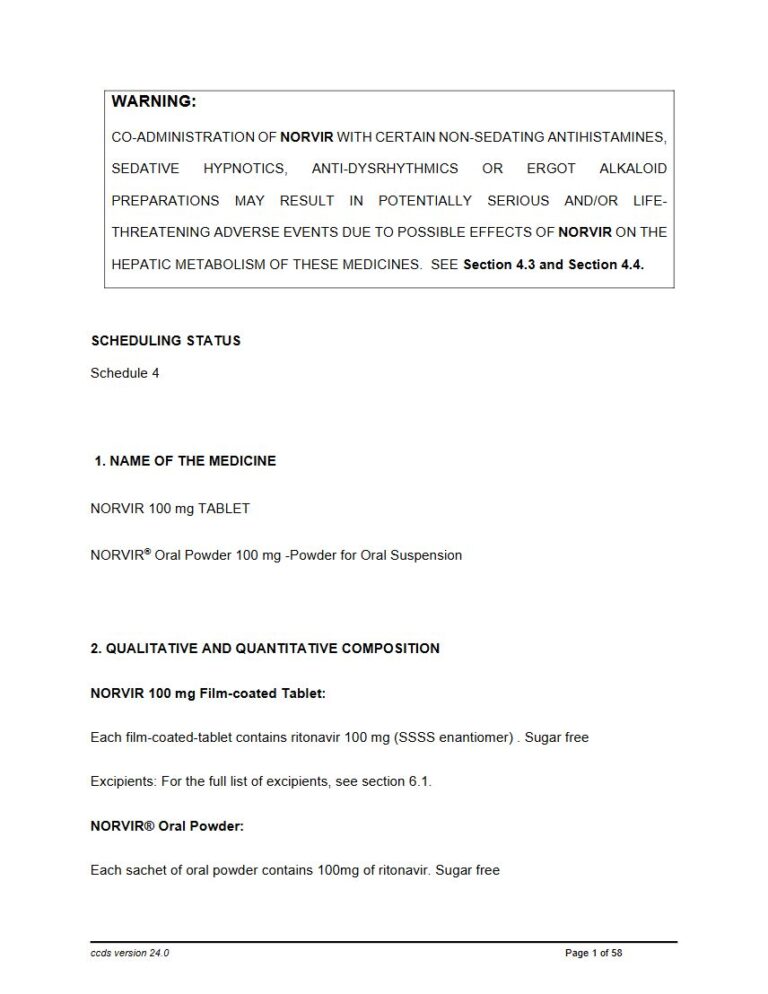
1. NORVIR is contraindicated in patients with known hypersensitivity to ritonavir or any of its formulation excipients listed in section 6.1.
2. When NORVIR is used as a pharmacokinetic enhancer of other protease inhibitors, consult the professional information of the co-administered protease inhibitor for contraindications.
3. Severe liver disease.
4. Antituberculosis regimens containing rifampicin. NORVIR is principally metabolised and eliminated by the liver. Therefore, caution should be exercised when administering NORVIR to patients with impaired hepatic function. In vitro studies have demonstrated that ritonavir is a potent inhibitor of many cytochrome P450 mediated biotransformations. Ritonavir is expected or has been shown to produce large increases in the plasma concentration of the medicines metabolised by cytochrome P450.
Medicines that are contra-indicated with NORVIR
Medicine Class Medicines within the Class that are contraindicated with NORVIR Clinical Comments Alpha1-adrenoreceptor antagonist alfuzosin HCL Potential for hypotension. Analgesics Pethidine Increased plasma concentrations of norpethidine. Thereby increasing the risk of serious respiratory depression or haematologic abnormalities or other serious adverse effects. Antianginal Ranolazine Potential for serious and/or life-threatening reactions. Antibiotic Fusidic acid Potential of increased fusidic acid-associated adverse events such as hepatitis or bone marrow suppression. Anticancer medicines Apalutamide Apalutamide is a moderate to strong CYP3A4 inducer and this may lead to a decreased exposure of ritonavir and potential loss of virologic response. In addition, exposure of apalutamide may increase with co-administration of ritonavir that may lead to serious adverse events including seizure.
Neratinib Potential for serious and/or life-threatening reactions including hepatotoxicity (see section 4.5). Venetoclax Increased plasma concentrations of venetoclax. Increased risk of tumor lysis syndrome at the dose initiation and during the dose titration phase (see section 4.5). Antidysrhythmics amiodarone, bepridil, dronedarone, flecainide, propafenone, quinidine, encainide, digoxin Potential for cardiac dysrhythmias. Antifungal Voriconazole Significant decreases in voriconazole plasma concentrations may lead to loss of antifungal response. Antigout colchicine Potential for serious and/or life-threatening reactions in patients with renal and/or hepatic impairment. Antihistamines astemizole, Increased plasma concentrations of astemizole and, thereby, increasing the risk of serious dysrhythmias from these medicines. Antipsychotic Blonanserin May result in potential increase in frequency or intensity of known neurological or other toxicities associated with blonanserin.
Lurasidone Potential for serious and/or life-threatening reactions. Pimozide Potential for cardiac arrthmias. Quetiapine Increased plasma concentrations of quetiapine which may lead to coma. The concomitant administration with quetiapine is contraindicated (see section 4.3). Ergot Derivatives dihydroergotamine, ergonovine, ergotamine, methylergonovine Post-marketing reports of acute ergot toxicity characterized by vasospasm and tissue ischaemia have been associated with co-administration of ritonavir and ergonovine, ergotamine, dihydroergotamine, or methylergonovine. GI Motility medicines Cisapride Potential for cardiac dysrhythmias. Herbal Products St Johns wort (hypericum perforatum) Co-administration may lead to a decrease in ritonavir levels, and to loss of virologic response and possible resistance to ritonavir or to the class of protease inhibitors Lipid Modifying medicines HMG-CoA Reductase Inhibitors: Lovastatin, simvastatin Potential for myopathy including rhabdomyolysis. Microsomal triglyceride Lomitapide Lomitapide is a sensitive substrate for CYP3A4 metabolism. CYP3A4 inhibitors transfer protein (MTTP) Inhibitor increase the exposure of lomitapide, with strong inhibitors increasing exposure approximately 27-fold. Concomitant use of moderate or strong CYP3A4 inhibitors with lomitapide is contraindicated (see prescribing information for lomitapide). Long acting beta-adrenoceptor agonist salmeterol May result in potential increased risk of cardiovascular adverse events associated with salmeterol. PDE5 inhibitor Avanafil Increased plasma concentrations of avanafil (see Section 4.4. and 4.5). sildenafil* only when used for the treatment of pulmonary arterial hypertension (PAH) Increased potential for sildenafil-associated adverse events (which include hypotension and syncope). Vardenafil Increased plasma concentrations of vardenafil (see Section 4.4. and 4.5). Sedative/hypnotics Midazolam, triazolam NORVIR is likely to produce large increases in these highly metabolized sedatives and hypnotics resulting in the potential for prolonged or increased sedation or respiratory depression.
4.4 Special warnings and precautions for use
When NORVIR is used as a pharmacokinetic enhancer of other protease inhibitors, full details on the warnings relevant to that particular protease inhibitor should be considered and the professional information for the particular protease inhibitor must be consulted.
Allergic Reactions Allergic reactions including urticaria, skin eruptions, bronchospasm, and angioedema have been reported. Rare cases of anaphylaxis and Stevens Johnson syndrome have also been reported.
Hepatic Reactions Hepatic transaminase elevations exceeding five times the upper limit of normal, clinical hepatitis and jaundice have occurred in patients receiving NORVIR alone or in combination with other antiretroviral medicines. There may be an increased risk for transaminase elevations in patients with underlying hepatitis B or C. Therefore, caution should be exercised when administering NORVIR to patients with pre-existing mild to moderate liver disease, liver enzyme abnormalities or hepatitis. Increased AST/ALT monitoring should be considered in these patients during the first three months of NORVIR treatment. There have been reports of hepatic dysfunction, including fatalities, particularly in patients taking multiple concomitant medicines and/or with advanced AIDS. NORVIR is contraindicated in patients with severe hepatic insufficiency (see Section 4.3).
Pancreatitis Pancreatitis has been observed in patients receiving ritonavir therapy, including those who developed hypertriglyceridemia. In some cases fatalities have been observed. Patients with advanced HIV disease may be at increased risk of elevated triglycerides and pancreatitis. Pancreatitis should be considered if clinical symptoms (nausea, vomiting, abdominal pain) or abnormalities in laboratory values (such as increased serum lipase or amylase values) suggestive of pancreatitis should occur. Patients who exhibit these signs or symptoms should be evaluated and ritonavir therapy should be discontinued if a diagnosis of pancreatitis is made.
Diabetes Mellitus/ Hyperglycaemia New onset diabetes mellitus, exacerbation of pre-existing diabetes mellitus, and hyperglycaemia have been reported during post-marketing surveillance in HIV-infected patients receiving protease inhibitor therapy such as NORVIR. Some patients required either initiation or dose adjustment of insulin or oral hypoglycaemic medicines for treatment of these events. In some cases, diabetic ketoacidosis has occurred. Patients who discontinued protease inhibitor therapy, the hyperglycaemia persisted in some cases.
Antigout medicines Life-threatening and fatal medicine interactions have been reported in patients treated with colchicine and strong inhibitors of CYP3A like NORVIR (see Section 4.3 and Section 4.5).
Corticosteroids Concomitant use of NORVIR and inhaled, injectable, or intranasal fluticasone, budesonide, triamcinolone, or other glucocorticoids that are metabolized by CYP3A4 is not recommended unless the potential benefit of treatment outweighs the risk of systemic corticosteroid effects, including Cushingu2019s syndrome and adrenal suppression. Fluticasone propionate can significantly increase fluticasone propionate plasma concentrations and reduce serum cortisol concentrations. Systemic corticosteroid effects including Cushingu2019s syndrome and adrenal suppression have been reported when NORVIR has been co-administered with inhaled or intranasally administered fluticasone propionate or budesonide or injectactable triamcinolone.
PDE 5 Inhibitors Caution should be used when prescribing sildenafil, tadalafil or vardenafil for the treatment of erectile dysfunction or pulmonary hypertension in patients receiving NORVIR. Co-administration of NORVIR with these medicines is expected to increase their concentrations and may result in increased associated adverse events, such as hypotension and prolonged erection. Concomitant use of sildenafil with NORVIR is contraindicated in pulmonary arterial hypertension patients (see Section 4.3).
Herbal Products Patients on NORVIR should not use products containing St. Johnu2019s Wort (Hypericum perforatum) because co-administration may be expected to reduce plasma concentrations of ritonavir. This may result in loss of therapeutic effect and development of resistance (see warnings and Special precautions for use and (see Section 4.3).
HMG-CoA Reductase Inhibitors The HMG-CoA reductase inhibitors simvastatin and lovastatin are highly dependent on CYP3A for metabolism, thus concomitant use of NORVIR with simvastatin or lovastatin is contraindicated due to an increased risk of myopathy including rhabdomyolysis. Caution must be exercised, and reduced doses should be considered if NORVIR is used concurrently with atorvastatin, which is metabolised to a lesser extent by CYP3A4. While rosuvastatin elimination is not dependent on CYP3A, an elevation of rosuvastatin exposure has been reported with NORVIR co-administration. If treatment with an HMG-CoA reductase inhibitor is indicated, pravastatin or fluvastatin is recommended (see TABLE 2).
Antimycobacterials Bedaquiline: Co-administration of bedaquiline with strong CYP3A4 inhibitors may increase the systemic exposure of bedaquiline, which may potentially increase the risk of bedaquiline-related adverse reactions (including QT prolongation) (see section 4.5). Bedaquiline must be used cautiously with ritonavir, only if the benefit of co-administration outweighs the risk. More frequent electrocardiogram monitoring and monitoring of transaminases is recommended (see section 4.5). Delamanid: Co-administration of delamanid with a strong inhibitor of CYP3A (ritonavir) may slightly increase exposure to delamanid metabolite, which has been associated with QTc prolongation. Therefore, if co-administration of delamanid with ritonavir is considered necessary, frequent ECG monitoring throughout the full delamanid treatment period is recommended (see section 4.5).
Resistance/Cross-Resistance Varying degrees of cross-resistance among protease inhibitors have been observed. Continued administration of NORVIR therapy following loss of viral suppression may increase the likelihood of cross-resistance to other protease inhibitors. The potential for HIV cross-resistance between protease inhibitors has not been fully explored. Therefore, it is unknown what effect NORVIR therapy will have on the activity of concordantly or subsequently administered protease inhibitors.
Laboratory Tests NORVIR has been associated with alterations in triglycerides, ALT, AST, GGT, CPK and uric acid. Appropriate laboratory testing should be performed prior to initiating NORVIR therapy and at periodic intervals or if any clinical signs or symptoms occur during therapy. For comprehensive information concerning laboratory test alterations associated with nucleoside analogues, medical practitioner should refer to the complete product information for each of these medicines.
Haemophilia There have been reports of increased bleeding, including spontaneous skin haematomas and haemoarthroses, in patients with haemophilia type A and B treated with protease inhibitors. In some patientu2019s additional factor VIII was given. In more than half of the reported cases, treatment with protease inhibitors was continued or reintroduced. A causal relationship has been postulated, although a mechanism of action has not been established.
PR Interval Prolongation Ritonavir has been shown to cause modest asymptomatic prolongation of the PR interval in some patients. Reports of second- or third-degree atrioventricular block in patients with underlying structural heart disease and pre-existing conduction system abnormalities or in patients receiving medicines known to prolong the PR interval (such as verapamil or atazanavir) have been reported in patients receiving NORVIR. NORVIR should be used with caution in such patients.
Lipodystrophy and metabolic abnormalities Combination antiretroviral therapy has been associated with the redistribution accumulation of body fat including central obesity, dorso-cervical fat, enlargement, and elevated serum lipid and glucose levels in HIV patients. Clinical examination should include evaluation for physical signs of fat redistribution. Patients with evidence of lipodystrophy should have a thorough cardiovascular risk assessment.
Immune Reconstitution Syndrome Immune reconstitution syndrome has been reported in HIV-infected patients treated with combination antiretroviral therapy. During the initial phase of combination antiretroviral treatment when the immune system responds, patients may develop an inflammatory response to asymptomatic or residual opportunistic infections (such as Mycobacterium avium infection, cytomegalovirus, Pneumocystis jiroveci (carinii) pneumonia or tuberculosis), which may necessitate further evaluation and treatment. Autoimmune disorders (such as Gravesu2019 disease, polymyositis, and Guillain-Barru00e9 syndrome) have also been reported to occur in the setting of immune reconstitution, however, the time to onset is more variable, and can occur many months after initiation of treatment.
Osteonecrosis Although the aetiology is considered to be multifactorial (including corticosteroid use, alcohol consumption, severe immunosuppression, higher body mass index), cases of osteonecrosis have been reported, particularly in patients with advanced HIV disease and/or long-term exposure to combination antiretroviral therapy (cART). Patients should be advised to seek medical advice if they experience joint aches and pain, joint stiffness or difficulty in movement.
Opportunistic infections Patients receiving NORVIR should be advised that they may continue to develop opportunistic infections and other complications of HIV infection, and therefore they should remain under close observation by healthcare professionals experienced in the treatment of patients with associated HIV disease. Regular monitoring of viral load and CD4 counts needs to be done.
The risk of HIV transmission to others Patients should be advised that current antiretroviral therapy, including NORVIR, does not prevent the risk of transmission of HIV to others through sexual contact or blood contamination. Appropriate precautions should continue to be employed.
Lipid Disorders Treatment with NORVIR therapy in combination with saquinavir has resulted in substantial increases in the concentration of total triglycerides and cholesterol. Triglyceride and cholesterol testing should be performed prior to initiating ritonavir therapy and at periodic intervals during therapy. Lipid disorders should be managed as clinically appropriate. See TABLE 2 for additional information on potential medicine interactions with NORVIR and HMG-CoA Reductase Inhibitors (hypolipidemics).
Geriatric Use Safety and efficacy has not been established in the elderly.
4.5 Interaction with other medicines and other forms of interaction
Medicines which increase CYP3A activity (e.g. Phenobarbitone, carbamazepine, dexamethasone, phenytoin, rifampicin and rifabutin) would be expected to increase the clearance of NORVIR resulting in decreased ritonavir plasma concentrations. NORVIR has a high affinity for several cytochrome P450 (CYP) isoforms with the following ranked order: CYP3A4 > CYP2D6 > CYP2C9 > CYP2C19 >> CYP2A6, CYP1A2, CYP2E1. There is evidence that NORVIR may induce glucuronosyl transferase, CYP1A2, CYP2C9 and CYP2C19 enzymes. Decreased plasma concentrations of the other medicine and loss of therapeutic effects during NORVIR co-administration may signify the need for dosage alteration of these medicines. In addition to the medicines listed in the contraindications section 4.3 TABLE 2 summarises some commonly prescribed medicines separated by the type of metabolism and expected magnitude of interaction when co-administered with NORVIR. Co-administration of NORVIR and medicines primarily metabolised by CYP3A may result in increased plasma concentrations of the other medicine, which could increase or prolong its therapeutic and adverse effects. Careful monitoring of therapeutic and adverse effects is recommended when these medicines are concomitantly administered with ritonavir. Dosage reductions may be required for those medicines extensively metabolised by CYP3A. Cardiac and neurologic events have been reported when NORVIR has been co-administered with disopyramide, mexiletine, nefazodone or fluoxetine. The possibility of interaction cannot be excluded.
TABLE 2 Potential Effects on Medicines Co-administered with NORVIR (Contraindicated Medications are listed in Column 1) Medicine Category Representative Medicines by Potential Interaction Category Contraindicated Medication Large 1 uf0db AUC 2 (CYP3A) Moderate 1 uf0db AUC 2 (CYP2D6) Moderate 1 uf0db or uf0dc AUC 2 (CYP2C9/19) Possible uf0dc AUC 2 (Unknown CYP) Possible uf0dc AUC 2 (glucu- ronidation) Analgesics, narcotics Alfentanil Fentanyl Hydrocodone Oxycodone Tramadol Levamethadyl (LAAM) Codeine Hydromorphone Meperidine* Methadone* Morphine
4.6 Fertility, pregnancy and lactation
Pregnancy NORVIR is contraindicated in pregnancy and lactation, as safety has not been established.
Breastfeeding NORVIR is contraindicated in pregnancy and lactation, as safety has not been established.
4.7 Effects on ability to drive and use machines
No studies on the effects on the ability to drive and use machines have been performed. As somnolence and dizziness are known undesirable effects, this should be taken into account when driving or using machinery.
4.8 Undesirable effects
When NORVIR is used as a pharmacokinetic enhancer with other protease inhibitors, full details on the side effects and special precautions relevant to that particular protease inhibitor should be considered, therefore the professional information for that particular protease inhibitor must be consulted. The most frequent reported clinical adverse events, other than asthenia, among patients receiving ritonavir were gastrointestinal and neurological disturbances including nausea, diarrhoea, vomiting, anorexia, abdominal pain, taste perversion and circumoral and peripheral paraesthesias. Adverse events at least possibly, probably or of unknown relationship to ritonavir are displayed by system organ class and frequency (very common u2265 1/10; common u2265 1/100, < 1/10) in TABLE 4 below. Where frequency data is not available in adverse events occurring in less than 2 % of patients the term u201cless frequentlyu201d is used.
4.9 Overdose
Human experience of acute overdose with NORVIR is limited. One patient in clinical trials took NORVIR 1500 mg/day for two days and reported paresthesias which resolved after the dose was decreased. A post-marketing case of renal failure with eosinophilia has been reported with NORVIR overdose. Management of Overdosage: There is no specific antidote for overdose with NORVIR. Treatment of overdose with NORVIR should consist of general supportive measures including monitoring of vital signs and observation of the clinical status of the patient. It is proposed that management of overdose could also entail and administration of activated charcoal. Since NORVIR is extensively metabolised by the liver and is highly protein bound, dialysis is unlikely to be beneficial in significant removal of the medicine.
