
Zatonav 300 mg FC tablets
PDF Leaflet Revision Date: 08 August 2025
Clinical Summary
Quick overview from the medicine insert
Indication
Treatment of HIV-1 infection in combination with other antiretroviral medicines.
Dosage (summary)
One tablet once daily with food.
Special Populations
- Elderly
- Renal impairment
- Hepatic impairment
Pregnancy & Breastfeeding
Contraindicated in pregnancy and lactation; safety not established.
Key Drug Interactions
- Rifampicin
- Digoxin
- Amiodarone
- Sedative hypnotics
- St. John's Wort
Contraindications
- Hypersensitivity to atazanavir or ritonavir
- Moderate to severe hepatic impairment
- Concomitant use with certain medications
Common side effects
- Jaundice
- Rash
- Nausea
- Diarrhea
- Headache
Counselling Points
- Take with food
- Monitor for jaundice
- Avoid certain medications
- Do not breastfeed
Serious warnings
- Serious drug interactions
- Potential for hepatic toxicity
- Risk of pancreatitis
Important Disclaimer
The Zatonav 300 mg FC tablets professional information leaflet below is the property of Viatris Healthcare and is provided on Medinsert exactly as issued, with no.. alterations or editorial changes. We make every effort to keep content current by updating documents as soon as new versions become available. Medinsert serves as a trusted access point for healthcare professionals, but does not replace official sources or clinical judgement. For more details, please read our full disclaimer. read more>>
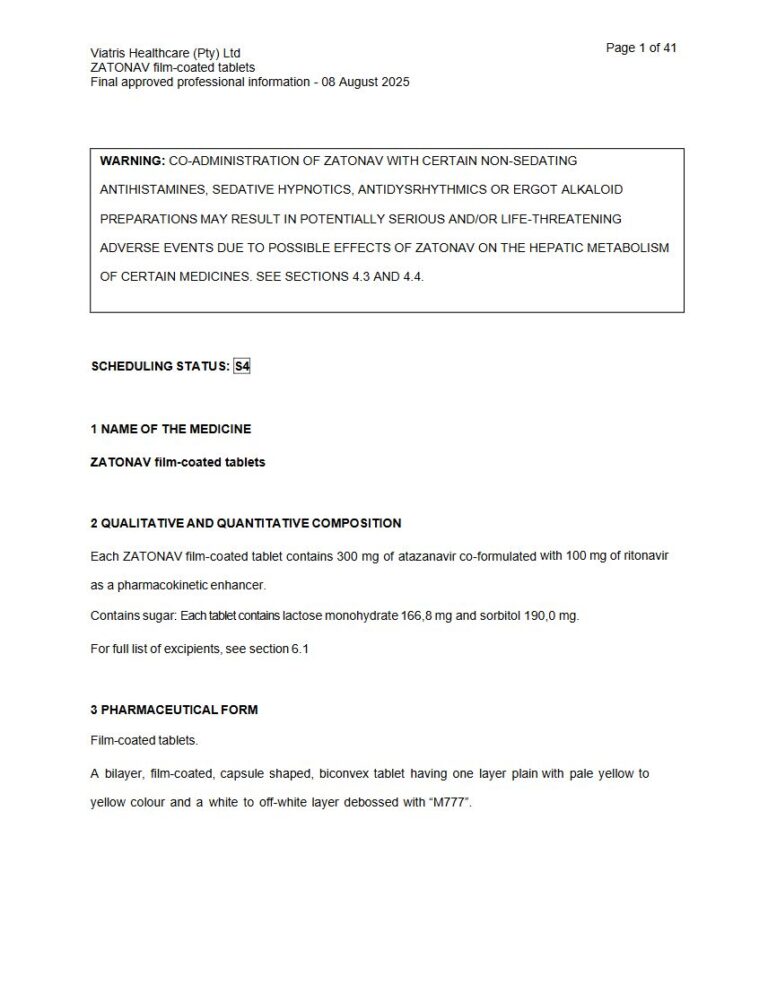 Healthcare Professionals Only
This content is for registered healthcare professionals
Sign in or create a free account to read the full package insert.
Free for HPCSA-registered professionals. Powered by Medinsert.
Clinical Particulars
Section 4 of the official insert — extracted exactly as issued, no alterations
4.1 Therapeutic indications
ZATONAV is indicated in combination with other antiretroviral medicines for the treatment of HIV-1 infection.
4.2 Posology and method of administration
Adults: The recommended dose of ZATONAV is one tablet once daily taken with food. The ZATONAV tablets should be swallowed whole.
Special populations
- Elderly: No data are available on which to make a dose recommendation for patients over the age of 65 years.
- Renal insufficiency: No dosage adjustment is required.
- Hepatic impairment: ZATONAV has not been studied in patients with hepatic impairment. ZATONAV should be used with caution in patients with mild hepatic impairment. ZATONAV should not be used in patients with moderate to severe hepatic impairment (see section 4.3).
Concomitant therapy
- Efavirenz: In treatment-nau00efve patients, it is recommended that ZATONAV be taken with efavirenz 600 mg (all once daily).
- Tenofovir: When co-administered with tenofovir it is recommended that ZATONAV and tenofovir 300 mg, be taken all as a single daily dose with food.
Method of administration
ZATONAV is to be taken orally, with food.
Missed dose
Doctors should advise patients who forget to take ZATONAV to take a dose as soon as possible and then continue with the normal dose. Patients should not take a double dose to compensate for the missed dose.
4.3 Contraindications
- Hypersensitivity to atazanavir, ritonavir, or any of the excipients of ZATONAV.
- Patients with hepatic impairment (see section 4.4).
- Concomitant administration with rifampicin.
- Concomitant administration with digoxin, amiodarone, astemizole, bepridil, cisapride, dihydroergotamine, encainide, ergotamine, flecainide, pimozide, propafenone, quinidine, midazolam and triazolam.
- Safety and efficacy have not been established in the elderly.
- Pregnancy and lactation (see section 4.6).
- ZATONAV is contraindicated when co-administered with medicines that are highly dependent on CYP3A4 for clearance, and for which elevated plasma concentrations are associated with serious and/or life-threatening events (see section 4.5).
Medicines that are contraindicated with ZATONAV:
Medicine Class and Medicines within Class
- Alpha 1-adrenoreceptor: alfuzosin - Potential for increased alfuzosin concentrations which can result in hypotension.
- Antidysrhythmics: quinidine - ZATONAV: Contraindicated due to potential for serious and/or life-threatening dysrhythmias.
- Antifungal: voriconazole - Voriconazole should not be administered to patients receiving ZATONAV.
- Antipsychotics: blonanserin - May result in potential increase in frequency or intensity of known neurological or other toxicities associated with blonanserin.
- Antimycobacterial: rifampicin - Rifampicin substantially decreases plasma concentrations of atazanavir, which may result in loss of therapeutic effect and development of resistance.
- Calcium Channel Blockers: bepridil - ZATONAV: Potential for serious and/or life-threatening adverse events.
- Ergot Derivatives: dihydroergotamine, ergotamine, ergonovine, methylergonovine - Potential for serious and/or life-threatening events such as acute ergot toxicity characterised by peripheral vasospasm and ischaemia of the extremities and other tissues.
- GI Motility Medicine: cisapride - Potential for serious and/or life-threatening reactions such as cardiac dysrhythmias.
- Proton Pump Inhibitors: omeprazole - Co-administration may reduce plasma concentrations of atazanavir. This may result in loss of therapeutic effect and development of resistance.
- Herbal Products: St. Johnu2019s wort (Hypericum perforatum) - Patients taking ZATONAV should not use products/medicines containing St. Johnu2019s wort because co-administration may be expected to reduce plasma concentrations of atazanavir. This may result in loss of therapeutic effect and development of resistance.
- HMG-CoA Reductase Inhibitors: lovastatin, simvastatin - There may be potential for serious reactions such as myopathy including rhabdomyolysis (see section 4.5 Other medicines, HMG-CoA Reductase Inhibitors).
- Neuroleptic: pimozide - Potential for serious and/or life-threatening reactions such as cardiac dysrhythmias.
- Sedative Hypnotics: Orally administered midazolam, triazolam - Potential for increased concentrations of the sedative hypnotic and increased risk of prolonged sedation or respiratory depression.
- PDE5 inhibitor: sildenafil - A safe and effective dose in combination with ZATONAV has not been established for sildenafil when used for the treatment of pulmonary arterial hypertension. There is increased potential for sildenafil-associated adverse events.
- Antineoplastic: irinotecan - ZATONAV inhibits UGT and may interfere with the metabolism of irinotecan, resulting in increased irinotecan toxicities.
- Protease Inhibitor: indinavir - ZATONAV and indinavir are associated with hyperbilirubinaemia. Co-administration of ZATONAV and indinavir is not recommended (see section 4.8).
4.4 Special warnings and precautions for use
Based primarily on literature review, ritonavir is expected or has been shown to produce large increases in the plasma concentration of the following medicines: digoxin, amiodarone, bepridil, cisapride, dihydroergotamine, encainide, ergotamine, flecainide, pimozide, propafenone and quinidine. These medicines have recognised risks of dysrhythmias, haematologic abnormalities, seizures or other potentially serious adverse effects (see section 4.3).
Additionally, post-marketing reports of acute ergot toxicity characterised by peripheral vasospasm and ischaemia of the extremities have been associated with the co-administration of ritonavir and ergotamine or dihydroergotamine. These medicines should not be co-administered with ZATONAV (see section 4.3).
Ritonavir, in addition is likely to produce large increases in plasma concentrations of metabolised sedatives and hypnotics such as: midazolam and triazolam. Due to the potential for extreme sedation and respiratory depression from these medicines, they should not be co-administered with ZATONAV.
Hepatic impairment and toxicity
Atazanavir and ritonavir are principally metabolised by the liver. Ritonavir is eliminated by the liver. Therefore, caution should be exercised when administering ZATONAV to patients with hepatic impairment because atazanavir concentrations may be increased (see section 4.2). Patients with underlying hepatitis B or C viral infections or marked elevations in transaminases prior to treatment may be at increased risk for developing further transaminase elevations.
Hepatic transaminase elevations exceeding five times the upper limit of normal, clinical hepatitis and jaundice have occurred in patients receiving atazanavir alone or in combination with other antiretroviral medicines. Therefore, caution should be exercised when administering ZATONAV to patients with pre-existing mild to moderate liver disease, liver enzyme abnormalities or hepatitis. Increased AST/ALT monitoring should be considered in these patients especially at baseline during the first three months of ZATONAV treatment and as frequently as needed for the duration of treatment. There have been reports of hepatic dysfunction, including some fatalities, particularly in patients taking multiple concomitant medicines and/or with advanced AIDS. ZATONAV is contraindicated in patients with severe hepatic insufficiency (see section 4.3).
Lipid disorders
Treatment with ZATONAV therapy in combination with saquinavir has resulted in substantial increases in the concentration of total triglycerides and cholesterol. Triglyceride and cholesterol testing should be performed prior to initiating ritonavir therapy and at periodic intervals during therapy. Lipid disorders should be managed as clinically appropriate. See section 4.5 on potential medicine interactions with ZATONAV and HMG-CoA Reductase Inhibitors (hypolipidaemics).
Laboratory Tests and Findings
ZATONAV has been associated with alterations in triglycerides, ALT, AST, GGT, CPK and uric acid. Appropriate laboratory testing should be performed prior to initiating ZATONAV therapy and at periodic intervals or if any clinical signs or symptoms occur during therapy. For comprehensive information concerning laboratory test alterations associated with nucleoside analogues, medical practitioners should refer to the professional information for each of these nucleoside medicines.
Adult patients: The most frequently reported laboratory abnormality in patients receiving regimens containing atazanavir and one or more NRTIs was elevated total bilirubin (87 % Grade 1, 2, 3 or 4). Grade 3 or 4 elevation of total bilirubin was noted in 36 % (20 % Grade 3, 6 % Grade 4, reported predominantly as elevated indirect bilirubin). Other marked clinical laboratory abnormalities (Grade 3 or 4) reported in u2265 2 % of patients receiving regimens containing atazanavir and one or more NRTIs included: elevated amylase (12 %), elevated creatine kinase (CK) (8 %), elevated ALT/SGPT (6 %), low neutrophils (6 %), elevated AST/SGOT (4 %) and elevated lipase (3 %).
The selection of antiretroviral therapy must be guided principally by antiviral efficacy. Consultation with standard guidelines for management of dyslipidaemia is recommended.
Pancreatitis
Pancreatitis has been observed in patients receiving ritonavir therapy, including those who developed hypertriglyceridaemia and fatalities have been observed. Patients with advanced HIV disease may be at risk of elevated triglycerides and pancreatitis. Pancreatitis should be considered if clinical symptoms (nausea, vomiting, abdominal pain) or abnormalities in laboratory values (such as increased serum lipase or amylase values) suggestive of pancreatitis occur. Patients who exhibit these signs or symptoms should be evaluated and ZATONAV therapy should be discontinued if a diagnosis of pancreatitis is made.
Lipodystrophy and metabolic abnormalities
Combination antiretroviral therapy has been associated with metabolic abnormalities such as hypertriglyceridaemia, hypercholesterolaemia, insulin resistance, hyperglycaemia and hyperlactataemia. Also redistribution/accumulation of body fat which includes central obesity, dorso-cervical fat, enlargement (u201cbuffalo humpu201d), peripheral wasting, facial wasting, breast enlargement, u201cCushingoid appearanceu201d, and elevated serum lipid and glucose levels in HIV patients. Clinical examination should include evaluation for physical signs of fat redistribution. Patients with evidence of lipodystrophy should have a thorough cardiovascular risk assessment.
Diabetes Mellitus/Hyperglycaemia
New onset diabetes mellitus, exacerbation of pre-existing diabetes mellitus and hyperglycaemia have been reported during post-marketing surveillance in HIV-infected patients receiving protease inhibitors. In some cases, diabetic ketoacidosis has occurred. In those patients who discontinued treatment, hyperglycaemia persisted in some cases.
Immune Reconstitution Inflammatory Syndrome
Immune reconstitution inflammatory syndrome (IRIS) is an immunopathological response resulting from the rapid restoration of pathogen-specific immune responses to pre-existing antigens combined with immune dysregulation, which occurs shortly after starting combination Anti-Retroviral Therapy (cART). Typically such reaction presents by paradoxical deterioration of opportunistic infections being treated or with unmasking of an asymptomatic opportunistic disease, often with an atypical inflammatory presentation. IRIS usually develops within the first three months of initiation of ART and occurs more commonly in patients with low CD4 counts. Common examples of IRIS reactions to opportunistic diseases are tuberculosis, pneumocystis jirovecii pneumonia, atypical mycobacterial infection, cytomegalovirus retinitis, and cryptococcal meningitis. Appropriate treatment of the opportunistic disease should be instituted or continued and ART continued. Inflammatory manifestations generally subside after a few weeks. Severe cases may respond to glucocorticoids, but there is only limited evidence for this in patients with tuberculosis IRIS. Autoimmune diseases (such as Gravesu2019 disease) have also been reported as IRIS reactions; however, the reported time to onset is more variable and these events can occur many months after initiation of treatment.
Osteonecrosis
Although the aetiology is considered to be multifactorial (including corticosteroid use, alcohol consumption, severe immunosuppression, higher body mass index), cases of osteonecrosis have been reported, particularly in patients with advanced HIV-disease and/or long-term exposure to combination antiretroviral therapy (cART). Patients should be advised to seek medical advice if they experience joint aches and pain, joint stiffness or difficulty in movement.
PR Interval
Atazanavir has the potential to prolong the PR interval of the electrocardiogram. ZATONAV should be used with caution in patients with pre-existing conduction system disease. Caution should be used when co-administering ZATONAV with medicines known to induce PR interval prolongation.
Opportunistic infections
Patients receiving ZATONAV should be advised that they may continue to develop opportunistic infections and other complications of HIV infection, and therefore should remain under close observation by healthcare professionals experienced in the treatment of patients with associated HIV disease. Regular monitoring of viral load and CD4 counts needs to be done.
Resistance/Cross-resistance
Varying degrees of cross-resistance among protease inhibitors have been observed. Continued administration of ZATONAV therapy following loss of viral suppression may increase the likelihood of cross-resistance to other protease inhibitors. The potential for HIV cross-resistance between protease inhibitors has not been fully explored. Therefore, it is unknown what effect ZATONAV therapy will have on the activity of concordantly or subsequently administered protease inhibitors.
The risk of HIV transmission to others
Patients must be advised that current antiretroviral therapy, including ZATONAV, does not prevent the risk of HIV transmission to others through sexual contact or blood contamination. Appropriate precautions must continue to be employed.
Allergic reactions, rash, and associated syndromes
Ritonavir: Allergic reactions including urticaria, skin eruptions, bronchospasm, and angioedema have been reported. Rare cases of anaphylaxis and Stevens-Johnson syndrome have also been reported.
Atazanavir: Rashes are mostly mid-to-moderate maculopapular skin eruptions that occur within the first 3 weeks of initiating therapy with atazanavir, as contained in ZATONAV. ZATONAV should be discontinued if severe rash develops. Cases of Stevens-Johnson syndrome, erythema multiforme, and toxic skin eruptions including Drug Rash, Eosinophilia, and Systemic Symptoms (DRESS) syndrome have been reported in patients taking atazanavir.
Corticosteroids
Concomitant use of ritonavir and fluticasone propionate can significantly increase fluticasone propionate plasma concentrations and reduce serum cortisol concentrations. Systemic corticosteroid effects including Cushingu2019s syndrome and adrenal suppression have been reported when ritonavir has been co-administered with inhaled or intranasally administered fluticasone propionate. Similar findings with concomitant administration of ritonavir and other inhaled corticosteroids that are metabolised similarly to fluticasone, such as budesonide, cannot be excluded.
4.5 Interactions with other medicines
Medicines which increase CYP3A activity (e.g. phenobarbital, carbamazepine, dexamethasone, phenytoin, rifampin and rifabutin) would be expected to increase the clearance of ZATONAV resulting in decreased ritonavir plasma concentrations.
ZATONAV has a high affinity for several cytochrome P450 (CYP) isoforms with the following ranked order: CYP34A> CYP206> CYP2C9> CYP2C19>> CYP2A6, CYP1A2, CYP2E1. There is some evidence that ZATONAV may increase the activity of glucuronosyl glucuronyl transferase; thus, loss of therapeutic effects from directly glucuronidated medicines during ZATONAV therapy may signify the need for dosage alteration of these medicines. In addition to the medicines listed in the section 4.3, Table 1 summarises some commonly prescribed medicines, separated by the type of metabolism and expected magnitude of interaction when co-administered with ZATONAV. Careful monitoring of therapeutic and adverse effects is recommended when these medicines are concomitantly administered with ritonavir, and therefore ZATONAV. Dosage reductions may be required for those medicines extensively metabolised by CYP3A.
Cardiac and neurologic events have been reported when ritonavir, as contained in ZATONAV, has been co-administered with disopyramide, mexiletine, nefazodone or fluoxetine. The possibility of medicine interaction cannot be excluded.
TABLE 1 Potential Effects on Medicines Co-administered with ritonavir as contained in ZATONAV (Contraindicated Medicines are listed in Column 1)
Medicine Category Representative Medicines by Potential Interaction Category
Contraindicated Medicines
Large 1 u2191AUC 2 (CYP3A) Moderate 1 u2191AUC 2 (CYP2D6) Moderate 1 u2191 Or u2193AUC 2 (CYP2C9/19) Possible u2193AUC 2 (Unknown CYP) Possible AUC 2 (glucuronidation)
Analgesics, Narcotics
- Alfentanil
- Fentanyl
- Hydrocodone
- Oxycodone
- Propoxyphene
- Tramadol
Analgesics, Non-steroidal
- Diclofenac
- Flurbiprofen
- Ibuprofen
- Indomethacin
- Piroxicam
- Nabumetone
- Sulindac
- Ketoprofen
- Ketorolac
- Naproxen
Antidysrhythmic
- Amiodarone
- Encainide
- Flecainide
- Propafenone
- Quinidine
- Lidocaine
- Disopyramide
- Mexiletine
- Tocainide
4.6 Fertility, pregnancy and lactation
ZATONAV is contraindicated in pregnancy and lactation, as safety has not been established. Women on treatment with ZATONAV should not breastfeed their infants. Transfer of one or both active ingredients into breastmilk in concentrations that may harm the baby cannot be excluded. It is recommended that HIV infected women do not breastfeed their infants in order to avoid transmission of HIV.
4.7 Effects on ability to drive and use machines
ZATONAV may influence the ability to drive and use machines. Patients should not drive and use machines until they know how treatment with ZATONAV affects them. Dizziness, somnolence, disorientation, blurred vision and syncope have been reported in patients on treatment with ZATONAV.
4.8 Undesirable effects
The following adverse reactions of moderate intensity or greater with at least a possible relationship to regimens containing atazanavir and one or more NRTIs have been reported:
ATAZANAVIR:
Immune system disorders: Less frequent: Hypersensitivity, allergic reaction
Metabolism and nutrition disorders: Less frequent: Decreased weight, weight gain, anorexia, increased appetite
Frequency unknown: Hyperglycaemia, diabetes mellitus
Psychiatric disorders: Less frequent: Depression, disorientation, anxiety, insomnia, sleep disorder, confusion, abnormal dreams.
Nervous system disorders: Frequent: Headache, dizziness Less frequent: Peripheral neuropathy, syncope, amnesia, somnolence, abnormal gait, dysgeusia
Eye disorders: Frequent: Ocular icterus
Cardiac disorders: Less frequent: Oedema, palpitation, torsade de pointes, QTc prolongation Frequency unknown: Second-degree AV block*, third-degree AV block*
Vascular disorders: Less frequent: Hypertension, syncope
Respiratory, thoracic and mediastinal disorders: Less frequent: Dyspnoea
Gastrointestinal disorders: Frequent: Vomiting, diarrhoea, abdominal pain, nausea, dyspepsia Less frequent: Pancreatitis, gastritis, abdominal distension, stomatitis aphthous, flatulence, dry mouth
Hepatobiliary disorders: Frequent: Jaundice Less frequent: Hepatitis, hepatosplenomegaly, cholelithiasis, cholestasis, cholecystitis
Skin and subcutaneous tissue disorders: Frequent: Rash Less frequent: Urticaria, alopecia, pruritus, vesiculobullous rash, eczema, angioedema, vasodilatation, medicine rash with eosinophilia and systemic symptoms (DRESS) syndrome, eruptions, Stevens-Johnson syndrome
Musculoskeletal and connective tissue disorders: Less frequent: Muscle atrophy, arthralgia, myalgia, myopathy
Renal and urinary disorders: Less frequent: Nephrolithiasis, haematuria, proteinuria, pollakiuria, interstitial nephritis, kidney pain, chronic kidney disease
Reproductive system and breast disorders: Less frequent: Gynaecomastia
General disorders and administration site conditions: Frequent: Lipodystrophy syndrome, fatigue Less frequent: Chest pain, fever, malaise, pyrexia, asthenia, gait disturbance
RITONAVIR:
Infections and infestations: Frequent: Pharyngitis
Blood and the lymphatic system disorders: Frequent: Decreased white blood count, decreased haemoglobin, decreased neutrophils, increased eosinophils Less frequent: Increased white blood count, increased neutrophils and increased prothrombin time, anaemia, ecchymosis, leukopenia, lymphadenopathy, lymphocytosis Frequency unknown: Thrombocytopenia
Immune system disorders: Frequent: Allergic reactions including urticaria, face oedema Less frequent: Anaphylaxis and Stevens-Johnson syndrome
Metabolism and nutrition disorders: Frequent: Anorexia, hyperlipidaemia, weight loss Less frequent: Dehydration, diabetes mellitus, hyperglycaemia, avitaminosis, cachexia, oedema, glycosuria, gout, hypercholesteraemia, peripheral oedema, redistribution/accumulation of body fat (see section 4.4) Frequency unknown: Hypertriglyceridaemia, hyperuricaemia
Psychiatric disorders: Frequent: Anxiety Less frequently: Agitation, confusion, depression, emotional liability, euphoria, hallucinations, decreased libido, nervousness, personality disorder, abnormal thinking
Nervous system disorders: Frequent: Dizziness, paraesthesia, hyperaesthesia, somnolence, circumoral paraesthesia, headache, taste perversion Frequency unknown: Seizure, syncope, abnormal dreams, amnesia, aphasia, ataxia, convulsion, grand mal convulsion, inco-ordination, neuralgia, neuropathy, paralysis, parosmia, peripheral neuropathy, peripheral sensory neuropathy, taste loss, tremor, visual field defect
Eye disorders: Less frequent: Abnormal vision, amblyopia/blurred vision, blepharitis, diplopia, eye pain, iritis, photophobia, uveitis
Ear and labyrinth disorders: Less frequent: Ear pain, hearing impairment, increased cerumen, tinnitus, vertigo
Cardiac disorders: Less frequent: Palpitations, syncope Frequency unknown: Tachycardia, myocardial infarction
Vascular disorders: Frequent: Vasodilation Less frequent: Haemorrhage, hypotension including orthostatic hypotension, migraine, peripheral vascular disorder, postural hypotension
Respiratory, thoracic and mediastinal disorders: Frequent: Pharyngitis, increased cough Less frequent: Asthma, dyspnoea, epistaxis, hiccup, hypoventilation, interstitial pneumonia, lung disorder and rhinitis
Gastrointestinal disorders: Frequent: Abdominal pain, nausea, diarrhoea, vomiting, dyspepsia, anorexia, local throat irritation, flatulence, dry mouth, eructation, mouth ulcer Less frequent: Enlarged abdomen, abnormal stools, bloody diarrhoea, cheilitis, colitis, constipation, dysphagia, oesophagitis, gastritis, gastroenteritis, gastrointestinal disorder, gastrointestinal haemorrhage, gingivitis, ileitis, oral moniliasis, pancreatitis, periodontal abscess, rectal disorder, tenesmus, thirst
Hepato-biliary disorders: Frequent: Blood bilirubin increased (including jaundice) Less frequent: Hepatitis, cholangitis, hepatomegaly, liver damage
Skin and subcutaneous tissue disorders: Frequent: Rash, pruritus, sweating, lipodystrophy, maculopapular rash Less frequent: Acne, contact dermatitis, dry skin, eczema, facial oedema, folliculitis, molluscum contagiosum, photosensitivity reaction, psoriasis, seborrhoea, urticaria, vesiculobullous rash, Stevens Johnson syndrome, Toxic epidermal necrolysis (TEN)
Musculoskeletal and connective tissue disorders: Frequent: Myalgia Less frequent: Myositis, rhabdomyolysis, arthalgia, arthrosis, back pain, facial pain, joint disorder, muscle cramps, muscle weakness, neck pain, neck rigidity, twitching, myopathy/CPK increased
Renal and urinary disorders: Less frequent: Dysuria, haematuria, kidney calculus, kidney failure, kidney pain, nocturia, polyuria, pyelonephritis, urethritis, urinary frequency, urinary retention Frequency unknown: Acute renal failure
Reproductive system and breast disorders: Less frequent: Impotence, penis disorder Frequency unknown: Menorrhagia
General disorders and administration site conditions: Frequent: Asthenia, fever, pain, weight loss Less frequent: Abnormal gait, chest pain, chills, flu syndrome, malaise, substernal chest pain
Investigations: Frequent: Abnormal liver function tests Less frequent: Abnormal electro-oculogram, abnormal electroretinogram, altered hormone level
Injury and poisoning: Less frequent: Accidental injury, hypothermia
4.9 Overdose
In overdose with ZATONAV side effects of both Atazanavir and Ritonavir can be precipitated and/or be of increased severity.
Atazanavir: Human experience of acute overdose with atazanavir is limited. In overdose, side effects of atazanavir can be precipitated and/or be of increased in severity. Jaundice due to indirect (unconjugated) hyperbilirubinaemia (without associated liver function test changes) or PR interval prolongations may be observed.
Ritonavir: Human experience of acute overdose with ritonavir is limited. In overdose, side effects of Ritonavir can be precipitated and/or be of increased severity. Paraesthesias and renal failure with eosinophilia have been reported with ZATONAV overdose.
Management of Overdosage: There is no specific antidote for overdose with ZATONAV. Treatment of overdose with ZATONAV should consist of general supportive and symptomatic treatment measures including monitoring of vital signs and observation of the clinical status of the patient. Since ZATONAV is extensively metabolised by the liver and is highly protein bound, dialysis is unlikely to be beneficial in significant removal of the substance.
