
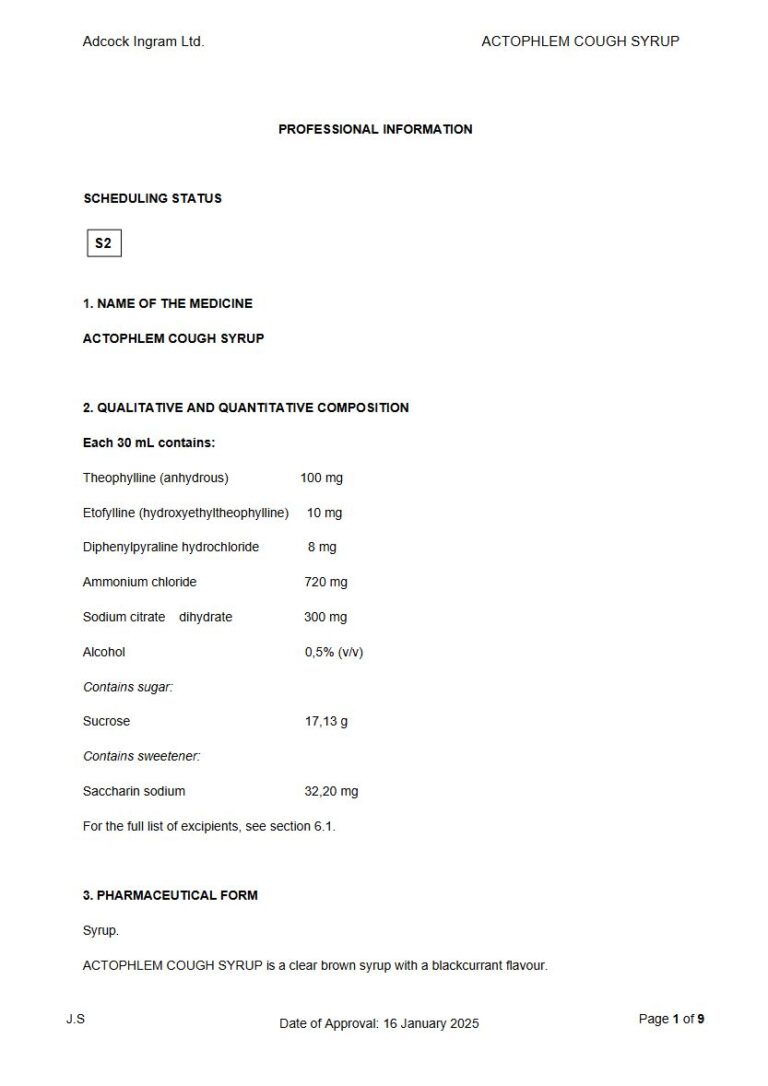
Actophlem Cough Syrup
Clinical Summary
Quick overview from the medicine insert
Indication
Relief of cough and associated symptoms in respiratory tract infections and allergies.
Dosage (summary)
Adults: 10-20 mL every 4-6 hours as needed. Children: 5-10 mL every 4-6 hours as needed. Do not exceed 120 mL in 24 hours.
Onset of Action / Duration
Onset of action typically within 30 minutes; duration of effect varies based on individual response.
Special Populations
- Elderly patients
- Patients with hepatic impairment
- Patients with renal impairment
Pregnancy & Breastfeeding
Use with caution during pregnancy; not recommended during lactation due to potential effects on the infant.
Key Drug Interactions
- May enhance the sedative effects of other CNS depressants.
- Theophylline may interact with other medications metabolized by CYP1A2.
- Avoid concurrent use with MAO inhibitors.
Contraindications
- Hypersensitivity to any of the active ingredients.
- Severe asthma or respiratory failure.
- Peptic ulcer disease.
Common side effects
- Drowsiness
- Dry mouth
- Nausea
- Tachycardia
- Gastrointestinal disturbances
Counselling Points
- Avoid alcohol while taking this medication.
- Do not exceed the recommended dosage.
- Consult a healthcare professional if symptoms persist for more than 7 days.
- Report any severe side effects or allergic reactions immediately.
Serious warnings
- Caution in patients with cardiovascular disorders.
- Monitor for signs of respiratory depression.
- Use with caution in patients with a history of seizures.
Important Disclaimer
The Actophlem Cough Syrup professional information leaflet below is the property of Adcock Ingram and is provided on Medinsert exactly as issued, with no.. alterations or editorial changes. We make every effort to keep content current by updating documents as soon as new versions become available. Medinsert serves as a trusted access point for healthcare professionals, but does not replace official sources or clinical judgement. For more details, please read our full disclaimer. read more>>
 Healthcare Professionals Only
This content is for registered healthcare professionals
Sign in or create a free account to read the full package insert.
Free for HPCSA-registered professionals. Powered by Medinsert.
Clinical Particulars
Section 4 of the official insert — extracted exactly as issued, no alterations
4.1 Therapeutic Indications
ACTOPHLEM COUGH SYRUP is indicated for the alleviation of cough.
4.2 Posology and method of administration
Adults: Three medicine measures (15 mL) three times daily after meals and at bedtime.
Children (7 years and older): Two medicine measures (10 mL) three times daily after meals.
Children (3 to 6 years): One medicine measure (5 mL) three times daily after meals.
Do not exceed the recommended dose (see section 4.9).
Children: Children are particularly sensitive to the effects of theophylline and it should not be administered more frequently than every eight hours.
Elderly or Cardiac patients: Theophylline should be administered with caution to elderly patients and those suffering from cardiac disease.
Renal impairment: Patients undergoing routine haemodialysis may require increased doses.
Method of administration: Oral administration only. Shake well before use.
4.3 Contraindications
Hypersensitivity to theophylline, hydroxyethyltheophylline, diphenylpyraline, ammonium chloride, sodium citrate or any of the excipients listed in section 6.1.
ACTOPHLEM COUGH SYRUP is contraindicated in patients suffering from:
- renal or hepatic disease
- diabetes
- severe hypotension
- peptic ulcer
- gout
- alcoholism (rehabilitated alcoholics).
4.4 Special warnings and precautions for use
- Diphenylpyraline hydrochloride may precipitate fits in epileptics.
- ACTOPHLEM COUGH SYRUP contains 17,13 g of sucrose per 30 mL of syrup which may have an effect on the effects of the glycaemic control of patients with diabetes mellitus.
- ACTOPHLEM COUGH SYRUP contains 0,15 mL of alcohol (ethanol) in each 30 mL of syrup expressed as 0.5% (v/v). The alcohol in this medicine may alter the effects of other medicines.
- This medicinal product contains 73,6 mg sodium per 30 mL or 2,45 mg/mL of syrup, equivalent to 5,5 % of the WHO recommended maximum daily intake of 2 g sodium for an adult.
4.5 Interactions with other medicinal products and other forms of interaction
- The bronchodilator and toxic effects of theophylline may be enhanced by sympathomimetics and by administration with other xanthines.
- Smokers may require increased doses.
- Diphenylpyraline hydrochloride has anticholinergic properties and should be used with care in conditions such as glaucoma and prostatic hypertrophy. The effects of atropine and tricyclic antidepressants may be enhanced.
- This medicine may lead to drowsiness and impaired concentration that may be aggravated by simultaneous intake of alcohol or other central nervous system depressants (see section 4.3 and 4.7).
- The concomitant administration of other theophylline containing preparations and ACTOPHLEM COUGH SYRUP may lead to toxic levels of theophylline and patients should be cautioned accordingly.
- The warning symptoms of damage caused by ototoxic drugs may be masked and the metabolism of drugs in the liver may be affected.
- Diphenylpyraline hydrochloride may enhance the sedative effect of the central nervous system depressants including alcohol, barbiturates, hypnotics, narcotic analgesics, sedatives and tranquillizers.
4.6 Fertility, pregnancy, and lactation
Safety and/or efficacy in fertility, pregnancy and lactation has not been established.
4.7 Effects on ability to drive and use machines
ACTOPHLEM COUGH SYRUP may lead to drowsiness and impaired concentration, which may be aggravated by the simultaneous intake of alcohol or other central nervous system depressant agents. Patients should be warned against taking charge of vehicles or machinery or performing potentially hazardous tasks where loss of concentration may lead to accidents.
4.8 Undesirable effects
Tabulated summaries
System organ Class Frequent Undesirable effect
- Blood and lymphatic system disorders Unknown Blood dyscrasias including agranulocytosis and haemolytic anaemia may occur.
- Immune system disorders Unknown Allergy and anaphylaxis may occur.
- Metabolism and nutrition disorders Unknown Anorexia.
- Psychiatric disorders Unknown Anxiety, elation or depression, irritability, nightmares.
- Nervous system disorders Unknown Insomnia, headache, confusion, restlessness, vertigo, nervousness, tremors. Frequent Sedation which can vary from slight drowsiness to deep sleep, and includes the inability to concentrate, lassitude, dizziness, incoordination, convulsions, dryness of the mouth, tingling, heaviness and weakness of the hands may occur.
- Eye disorders Unknown Visual disorders.
- Ear and labyrinth disorders Unknown Tinnitus.
- Cardiac disorders Unknown Palpitations, tachycardia.
- Vascular disorders Frequent Hypotension.
- Respiratory, thoracic, and mediastinal disorders Unknown Hyperventilation, tightness of the chest.
- Gastrointestinal disorders Frequent Nausea, vomiting, gastrointestinal bleeding, diarrhoea or constipation, epigastric pain.
- Musculoskeletal and connective tissue disorders Unknown Muscle twitching, Frequent Muscular weakness.
- Renal and urinary disorders Unknown Difficulty in micturition.
- Paediatric population In infants and children diphenylpyraline hydrochloride may act as a cerebral stimulant.
Reporting of suspected adverse reactions
Reporting suspected adverse reactions after authorisation of the medicine is important. It allows continued monitoring of the benefit/risk balance of the medicine. Health care providers are requested to report any suspected adverse drug reactions to SAHPRA via the Med Safety APP (Medsafety X SAHPRA) and eReporting platform (who - umc.org) found on SAHPRA website. Adverse Drug Reactions may also report to Adcock Ingram Limited using the following email: [email protected]
4.9 Overdose
Ammonium chloride causes symptoms such as nausea, vomiting, thirst, headache, hyperventilation, progressive drowsiness, hypokalaemia, mental confusion and hyperchloraemic acidosis. Overdosage of theophylline may lead to maniacal behaviour, repeated vomiting with extreme thirst, delirium, hyperthermia and convulsions.
Paediatric Population: It is important to keep ACTOPHLEM COUGH SYRUP out of reach of young children. If a large overdose has just been taken, contact the nearest doctor, hospital or poison control center. Treatment is symptomatic and supportive.
