
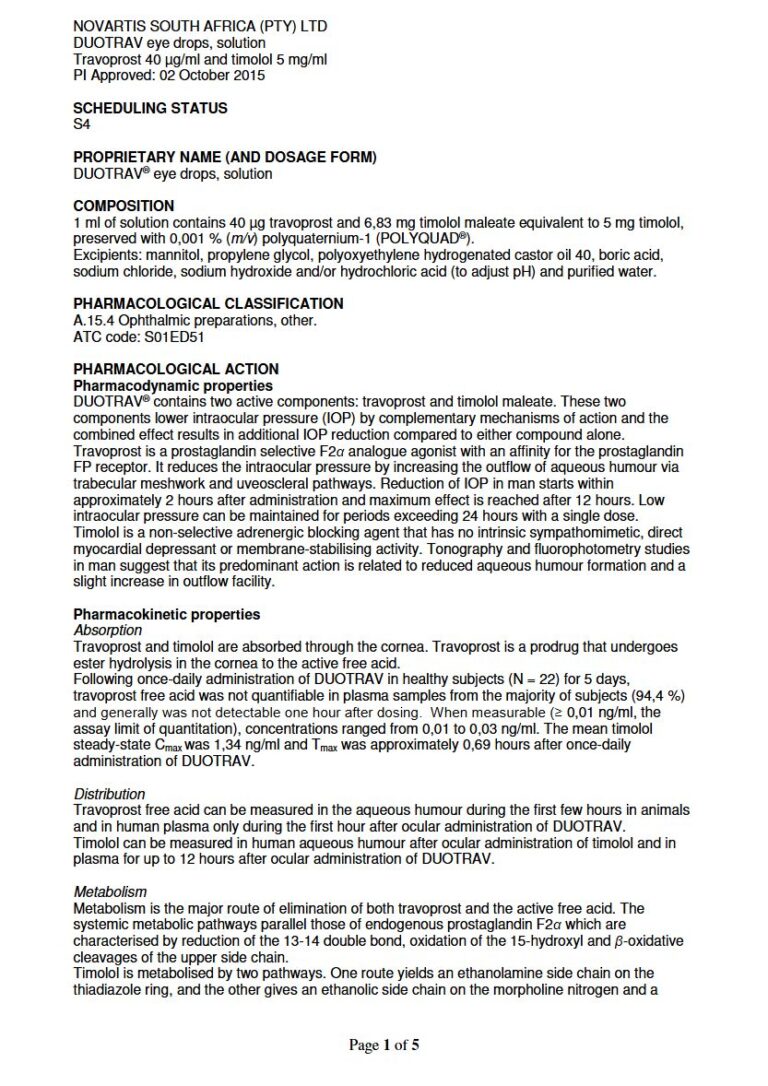
Duotrav 5mg eye drops. solution
PDF Leaflet Revision Date: 02 October 2015
Clinical Summary
Quick overview from the medicine insert
Indication
Decrease elevated intraocular pressure in ocular hypertension or open-angle glaucoma.
Dosage (summary)
One drop in the affected eye(s) once daily.
Onset of Action / Duration
Onset: 2 hours, Duration: >24 hours
Special Populations
- Hepatic impairment
- Renal impairment
Pregnancy & Breastfeeding
Not recommended in pregnancy; contraindicated in breastfeeding.
Key Drug Interactions
- Oral beta-blockers
- Calcium channel blockers
- Antidiabetic agents
Contraindications
- Hypersensitivity to components
- Bronchial asthma
- Severe COPD
- Cardiac failure
Common side effects
- Ocular hyperaemia
- Eye irritation
- Headache
Counselling Points
- Inform about potential eye color change
- Remove contact lenses before use
- Wait 15 mins before reinserting lenses
Serious warnings
- Systemic absorption may cause cardiovascular and pulmonary reactions
- Caution in patients with severe cardiac disease
Important Disclaimer
The Duotrav 5mg eye drops. solution professional information leaflet below is the property of Alcon Laboratories (Sa) and is provided on Medinsert exactly as issued, with no.. alterations or editorial changes. We make every effort to keep content current by updating documents as soon as new versions become available. Medinsert serves as a trusted access point for healthcare professionals, but does not replace official sources or clinical judgement. For more details, please read our full disclaimer. read more>>
 Healthcare Professionals Only
This content is for registered healthcare professionals
Sign in or create a free account to read the full package insert.
Free for HPCSA-registered professionals. Powered by Medinsert.
Clinical Particulars
Section 4 of the official insert — extracted exactly as issued, no alterations
4.1 Therapeutic indications
Decrease of elevated intraocular pressure in patients with ocular hypertension or open-angle glaucoma for whom treatment with either travoprost or timolol given alone provides insufficient IOP reduction.
4.2 Posology and method of administration
For ocular use.
Posology
Use in adults, including the elderly
The dose is one drop of DUOTRAV u00ae in the conjunctival sac of the affected eye(s) once daily, in the morning or in the evening. DUOTRAV should be used at the same time each day. Nasolacrimal occlusion or gently closing the eyelid after administration is recommended. This may reduce the systemic absorption of DUOTRAV administered via the ocular route and result in a decrease in systemic side-effects. If more than one topical ophthalmic medicine is being used, the medicines must be administered at least 5 minutes apart (see Interactions). If a dose is missed, treatment should continue with the next dose as planned. The dose should not exceed one drop in the affected eye(s) daily. When substituting another ophthalmic antiglaucoma agent with DUOTRAV, discontinue the other agent and start the following day with DUOTRAV.
Use in children and adolescents
The efficacy and safety of DUOTRAV in patients below the age of 18 years have not been established and its use is not recommended in these patients until further data becomes available.
Use in hepatic and renal impairment
No studies have been conducted with DUOTRAV eye drops in patients with hepatic or renal impairment. Travoprost has been studied in patients with mild to severe hepatic impairment and in patients with mild to severe renal impairment (creatinine clearance as low as 14 ml/min). No dosage adjustment was necessary in these patients.
Method of administration
The patient should remove the protective overwrap immediately prior to initial use. To prevent contamination of the dropper tip and solution, care must be taken not to touch the eyelids, surrounding areas or other surfaces with the dropper tip of the bottle.
4.3 Contraindications
Hypersensitivity to travoprost, timolol, or to any of the excipients. Patients with bronchial asthma, a history of bronchial asthma, severe chronic obstructive pulmonary disease, sinus bradycardia, second or third degree atrioventricular block, overt cardiac failure or cardiogenic shock.
4.4 Special warnings and precautions for use
Systemic effects
DUOTRAV u00ae is absorbed systemically. Due to the beta-adrenergic component, timolol, the same types of cardiovascular and pulmonary adverse reactions as seen with systemic beta adrenergic blocking agents may occur. Cardiac failure should be adequately controlled before beginning therapy with timolol. Patients with a history of severe cardiac disease should be observed for signs of cardiac failure and have their pulse rates checked. Respiratory reactions and cardiac reactions, including death due to bronchospasm in patients with asthma and, rarely, death in association with cardiac failures, have been reported following administration of timolol maleate. DUOTRAV should be administered with caution in patients subject to spontaneous hypoglycaemia or to diabetic patients (especially those with labile diabetes) as beta adrenergic blocking agents may mask the signs and symptoms of, and the response to hypoglycaemia. It may also mask the signs of hyperthyroidism and cause worsening of Prinzmetal angina, peripheral and central circulatory disorders and hypotension.
Anaphylactic reactions
While using DUOTRAV, patients with a history of atopy or a history of severe anaphylactic reaction to a variety of allergens may be unresponsive to the usual doses of adrenaline used to treat anaphylactic reactions.
Concomitant therapy
Timolol may interact with other medicines. The effect on intraocular pressure or the known effects of systemic beta-blockade may be potentiated when DUOTRAV is given to patients already receiving an oral beta-blocking agent. The use of two local beta-adrenergic blocking agents or two local prostaglandins is not recommended.
Ocular effects
Travoprost may gradually change the eye colour by increasing the number of melanosomes (pigment granules) in melanocytes. Before treatment is instituted, patients must be informed of the possibility of a permanent change in eye colour. Unilateral treatment can result in permanent heterochromia. The long term effects on the melanocytes and any consequences thereof are currently unknown. The change in iris colour occurs slowly and may not be noticeable for months to years. The change in eye colour has predominantly been seen in patients with mixed coloured irises, i.e. blue-brown, grey-brown, yellow-brown and green-brown; however, it has also been observed in patients with brown eyes. Typically, the brown pigmentation around the pupil spreads concentrically towards the periphery in affected eyes, but the entire iris or parts of it may become more brownish. After discontinuation of therapy, no further increase in brown iris pigment has been observed. In controlled clinical trials, periorbital and/or eyelid skin darkening in association with the use of travoprost has been reported. Travoprost may gradually change eyelashes of the treated eye(s); these changes were observed in about half of the patients in clinical trials and include: increased length, thickness, pigmentation, and/or number of lashes. The mechanism of eyelash changes and their long term consequences are currently unknown. Travoprost has been shown to cause slight enlargement of the palpebral fissure in studies in the monkey. However, this effect was not observed during the clinical trials and is considered to be species specific. There is no experience of DUOTRAV in inflammatory ocular conditions; nor in neovascular angle-closure, narrow-angle or congenital glaucoma and only limited experience in thyroid eye disease, in open-angle glaucoma of pseudophakic patients and in pigmentary or pseudoexfoliative glaucoma. Caution is recommended when using DUOTRAV in aphakic patients, pseudophakic patients with a torn posterior lens capsule or anterior chamber lenses, or in patients with known risk factors for cystoid macular oedema. In patients with known predisposing risk factors for iritis/uveitis, DUOTRAV can be used with caution. DUOTRAV contains propylene glycol and polyoxyethylene hydrogenated castor oil 40 which may cause skin irritation. Patients must remove contact lenses prior to application of DUOTRAV and wait 15 minutes after instillation of DUOTRAV before reinsertion.
4.5 Interactions with other medicines
Interactions of DUOTRAV u00ae with other medications have not been specifically evaluated. There is a potential for additive effects resulting in hypotension and/or marked bradycardia when eye drops with timolol are administered concomitantly with oral calcium channel blockers, or beta-blocking agents, antidysrhythmics, digoxin or parasympathomimetics. The hypertensive reaction to sudden withdrawal of clonidine can be potentiated when taking beta-blockers. Beta-blockers such as timolol contained in DUOTRAV may increase the hypoglycaemic effect of antidiabetic agents and may mask the signs and symptoms of hypoglycaemia (see WARNINGS AND SPECIAL PRECAUTIONS).
4.6 Fertility, pregnancy and lactation
Pregnancy
There are no adequate data from the use of DUOTRAV u00ae in pregnant women. Animal studies with travoprost have shown reproductive toxicity. DUOTRAV should not be used during pregnancy.
Women of child-bearing potential
DUOTRAV must not be used in women who may become pregnant unless adequate contraceptive measures are in place.
Lactating women
Timolol is excreted into breast milk. Therefore mothers breastfeeding their babies should not be treated with DUOTRAV.
4.7 Effects on ability to drive and use machines
Temporary blurred vision or other visual disturbances may affect the ability to drive or use machines. If blurred vision occurs at instillation, the patient must wait until the vision clears before driving or using machinery.
4.8 Undesirable effects
In 3 clinical trials involved in the development of DUOTRAV u00ae (polyquaternium-1-preserved), 372 patients/subjects were exposed for up to 6 months. No serious ophthalmic or systemic side-effects related to the product were reported in any of the clinical trials. The most frequently reported treatment-related side-effect with DUOTRAV was hyperaemia of the eye (10,8 %), which included ocular or conjunctival hyperaemia. The majority of patients (90 %) who experienced hyperaemia of the eye did not discontinue therapy as a result of this reaction. The following side-effects were observed in clinical studies. They are ranked according to system organ class and classified according to the following convention: very common (u2265 1/10); common (u2265 1/100, < 1/10); uncommon (u2265 1/1 000, < 1/100); rare (u2265 1/10 000, < 1/1 000); very rare < 1/10 000). Within each frequency grouping, side-effects are presented in decreasing order of seriousness. The following side-effects were found in trials with DUOTRAV:
Immune system disorders: Uncommon: hypersensitivity.
Nervous system disorders: Uncommon: headache.
Eye disorders: Common: eye pain, eye irritation, foreign body sensation in eyes, dry eye, eye pruritus, conjunctival hyperaemia, ocular hyperaemia. Uncommon: punctate keratitis, photophobia, ocular discomfort, abnormal sensation in eye, blurred vision, keratoconjunctivitis sicca, conjunctivitis, allergic conjunctivitis, meibomianitis, eyelid margin crusting, eyelids pruritus, asthenopia, increased lacrimation, iris hyperpigmentation, growth of eye lashes, dark circles under eyes.
Cardiac disorders: Uncommon: bradycardia.
Vascular disorders: Uncommon: hypotension.
Skin and subcutaneous tissue disorders: Uncommon: skin discolouration, abnormal hair growth.
General disorders and administration site conditions: Uncommon: fatigue.
Investigations: Uncommon: decreased heart rate.
4.9 Overdose
If overdosage with DUOTRAV u00ae occurs, treatment should be symptomatic.
